Monday, July 24, 2006

The Hi-Lo's I Presume


Posted by Picasa

What you see with your eyes closed is what counts.

---Lame Deer, Lakota sage

To be nobody but yourself in a world which is doing its best to make you everybody else, means to fight the hardest human battle ever and to never stop fighting.

---E.E. Cummings

What do you want to get enlightened for? You may not like it.

---Shunryu Suzuki

Once upon a time four guys decided to start a singing group, just for the fun of it, as any four folks have done since time began. Creation likes to sing and harmony is one of those things humans stumbled on. It's a gift from God. This story starts in Milwaukee where 2 fellows found themselves singing in the same choir and became buddies. It was the 1940s. Bob Strasen went off to Japan with the Army and led a male chorus there, but Gene Puerling got a job as a disc jockey back home and formed a couple singing groups on the side. In 1951 he moved to Los Angeles, as did lots of musicians from all over the place. There was work there: TV now, as well as movies and record companies. He needed to share an apartment with somebody, and along came Clark Burroughs, a guy with a sky-high voice, impeccable intonation, and a knack for hilarity that got him a few acting jobs too. Clark was from LA, was schooled and even had sung with the Roger Wagner Chorale. Now he was in a sort of novelty quartet called the Encores that sang on Billy May records. Billy was from Pittsburgh, had been in the bands of and arranged the jazz tunes for Glenn Miller and Charlie Barnet, but now had been doing children's records at Capitol and only lately had been convinced to start a dance band and take it on the road. In the Encores was Bob Morse from Pasadena, who came from a wildly musical family, with brothers who played and arranged for Stan Kenton and Johnny Richards. Morse sang baritone in the Bob Eberle crooner style and could solo well. In 1952 Clark and Puerling, who'd been working in a record store, got the idea to start their own group with Bob Morse. Gene would sing bass and he called Milwaukee, since Strasen was back, and talked him into coming to LA to sing tenor. Clark would handle all the notes above that, which was not yet a sound you'd hear out of a man who wasn't in the Ink Spots. Vocal quartets everywhere have a tradition of choosing catchy silly names for themselves and our guys were no different. These were The Hi-Lo's.

They took any work there was for a group that could sing anything with staggering accuracy. Puerling's arrangements were a challenge for singer and listener alike, always switching parts around so you---and maybe they---weren't sure who was singing melody. They were like a group of musical acrobats, which might have been interesting in itself, but the ideas and harmonies were so close and delicious they soon got heard around LA. The West Coast was a place of adventure and new things at the time. Gerry Mulligan and Chet Baker and Dave Brubeck were winning audience with the young, and jazz was in the air. Their first break came when Jerry Fielding heard them. Jerry had met Billy May when they both arranged for Alvino Rey's band after the War, and now was working TV directing bands on Groucho Marx and The Life of Riley. He also was in on the organization of a new small record label called Trend that offered The Hi-Lo's a first session immediately. On April 10, 1953, backed by a huge screaming orchestra under Fielding, they recorded a 45 RPM extended play album of 4 songs: They Didn't Believe Me, Georgia On My Mind, Peg O' My Heart, and My Baby Just Cares For Me. Trend made sure it got to DJs all over the country. The same month Sinatra recorded his first sides with Nelson Riddle.

I was 13, living in Jamestown, New York, and listening every day after school to a disc jockey out of Niagara Falls named Joe Rico. Joe loved vocalists and Stan Kenton, who had gotten a theme song written for him and recorded by the band---over the years at least 3 times I think. This was AM radio and Niagara Falls was just far enough away that I had to run extra antenna wire around the ceiling of my room to bring the station in. (My mother began to worry about my strange devotion to this terrible music.) Almost at once Joe began to play The Hi-Lo's, mixed in with the Miles Davis Birth of the Cool sides and any jazz from the West Coast. He was also the kind of DJ who'd decide on a favorite out of an album and play it every day. We wanted to hear more from The Hi-Lo's. Where were they? Trend was in trouble already, having concentrated heroically on the DJs but not distribution. The quartet was picked up in late 1954 by another small label called Starlite, and now came their first full album, The Hi-Lo's Under Glass. Fielding was following Billy May into financial disaster by taking a band on the road himself, so the arranger this time was Frank Comstock who was doing most of the charts for Les Brown and His Band Of Renown, a band that STILL may be for hire even today. Comstock would stay with them another 15 years. They made 4 albums for Starlite, which got air play and much admiration through the music industry, but I couldn't find them downtown nor were they on the juke box. They weren't played at the sock hop either, although other small labels were but the music was very different. I began to find myself no longer in the mainstream.

The Hi-Lo's started showing up on TV. There were variety shows and the group had some great routines. They liked to do Rockin' Chair, changing tempos a couple times and very swinging. This wasn't Satchmo and Teagarden swishin' flies 'round their heads. Steve Allen had them on so much they almost were regulars, like Steve & Edie and Andy Williams. They were on Nat Cole's show. Then they were hired for a 39 week run with Rosemary Clooney. It was 1957 now, and since Rosie recorded for Columbia, so should "her group." The resulting 3 albums, with Comstock arranging, hit the charts. These records I could get---and take to parties. But my friends were not sold...especially the girls. This group was keyed awful high, and although the slow ones danced well---when they weren't changing tempos---this wasn't rock n' roll. If I was sitting around with a bunch of guys, we could dig their albums---and even try to sing along, although it really was impossible, not like the Four Freshmen. And they sang novelty numbers that weren't always cool. My Time Is Your Time? Well, the fact was this group, for better or worse, was not into selling popularity. They sang timeless.

In 1958, my high school graduating year, they released perhaps their masterpiece. A stupid title, The Hi-Lo's And All That Jazz, but the arranger was Marty Paich with a collection of the finest musicians still in LA. Paich liked to use Miles' Birth of the Cool instrumentation, so he had French horn and tuba, with 2 trumpets, valve trombone, alto, tenor, and baritone saxes, and a rhythm section of Clare Fischer, Joe Mondragon, and the master, Mel Lewis, on drums. The trumpet solos were handled by Jack Sheldon, Herb Geller on alto, Bill Perkins on tenor, and Bud Shank playing baritone. There were 4 pieces on the album that had no words at all, but ensemble singing by The Hi-Lo's that seems even today practically impossible to perform. However, to the jazz listener the lines are so full of hooks that you can't get them out of your head---even if it's hard to name which tune is which. Here's one of those mysterious albums that is so great it probably won't sell at all. Isn't it strange? Why do some great albums sell a lot and some not any? What constitutes that phenomenon? This was it. it couldn't get any better. The essence was realized...and Bob Strasen quietly left the group.

Now the story turns to struggle, and it's not pretty. I'll spare you details. It's not as difficult as it was for Rosemary Clooney. And it doesn't shift gears into other pursuits, as it did for Doris Day and Tony Bennett. Columbia demanded hit material from its artists. You know it's funny, we think of the 1950s as very straitlaced and buttoned-down, and the 1960s as wide open and ready for anything. But musically the 1950s were very experimental and groups like The Hi-Lo's could try whatever they liked. Now musicians were having to form their own labels to do what they wanted. Everybody from Frank Sinatra to Stevie Wonder and the Beach Boys, who readily credit The Hi-Lo's for showing them the way, started up their own studios. The Hi-Lo's stuck with Columbia for another couple of years, but the records became painful. Strasen's replacement, Don Shelton, was not a bad singer and could do the parts...but the arrangements were aimed at something simpler now. Sometimes they sounded like they were imitating the Freshmen, targeting an audience that would cuddle up with the music. It didn't work, and the singles were atrocious. They even tried Mitch Miller singalong---honkytonk piano and all. It was over in 1964.

Let it be said The Hi-Lo's maintained a freshness and good humor through it all. There were no nervous breakdowns or drugs that I ever heard about. The men remained professional and simply found other work as they could. Burroughs never had any trouble...and you'd still see him on TV or notice his name in the best vocal groups and choruses. Nobody could cut him or do what he could do. Gene Puerling settled for a life of arranging, running a recording group called Singers Unlimited for a while. Those records are collectors items for anyone interested in choral singing. American choruses through this period had not been spectacular. We sing hymns over here. There were the Voices of Walter Schuman, Norman Luboff, the Ray Charles Singers (not THAT Ray Charles) and probably a couple other mood music choirs I'm forgetting. Ray Conniff probably did for Columbia what they were asking The Hi-Lo's to do. But our ability to sing classical music was unheralded, even with Roger Wagner.

A quiet revolution was beginning to happen though. From underneath and within, music education in the 1970s and 1980s was bringing forth choral directors and singers. People that were driven out of the recording industry found themselves teaching classes in small town schools. Some started choirs and bands after hours and maybe recorded something locally. Dale Warland started a choir up north and even commissioned compositions, a choir so good it almost was able to survive up to even this period of our cultural life. Americans learned to sing with the best in the world. No one needed to make excuses about what a young and inexperienced country we were...as far as art was concerned. And if any of the new choirs wanted an arrangement of one of those great American ballads from the 1930s, the directors remembered the name Gene Puerling and called him up. A choir named Chanticleer formed a few years back, I think in the Southwest somewhere. It's a male choir that sings chants and very old music, stuff from Mexico nobody's heard before and things like that, and essentially they specialize in the same vocal range as The Hi-Lo's did. They made an album called Lost In The Stars, of romantic American songs, and if you have it you'll see Puerling arranged some. I guess if we don't have a lot of gold records, we still can talk about influence.

The Hi-Lo's reformed briefly...a couple of times. Once was to record an album for Pausa in 1979 called The Hi-Lo's! Back Again! Here the huge and wailing band is that of Canadian Rob McConnell---which is another story of someone brilliant and wonderful who tried so hard. About half the record is material you may remember from earlier days, but the other half is new, including an arrangment of When Sunny Gets Blue that brings me to my knees every time. They got together once more in the early 1980s I think with the McConnell band to do one of the festivals in California. Everytime I've heard them they sound perfect. They weren't really ahead of their time. Time won't ever catch up. Bing Crosby said, "These guys are so good they even whisper in harmony." The Hi-Lo's celebrated and carried forward a tradition in American popular music, really transferring it as a group into jazz for the first time. Others were coming along with the same ideas, but nobody did it with such precision and artistry. They set new benchmarks that people who know about them still are striving for. CD reissues of The Hi-Lo's are not easy to find, and if you go to a site like All Music Guide you won't see them well or adequately reviewed. www.thehi-los.com/ has a tremendous amount of information (that might have been good if I'd read before I wrote this) plus downloads and a juke box so you can hear them. I also learn unfortunately that both Morse and Strasen have passed away. Maybe this little essay of gratitude and admiration will get you to listen...and better yet start to sing.

Monday, July 17, 2006

Laying Lay To Rest


AP DAVID J. PHILLIP
SAYING GOODBYE Former President George H. Bush pays his respects Wednesday to Enron founder Kenneth Lay, who died of heart disease July 5 while vacationing in Aspen, Colo. Lay faced sentencing this fall on his fraud and conspiracy convictions which led to the collapse of Enron in 2001. Bush did not speak at the service at the Houston church.http://www.cantonrep.com/index.php?ID=296413&Category=23Posted by Picasa

Do not arouse disdainful mind when you prepare a broth of wild grasses; do not arouse joyful mind when you prepare a fine cream soup.

---Dogen

Only our own searching for happiness prevents us from seeing it. It is like a vivid rainbow which you pursue without ever catching it, or a dog chasing its own tail. Although peace and happiness do not exist as an actual thing or place, they are always available, and accompany you every instant.

---Gendun Rinpoche

Life, we learn too late, is in the living, in the tissue of every day and hour.

---Steven Leacock

Special Reports
Bring me the head of “Kenny Boy” Lay: Another convenient death invites new investigations of Enron-Bush crimes
By Larry Chin
Online Journal Associate Editor
Jul 10, 2006, 00:38

Kenneth Lay, world-class Enron criminal, long-time Bush family friend and crime ally, was pronounced dead on July 5, allegedly of a heart-related condition.

Lay’s name can now be added to the list of dubious Enron-related deaths, which include the alleged 2002 shotgun suicide of Enron Vice Chairman Clifford Baxter (also see analysis here, and here).

Lay’s hasty exit, which comes as he faced 45 years of prison for conspiracy and fraud charges (the barest tip of the iceberg of his true crimes), has sparked rampant speculation. Initial mainstream reports on the cause of death have been confusing at best: “heart attack," “heart failure," and “heart disease” are distinct and different conditions.

Lay, who was reportedly depressed and embittered, has now been conveniently removed before receiving punishment (elite criminals rarely get what they deserve). Charges against Lay and his estate may be conveniently tossed (leaving his squirreled assets available for new uses). The Bush administration, and Congress, is conveniently protected from any possibility of a damning testimony or revelation.

Lay’s supposed demise, however interesting, is ultimately irrelevant. Far more important is the fact that Enron is still an open criminal case: the true crimes of Enron remain unaddressed.

More importantly, the apparatus that Ken Lay and Enron set into motion is alive and well. It still shapes the fabric of daily geopolitical life.

Ken Lay’s living legacy in our faces

Lay, affectionately named “Kenny Boy” by the Bushes themselves, has in recent years gone from a leading Bush policy architect to the family’s number one persona non grata. From a Wall Street darling, to a pariah and the poster child of malfeasance, shunned by those whose pockets he once lined.

His public treatment notwithstanding, the Bush administration, and the New World Order’s inner circle, must privately worship Lay for the way he wielded Enron as a geostrategic weapon of mass destruction. Consider what Lay has left the world:

1. Lay and Enron not only helped create the Bush administration’s energy and war policies; it brought them nightmarishly to life, in every corner of the planet. Ken Lay’s fingerprints can be found, today, in every resource-rich hot spot that Enron infiltrated and conquered, from Central Asia and India, to Colombia and the Far East. The invasions and occupations of Afghanistan and Iraq, as well as plans to control domestic energy supplies and prices (and the lives of Americans) are a direct result of Ken Lay’s machinations.

Dick Cheney’s Energy Task Force, the infamous and secret US National Energy Policy Development Group (NEPDG), the probable “rosetta stone” of 9/11 that documents the motives behind the Bush administration’s world energy conquest, has remained the subject of intensive and illegal stonewalling. Ken Lay was there: official memos have amply documented Lay’s direct links to Cheney and Cheney’s energy plan.

2. The practices pioneered by Enron and pushed to spectacular and creative extremes -- financial fraud, pro-forma accounting, money laundering, offshore funneling of illegal monies, shell companies, “off the books” transactions, energy gaming, etc. -- continue to be quietly used by corporations everywhere. It is business as usual on Wall Street.

3. Globalization, the brand epitomized by Enron, thrives. Multinational corporations continue to function as quasi-military-intelligence arms of the US, and other allied predatory governments, working alongside the intelligence agencies and militaries themselves. Witness the operations of Halliburton, DynCorp and AIG.

4. The financial institutions, banks and investment houses that assisted Enron in its schemes, domiciled in the US as well as offshore, continue to feed like engorged tapeworms from trillions of dollars of looted funds. Perhaps you still bank with one of these institutions. Perhaps your pension fund is under the control of one of them now. You can thank Ken Lay for that.

5. The manipulation of energy and the fleecing of consumers also continue to this day, in more shaded and sophisticated forms, as does “deregulation." The occasional cries of foul from certain politicians in victimized regions has changed nothing. As energy prices soar, as Peak Oil and Gas makes itself felt in earnest, and new “energy crises” erupt, the ghost of Ken Lay will be there, grinning. He -- it -- still presides over this nation’s energy grids and energy trader’s “gaming” rooms.

6. Enron is not dead and buried, any more than BCCI was ever destroyed. There is no cause for celebration. The Enron corporation itself even lives on (as does BCCI) in the form of renamed, acquired and merged entities.

The Enron players hiding in plain sight

Legions of politicians fed at Enron’s trough, Republicans and Democrats alike. The same members of Congress who received fat Enron checks are still in Washington.

The George W. Bush administration, that Enron helped install and push into power, has two more years to expand its world war, seize remaining energy supplies, squeeze profits from Peak Oil for their own constituents, and deepen the militarization of the United States.

Arnold Schwarzenegger is the governor of California. His direct Enron connections scarcely mentioned, or even acknowledged. He will likely be re-elected (or re-selected) this fall, continuing the Republican plunder of California -- not ironically the target of Enron’s first crimes in 2000.

The former chairman of Enron’s finance committee, Herbert "Pug" Winokur, the wolf in the Enron fold, is still out there, untouched. As noted by Michael C. Ruppert in Crossing The Rubicon: The Decline of the American Empire at the End of the Age of Oil:

“Aside from playing a major role in the looting of Russia, Harvard University also seems to have deep connections into the domestic economy of crime. Catherine Austin Fitts connected the dots in a 2002 article which told us that not only had Winokur chaired the Enron finance committee and escaped federal scrutiny, he was also a lead investor in, and creator of, a company called DynCorp (now CSC-DynCorp) that has lucrative vaccine and biowarfare contracts . . .

“So ubiquitous is DynCorp that we will see its hands all over the map in connection with 9/11 and the ruling of America. DynCorp is everywhere. It manages the Congressional telephone system. Along with Lockheed-Martin, it does the computerized bookkeeping for a dozen federal agencies including the DoD and HUD, which have lost (or allowed to be stolen) trillions of taxpayer dollars. It also has a contract to manage the police and court systems in US-occupied Iraq.

“Winokur’s connections to Enron, DynCorp and the Harvard Endowment (which during the Clinton years saw its assets increase from $3 billion to $19 billion) demonstrate that quite often the key players escape mainstream scrutiny altogether . . . Among other revelations were the facts that Harvard had made direct financial investments bailing out an ailing Harken Energy Corporation, then run by George W. Bush, and that, through its investment arm, Highfields Capital, it had dumped large quantities of Enron stock just before it crashed: insider trading at its best. ” There is no doubt that “Kenny Boy” Lay, the founder of Enron, was there every step of the way with “Pug."

Where, indeed, are the trillions of missing taxpayer dollars that were bilked by Enron?

Enron: case still open

Most, if not all, of the most important Enron-related facts remain wide the subject of denial and cover-up. From Lay’s long-time connections to the Bush family and the Texas oil/intelligence/crime milieu (captured in the book The Mafia, the CIA and George Bush by Pete Brewton), and the company’s virtual ownership of successive US presidencies and the US Congress, to Enron’s power-brokering role behind major US energy-related geostrategic operations over the past decade and a half.

It goes without saying that no federal or state “probe” over the past five years has addressed the true Enron corruption. The show trials of Lay, and his lesser Enron colleagues, Jeffrey Skilling and Andrew Fastow, have been, by design, limited hangouts that have begun to address the real crimes.

The true case against Enron leads to the very heart of the American Empire’s inner workings:

Enron: Ultimate Agent of the American Empire (Part One)

Enron: Ultimate Agent of the American Empire (Part Two)

The evidence detailed in this 2002 series tying Enron to the political crimes of both the George W. Bush and Clinton administrations have not only been confirmed, but strengthened by subsequent investigations and analysis by dogged and courageous independent investigators such as Catherine Austin Fitts, and Jason Leopold (a contributor to Online Journal, Truthout, and other sites), who has spent years doggedly pursuing various aspects of the Enron crime.

Neoliberals and progressive journalists have taken cracks at Enron in recent years, including Greg Palast, and the Institute for Policy Studies (see "Enron's Pawns"), with mixed results.

As Carolyn Baker writes in a piece titled "Godfather Government", there is no more stellar symbol of corporate dominance than the infamous glass skyscraper formerly occupied by Enron Corporation. But, as Baker notes, work towards revealing the true magnitude of Enron’s criminality has been limited.

“Catherine Austin Fitts has superbly connected the dots between the egregious criminality of Enron, the Harvard Endowment, and one of the federal government’s principal contractors, CSC-DynCorp. More recently, with the conviction of former Enron golden boys, Jeff Skilling and Ken Lay, investigative journalist, Greg Palast, has unleashed a scathing expose of Enron throughout alternative media . . .

“With the convictions of Lay and Skilling, Palast has seized the opportunity to muckrake enough dirt on Enron to fill its former Houston headquarters from basement to rooftop. So too have Peter Elkind and Bethany McLean in their fabulous 2006 documentary, “The Smartest Guys In The Room”; however, what Palast and the filmmakers both failed to address . . . was Enron’s involvement in moving and laundering massive quantities of drug money through its Enron Online trading company. From the research of Palast, Elkind, and Mc Lean, it is obvious that Enron cooked its books and used the smoke and mirrors of “Mark To Market” accounting to book profits out of thin air, but none of them can explain where Enron acquired the money to actually run its corporation while selling worthless stock and paving the way to financial oblivion for its investors and employees. The missing link in the Enron story is drug profits, but Mike Ruppert caught that link, as did Catherine Austin Fitts in her many articles revealing the Enron-Harvard-Citibank-DynCorp connection.”

A real investigation of Enron, one that spares the American Empire no quarter, still begs to be conducted.

To the bitter end

In The Life and Death of Adolf Hitler, Robert Payne wrote, “Dictators deserve to be hanged in the market place in the sight of the people they ruled and corrupted. This is why the hanging of Mussolini upside down in a Milan gas station was, in human terms, so eminently satisfactory, while the obscure suicide of Hitler, in a bunker fifteen feet below the surface of Berlin left so many of his victims with the sense of being cheated. Hitler himself was perfectly aware that he was cheating and he rejoiced in his last act: once more he had outwitted his enemies.”Ken Lay has cheated the world, too. So did Richard Nixon, former CIA Director William Casey and other elite criminals who slithered away without suffering the punishment they richly earned. No doubt the Bushes, Dick Cheney, Donald Rumsfeld, Condi Rice, the Clintons, Henry Kissinger, and others are planning similar contingencies.

Copyright © 1998-2006 Online Journal
Email Online Journal Editor
http://onlinejournal.com/artman/publish/article_976.shtml

Monday, July 10, 2006

What I've Learned


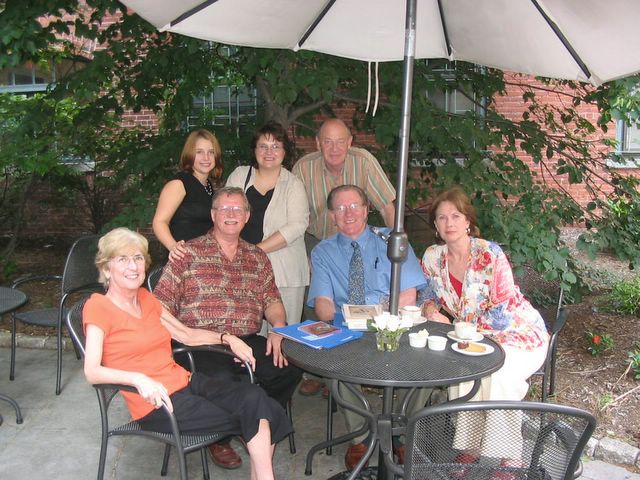
The author in Providence last weekend among friends and a couple of generations too.Posted by Picasa

I fell in love with the wings of birds
The light of spring on them!

---Chora

In the light of flowers
I travel
Just for the sake of traveling.

---Soen Nakagawa

The mind creates the abyss, and the heart crosses it.

---Sri Nisargadatta

Some replies received to the post I put out yesterday, which was sort of about global warming but involved a sense of futility as well, have motivated me to get my act together. I didn't start out writing on the Internet about political things, but somehow or other during these Bush years, when concerns about the "mainstream media" in this country come from all sides, I started sending stuff to friends and contacts that I hoped would be helpful in keeping discussion going. I think that media problem may motivate much of the blogging revolution for people. Where do you find out what's really going on in the world? Ordinarily I sprinkle links and footnotes all over such pieces, which is how I learned to do research for social studies papers and debating. I'm not going to do that this time because I need to speak from my own history and experience. I see no other way to address those replies.

I know a couple guys online I've never met face-to-face who like to keep things jumping with really basic questions. I hesitate to summarize what they stand for...and they are very different people...but they share a sort of warrior mentality. They live in the US---I think---and seem ready to survive, if necessary, with a knife and some matches...or with nothing if those luxuries are not available. So whenever I post about a political solution to something, one or the other or both generally jump in with both feet.

One of the guys grew up in the inner city but now lives in the Arizona desert, very close to the recent fires. His nickname is Bushman, for a couple of reasons probably...but I think he is available to do landscape work and tend your bushes. He wrote back the following: "It's all right here. Cleansed by fire, again." And he included a link to some Hopi prophecies. He means he's ready to ride it out with things as they are, rather than muck about with government agencies trying to regulate everything.

The other fellow changes his nickname about once a month and currently is going by Darklander. Here's what he has to say: "Fear is a good tactic that all hierarchs love to use to keep the sheeple in line. Stop voting for these dingbats (sure doesn't do you any good!), disband the military, stop sending your sons and daughters to Moloch, quit the 501 3C 'Corporate' churches, find out who you really are... be free from the lot of the rot. Nah, easier to blame it on, ah, global warming..."

Now I like both these guys a great deal. For one thing, they have great wit and keep me laughing. Nothing is better in the midst of argument and struggle. I have a friend here in Athens something like Bushman and Darklander, who just retired from 3 decades of teaching industrial tech and intends to move into a cave and become a cannibal. What do I say to people like this...and why does it matter?

I see signs everywhere in America that we are rethinking the basics. If the Bush paleocons and neocons, or whatever they are, have done nothing else, they've forced us to do that. How did it all happen to this country? There used to be a magazine called Saturday Review. When it went out of business, we got the first hint that institutions we thought were the very foundation pillars of civilization could collapse and disappear. Saturday Review had a series of occasional articles by geezers called What I've Learned. I think those essays got collected into a book eventually. Now that I'm a geezer, I'm going to try one.

When I was a boy it was the postwar 1940s. My mother had a wringer washer and there were no driers. She washed clothes twice a week and hung them out on a clothesline. A mile east were factories and the Erie railroad. Coal was used to fire everything. We just had gotten rid of our coal furnace, replacing it with oil or gas...not sure which. But most people still used coal...or steam fired somehow by coal. Coal meant soot. In the late '40s there was soot everywhere...on windowsills (no air conditioning) which meant lots of dusting every day, and on Mom's clean sheets hanging outdoors. She cursed the darn soot...but not too much. We lived with soot because it meant prosperity and food in the fridge. We liked seeing smoke pour out of the stacks because jobs and production were going full blast. We liked the locomotives puffing through town, carrying passengers and goods alike. The sound of a train whistle still is enough to stop a geezer in his tracks!

Did anyone think about carbon emissions destroying the planet? I don't think so, and on we went into the automobile models of the 1950s. My father even got a job selling them, and so we had a brand new Mercury every year. What kind of mileage did they get? Who cared? Gasoline was pennies a gallon. Everything was pennies a gallon. Milk was delivered to your early morning door, in returnable glass bottles with cream on the top. Such a world may seem strange now, even alien...but many Americans yearn to return to it somehow. Ronald Reagan probably was such a man...and possibly even continued to live in the 1950s somewhere in his mind. Why did he happen?

My father was a simple man. His family circumstances during the Depression made something like college unthinkable. He had to help support his family and went to work, and continued to work until he couldn't anymore and was content to get a week or 2 off a year for vacation. I don't believe he ever made more than $10,000 a year. In the 1960s and 1970s, when my father was heading into retirement, young people just starting out got $20,000 a year at least. Inflation. But Dad's Social Security check was based on $10,000 a year in a world where everybody needed $20,000 a year. Republicans blamed Democrats for causing the inflation and Reagan won. My father voted for him.

Some say the inflation was caused by big government. There were regulatory agencies that sucked up your income and they had to be dismantled. The Bush people are completing that job at the moment. Others said corporations were passing their labor costs onto the public by raising prices of goods all the time. People blamed the unions for this and even the working man believed it and turned against the union movement. I must say I was startled when I did some factory work in the mid-'70s to see high school dropouts making more money on a machine than I had made teaching school with a college degree. But part of their wages were going to pay for the new medical benefits that came with the job. Why in the world did companies start up benefit packages like that?

One answer I heard was in the late 1940s there were price controls. The Truman administration may have tried that approach to inflation. I've always liked the idea of price controls as a way to control corporate excess...but they have significant disadvantages. One is that a company has a hard time attracting the best workers if they can't offer higher wages than the next guy. To get around it, companies began to offer benefits other than money. An insurance plan shared by the company workers, with premiums paid by the boss, did the trick. Did anybody think eventually your part of the medical premium out of that paycheck would amount to hundreds of dollars a month?

Let's talk about schools. In my hometown of 40,000 people in the 1940s and 1950s, there were 6 elementary and 3 junior high schools. You walked to them everyday, came home for lunch, and walked back for the afternoon. Out in the rural areas, they were starting to shut down the one-room schoolhouses, where my aunt had taught all alone, and build central schools. They had something called schoolbuses out there and sometimes even a lunchroom. I never saw a schoolbus in town except for those few that brought country kids into our high school. Gas was pennies a gallon.

During the 1960s, for a number of reasons including civil rights, school systems in the US started buying whole fleets of buses. That meant hiring a lot of drivers too. At the same time we decided to build cafeterias and hire cooks and servers to be sure everybody got good nutrition. (Checked a school menu lately?) Food and transportation now have become huge budget items...and of course gasoline is forcing teachers out of work. Why didn't anybody foresee these problems? Can we go back to the old way? Those schools have been converted into housing units for the elderly by now. Privatize? Do away with public education?

You see what I mean...and of course Bushman and Darklander are way ahead of me here. These problems of environment, oil prices, education, and the health system are so gigantic few political leaders seem able even to talk about them. Yeah, flagburning is an issue we can get our heads around. I know the idea of government agencies and bureaucracy is loathsome and there is waste galore. I did some of that work in my time too, and I can tell you there are plenty of workers and administrators alike who drink lots of coffee everyday and do little else. But the work of regulation and services that don't make the kind of profit that interests Republicans is necessary work I say, and watchdogging those agencies can be done. Agencies are easier dogs to watch than these corporations we have around it seems. Unless the agency is locked up in secrecy---which is another problem the republic faces.

What I've learned is mistakes have been made. They're gigantic and some may be reversible and some may not. What many think now is calculations were made too. Maybe that inflation that brought Reagan to power was planned out. Maybe the banking system is corrupt beyond repair. Lawyers are to blame. All I know is I don't want to bide my next 2 years either hoping Bush will croak or somebody will blow the ultimate whistle to expose the whole mess. I don't want to look in vain for a politician to dare to speak out either. But I have faith people can wake up and come together and build something sensible and lasting. I'd like to think there can be more to life than building a fortress around your own little campfire. Let's talk about it.

Sunday, July 09, 2006

The Earth On Fire


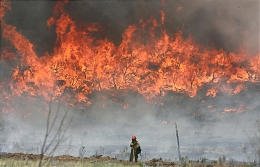
Photo by George Kochaniec, Jr., Associated PressFlames and smoke from a backburn set to control the Mato Vega Fire near Fort Garland, Colo., tower over a firefighter.Posted by Picasa

You can't make a date with enlightenment.

---Shunryu Suzuki

Seeing misery in views and opinions, without adopting any, I found inner peace and freedom. One who is free does not hold to views or dispute opinions. For a sage there is no higher, lower, nor equal, no places in which the mind can stick. But those who grasp after views and opinions only wander about the world annoying people.

---The Sutta Nipata

Lark on the moon, singing---
sweet song
of non-attachment.

---Basho

Was it Mark Twain who said, "Everybody talks about the weather but nobody does anything about it"? Fifty years ago that was funny. Now everybody's still talking about the weather, but we wonder if the stuff we do affects it or not. Nobody with a brain doubts global warming is happening, but is it merely a natural cycle, as the Right sings to us, or has our pollution screwed us up, as the Left maintains? Either way, is it going to kill us and what is one person supposed to do about it?

This weekend every news outlet in the world is carrying a study that shows the Warming causes more and worse forest and desert fires. Is CNN middle of the road enough? http://edition.cnn.com/2006/US/07/07/environment.wildfires.reut/ But that's not all this time. Scientific American is carrying it. http://www.sciam.com/article.cfm?chanID=sa003&articleID=000CE037-681B-14AD-A77C83414B7F4945 So is Science News. http://www.sciencenews.org/articles/20060708/fob1.asp And National Geographic. http://news.nationalgeographic.com/news/2006/07/060706-warming-fires_2.html Satellite pictures the other day show Central Canada choking in flames and smoke. http://earthobservatory.nasa.gov/NaturalHazards/natural_hazards_v2.php3?img_id=13692

The New York Times yesterday carried an editorial pointing out the Supreme Court has decided to handle a case on whether the Environmental Protection Agency has the legal authority to regulate greenhouse gas emissions. The case, brought by a collection of state governments and environmental groups, grows out of the way Bush reads the Clean Air Act. http://www.nytimes.com/2006/07/08/opinion/08sat1.html?_r=1&oref=slogin And then there's the Al Gore movie.

The New Scientist wrote yesterday, "AN INCONVENIENT TRUTH is not only inconvenient - it's an outright anomaly. The movie's average per-screen box office earnings beat the recent romantic comedy blockbuster The Break-up starring Jennifer Aniston and Vince Vaughn. Its companion book has reached number three on The New York Times bestseller list. And it stars 'the former next president of the United States', Al Gore, talking about global warming with the help of a slideshow." http://www.newscientist.com/channel/opinion/mg19125592.100-review-ian-inconvenient-truthi.html Yeah, but is it changing anybody's mind? The "choir" went to see it, but did anybody else? GoogleNewsSearch "An Inconvenient Truth" and you'll find rightwing bloggers still hacking Al Gore up with accusations of tinfoil hat insanity. How about a little movie that combines his urgency with The March Of The Penguins? http://www.youtube.com/watch?v=IZSqXUSwHRI George Bush is proud to say he won't be seeing it. http://www.enn.com/today.html?id=10516

And it's not only the Right who have doubts about what the movie accomplishes. Liberals have a tendency to kick back in expectation that once their truth has been told, somebody will do something about it. Talk about creating your own reality! My good friend Annie Warmke at http://www.bluerockstation.com/ went so far as to write Gore an open letter in which she tosses down a challenge to him of her own. She asked me to distribute it for her but a trip to New England delayed me from doing so...but here it is now~~~

The Inconvenient Truth…about us humans – An open letter to Albert A. Gore

By Annie Warmke www.bluerockstation.com

Dear Mr. Gore,

You surely put on a good lecture in the film "The Inconvenient Truth". It was especially touching when you shared how, as a young college student you learned what was happening to the earth’s atmosphere…and after you were momentarily "America’s next president" it became clear to you that you needed to go back to "the slide show" (the information you shared in the film). It occurred to me that up until the election you have been on the wrong path.

But frankly, I don’t think any of our "handsomest politicians" care beyond a fleeting thought what happens to the earth. And I can see from past performance that the giant corporations of the world don’t either. Most of us Americans are too ignorant or lazy to care. So that leaves those who CAN see the forest for the trees pondering what to do next.

You say you are going to take the logic and scientific evidence of how the earth is changing to one city at a time, one person at a time, one family at a time. That’s an old political organizing strategy, but, again to be quite frank, it isn’t going to work.

Folks in America want more of everything, including electricity, and they don’t seem to be able to "connect the dots" between what is happening to weather patterns, and their tremendous need to consume everything in sight. In America we seem to believe that it is our God-given right to shop until we drop, and we want to drive to the shopping in the biggest car possible. I saw an ad in the paper yesterday for a machine, for home use, that made 33 lbs. of ice in 24 hours. There was another machine to warm a person’s hand lotion. With that kind of competition to your message of scientific logic I just don’t see how Americans are going to run out of the theater (if they even bothered to show up for the film) and begin to change how they live.

We seem to think that if we change we have to give up something…and we want everything – the bigger the better. The other problem we face is the fact that we don’t see the earth as an asset that shores up our very existence. We don’t seem to understand that without the Earth’s systems working properly we can’t survive. We’re like the bumper sticker that reads, "No more money? But I still have checks!"

We CAN make changes, but we won’t. You know it, and I know it. We’ll adapt as the earth heats up, but we won’t change how we use electricity or stop burning fossil fuels or promote population control because that takes work, and the big corporations are making plenty of money so that they can keep our "handsomest politicians" supporting their efforts.

In the beginning of your film you talk about living on a farm where the cool river water and the rustling of the tree leaves reminded you to take a deep breath and say to yourself, "I remember this". Mr. Gore, most of us don’t even know what being quiet or calm or still feels like so we can’t possibly "remember". Have you listened to the noise level of this country lately? Even if we wanted to we couldn’t hear ourselves think over TV’s blaring everywhere we go, music playing (in the background, of course) in shops, and all kinds of motors running to keep things like home made ice machines churning out ice.

It seems people are afraid of silence. If we heard the silence we might be forced to face the inconvenient truth that we’ve become something our grandparents wouldn’t like…childish bullies grabbing it all and killing off the source of life in the process.

So Mr. Gore, even though I’m grateful to see mainstream American theaters allowing you the freedom to show this film, I cannot embrace your blind faith that we will change our ways.

As the film credits rolled, and we listened to the moving song about making change tears welled up in my eyes as I watched the list of all of the amazing simple ways we could make earth saving changes. If only we could all magically make that list a part of our lives…but it can’t possibly happen to 300 million people all at once.

Just so you know…there are some of us who will continue to live simply, "plant lots of trees, eat locally and pray that people will change". None of that is going to alter anything except for us, and that’s the "inconvenient truth" about what our grandchildren and their children face, but thanks Mr. Gore for trying.

~~~~~~~~~~~~~~~~

Annie's not alone in asking Al Gore to get tougher. An interview with him in the July 13-27 ROLLING STONE raises the same issue~~~

RS - At the end of the movie, you make it sound like it's not going to be that hard to stop global warming -- we'll just change our lifestyles and turn this thing around. But isn't that too optimistic? The scientist James Lovelock says that by the end of this century, most of the Earth will be uninhabitable -- the planet's population will plummet by eighty percent.
Gore - Lovelock is truly a visionary. But I disagree with his darker view. He's forgotten more about science than I'll ever learn -- but I think I know one thing about politics that he doesn't. Sometimes, the political system is like the climate system, in that it's nonlinear. It can seem to change at a snail's pace and then suddenly cross a tipping point beyond which it shifts into a shockingly fast gear. All of a sudden, change that everybody thought was impossible becomes matter of fact. In 1941, it was absurd to think the U.S. could build a thousand airplanes a month to fight the Second World War. By 1943 that was a real small number. Imagine where we would be today if Bush, after properly invading Afghanistan to hunt down Osama bin Laden, had not unwisely invaded a country that had no role in the attack on us. He could have pursued the terrorists and called upon the United States to become independent of oil.
RS - OK, say you're the guy making that call. What do you ask us to do -- trade in our cars and buy a hybrid?Gore - Here's the essence of our problem: Right now, the political environment in the country does not support the range of solutions that have to be introduced. The maximum you can imagine coming out of the current political environment still falls woefully short of the minimum that will really solve the crisis. But that's just another way of saying we have to expand the limits of the possible. And that's the main reason that I made this movie -- because the path to a solution lies through changing the minds of the American people. Not just on the facts -- they're almost there on the facts -- but in the sense of urgency that's appropriate and necessary. Once that happens, then things that seem impossible now politically are going to be imperative. I believe there is a hunger in the country to be part of a larger vision that changes the way we relate to the environment and the economy. Right now we are borrowing huge amounts of money from China to buy huge amounts of oil from the most unstable region of the world, and to bring it here and burn it in ways that destroy the habitability of the planet. That is nuts! We have to change every aspect of that.
RS - And that has to be done within ten years?
Gore - No, we don't have to do all of it in ten years -- that would be impossible. What the scientists are saying when they give this dark warning is that we may have as little as ten years before we cross a tipping point, beyond which there's an irretrievable process of degradation. They are saying that we have to make a large, good-faith start -- to first reduce the amount of global-warming pollution, and then eventually to flatten it and turn it down. It is very possible to start leveling it out within the next five years.
RS - How is that possible, given the current administration?
Gore - This is not a partisan issue. I talked to a CEO of one of the ten largest companies in the United States, who supported Bush and Cheney. He told me, "Al, let's be honest. Fifteen minutes after George Bush leaves the presidency, America is going to have a new global-warming policy, and it doesn't matter who's elected." And I think that the smartest CEOs, even in places like Exxon-Mobil, now understand that the clock is ticking, and the world is changing, and the United States is not going to be able to continue living in this little bubble of unreality.
RS - Do you think these people are taking that message to Bush and Cheney?
Gore - Some of them are. But Bush is insulated -- his staff smiles a lot and only gives him the news that he wants to hear. Unfortunately, they still have this delusion that they create their own reality. As George Orwell wrote, we human beings are capable of convincing ourselves of something that's not true long after the accumulated evidence would convince any reasonable person that it's wrong. And when leaders persist in that error, sooner or later they have a collision with reality, often on a battlefield. That, in essence, is exactly what happened in Iraq. But we have to keep that from happening with the climate crisis. Because by the time the worst consequences begin to unfold, it would be too late.
RS - What gets in the way of people hearing that message?
Gore - Part of it is evolution. Our brains are much better at perceiving danger in fangs and claws and spiders and fire. It's more difficult to trigger the alarm parts of the brain -- those connected to survival -- with grave dangers that can only be perceived through abstract models and complex data.Another part of it is the marketplace of ideas. A few loud voices have enough money to buy repetitive messages, like the Exxon-Mobil ads on the op-ed page of The New York Times. As the big money fueling political commercials does these little short slogans, it becomes even more difficult for a self-governing democracy to be honest with itself about an unprecedented danger that is woven into the fabric of our society.
RS - How do you fight that big money?
Gore - Tipper and I are giving 100 percent of all the profits we get from both the movie and the book to a new bipartisan alliance for climate protection. It will run ads about the nature of the crisis and the way we can solve it. But the profits from the film won't begin to approach the money that Exxon has. They will have a lot of money. I am not on the board of it, but I'm giving them a lot of money, and I'm raising them much, much more. There are some real heavyweights involved in this. We have former members of the Reagan and first Bush administrations. Steve Jobs is helping to design the ad campaign. At the end of September, I'm going to start training a thousand people to take my slide show all across the country, to high schools and civic clubs and anybody who will listen. We're going to get this message out there -- and when we do, the political system will shift gears, and you'll see a dramatic change. I will make a prediction that within two years, Bush and Cheney themselves will change their position.
RS - In two years they'll be gone!
Gore - Before they leave office. Unfortunately, they've got two and a half years left. Two and a half days is too much, in my opinion. I must confess I'm beginning to lose my objectivity with Bush and Cheney. I regret that, but I must be candid with you [laughs].
RS - What did you think during the 2000 campaign on the day that Bush announced he would limit CO2 emissions if he were elected? Did you think, "That's bullshit"?
Gore - I thought it was fraudulent. I actually did not anticipate that he would directly and brazenly break that pledge, and go 180 degrees in the opposite direction at full speed, but I thought that he would slow-walk it and make it meaningless. They were trying to drain the moral energy out of an issue that they felt could hurt them if the public perceived a clear contrast on the issue.
RS - Did it seem like a smart move, strategically, at that point?
Gore - Well, if you define the word "smart" in an antiseptic and clinical way that excludes any ethical dimension, then, yeah, I guess it was smart. Smart, if you're willing to say things that you know are not true. But that's what Karl Rove is known for. Bush's whole pose as a compassionate conservative was fraudulent. His budget was fraudulent. Even the idea that he would be staunchly opposed to nation building was fraudulent. I don't mean that he actually knew at the time of the campaign that he was going to invade Iraq -- because I don't think Cheney had told him yet [laughs]. But the statement on global warming, and the specific pledge to reduce CO2 emissions with the force of law, was part of a larger pattern. He was completely fraudulent from head to toe.
RS - Will changing their position be forced by external events, like another hurricane?
Gore - I see it being forced by a collision with reality. What part of their bubble feels the first impact of the collision? Is it the bumper or is it the windshield; is it the driver-side door? I don't know. I think Katrina was a tipping point for millions of Americans. A top insurance executive at Lloyd's of London said just the other week that if we don't act now to prevent this looming catastrophe, "we will face extinction." You know -- just a typical, long-haired hippie at Lloyd's of London.

©Copyright 2006 Rolling Stone
http://www.rollingstone.com/politics/story/10688399/al_gore_30/1 and continuing
~~~~~~~~~~~~~~~~~

The website for An Inconvenient Truth is here http://www.climatecrisis.net/ and I must admit my computer is too tired right now to bring it up. There seems to be a Take Action link on there, so maybe there's something we can do today. I can't find Al Gore's email address, but if you find one send him Annie's letter.

Friday, July 07, 2006

The United Nations Of Poetry


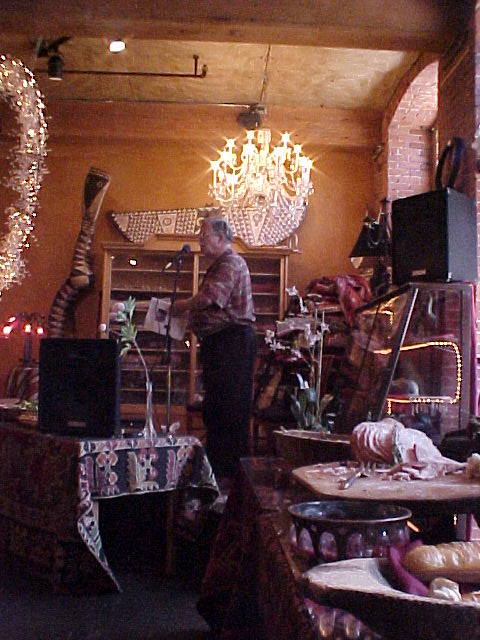
The author attempts to capture the poet at CAV, Providence, July 1st. Posted by Picasa

Let's have a merry journey, and shout about how light is good and dark is not. What we should do is not FUTURE ourselves so much. We should NOW ourselves more. "NOW thyself" is more important than "KNOW thyself." Reason is what tells us to ignore the present and live in the future. So all we do is make plans. We think that somewhere there are going to be green pastures. It's crazy. Heaven is nothing but a grand, monumental instance of the future. Listen, NOW is good. NOW is wonderful.

---Mel Brooks

The cloud is free only
to go with the wind.

The rain is free
only when falling.

---Wendell Berry

A monk asked Chao-Chou: "What is zazen?"
Choa-Chou replied: "It is non-zazen."
The bewildered monk said: "How can zazen be non-zazen?"
"It's alive!" was Chao-Chou's reply.

---Zen mondo

John Tagliabue, the late poet, spoke of The United Nations of Poetry. He created the term sometime in the early 1960s. I don't think he ever wrote a poem about it...or defined exactly what it was. It didn't seem to have an organization or charter or official members. Occasionally, in the early days of its non-existence, he said certain events or readings were sponsored by or part of the activities of The United Nations of Poetry. As the years went by, and there were more poems about "current events" turning up, he mentioned The United Nations of Poetry more and more. Many of us students and friends presumed, I guess, we were members of it...though John never said we were, and I know of nobody who ever asked for a meeting, Maybe I'll learn there were meetings somewhere. There was one on July 1st, however, in Providence, Rhode Island.

I didn't hear the term United Nations of Poetry mentioned even once during the 4 hours of wondrous tribute to our departed loved one. I didn't even think of it until I began to wonder how I'd write about the afternoon. That's when it came to me: that's what it was and that's who we are. How else to describe the astounding diversity of people who showed up? What other way than united were the laughter and tears we shared? The glowing spirit of the poet shimmered everywhere above us all.

Officially it was a memorial service on what would have been John's 83rd birthday, but he had died a month ago of what gets called now "complications from surgery." Somehow his widow Grace and 2 daughters Francesca and Dina had organized his dense little address book enough to send out invitations far and wide. There was an address of some restaurant in an old factory district of Providence...and there were directions that looked too complicated to read, so I stupidly depended on Mapquest instead to get me totally lost in there. Grace said on the phone, "I guess I should have put an RSVP on it," because she had no idea how many people were going to come. She said she thought a lot were. It was standing room only.

Clearly we were in a very chic and gourmet place. Converted from a knife factory, CAV (which reportedly stands for coffee, antiques, and victuals) is a large L-shaped room with the bar and kitchen to the center and side. Jazz gets played on a stage that can be seen by nearly every table, although you can find seclusion if you like. Lighting is by chandeliers, candles, lamps here and there. The whole place is "decorated" like a cross between an antique store and a shop specializing in tribal artifacts. In fact it is both of those besides an eatery/drinkery...and you can buy any of the art that intrigues you. Did I say there are rugs on the walls? Just the kind of place where you might expect some wise wizard to appear, blow the dust off a thick tome, and begin the incantation. And shortly, that's exactly what happened. Many wizards.

At first Cesca addressed us, thanked us all for coming, and introduced the central family table situated before the stage. Lots of Tagliabues were assembled. Then Bill Hiss came forward, representing the Administration of Bates College, where John taught all his life and many of us went to school. Bill said he'd MC the afternoon...but not so much, because there was no program and everyone hoped we'd all know what to do. Pretty much we did. Maybe the family had some idea of what it would be like, but I sure didn't. I had marveled for years at how John would send out envelopes full of poems to people, week after week, month after month. They were typed with carbon paper, preferably on a non-electric machine, and then cut to size with scissors, folded and put neatly with personal handwritten comments and greetings into envelopes, showering you---or at least your lap---with bliss when you opened them. Somebody said she thought maybe he was trying to save paper. (Probably he was trying to save postage, it occurs to me just now.) Another person said possibly everybody in the room had had a poem written especially about and for him or her. I figured I wasn't the only one---although he made you feel how special he knew you were---but I had no idea how far-reaching was the scope of his mailings.

Here came family members, some of them more "famous" than John was. They related how incredible it always was to meet him someplace, any place in the world, and what a traveler he was and how at home anywhere he always seemed. There were friends from Lewiston, Maine, where Bates is, who had driven down to tell us what knowing him in town had been like. University faculty don't always mix it up, you know, with just-folks who were born and raised downtown. John did, because if your paths crossed in a memorable way, he didn't care who you were or what you did. There were Maine poets who came, all of them recounting how Tagliabue had encouraged them, sometimes writing lengthy critiques---as poems of course---of their offerings, something I don't think he did for most of us students. I guess if you were a serious writer and you asked, he responded. At last a few of us students began to creep up to the formidable stage, and recount experiences and read a poem or 2. There were hugs and kisses with people I haven't seen in 45 years. And then some of us performed a scene and a bit more from the Mario series of 12 puppet plays. Never published and rarely seen, we tried our best to become the fantastic and mythical characters. My wife even attempted the overwhelming Green Queen (perhaps not knowing completely that usually only John played that part) and she was magnificent! And of course we wept.

When 4:00 came, Cesca and the owner did their best to sweep us out of the place. It was not easy, but they said we could continue on in the courtyard if we liked...and we did. At last, perhaps exhausted with all the intensity, we began to move individually back to our cars and our lives that had been so transformed. We were delegates to the rest of the world now. Dana touched my shoulder and said, "Grace is leaving, if you want to say good-bye." There she slowly came, this wonderful woman and artist I have known for so many years. What to say, how to say it? But as usual, she knew...and said, "O Dick, I'm so glad I got to see you now. I wanted to give you something," and she set down the beautiful orchid plant she was carrying. Then she offered me one of John's scarves...so important in the Maine winters. "I think it's alpaca," she said. I put it to my face, and the fragrance of John and their apartments in Maine and Providence filled me with memory. "Oh," I said, "I want to give you my gratitude and here you are giving me something. That's how it always is!" She smiled and laughed and we promised to talk on the phone...and then they were gone.

But that is how it is. And it's what I've learned from the meeting of The United Nations of Poetry. It's giving. You see, I've always had trouble receiving gifts and the Ultimate Gift and The Word. I've felt unworthy. I've felt I've been bad, and dishonest, and deceitful...and just not good enough to be forgiven, to be entrusted with great work, a mission. Some of that is a copout and laziness I know, and so there's all that to think about too. But the point is~~~it's not about me at all. Giving just happens. And John's poems and life demonstrate that again and again. Who deserves a daffodil? But there one is. Be grateful and just give. Don't you see?

The look and book of truth can never be unfaithful

Now it's not the first time that
I see angels
I mean snowflakes
or that I hear music
born out of what seems
silence but it is the
most necessary ( is that
easy ? ) fact in the
fabulous world of
changing events that
renewal is the law
of Providence.
It occurs in strange and at times difficult and painful
ways, death, loss of
faith; but as I see
all these minute
snowflakes in the grey
Maine day which I
cannot count any more than St. Thomas could the
angels on a pin's head
I am conscious of a quiet newness that I
declare a cool and refreshing
in some ways undecipherable
new testament.

---John Tagliabue

Monday, June 26, 2006

So You Think There's A Right To Vote?


Posted by Picasa

In this way and that I tried to save the old pail
Since the bamboo strip was weakening, about to break
Until at last the bottom fell out.
No more water in the pail!
No more moon in the water!

---Chiyono

I want to go soon and live away by the pond, where I shall hear only the wind whispering among the reeds. It will be a success if I shall have left myself behind.

---Henry David Thoreau

Since the house is on fire, let us warm ourselves.

---Italian proverb

When I read Greg Palast's column in the UK Guardian from Friday, and featured yesterday by TruthOut, I hesitated to get excited about it. Palast's stuff invariably is upsetting, but I sense a lot of resentment fueling him and also somehow his opinions just don't seem to catch fire. Maybe it's the "conspiracy" of the mainstream media that keeps other reporters and editorial writers from going near his theories. At any rate this time his article is titled "Democracy In Chains" and begins~~~

"Don't kid yourself: the Republican party's decision yesterday to 'delay' the renewal of the Voting Rights Act has not a darn thing to do with objections of the Republican's white sheets caucus.
Complaints by a couple of good ol' boys to legislation have never stopped the GOP leadership from rolling over dissenters.This is a strategic stall that is meant to decriminalise the Republican party's new game of challenging voters of colour by the hundreds of thousands."
http://commentisfree.guardian.co.uk/greg_palast/2006/06/voting_rights_act_nailed_to_bu.html

The first comment in the massive thread that erupted from the essay is by someone known as MisterD~~~

"This article conflates about five different issues in order to make the false claim that the Republicans are trying to deny citizens the right to vote. They are not. They are just trying to stop the massive vote fraud and ballot box stuffing the Democrats attempt at every election.
This is a poorly researched and poorly reasoned efort to smear Republicans as bigots. Like all of Palast's writing, it is designed to enflame the already feverish minds of the ignorant."

Hmmm, I decided to think it over for a while before running with Greg's ball. My connection with the Civil Rights Movement goes back a long way. Somehow I became a jazz fan as soon as I crossed the threshold into adolescence. (My parents thought I'd grow out of it.) You don't spend much time in the history of that music before you hear stories involving racial discrimination. So by the time I was in college and heard about a few other young people protesting segregation at Woolworth's lunch counters, I joined up. In the summer of 1961, I went to Chicago to train for Freedom Rides whose goal was shipping busloads of people into the South to encourage and help folks register to vote. These were states where poll taxes and literacy tests turned away thousands. The Voting Rights Act of 1965 was meant to remove these obstacles.

Lulled into a kind of complacency of victory and set rather at a distance by black backlash that was going on then, I didn't think about voting rights again until I heard about problems in Florida in 2000, and closer to home here in 2004 Ohio. Those of us who cried Foul around those elections generally have been ridiculed off the map for the same number of years it took to see progress in civil rights back in the '60s. Conspiracy theories just make you crazy, so why not give it up? Now comes Palast tying together election fraud and the Republican concerns about renewing the Voting Rights Act. Could he be right? Are Republicans testing the waters to see if anyone in America still is awake at all?

Pessimistically I typed "Voting Rights Act" in Google NewsSearch...and felt my jaw drop when pages of articles and editorials came up. It looks like every newspaper in the country has commented over the weekend on what Republicans are trying to do. More astonishing, most of them seem to see the same threat Palast sees. The most vocal of all are in the very states the legislation singles out as requiring special attention.

In Houston~~~

"The 1965 Voting Rights Act, much of which is permanent, choked off the Jim Crow laws that kept minorities from voting.e 1965 Voting Rights Act, much of which is permanent, choked off the Jim Crow laws that kept minorities from voting.
Section 5, which is up for renewal, made states with histories of voter discrimination get federal 'preclearance' for any changes in their voting law. Texas is one of those states.
There was good reason to subject Texas to federal review. Civil rights lawyers would wrestle down one assault on rights — a poll tax, or a literacy rule, or a morals test — only to see Dixiecrats dream up a new one.
Section 5 switched the burden of defending voter rights from civil rights workers to the federal government. Today, the rule is especially useful at the local level, where council members and others might not be sensitive to a law or procedure that would have an adverse impact on racial minorities.
When the Voting Rights Act was passed, it was easy to spot attempts to disenfranchise minority voters. Most took place in the South. In recent years, though, attacks on voter rights and access to polling places have erupted all over the map. In the last presidential election, some of the most egregious violations occurred in Florida and Ohio — states largely exempt from Section 5."
http://www.chron.com/disp/story.mpl/editorial/4001127.html

Alabama~~~

"What had happened was that a group of representatives from the South protested that, under the renewal, their states would still be required to have voting rule changes 'pre-cleared' by the Justice Department despite the improvements made since the act was originally passed.
They were joined by other Republicans who wanted to remove from the act the provision that requires ballots to be printed in languages other than English in states and counties where there are large numbers of non-English speakers.
Whatever the merits of the arguments for changes in the act, the bottom line is that a group of Red State Republicans, representing the heartland the GOP has captured and hopes to hold, have undermined their party’s hope to attract black and Hispanic voters in the upcoming election."
http://www.annistonstar.com/opinion/2006/as-editorials-0626-editorial-6f23s5543.htm

Georgia~~~

"For years, Southernors have insisted that the VRA is outdated, that the ills addressed by the act have been corrected. To a degree, this is a good argument. But it's not good enough. Real gains have been made, but there remain indications that, given the opportunity, political factions would pass laws that could present roadblocks to minority voting. Some cite Georgia's recently approved voter photo ID law, which could disenfranchise the poor and elderly, as the most blatant recent example.
One might also point out that just because the VRA has been successful, this is no reason to do away with it. Human nature being what it is, we can see no reason to let Section 5 expire because it works. In fact, that it works so well presents a solid argument for keeping it intact."
http://www.macon.com/mld/macon/news/opinion/14889907.htm

From Chicago yesterday, Clarence Page reviews voting rights violations taken to court in just the past few years~~~

http://www.chicagotribune.com/news/columnists/chi-0606250445jun25,1,7203155.column?coll=chi-news-col

From Atlanta, Julian Bond writes this powerful essay today~~~

"If murderers would promise not to murder again, we could eliminate all our laws against unlawful killing. No laws against murder — no murders.
That is analogous to the argument made by some Republicans against reauthorizing the 1965 Voting Rights Act.
We may have done wrong in the past, they say, but we won't in the future. So we can now eliminate the most effective civil rights law ever passed.
The act doesn't expire until September 2007, but a bipartisan coalition in Congress had pledged renewal this year. Now that effort has been derailed. Leading the train wreck has been U.S. Rep. Lynn Westmoreland (R-Ga.). He wants to radically alter Section 5 of the act, which requires federal permission to change voting rules in nine states.
The 1965 Voting Rights Act initially focused on six states where blacks had been systematically denied the right to vote — Alabama, Georgia, Louisiana, Mississippi, South Carolina and Virginia. Three more states — Arizona, Texas and Alaska — were added 10 years later to protect language minorities.
'The pre-clearance portions of the Voting Rights Act should apply to all states, or no states,' Westmoreland argues. 'Singling out certain states for special scrutiny no longer makes sense.'
But 'all states' don't have the history of the six originally covered by the act, including Westmoreland's Georgia.
Westmoreland knows full well that applying Section 5 to all 50 states likely will make the act unconstitutional, no doubt the outcome he wants. Singling out certain states, including Georgia, makes perfect sense.
From the end of Reconstruction forward, Georgia's white supremacist governments and private white citizens devoted considerable energy to preventing black citizens from registering to vote or casting ballots. Their tactics included murder, ballot stuffing, poll taxes, literacy tests that whites passed but most blacks failed, and wholesale intimidation.
When former Urban League Director and Georgia native Vernon Jordan testified for renewing the act in 1970, he said Georgia and other Southern states 'were the most efficient, determined and malicious in their efforts to keep black people off the registration rolls.'
In Harris County in Westmoreland's 8th Congressional District, blacks were 57 percent of the population in 1955, but no blacks were on the grand jury list, and blacks were only 2.3 percent of the trial jury list. Westmoreland's Douglas County adopted a majority vote requirement in 1968 without asking for pre-clearance when a black candidate prepared to run for office. The county was sued over this discriminatory procedure in 1975.
Since the act was last renewed in 1982, the Department of Justice has objected 80 times to proposed changes in Georgia's voting plans, finding they were discriminatory. Recently, only the Department of Justice's political appointees saved a biased Georgia voter identification law over the objections of career Justice Department lawyers. A federal court eventually struck the law down, but Georgia passed a substitute which justice's political appointees pre-cleared.
Sadly, the Southern Poverty Law Center lists 40 hate groups in Georgia today, operating from Athens to Valdosta, and ranging from the Imperial Knights of the Ku Klux Klan and Aryan Nations to the Council of Conservative Citizens and the League of the South.
Congress was justifiably proud of its bipartisan intention to renew the Voting Rights Act. The partisan objections of a few disgruntled defenders of a discredited system shouldn't be allowed to end agreement across the aisle on a law President Ronald Reagan said protected the 'crown jewel' of our democracy, the right to vote.
Westmoreland was quoted as saying about his and his colleagues' objections to the Voting Rights Act, 'A lot of it looks as if these are some old boys from the South who are trying to do away with it.'
Yup — it sure does.
We need renewal of the Voting Rights Act as is — just as we need to keep laws against murder on the books."
http://www.ajc.com/opinion/content/opinion/stories/0626edbond.html

And back to Palast~~~

"In the 2004 election, more than 3 million voters were challenged at the polls. No one had seen anything like it since the era of Jim Crow and burning crosses. In 2004, voters were told their registrations had been purged or that their addresses were 'suspect'.
Denied the right to the regular voting booths, these challenged voters were given 'provisional' ballots. More than 1m of these provisional ballots (1,090,729 of them) were tossed in the electoral dumpster uncounted.
A funny thing about those ballots: about 88% were cast by minority voters."

Robert Kennedy's article nearly 4 weeks ago and Steven Freeman's new book that I've referenced before attempt to chronicle a pattern to the election problems seen by many over the past half dozen years...particularly in Florida and Ohio. Accusations were made that particular voting blocs were disenfranchised, and the pattern described clearly favored the Republican Party. Now Republicans seem to be looking squarely into the spotlight at the scene of the crime. Is this possible? Or are we going to get a new spin that will send us back to our shrugging apathy?

Kennedy's article is here~~~
http://www.rollingstone.com/news/story/10432334/was_the_2004_election_stolen/1
and The Boston Globe has a new statement by Freeman today~~~
http://www.boston.com/news/globe/editorial_opinion/oped/articles/2006/06/26/a_call_to_investigate_the_2004_election/

Wednesday, June 21, 2006

A Woman Shall Lead Us


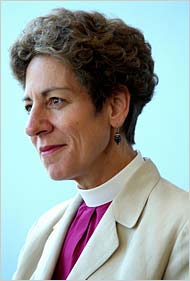
Bishop Katharine Jefferts Schori is the first woman to lead the Episcopal Church.
Michael Houghton for The New York TimesPosted by Picasa

Friend, hope for the truth while you are alive.Jump into experience while you are alive!What you call "salvation" belongs to the time before death.If you don't break your ropes while you are alive, do you think ghosts will do it after?

---Kabir

Actually there is no real teaching at all for you to chew on. But not believing in yourself, you pick up your baggage and go around to other people's houses looking for Zen, looking for Tao, looking for mysteries, looking for awakenings, looking for Buddhas, looking for masters, looking for teachers. You think this a searching for the ultimate and you make this into your religion. But this is like running blindly. The more you run, the farther away you are. You just tire yourself, to what benefit in the end?

---Foyan

A human being is a part of the whole called by us "the universe," a part limited in time and space. He experiences himself, his thoughts and feelings, as something separate from the rest---a kind of optical delusion of consciousness. This delusion is a kind of prison for us, restricting us to our personal desires and affection of a few persons nearest to us. Our task must be to free ourselves from this prison by widening our circle of understanding and compassion to embrace all living creatures and the whole of nature in its being.

---Albert Einstein

There are many peculiar terms in the Episcopal Church. "Episcopal" is one of them. The word in Latin means "bishop," which hardly differentiates this church from anything known as Anglican throughout the rest of the world. Its members want their own identity in the United States, so we use Episcopal instead of Anglican. Apparently that's only the first of many annoyances we cause.

The physical organization of the church resembles the Catholic, from which it broke so King Henry could keep trying out wives until he found one to suit him. (Not much spiritual inspiration there.) Other Protestant denominations have bishops and such, who are leaders elected in some way or other. In the Episcopal Church there are 2 houses, like Congress: the House of Bishops I suppose is like the Senate, smaller and with more clout; the House of Deputies is similar to the House of Representatives.

The "president" of the whole Anglican Community is known as the Archbishop, and as anybody can become a priest and a bishop anybody could get elected Archbishop too. Well...until now, any MAN could be Archbishop. And to be more specific, any clearly practicing heterosexual man. A priest needn't be married but it's better, if he's going to have some kind of sexual partner living with him, that it be a woman. You know, help with church auxiliaries and picnics, choir practice, Sunday school...that kind of "womanly" thing. I suppose our Catholic friends laugh up their sleeves at how complicated all this has become for us. We have nuns too.

The Church here is divided up into dioceses, which are like sections of states and territories. A bishop is elected to preside over the individual churches in each of them. Our bishop currently is named Price, and 2 hours ago he sent out an email message announcing an extraordinary meeting will be held this morning at 10:45. Last year the Episcopal Church in America elected a bishop in New Hampshire, who is openly gay, with a partner and all that. The Anglican Community objected in a document known as the Windsor Report. Pretty much, we were told to get in line...or else. We put a moratorium on electing any more bishops until our next General Convention of Bishops and Deputies, when we'll come up with an answer to the Windsor Report. That time is right now.

Last night the current Presiding Bishop, who is Frank Griswold, "proposed a rarely used prerogative of calling for a Joint Session of the two houses for today following the Eucharist. The purpose of the session is to craft a response that will truly represent the mind of both houses," according to Bishop Price's message. The representatives in each house had debated all day yesterday and into the night, without coming up with a definite resolution to present to each other for confirmation. Under discussion is not only the continuing freedom for gay and lesbian people to become bishops in this church, but the official blessing of gay union in our services.

On Sunday, as you probably know by now, we elected the first woman Presiding Bishop, or head of the Episcopal branch of the Anglican Union. The Convention may run out of time before we get to abortion and the invasion of Iraq.

This morning The New York Times ran a pretty nice profile of Katharine Jefferts Schori. Here it is...while we await further developments in Columbus~~~
--------------------------------------------------------------------------------
The New York Times
June 21, 2006
For an Episcopal Pioneer, the Challenge Is to Unite
By NEELA BANERJEE

COLUMBUS, Ohio, June 20 — As she talked about her past and her future, Bishop Katharine Jefferts Schori on Tuesday described a life filled with so many unusual steps — including learning to fly and entering the Episcopal priesthood at age 40 — that it seemed to suggest an almost congenital appetite for challenge.

She now faces one of her greatest challenges, one that she has called "a grand adventure."

Bishop Jefferts Schori's election on Sunday as the first woman to lead the Episcopal Church has cast her deep into the maelstrom that has engulfed the American arm of the 77-million-member Anglican communion.

"We need to send a message that we fully intend to be part of the communion," she said on her way to the daily Eucharist service. "All of this calls for us to grow and stretch. I think we're willing to stretch very far indeed."

An angry debate about the election of a gay bishop and the blessing of same-sex unions in the United States has frayed the church at home and threatened to fracture the Anglican communion, the world's third-largest church body. Lay and clergy representatives at the Episcopal Church's triennial general convention here are trying to hammer out a response that would satisfy the Archbishop of Canterbury and those Anglican primates abroad who are profoundly offended by the Episcopal Church's actions.

Bishop Jefferts Schori, the 52-year-old bishop of Nevada, will have to sell whatever decision her church makes to the rest of the global communion, a task that may be made more difficult by her sex. Most of the 37 other provinces of the communion do not ordain women, and the willingness of those primates to accept a woman, particularly one who has endorsed gay bishops and same-sex unions, will only become clear over time.

A tall, slender woman who speaks in a soft alto, Bishop Jefferts Schori was born March 26, 1954, in Pensacola, Fla., the oldest of four children. She grew up around Seattle and in New Jersey. But Bishop Jefferts Schori returned to the West Coast to attend college at Stanford University and then to pursue a master's and doctorate in oceanography at Oregon State University. Her master's work dealt with "things that live in mud," on the Oregon coast, she said.

Bishop Jefferts Schori's family seems to be defined by staggering competence.

Her father was an atomic physicist who became an astrophysicist and then went on to help invent a system to tag and code salmon. Her mother had a degree in comparative literature but later became a microbiologist. Her husband of 27 years, Richard M. Schori, is a retired theoretical mathematician. Her 24-year-old daughter, Katharine, is a pilot in the Air Force.

Bishop Jefferts Schori has been flying airplanes since college and took up rock climbing with her husband, a skilled mountaineer. She is fluent in Spanish.

Bishop Jefferts Schori's parents were Catholics who left the church when she was about 9 to join an Episcopal parish, she said.

"We went from a liturgy in Latin to one in English," she said, "from a large and anonymous church to a small and intimate one."

Her turn toward the ministry began more than 15 years ago, when her opportunities for work in oceanography were narrowing. At the same time, several people in her congregation told her she should become a minister. She said she studied and prayed with her pastor in Corvallis, Ore., and the answer became clearer over a period of years.

"My sense of call was like looking at a series of doors closing and others opening, not like there were words on fire on the wall," she said. "It was this dawning awareness that, 'Yes, it makes sense, that there is a coherence to the pieces I am experiencing.' "

Bishop Jefferts Schori was ordained in 1994. The church first ordained women in 1976.

When she walked down the hall toward the Eucharist, a woman in a wheelchair flashed her a smile and a pink button that read, "It's a girl!"

But to the Episcopal Church's critics, Bishop Jefferts Schori's election is another step in the wrong direction, given her liberal theology and her sex. Already, the diocese of Fort Worth, one of three that does not ordain women, has sent a letter to the archbishop of Canterbury asking to be placed under the oversight of a different primate. No decision on that is expected soon.

The archbishop himself sent rather wan greetings to Bishop Jefferts Schori, that in part cautioned that "her election will undoubtedly have an impact on the collegial life of the Anglican primates; and it also brings into focus some continuing issues in several of our ecumenical dialogues." That translates into concerns that other Anglican primates may not accept her, and the Vatican and Eastern Orthodox bishops might not, either.

If her fellow primates are not willing to sit at the table with her, Bishop Jefferts Schori said, she is willing to get up and follow them as they walk away.

"I think that building trust in other parts of the communion is crucial because there is anxiety about a woman in the boys club, as some have said, though I already know a number of the primates," she said. "There is anxiety about the place of the Episcopal Church in the communion. But we want to show that the main thing is that we aren't here to argue about matters of sexuality. We are here to build a holy community."

Copyright 2006 The New York Times Company
http://www.nytimes.com/2006/06/21/us/21episcopal.html?_r=1&th&emc=th&oref=slogin

Saturday, June 17, 2006

Ilona: Back In The B-USA


Ilona newly arrived, like Spring, in Pau. Posted by Picasa

To get this chance is very difficult. To be born as a human being is very difficult. Among uncountable sperms and eggs...you are here. Wonderful chance. Congratulations!

---Soen Nakagawa

You cannot stay on the summit forever. You have to come down again....One climbs and one sees; one descends and one sees no longer, but one has seen. There is an art of conducting oneself...by the memory of what one saw higher up. When one no longer sees, one can at least still know.

---Rene Daumal

When it's over, I want to say: all my life
I was a bride married to amazement.
I was the bridegroom, taking the world into my arms...

---Mary Oliver

Ilona's been back in the Bush United States of America for 10 days. I don't mean to politicize this essay, but they were her first comments: all these flags everywhere, all these pushy, frightened people. Since March 20th she had been in France, away from all this: blaring news reports of optimism, military state of mind, body searches, and thoughts of terrorists at the front door. "They don't have that in France," she said...and it was impossible to imagine.

The first couple days she spoke in French all the time. I found I could understand what she said pretty well, and so I became interpreter for her mom and grandmother. I know I couldn't have translated exactly, and certainly not spoken back...but I did OK with my occasional replies. Amazing! So now it was possible to imagine how someone only 14 could go to another country, take the remainder of her 9th grade there in French, make new friends, and have an absolutely wonderful time.

These first days we have learned a lot. I knew that would be the case, but had no idea what it would be like. She is calmer, stronger, deeper. I don't want to suffer illusion here, but she seems to perceive herself with new and more maturity. Is it possible? As I think this, she says so herself. She tells us she feels she has learned true compassion for other people. I know that's pretty abstract and a far reach for 14, but indeed she has maintained an equilibrium.

And Dana and I certainly have inadvertently provided the challenge. The weekend before her flight touched down, we had been in Columbus at a highly-charged political intensive for 2 days. We still were chomping at the bit to get change happening at the grassroots! I think on the drive home from Cincinnati, Dana launched into a complaint about the Ohio legislation pending to ban all abortion in this state, no matter how the pregnancy was caused or what the result might be. Ilona wanted to plug her ears. How grand it had been to live free of a restrictive society for some months!

Then almost immediately, Dana and I were off to Columbus again, this time to volunteer during the first couple days of the Episcopal General Convention. Yeah, that's the one about whether a bishop can let anyone know he's gay or not. Ilona was back. Plus, there have been evening meetings to help organize congressional campaigns for the upcoming election. And I'm preparing for a 2-week theater run of Inherit The Wind, the monkey trial play. I mustn't forget being on the phone and computer all the time planning for the memorial for Tagliabue...which will mean a trip for us to Providence for a few days shortly.

Ilona said, "Oh let's keep going and get out of the country for the Fourth of July." Rebellious talk, but she really means she misses that French countryside so much already. And her new friends, who sound so delightful. Do you know what they did? They gathered together and greeted her and her friend at their school on the final day. They had made a card, with all their pictures on it and each signed a special greeting. It is so beautiful, and certainly her most prized keepsake of the trip.

Well, there were some problems over there. We had tried to prepare the family chaperoning Ilona she might have homesickness and physical upsets along the way. The homesick part passed quickly but there were some maladies here and there that probably were stressful. And there's always cabin fever, even just among a family of 5, never mind adding an outsider. Her new digital camera was picked out of the pocket of her friend at the Louvre. There were too many American tourists in Paris, and the shopkeepers were impatient. Alas, Paris was the biggest disappointment. (Papa confesses a little relief she didn't meet some boulevardier there for whom she wants to pack her bags and go back to a Moulin Rouge life.)

She hiked the Pyrenees with her friend, and his mother and stepdad. They were up there for days, spending nights in little lodges, bed & breakfast kinds of homes, and Easter in tiny Lascun. She has a couple hundred photographs of the experience, and it truly looks to have been idyllic. She loves the Basque traditions. She brought us goat cheese, and made sure we had some while we still were in the airport parking lot. It was heaven!

Dana has whisked her off again this weekend for family business in Western Pennsylvania. They should be back tonight though...and I so look forward to see her. (And yes, Dana too.) Her brother Jeroch was over here yesterday and he reflected too how she has grown in every way. He and I hiked through the woods before taking off for a baseball game with a community team he's on. I had such a great time, and his lady Karen was there to keep me company. Hey, troubled as this Old Glory may be these days, we still have hot dogs at the ballpark. And jazz. I'll try to remember that when the French girl gets back.

Saturday, June 03, 2006

John Tagliabue: Last Words


John and Grace Tagliabue were photographed in the Muskie Garden at Bates College in 1998 by Phyllis Graber Jensen, shortly before their move to Providence, R.I. John died on May 31. Posted by Picasa

The important thing is to do, and nothing else; be what it may.

---Pablo Picasso

You yourself are time---your body, your mind, the objects around you. Plunge into the river of time and swim, instead of standing on the banks and noting the course of the currents.

---Philip Kapleau

Who whispered, souls have shapes
So has the wind, I say.
But I don't know.
I only feel things blow.

---Stanley Kunitz

You can, you do...prepare---sometimes for years---for the last word, the final departure...of a friend, a loved one. But we're never really ready when it comes. Still the shock. The welling up, unexpected sobbing. Breaking down...alone or with a comforting hand upon one's shoulder. It cannot be contained. The grief.

And so it came...yesterday afternoon, while I was down at the garden, the phone call's recorded message telling me John Tagliabue is gone.

Exactly a month ago his last letter arrived announcing the "big operation" would be "tomorrow morning, might take 4 - 7 hours!!" Nearly 83, John had agreed to extreme measures to remove part of a pancreas gone bad. There were complications...and another surgery...and then the final morphine drip. With wife and 2 daughters in the room reading him his poems, John gave us the slip and danced lightly further into the fantastic. May I share with you just a few of the last things he wrote?

++++++++++++++++++++

Dear sensitive thoughtful shaken one, Shakespeare student, praised actor, stirring one, Dick Carlson,

I wanted to cheer myself up a bit
so I remembered what Amy Clampitt wrote about me:
"John Tagliabue writes out of a deeply sacramental sense of nature and history. He is, moreover, that rare person to whom poetry appears to come as naturally as breathing. It comes to this reader, poem by poem, as a Franciscan act of courtesy and praise."

The Collected Poem

I didn't want to be
an entertainment commodity
a seminar commodity
an attitude to be approved of
by this fashion or that ideology
I had no plans or programs or theories for it
but it was from my heart
of no importance
of all importance
it was not to be named or foretold
it alone gave me freedom.

+++++

Particularity and
some also call it freedom and Democracy

Something in
my biological nature
(it must be cosmic ? ) wants me to get up and
yawn and
then pee and then have my 1st meal of the day,
coffee, breakfast,
and later more, day by day, mile by mile,
to imbibe,
to chew, to make faces and acts, to act up,
to have
more or less yearnings, how habitual ! to write
phrases, millions
of them, moods, billions of them, to listen to
the more and more
hideous world news, politics, economics, murders
and murders,
indeed one has to be strong, very strong, to get
through the
so called ordinary day year after year after year,
and now it's
almost 82 years that the biological and cosmic functions
have been particular
in me.

+++++

Drizzle and repeating Success

The delicate new leaves are certainly being visited
by thousands of
delicate rain drops day after day after day and
the young bridegroom
is visiting night after night and often in the daytime
too the new
young bride she of the delicate skin, hands sliding
on the body,
warmth in the ease, the curve of the young breast,
the penetration
of the mesmerized devout husband, he who plays
like a light
magician and musican on the instrument of bliss
with the
happy instrument of bliss and all around for
miles and
miles and forever are the necessary new blossoms
flowerings,
the drizzle and the continuous dizziness night after
night
day after day in the delicate celebration of
marriage perfection.

+++++

Master T.S. Eliot finely pronounced it the Waste Land

From my lofty 4th floor window
I see it,
there goes off the 1st black car of the day,
a man
in a tin can gliding like a coffin, drizzle
day,
business day, from computer to computer, from sigh
to sigh,
poor trapped man industrious and trapped in his bureaucracy
while more
nuclear bombs are being prepared, more nuclear waste
is being
piled up, while more fresh young soldiers are being
sent off
to be slaughtered - for Democracy for Freedom for
Wall Street
for Corporation and Madness and More Corporations and
Madness;
some more coffins will glide by in Edgar Allen Poe's
Country
of Quote the Raven and Advertisements, Dental Ads
and Viagra
and Constipation Cures, More Advertisements for Cars and
Cheerfulness
in Routine Despair.

+++++

and from the last letter...these 4~~~

And faith ? Certainly Charity

They don't care about that - the frivolity,
the foolishness,
the insane ambitions of politics, illusions
ridiculous of "power" -
the Springtime daffodils, magnolia, blossoms
of all kinds, they
simply Appear, miraculously Appear; I ask you
song of myself and
friends not to disappear but be enlightened as
the daffodils, as
April thoughts of resurrection, baffle elate,
not late,
the future centuries with hope.

All kinds at the bib, bibles, 1st and last suppers

What are you going to do to make it,
lo Spirito Santo ?
the mosquito, the weed, the clown, the tormented
philosopher, what ?
Hamlet at the crossroads mumbling to the gravediggers,
Christ on the
Cross Exhausted, He who gave away His sermon on the Mount,
He who
said with Him we can move all mountains. Someone with a
twinkle
in his eyes and humored looked up from the spaghetti he was
enjoying
and said - good, you like to philosophize, you help us pass
the time.

Being is its own reward for being.
Beauty is its own reward for being.

Weeping is its own wet reward,
I hear the pitter patter of the rain,
it is twice blessed, it blesses him or her
that gives
and those who hear and see and sometimes sing; weep,
O skies,
you skies that Turner in his glory, that Tiepolo
in his
glory also and others, tried to paint; we faint
from weeping,
we fortunate to have loved and loved and loved.
Skies could not
be higher than we weeping. Sleep awhile, keep
the secrets
of what we call infinity. "The more I give, the
more I have,
for both are
infinite..."

Sensitive Observer, be a night in armor

Watching
the man on the Cross or
the person at the dark or shattering light
crossroads
in pain or perplexity is great pain for the
mother or
lover, receiving the news of the agony or death,
the amputation
or blindness of the son or soldier perplexes
agonizes
as pain can do unto death; dear weeping
daughter,
tortured relative, if you must weep weep - not
then sleep,
awake and lifetime recollect all my thoughts
and acts
of love.

John Tagliabue's last words to me were these~~~

What I know as I Approach 83 is that much is unknown & that I've had a most helpful wonderful wife & loved family & good friends (you are one of them - ); and I want to say thanks - & Best Wishes to us all

John

http://www.bates.edu/x117650.xml