Monday, July 16, 2007

Constitutional Crisis


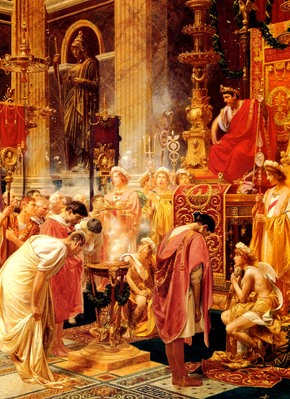
Alessandro Pigna (1883-1903)
Paying Homage To The Emperor


The great way of the Buddhas is profound, wondrous, inconceivable; how could its practice be easy? Have you not seen how the ancients gave up their bodies and lives, abandoned their countries, cities, and families, looking upon them as like shards of tile? After that they passed eons living alone in the mountains and forests, bodies and minds like dead trees; only then did they unite with the way. Then they could use mountains and rivers for words, raise the wind and rain for a tongue, explain the great void...

---Dogen

When we speak of being highly developed spiritually, this does not mean that we float in the air. In fact, the higher we go, the more we come down to earth.

---Chogyam Trungpa

You are seeing impeachment as a constitutional crisis. Impeachment is the cure for a constitutional crisis. Don't mistake the medicine for the disease. When you have a constitutional crisis, the founders are very clear. They said there is a way to deal with this. We don't have to have a war. We don't have to raise an army and go to Washington. We have procedures in place where we can sanction a president appropriately, do what needs to be done up to the point of removing him from office and continue the republic.

---John Nichols on Bill Moyers Journal, 7/13/07

I am not a constitutional scholar. I'm not a lawyer. I might think about citizenship quite a bit, but I may be pretty much an average American. As I understand the Constitution of the United States, that qualifies me to register concern...and to do so with forceful words.

Whatever our history has been and however we managed it, a republic was established so that each citizen could have a fair chance of a voice in the conduct of government which so affect our lives. My understanding of how that works is through a series of representative assemblies from local to state through federal levels.

At the top, in Washington, DC, we have the House of Representatives and the Senate. Between them, they legislate and debate and ultimately create laws and programs that enable us to live better lives...and maybe help people in other countries too. A system of public education was considered vital to maintain an informed electorate.

But at that point the Congress must turn over the created legislation to the Executive, whose job it is to put these examples and results of the will of the people into action. Sometimes, for one reason or another, the President doesn't think he can or should do it...and he tells Congress that. Maybe they can overrule his judgment or perhaps the Supreme Court must decide who is right, according to the Constitution.

Sometimes a great threat materializes and war must be declared. The Congress does this and thus hands to the President the awesome duties of Commander in Chief of the armed forces of the country. When this happens, everyone in the nation is expected to sacrifice aspects of life and liberty to enable the President to expedite the battle quickly. All Americans know this and we have done it.

There have been instances in the histories of all nations when supreme leaders have used occasions of warfare to increase personal and family fortunes. We expect such events in a dictatorship, but it is the worst thing to happen in a republic. Here, there is no question but that the money in the Treasury is ours, kept and spent in trust by freely elected representatives. If those people are stealing our money for themselves, they must be stopped or all fails.

There is a distinct possibility our Congress acted in the fever of haste when war powers were handed over to George Bush. Troops have been dispatched, and hundreds of thousands of people may be dead...or forever maimed. Everyone in the world knows the intelligence, in the full sense of that word, was "flawed" in developing the case for war. But now that we're there, the Commander says, we have to fix stuff before we leave. He's not in a terrible hurry on this because 1) he can pass the mess onto a successor, and 2) a lot of money is still to be made by private supporters.

It seems the nation and the Congress disagree with the President, but now how do we stop him? We gave him all these powers, matters of "executive privilege," and now he claims the national security he is pledged to maintain is endangered by any investigation. Even if the powers were granted under false pretenses, what, short of the Senate storming the White House, can be done? Or is it time to storm the White House?

Last Friday, the same day Bill Moyers gave a TV hour to consider impeaching both President and Vice President to remove them from office http://www.pbs.org/moyers/journal/07132007/transcript4.html , former presidential counsel John Dean wrote an article about the problem of Harriet Miers. It is auspicious he did so, for he held precisely the same position as Ms. Miers in an administration that was brought to collapse under the scrutiny of Congress. Mr. Dean did appear before investigation when called and told the truth to the best of his ability. Ms. Miers refused to do so.

In his article John Dean considers what the Legislature can do next. Papers have been drawn up to charge Harriet Miers with contempt of Congress, conviction for which carries fines and jailtime. But those papers must be handed over to the Executive Branch for implementation, and it was the Executive who told Miers not to show up. What now?

The article is lengthy and detailed, but concludes with this scenario~~~

Congress Needs To Protect Its Powers: Only One Way It Can Do So

Marty Lederman has prepared a nice overview analysis of what happens when officials defy a congressional subpoena. http://balkin.blogspot.com/2007/07/what-would-happen-if-administration.html

Let's suppose that the House votes Miers in contempt, and the matter is sent to the U.S. Attorney. One can expect that no prosecution will be brought. During the Reagan years, the Justice Department ruled that even though the referral statute makes it the "duty" of the U.S. Attorney to take the matter to the grand jury, Congress cannot enforce that duty on the Executive Branch if the Executive Branch refuses to honor it. As noted, it would appear that under the most recent Justice memo on the subject, the White House will not permit the U.S. Attorney to prosecute the matter, and Congress has no power to overrule that by forcing the U.S. Attorney to go forward.

If the U.S. Attorney did go forward could criminal sanctions be imposed on a witness such as Harriet Miers who is (albeit willingly) following the orders of the president by refusing to honor a congressional subpoena? The issue raises serious Constitutional questions that have not been resolved by the Supreme Court. If the issue did reach the Court, how would the Court rule? Given its current conservative majority, the Justice Department and White House may be right if they have concluded that they can win before the Court, convincing at least five Justices to declare such criminal sanctions unconstitutional.

If the House votes Miers in contempt, they can also institute a civil legal action by seeking declaratory judgment from a federal court to compel enforcement of their subpoena. However, there is a growing body of law, coming from conservative jurists, calling for conflicts like this between the executive and legislative branch to be considered "political questions" that are improper for the federal courts to resolve. Thus, it seems likely that the Court might - citing the political-question doctrine - decline to take jurisdiction over this clash, thereby leaving the White House's status quo untouched. For the Bush Administration, the worse case scenario, as Lederman suggests, is simply that the courts will seek to force a political settlement.

Finally, if Miers is found in contempt, the House itself can take action against her at the bar of the House. (The Senate can similarly hold such proceedings.) Congress has the power to prosecute contumacious witnesses to require them to comply, and the Supreme Court has repeatedly reaffirmed this power. For example, in 1987, in Young v. U.S., Justice Antonin Scalia recognized "the narrow principle of necessity" or "self-defense" of the Congress in protecting its institutional prerogatives. Scalia said "the Legislative, Executive, and Judicial Branches must each possess those powers necessary to protect the functioning of its own processes, although those implicit powers may take a form that appears to be nonlegislative, nonexecutive, or nonjudicial, respectively." http://caselaw.lp.findlaw.com/scripts/getcase.pl?navby=case&court=us&vol=481&page=820

When all is said and done the only way Congress can protect its prerogatives is to undertake its own contempt proceedings. The parliamentary precedents of the House provide such procedures, by which Congress can effectively protect itself. There is no shortage of past instances where the Congress has held such trials. Readers may want to consult, for example, Hinds' Precedents http://frwebgate.access.gpo.gov/cgi-bin/getdoc.cgi?dbname=hinds_prec_vol_iii&docid=f:hinds_liii.pdf and Canon's Precedents http://frwebgate.access.gpo.gov/cgi-bin/getdoc.cgi?dbname=cannons_prec_vol_vi&docid=f:cannon_clxxxv.pdf . Unfortunately, however, this machinery has become a bit rusty, for these procedures have not been used since 1934.

Congress Must Avail Itself of Traditional Procedures to Compel Testimony and/or Punish Contempt

Given the clear attitude of conservative presidents, who are doing all within their power to make Congress irrelevant, Congress should turn to these underemployed precedents and put them back to work. The House and Senate Judiciary Committees should take the lead in reviving these procedures, and the Democrats' leadership should announce that they are embracing them.

If they do not, Fred Fielding has it right: Officials are absolutely immune from compelled Congressional testimony. Bush can simply tell Congress to stop sending subpoenas to his appointees. However, if Congress does engage in a little self-help at this crucial juncture, it can be sure that not only Harriet Miers, but also George Bush, will be forced to pay attention to congressional subpoenas - for the bottom line is that Congress will not need the cooperation of the other branches to enable it to conduct proper oversight.

http://writ.lp.findlaw.com/dean/20070713.html

Friday, July 06, 2007

Department Of Divine Intervention

What is in the mind of the spring wind,blowing day and night in these groves and gardens?It never asks who owns the peach and plum treesbut blows away their petals without a word.
---Ch'i-Chi
I want death to find me planting my cabbages, but caring little for it, and much more for my imperfect garden.
---Michel De Montaigne
May your trails be crooked, winding, lonesome, dangerous, leading to the most amazing view. May your mountains rise into and above the clouds.
---Edward Abbey
God (D-Outer Space) had a special message for America on July 4: He hates you all. From coast to coast, the Lord sent his plagues down upon ye, ruining everything from that stupid A Capitol Fourth concert to simple backyard barbecues. His hate was, as always, limitless in scope and awesome in power.
He sent tornadoes and deadly lightning strikes to the National Mall, forcing hundreds of thousands of people to run screaming for shelter. Those who endured two hours of miserable huddling inside various Smithsonian buildings were finally allowed out again at 7 p.m. and forced to go through the ridiculous security checkpoints all over again. Many simply gave up, went home and wept.
In New York’s Hudson Valley, eastern Pennsylvania, Maryland, Rhode Island, Virginia, Vermont, and across the vast waterlogged state of Texas, hundreds of patriotic fireworks spectaculars and Independence Day Parades were canceled due to ceaseless rain, tornado warnings and flooding.
Huge, deadly ocean waves off of New York’s beloved Jones Beach forced the cancellation of the July 4 fireworks show because it was too dangerous to send out the fireworks barge!
The violent, angry surf forced cancellation of major fireworks shows on the Florida coast, too. Such was the Lord’s fury that a monster wave crashed over the Daytona Beach fireworks barge and “washed more than half of the pyrotechnics off the vessel and into the water.”
In Tennessee, the popular Oak Ridge fireworks show was canceled when police learned the “shooters” were dangerous amateurs without professional fireworks licenses.
Anywhere without a deadly deluge was a broiling, drought-stricken wasteland — the entire
Southwest, South, Rocky Mountains and Great Lakes regions — and literally hundreds of local fireworks shows were called off due to the risk of apocalyptic firestorms.

Wednesday, July 04, 2007

Justice Texas Style


Habit, laziness, and fear conspire to keep us comfortably within the familiar.

---Poet Jane Hirshfield, whose BA from Princeton was received in its first graduating class to include women

For eight straight years George Bush hasn't displayed the slightest interest in anything we care about. And now that he's after a job that he can't get appointed to, he's like Columbus discovering America. He's found child care. He's found education. Poor George. He can't help it - he was born with a silver foot in his mouth.

---Texas Governor Ann Richards, who was defeated for re-election mysteriously by George Bush's son, also named George Bush

We went from being a party of confidence and fiscal restraint and individual liberty to being the party that encouraged intervention in Terry Schiavo's case, the disastrous experience in Iraq, Katrina, and an $8.5 trillion debt. It was hogs feeding at the trough from Jack Abramoff to Karl Rove. I'm just sad and angry.

---Author Christopher Buckley, the son of National Review founder and supreme conservative William F. Buckley, Jr.

Before a television set was in every home, American families used to sit out on the front porch after dinner every evening. They'd call greetings to neighbors and watch the world go by. After that, they might set up a card table in the living room and play a game. Sometimes a game might be saved when somebody had to go to bed, and brought out to be continued the next night. Canasta games might go on for a week.

Among the board games there was Monopoly. I always had mixed feelings about that game. There was an edge to it that seemed to encourage the person who was winning to gloat and ridicule and inflict emotional pain on the others. Losing in Monopoly felt like drowning. And so I probably shouldn't have been surprised when one afternoon in 1965 as we were playing the game, my friend from Tyler, Texas, Tony Andretta, reached around to his desk, opened a drawer, took out a loaded six-shooter, and placed it on the table.

I use Tony's real name because, while it is highly unlikely he still is alive, I would love someone who knew him to discover this article and let me know whatever happened to him. We both were in our first teaching jobs at a school in The Bronx. He taught science and I, hired to teach English, ended up chairing the social studies department. He was a bit older than I was and had fought, he said, in Korea. He'd received a wound to his stomach, which for some reason never could heal and he had to change the dressing all the time. It didn't seem to slow him down much though, and he actively pursued a life of women, brawling, smoking and booze.

We were unlikely friends I guess, but somehow our differences made us curious. He came from an oil family and so this teaching stuff was just for the heck of it. Maybe there was temporary friction with his father, something like that. He'd been married a few times and always seemed on the verge of doing it again. About the gun, he told me later that's how they do things in Texas. He said he always had a gun in his glove compartment, because in Texas if a trooper pulls you over you come out shooting. One time we pretended to be federal inspectors in a Woolworth's pet department, concerned about the condition of the creatures in there. Under threat of being shut down, the manager gave us some lizards Tony wanted for his terrarium.

After a couple of years, we went our separate ways and lost track of each other. Tony lived loud and big, and could back it up. He was the first Texas male I'd ever met. In my experience, Texas women tend to be quite different from the men. Not the loud and big part, but in how liberal and democratic they like to be. I wish a couple of them still were around to comment on the Scooter Libby business.

The Bushes may run a lot of Texas but Texans know they aren't really from there. In fact, Ann Richards in that same famous 1988 speech before the Democratic Convention said, "I am delighted to be here with you this evening because after listening to George Bush all these years, I figured you needed to know what a real Texas accent sounds like." [link] But the George Bushes of the world keep trying to be the real deal, faking bravado at the Alamo until finally a Mexican soldier's bullet takes them down.

Two or 3 articles have appeared the last couple days about the Libby commute to which I'd like to refer you. The first is by William Rivers Pitt, who manages to get both the indignation and history together for folks who haven't been following this closely~~~

http://www.truthout.org/docs_2006/070307R.shtml

The second is from the Associated Press that posted first reactions on Monday~~~

http://apnews.myway.com/article/20070703/D8Q4QAK80.html

This morning's New York Times has collected comments from various attorneys and legal scholars~~~

[link]

Monday, June 25, 2007

When Christians Torture


The Torture Of St. Victor was created by an unknown painter in 1490.
O to be delivered
from the rational
into the realm of
pure song...
---Theodore Roethke
Remember these teachings, remember the clear light, the pure bright shining white light of your own nature. It is deathless.
---The Tibetan Book Of The Dead
The healthy person doesn't torture others. Generally, it's the tortured who turn into torturers.
---C.G. Jung
I've never been comfortable with the notion of the United States as a Christian nation. Even as a child, I wondered what trusting in God was doing printed on all our money. Was it supposed to be a reminder not to get too involved in the things of this earth? If so, I'm not sure that strategy has worked.
I knew no Pagans, Muslims, Buddhists or Hindus in the 1940s, but Jews were among our neighbors and family friends. A classroom assignment in the second grade in which we were supposed to write a paragraph about our family's Christmas celebration and then read it aloud reduced a Jewish friend to tears when it was his turn. He read, "In my family we have no Christmas. We have no Christmas tree. There is no Santa Claus or presents." And he put his head down on his desk and cried. That's a long time for me to remember that essay. Obviously it changed me forever.
In the 1950s during the "Red Scare" and McCarthy's era, I remember distinctly when "under God" was added to the Pledge of Allegiance. We said the pledge in school everyday, and at first nobody could get it right. The teachers finally said we didn't have to say the new thing if we didn't want to, but just be silent during the time others might say it. I still don't say it.
So it's been quite a stretch for someone as old as me and so often described as a kid who always was thinking about things to get my head around the policies my government has evolved the last quarter century. Bush described his foreign policy at first as a Crusade. He quickly was shut up, not so much because it didn't describe the spiritual nature of Globalization, as his family saw it, but because the term obviously brought back some memories for followers of Islam...and after all, some of those guys are clients.
When the first photographs from Abu Ghraib came out, I thought sure the White House game was up...and I said so. I remembered a couple of photos from Viet Nam that lost us that war, or whatever it was. But the years and months and deaths have dragged on since then. Aren't Americans affected anymore? And what of the Republican "Christian base?" How do they theologize treatment of "detainees?" Do they think about it? Do they pray for them? Do they forgive? Do they love?
As I've written before, we have a new priest at The Church of the Good Shepherd. Bill Carroll and his family have been with us a year now, and so I'm glad to let him know he's not "new" to me anymore but instead a wonderful leader and accepted easily as my personal priest. His wife Tracey is a priest too, although understandably she ministers as Mother more to their 2 children than to us right now.
Both share strong academic backgrounds and Bill clearly is a biblical scholar and Anglican historian. Sometimes his sermons reflect a prior career of lecturing to theology students...which is fine with me. Perhaps there's some of that in the message he delivered yesterday. He used as his text a line from Psalm 63, which we had chanted earlier in the service, and spent most of the sermon differentiating between an idol and an ikon. That's an important distinction to make in one's worship, in whatever religion, but why am I writing to you about it this morning?
It's because at the end, he suddenly made a connection between idolatry and the frame of mind it must take to torture someone that I find stunning. And of course it's because Christians worship Christ who was tortured to death.

http://gsathens.blogspot.com/

Wednesday, June 06, 2007

The US: One Big Drug Store


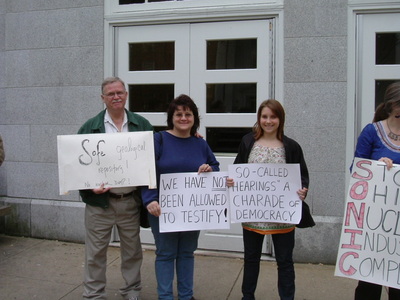
The family that protests together...: Richard, Dana, Ilona demonstrating against a nuclear dump they want to build down the road apiece. (Photo by Loraine McCosker)
In a single cry
the pheasant has swallowed
the fields of spring.
---Yamei
The real miracle is not to walk on water or thin air but to walk on the earth!
---Thich Nhat Hanh
Music is your own experience, your thoughts, your wisdom. If you don't live it, it won't come out your horn.
---Charlie Parker
I went to my dentist for the semi-annual checkup yesterday, and noticed a new product in the little bag of stuff they give you afterwards. I wisecracked to the receptionist that Listerine must be sending my doctor and his family on a cruise somewhere. She was quick to reply he never takes anything from companies except the free samples. I was happy to hear that.
Whereupon I gave her an earful about my family doctor's office. I said I hadn't been in there even once in the past 2 years (and I go maybe 3 times a year---they want to get all they can out of my insurance company) when there wasn't a drug salesperson pushing pills. These people are particularly sickening, as they try to get from the reception window into the back area to unload their suitcases full of drugs and bribe the doctors. The payoffs are free dinners, trips, and various toys to be strewn all over the place with big long names of pills on them. Undoubtedly they hope some patients will steal the toys to take home and spread the word. Free advertising. The dinners are gigantic feasts, and receptionists are encouraged to have to doctor invite all their friends if they want to. This is done in brazen broad daylight in front of a room of patients, waiting hour after hour to get that prescription.
I was in there last week, for a sprained foot I wanted X-rayed, and the drug lady was suggesting perhaps the doctors would like a new restaurant this time. Maybe one in Columbus or Parkersburg, a finer one, a richer one. The receptionist said she'd ask. "And oh!" the pusher said, "did you notice my new outfit?" She did a little swirl in front of the window. "It's color coordinated with our featured capsule!" I couldn't believe my ears. "See? The same colors as (she named the drug). Even the waistband is the color of the little separating line." I felt nauseated, and nearly stood up and let her have it. This is our health system in action, and I'm about to go in an office for treatment that will pay for this woman's salary, costume, and a doctor's free vacation courtesy of pharmaceuticals.
Maybe 20 years ago or more doctors started giving us free samples of drugs they were prescribing. I appreciated that because sometimes I was sick with flu or something, and just felt like going back to bed rather than a drug store to get medication. But since then, the practice has become obscene. Is this the free market the people in power tell us is a new religion solving the world's problems? If so, I want out! I'll gather roots and herbs in the woods before I'll take any more of this horror show. Have a look at TruthOut's article on the mess from Monday afternoon~~~
Prescription Drugs: Where's the Free Market?
By Dean Baker
t r u t h o u t Columnist
Monday 04 June 2007
For the last several years The New York Times has run articles almost every week exposing abuses by the prescription drug industry. (It had two last weekend Doctor Says Drug Maker Tried to Quash His Criticism of Avandia and After Sanctions, Doctors Get Drug Company Pay.) The stories usually document indirect payoffs to doctors for prescribing drugs, such as exorbitant speaker fees, expense-paid trips to industry-sponsored seminars at resort locations, or excessive fees for participating in clinical trials. In some cases the articles document outright kickbacks, as when the NYT reported that doctors who administer an anemia drug in their office could receive tens of thousands of dollars annually in rebates from the manufacturer.
The abuses also affect the research that is used to establish a drug's safety and effectiveness. There have been many incidents in which drug companies have concealed evidence that their drugs may not be more effective than cheaper alternatives. In some cases, they have concealed evidence of negative side effects from the public and the Food and Drug Administration. And, there is the problem that drug companies often pay researchers to sign their names to articles touting the benefits of their drugs, which the researchers did not write.
Such abuses should not be surprising to anyone who appreciates the value of a competitive market. The root cause of all of these problems is government-granted patent monopolies that allow the pharmaceutical industry to sell drugs at prices that can exceed the cost of production by a factor of a hundred, or more. Last fall, Wal-Mart began selling hundreds of generic drugs for $4 per prescription. The vast majority of brand drugs could also be profitably sold for $4 per prescription, if it were not for the patent monopoly granted by the government.
As a result of patent monopolies, drug companies can sell drugs for hundreds of dollars that cost them a few dollars to manufacture. This situation invites the sort of corruption that NYT documents regularly in its pages.
Drug patents do serve a purpose: they provide an incentive to the industry to develop new drugs. However, there are other ways in which this research can be financed. The federal government already spends nearly $30 billion a year on biomedical research conducted through the National Institutes of Health. By doubling this amount, it could probably replace the research conducted by the pharmaceutical industry, most of which currently goes to develop copycat drugs (another problem of the patent system).
As another possible alternative, Nobel Laureate Joe Stiglitz has suggested a prize system, in which the government would buy out patents at prices determined by their usefulness. The patents would then be placed in the public domain so that all new drugs could be sold as generics.
The United States spends almost $240 billion a year on prescription drugs, which comes to $800 per person. The cost of prescription drugs are a major burden to millions of low and moderate income households as well as to the government itself, which now picks up much of the tab through Medicare and Medicaid. In addition, hundreds of millions of people in the developing world are denied access to prescription drugs because they cannot afford to pay patent-protected drug prices.
The time has long passed when we should be seriously considering alternatives to patent financed research for prescription drugs. However, the power of the pharmaceutical industry has largely kept any such discussion off the political agenda.
A recent article in The Nation triggered a debate in the blogosphere as to whether the methodology of mainstream economics prevents it from considering important issues. In the case of patent financing of prescription drug research, there are no methodological issues at stake. Economists could use the exact same models that show the losses from trade barriers on shoes and shirts to quantify the much larger economic harm from patent monopolies on prescription drugs.
Unfortunately, the political force behind protection for prescription drugs is much greater than the political force behind protection for shoes and shirts. Therefore, we can look forward to reading many more articles in the NYT about abuses in the prescription drug industry.
--------------------------------------------------------------------------------
Dean Baker is the co-director of the Center for Economic and Policy Research (CEPR). He is the author of The Conservative Nanny State: How the Wealthy Use the Government to Stay Rich and Get Richer (www.conservativenannystate.org). He also has a blog, "Beat the Press," where he discusses the media's coverage of economic issues. You can find it at the American Prospect's web site.
http://www.truthout.org/docs_2006/060407D.shtml

Friday, June 01, 2007

The Divine Feminine


Offering of Fruits to Moon Goddess, 1757
Giovanni Domenico Tiepolo (b. 1727, Venezia, d. 1804, Venezia)
There is not a petal of a flower or a blade of grass that does not configure the Way.
---Bassui
Everyone wishes to have truth on his side, but not everyone wishes to be on the side of truth.
---Richard Whately
There is no end. There is no beginning. There is only the infinite passion of life.
---Federico Fellini
I have to be very careful here. Here I am offering up an article about a (The?) feminine perspective, and all the quotations up there are by guys. Is it a (The?) male perspective to explain things and solve problems, as those gentlemen are attempting? Women often respond by telling me what's wrong with my thinking and ignoring my solutions.
And of course there is a thin line between reporting and advocacy. I've had a whole life of trouble through advocating things, albeit worthwhile. Civil rights, anti-nukes, peace, organics, education and citizenship, cleaning up fraud and corruption, anti-consumerism. But of all the movements I tried to support, the feminine one has been the trickiest around which to maintain objectivity.
So I'm going to try just to report something here that I think may be significant and of interest having to do with what some call a particularly feminine outlook. Actually Cathy Holt is going to report it, so I'm hoping to get pretty much off the hook. I've subscribed to Cathy's occasional newsletter almost from the first day I got onto the Internet. Originally she wrote about natural foods and the alternative lifestyle, but from the vantage point of someone still struggling in the mainstream. That appealed to me because I try to do that. But a couple years ago, she decided to involve herself in an experimental community of people in North Carolina, who want off the grid and out of the rat race. As far as I know, there she has stayed...and while she doesn't write much about the struggles of such attempts, it seems to be going OK.
This article is a bit different, as she reports on a workshop she attended. Since most of the people who read what I send out---or at least skim through the ones with intriguing titles (before hitting delete)---have an interest in what direction the species seems to be headed, I'm hoping Cathy's effort will be helpful and inspiring toward hope!
EARTH & US: Sacred Activism
The Divine Feminine came to Asheville in the form of Jim Garrison and Andrew Harvey of Wisdom University. They electrified hundreds at a weekend workshop on Sacred Activism. Garrison is a theologian and philosopher, author of six books, and a proponent of the emerging "Wisdom Culture." Harvey is a Rumi scholar, worshipper of the Divine Feminine, and author of numerous books including The Direct Path.
"Wisdom is always collective," said Garrison. "Why is it that after billions of years, our species has brought all life to the brink of extinction?" This ability to destroy the world was seen as something only God could do, previously to our times. He reminded us of other times of collapse in history, when many thought that the end of the world had come. For example, in 14th century Europe, the plague killed one-quarter of Europe's population. The medieval order collapsed along with monarchy. However, in 1380, two councilmen from Florence reformed the educational system. Teaching children "civic humanism" may have been the spark that ignited the Renaissance, the Reformation, the Enlightenment. At moments of great duress, the feminine wisdom takes hold, Garrison believes, adding, "We are in one of those moments now."
All the movements of the sixties and seventies have now produced a body of some 60 million people which Garrison calls "the new moral majority." Quoting Dr. Paul Rahe (another professor at Wisdom University), Garrison says that Conservatives are now about 24% of the populace (and dropping), Moderns about 50%, and Cultural Creatives are about 26% and rising. Their values:
* Personal development, spiritual growth
* Environmental protection
* Community
* Social justice
Genocide is at the basis of the power of the U.S. empire. The U.S. has broken treaties and international laws under Bush; the world community now sees the U.S. as a rogue nation. It’s up to our generation to change that, by realizing our power and using it to create social change arising from collective vision and reverence for the Earth.
Andrew Harvey, who was raised in India, first experienced the divine feminine there. "Rumi is a force of the great birth in the midst of apocalypse," he said. "Unless we transform our consciousness on every level, we'll die and take most of nature with us." He believes that our false self is showing up as fundamentalism, ecological crisis, trashy mass media, techno-addiction ("the cement garden"), insane busy-ness, and psychotic denial. The Divine Mother offers transformative wisdom now, leading to the fusion of the mystic's passion for the divine and the activist's passion for justice. "The shadow of the mystic is being without doing; the shadow of the activist is acting from indignation, demonizing the opponent, and addiction to doing," Harvey declared. "The dynamic, passionate fire of love in action will transform the Earth into a garden!"
Quoting Rumi ("the voice of the birth of mystic truth"):
The tender words we said to one another
Are stored in the secret heart of heaven.
When the world is consumed with fire,
They will descend like rain
And the world will grow green with our love.
Harvey spoke of Rumi's luminous vision of creation: "each thing filled with wisdom and beauty." The profoundest courtesy of soul is due every creation, which we must respect and cherish with deep tenderness. Harvey, who is a great lover of cats, is fond of pointing out that Rumi's cat died shortly after he did, and was buried along with him.
Real birth and transformation, Harvey said, isn't all light. It's a scary process and can only arise from the death of the false self. This is the dark night of the soul which every mystic experiences, followed by the resurrection, the liberation into the power of alignment with divine compassion. "Just as soil must be broken in order to grow food, abscesses must be pierced to heal, trees are cut to build a house, and wheat is ground on the millstone, so must we purify ourselves and abandon all arrogance, burn our egos to ash, and receive the bliss of limitless existence." Such transformation comes not from intellect, but from the sacred fire.
"Passion burns down every branch of exhaustion."
– Rumi.
"Let divine passion derange and possess you," Harvey exhorted. "Marry the human nothing with the divine everything."
Harvey led us to examine our shadow and its seven aspects of fear: fear of suffering; of looking weak & emotional; of trusting our deep instincts; of overwhelming guilt; of causing pain to others (and losing their approval); of powerlessness, helplessness; and of awakening to full power and total responsibility.
The activist often has a Messiah complex, "I have to do it all." Activists may demonize their opponents, self-righteously projecting evil onto others. They may mistake stress and burnout for glory and authenticity; they may depreciate ordinary life, preferring heroics; and they may be ungrounded in spirit. Mystics, on the other hand, may be addicted to transcendent bliss, escaping from the real, believing "I need do nothing but love." They may deny the reality of evil, and even lack compassion for the suffering of others.
Owning the shadow gives us wisdom to see our "opponents" as a manifestation of ourselves. "Knowing our own darkness is the best way of dealing with the darknesses of other people," Harvey asserted. He listed seven practices to help the activist find balance.
1. Spiritual practices: "Cool" practices of meditation, mindful breathing and walking, calming and peaceful focus on the Divine; "warm" practices to keep the heart compassionate, from Christian mysticism and Mahayana Buddhism; sacred body practices to strengthen and ground oneself, such as yoga and Tai Chi.
2. Surrender the fruits of action (non-attachment). This clears the ego out of the way and prevents discouragement when results are poor. The greatest power is in surrendering to divine intention. This was true of both Jesus and Gandhi.
3. Recognize evil, face it in oneself and in society. Evil is the conscious enjoyment of destructive power. So much human intelligence has been focused on cruelty to one another.
4. Transform anger into fierce wisdom energy. This is not demonizing others, not suppressing or repressing outrage, but transforming it into wisdom and compassion. Allow anger to arise, imagine it flows out the belly and into Kali's mouth, where she breathes it into herself to transmute. She saves the pure gold and streams it back to us as fierce wisdom with compassion.
5. Do shadow work. This means seeing the other as oneself reflected, leading to heart-broken tender compassion for all beings. "Shadow work is the ultimate form of protection." We can each claim the parts of ourselves that are like George Bush, and send healing energy to those parts. "The way out of hell is to find a child of the enemy and raise him with total love."
6. Create networks of grace. Don't wait for governments and corporations to change, but network with people everywhere. Realize you can't do it alone, and that synergy, mutual sharing of insights and resources, is the only way.
7. Challenge escapist and burnt out activism. There is great joy in inspiring, uplifting and energizing people, unleashing the energy of the creative force. When we are joyful, others can't help wanting to join us.
He closed with a powerful story from the Truth and Reconciliation process in South Africa. An elderly black woman offered her love to the white man who had killed her children. When asked how that was possible, she simply said, "Jesus gave me the strength."
Cathy Holt
Stop the words now.
Open the window in the center of your chest
And let the spirits fly in and out.
- Rumi

Wednesday, May 23, 2007

Who Is Davis Mac-Iyalla And Why Is He Here?


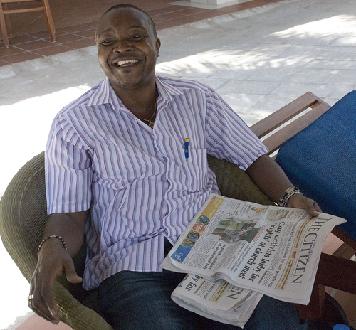
Photo of Nigerian Anglican Gay activist Davis Mac-Iyalla in Dar es Salaam, Tanzania, during the Anglican Primates' Meeting February 17, 2007. He was there to confront Peter Akinola, the Anglican Primate of All Nigeria, who has pressed for the world's most sweeping anti-Gay law. (The Rev. Scott Gunn)
Do not attempt to become Buddha.
---Dogen
Resolve to be thyself; and know that he who finds himself loses his misery.
---Matthew Arnold
The more deeply we are our true selves, the less self is in us.
---Meister Eckhart
The simple answer to the question is he has made his first visit to the United States from Togo, where he is in exile, to tell his story. It is the story of a young man born in the south of Nigeria (an important geographic distinction following civil war there some 40 years ago) who happened to get asked to run a church school and accepted. He did so with some fear because at age 14, he realized his sexual desires were for other males. In Nigeria you could go to jail if you acted on such impulses. His work at the school was so successful that it came to the attention of the Anglican bishop of the area at the time, who invited him into his administration. In 2003 Bishop Ugede died suddenly of tuberculosis. The new administration, appointed by Archbishop Peter Akinola, fired Davis and removed any priests who supported him. Within 2 years, Davis had become the center of a growing movement of gays and lesbians in Nigeria demanding rights for their way of life. Archbishop Akinola responded with support for legislation, currently pending, that will make it a crime for any citizen to associate in any way with someone identified as homosexual. The term of imprisonment will be 5 years.
That story is the simple answer. At the same time, the American branch of the Anglican Church, known as the Episcopal, consecrated a bishop in New Hampshire who is openly gay and has a partner. Within hours, Peter Akinola in Nigeria declared the overwhelming majority of archbishops and primates in the area known as the Global South would not recognize Gene Robinson as a bishop. He said the church now was in a "state of impaired communion" and declared he refused ever to be in the same room with a homosexual person. Conservative Episcopal churches in the United States have moved to support Akinola financially and even explore ways to join his diocese in Nigeria. It is possible the entire Anglican church, numbering millions of members worldwide, will divide over this issue. The Archbishop of Canterbury will make his first visit to the States since all this blew open at the end of the summer...around the time Davis will conclude his tour in California. Can this one man have any impact on the situation?
When Davis became convinced he should make himself available in the US for a speaking tour, naturally there were problems getting a visa from this country to allow him in. A call went out for individual churches to extend a formal invitation to him to speak. Among the first---and maybe the first---was from my rector, Bill Carroll, from Good Shepherd Episcopal Church here in Athens, Ohio. So it was that Davis Mac-Iyalla presented the first address of his tour here on Sunday. My personal reflections on the talk, those of my 15-year-old daughter, and press coverage of the event will follow in comments. I wanted to get something up and out right away though because of the urgency surrounding this whole situation.
He was in Columbus Tuesday and continues to Cleveland today. His itinerary still is open for invitation. Accompanying him is a writer named Josh Thomas, from Cincinnati I believe. His account of Davis' story is here [link] among other places on the Internet. A new interview with the Archbishop of Canterbury is reported here [link]

Thursday, May 17, 2007

We've Changed Earth's Climate: Now What?


That which man acquires by contemplation he should spend in love.

---Meister Eckhardt

All know that the drop merges into the ocean, but few know that the ocean merges into the drop.
---Kabir

Everybody talks about the weather, but nobody does anything about it.

---Mark Twain, August 27, 1897

Mark Twain's famous remark remained funny for about a hundred years. Then we began to wonder. With all our technology, why can't we change the weather in some places if we want to? But at the same time, gloomier forecasts were accumulating that in fact humanity, in that same hundred years of industrialization, was changing not only the weather but the very stability of the planet's current climate arrangement. We've had at least 10 years of raging argument about this, and still we have "scientists," mostly in the pay of corporations who can't find a profit motive yet, who tell us it all is too complicated for people to understand and it's better to do nothing. Most people, in the States anyway, seem to believe there's global warming or whatever we end up calling it, but feel it's too big for them to change any behavior about. I mean, what is one guy supposed to do?

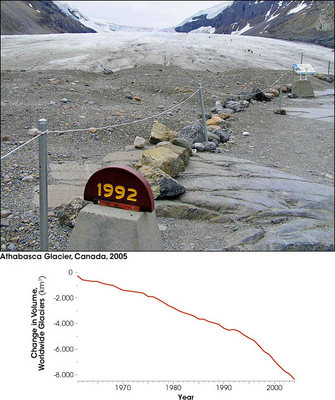
On Tuesday, the government's NASA site called Earth Observatory put up the 2005 photo you see here with this comment:

"Perhaps the most visible sign that Earth’s climate is warming is the gradual shrinking of its glaciers. In North America, the most visited glacier is the Athabasca Glacier, one of six glaciers that spill down the Canadian Rockies from the Columbia Icefield in western Canada. Visitors who return to the glacier a few years after their first visit will notice the change wrought by warming temperatures. In the past 125 years, the Athabasca Glacier has lost half of its volume and receded more than 1.5 kilometers (0.93 miles), leaving hills of rock in its place. Its retreat is visible in this photo, where the glacier’s front edge looms several meters behind the tombstone-like marker that indicates the edge of the ice in 1992. The Athabasca Glacier is not alone in its retreat: Since 1960, glaciers around the world have lost an estimated 8,000 cubic kilometers (1,900 cubic miles) of ice. That is approximately enough ice to cover a two-kilometer-wide (1.2 mile-wide) swath of land between New York and Los Angeles with an ice sheet that is one kilometer (0.62 miles) tall.

"Melting glaciers, dwindling sea ice, rising global temperatures, and rising sea levels. Little by little the evidence is adding up to show that Earth is getting hotter, and scientists are almost certain that people are to blame. A number of activities from burning fossil fuels to farming pump heat-trapping gases—greenhouse gases—into the atmosphere. Once in the atmosphere, these gases stay there for thousands of years, absorbing the heat that comes from the Earth and re-radiating it back to the surface, enhancing Earth’s natural greenhouse effect. Between 1906 and 2006, the average surface temperature of the Earth rose 0.6 to 0.9 degrees Celsius (1.08 to 1.62 degrees Fahrenheit), while greenhouse gas concentrations reached their highest levels in at least the past 650,000 years. Most climate scientists believe that there is a connection and warn that if greenhouse gas emissions continue, temperatures are likely to go up 2 to 6 degrees Celsius (3.6 to 10.8 degrees F) by the end of the 21st century.

"While this might seem like a small change, it will probably lead to big changes in the environment. Warming temperatures will likely lead to more frequent heat waves, bigger storms, including more intense tropical cyclones (hurricanes), and more widespread drought. Since water expands as it heats, and melting glaciers and ice caps have dumped more fresh water into the world’s oceans, sea levels have already started to rise. Higher sea levels lead to more erosion and greater storm damage in coastal areas, many of which are densely populated. As much as 10 percent of the world’s population lives in vulnerable coastal regions that have an elevation less than 10 meters (32 feet) above sea level."
http://earthobservatory.nasa.gov/Newsroom/NewImages/images.php3?img_id=17644

At that point, in a move not at all typical of this site---and I visit it everyday---the reader is referred to another page where begins a lengthy treatise on Global Warming. It is illustrated with many striking photos, maybe most of them taken from satellites circling the Earth. http://earthobservatory.nasa.gov/Library/GlobalWarmingUpdate/ Well, it's a dot gov site, so where's the policy? Must we wait for the dot coms to sell us stuff to solve it? How organized are all the dot orgs? Is the species finished?

Groups are beginning to meet across the land, many of them in churches, and the concern seems to be the first issue since 9/11 that crosses all political boundaries. They've spent the last year looking at the videos and DVDs and hearing the speakers, and now comes the time to figure out what to do. At just this moment, a writer named Garret Keizer from up in Vermont has gotten an essay published on the Notebook page of the June Harper's. Put his name with "climate" into Google this morning, and stand back. I think the magazine arrived in our mailbox the same day Earth Observatory put up that photo, and already the Internet is buzzing about what this guy's got to say. Essentially his message is nothing could be worse than if liberals trot out their usual package of reforms, then go back to their decks and patios overlooking the manicured sward, and end up wondering in 20 years why everything is worse than before. Harper's undoubtedly will get this essay online, but they like to wait a couple weeks so that people actually give them some money at the newsstands. Bits and pieces already are emerging in the blogs and I'll give you a taste of those excerpts in a minute. But first, who is this Keizer dude?

A fairly detailed outline of his life appeared a couple years ago in the Vermont "alternate web weekly" called Seven Days. http://www.sevendaysvt.com/features/2004/gladtohelp0.html Here we learn he grew up in New Jersey, attended the University of Vermont where he got a master's in English, and settled around Burlington, where he taught the subject in high school for 17 years. In the meantime he married a Catholic girl and, not wanting particularly to abandon his Protestant perspective, he got her to attend the Episcopal Church. They asked him to give a sermon and then to take charge of some services, and eventually the church ordained him, even though he never went to divinity school, so he could manage activities in some outlying parishes. He quit teaching partly because of all this, and his own writing became increasingly involved with morality. Christianity Today has 35 articles by him. http://ctlibrary.com/search.html?query="Garret Keizer"&x=10&y=5 In his mid 50s, Garret Keizer may find his quiet life around the Vermont town common suddenly disturbed by the kind of notoriety you get when you seriously rock the boat.

Here are some sections from his essay Climate, Class, and Claptrap~~~

This pretense of not knowing what every idiot knows has increasingly come to define our national discourse. To say, by way of example, that it has characterized the protracted denial of global warming is to understate the point. It also characterizes the burgeoning acknowledgment of global warming, the willingness to grant that a crisis exists even as our key players scramble to guarantee that every systemic cause of that crisis remains intact. It characterizes our farcical debate over the timetable for the withdrawal of US troops from Iraq even as permanent bases are constructed in that country to oversee the flow of its denationalized oil to our national snout. More than anything else, it characterizes our official take on wealth and class, a blind spot as large as any hole in the ozone. ...

...

But I shall be accused of dancing around the most important issue of our time, the issue at the name of which every knee shall bow. Global warming, we are told, will have its most devastating effects on the worlds' disadvantaged. Therefore, we need not care so particularly about the world's disadvantaged; we need only care about global warming -- as mediated, of course, by those who stand to make a bundle off it ...

...

Am I too irreverent? Am I not aware that polar bears are drowning in the Arctic? I am very much aware, and very grieved as well. I am also aware, thanks to book after book by Jonathan Kozol, that children are drowning in our inner-city schools and have been drowning there year after year and decade after decade, but I do not recall anything like the universal lament that has met the drowning scene in An Inconvenient Truth. Then again, the polar bear depicted in that movie has two incontrovertible advantages over Kozol's kids: it's digital and it's white ...

...

The intestinal tipping point came for me when a contingent of students from Middlebury College (annual tuition and fees $44,330) found both the gas money and the gall to drive to the town of Sheffield (annual per-capita income $13,277) in order to lecture the provincials on their responsibility to the earth and its myriad creatures. Not to be outdone, a small private school in our area (annual tuition and fees $76,900) has challenged the wind projects as a source of noise disturbance for its special-needs students. This could actually turn the tide. Like a bookie assessing the hindquarters of horses, I've learned to place my bets with a sharp eye on tuition and fees. Don't tell me where you went to school; just tell me what it cost.

...

Gore speaks of the need for "a different perspective" ... But this is the old perspective: the race to the moon, the triumph of the will, the forward march of progress on a goosestep and a prayer. The unquestioned belief that the answer to every human dilemma and desire is a gizmo -- in short, the very attitude that gave us global warming to begin with. Those measuring the ice shelf in Greenland would do well to spend a few weeks measuring the time that typically elapses between any mention of conservation and the quick segue to something sexier; that is, to something you can buy or sell. The abolition of obscene excess, the equitable distribution of finite resources -- these have the same appeal for our movers and shakers as adopting a crack baby has for the infertile members of their club. We have all these wonder-working technologies, all these clever schemes for producing the golden eggs -- or you could always take home little Bernice. But that's going to be a lot of work.

The bottom line here is, as always, the bottom line, already being parsed out in prospectus form for the eco-savvy investor. ... Gregg Easterbrook, writing in the April issue of The Atlantic, is less of a prig. The question he invites us to ask in regard to climate change -- "What's in it for me?" -- is "neither crass nor tongue-in-cheek," he assures us. Much of what's in it for you (that is, if you happen to be affluent, educated, etc.) will come in the form of carbon trading, a shell game allowing polluters to purchase "offsets," in green-energy production, which may or may not come to include nuclear power ...

...

Presumably this is not the same greed that inspired ExxonMobil to wage a campaign of disinformation about climate change. Presumably we might also consider redirecting the primal human impulse of hate. We could get the Ku Klux Klan to buy "offsets" for lynchings in Mississippi ... It's the Devil's old remedy: If you're being poisoned to death, try taking more poison.

...

... It is not enough to acknowledge that global warming exists; we also need to ask what global warming means. Surely one thing it means is that a culture that has as its highest aim the avoidance of anything remotely resembling physical work must change its life

... But that is only half a meaning, less than half. We're told that "that science is all in on global warming" and that it's just about unanimous. ... But the science has also been in, and in for a while, and is every bit as unanimous in concluding that we are members of a single species, descendents of common ancestors -- family in every conceivable sense of the word. How can we imagine that we will address one overwhelming consensus of scientific opinion without having acted fully on the other? ...

To put that as succinctly as possible, the days of paradise for a few are drawing to a close. The game of finding someone else in some convenient misery to fight our wards, pull our rickshaws, and serve as the offset for our every filthy indulgence is just about up. It is either Earth for all of us or hell for most of us.

...

Those excerpts are taken from a blog that Grist runs, and as of this morning there are 46 comments raging there. http://gristmill.grist.org/story/2007/5/12/02418/8290 Since other bloggers are having a similar experience, maybe a dialogue will start right here. Here's Harper's to watch for the post online http://www.harpers.org/ .

Tuesday, May 08, 2007

Death Of A Bebop Wife


In the photo Grange boards plane to meet Al. (1960)

Death Of A Bebop Wife by Grange (Lady Haig) Rutan
Published by Cadence Jazz Books, Redwood NY 13679 http://www.cadencebuilding.com/cadence/cjb.html

The modern pianist has a very special relationship with his drummer and his bassist. As his instrument has hammers, it resembles the drums; and as it has strings, it's like the bass. His position in the rhythm section is more detached, and more ambiguous than that of his partners, the bass and the drums. If he feels like it, he can stop playing for a few bars and let the bass define the harmony and the drums ensure the rhythm. He can suggest new harmonic directions, fall into step with a soloist, then break away a moment later. On again, off again. He opens or he closes. He's present at the heart of the rhythm, then suddenly he's gone.

---Laurent De Wilde
from chapter 5, p. 21

There's a scene in Grange Rutan's long-awaited book about her first husband Al Haig in which the legendary piano player introduces his young bride to Miles Davis. The men had played together with Charlie Parker in the tumultuous beginning years of bebop, and Al was pianist on one of Miles' Birth of the Cool sessions. By the summer of 1960, Miles Davis was packing in crowds at the Blackhawk in San Francisco, but Al Haig was scuffling for work. After turning down Miles' urgent invitation to sit in with the band, Al sheepishly confesses he and Grange have no place to sleep. Without hesitation, Miles reaches into his pocket and hands Al Haig the key to his dressing room. It was there, on a stained mattress in a shabby back room of a nightclub, the couple consummated their marriage. The bride looked brave, despite 2 black eyes.

Much about jazz, its artists, its working conditions, its devoted followers, and both the generosity and freakouts, is revealed in that passage. There have been many books written about the history of the music, including the death-defying years of bebop, but here's one long overdue from the perspective of a woman who loved a man who created some of it. And Grange Rutan goes beyond her own marriage of 2 1/2 years with Al Haig, into his next marriage which that girl did not survive. Rumors of murder persist to this day, and Grange presents her view as to whether Al could have done it.

Please consider, we are talking about a creator of some of the most gentle and sensitive beauty on jazz piano to come before Bill Evans. Here's a man whose daily warm-up practice involved pieces by Bach, Rachmaninoff, Ravel, Debussy, and especially Chopin. Imagine if you can Chopin playing Night In Tunisia, and you'll get the idea. With a touch as light as Teddy Wilson's, it was Al Haig that Dizzy Gillespie and Charlie Parker had to have in the group if they could get him. And shortly after, Stan Getz would launch a career of gorgeous gold to Al Haig's accompaniment. Could a quiet, dedicated artist like this hurt a woman?

What did it take in a segregated 1945 to be one of the only white men to play this music? What was required to learn the lightning twists and turns of bebop lines? Who can hum for me right now the melodies to Driftin' On A Reed or Quasimodo? I often compare learning bebop to identifying the opening movements of the Haydn symphonies by number. What does it take out of someone to do that...and to do it every night between the hours of 10 and 3 in the morning---maybe 40 minutes on and 40 minutes off---in a smoke-filled room where the audience is getting drunk...and perhaps worse?

Lady Haig, thus dubbed by Dizzy when he met and noticed her regal qualities, does not disguise the wild streak that got her hooked up with Al Haig in the first place. Living in a comfortable Presbyterian home in Montclair, New Jersey, the family nevertheless found itself close enough to the Meadow Brook Ballroom to enjoy the influence of the great dance bands of the late '30s and early '40s. As Grange became a teenager, she was listening to jazz DJs out of New York, instead of that new rock 'n roll stuff. When it came time to be out of school and at her first job, the City's where she headed and meeting jazz players was her goal. It was a risky challenge, considering she vowed to maintain purity for marriage.

While the story is gripping and all jazz fans love to hear new anecdotes about the masters of the music, it's Grange Rutan's wonderful writing style that you'll notice at once. This work of about 550 pages, including index, chronology and discography, 15 years in the writing, is like a scrapbook. There is something of a linear development, but she can't be hemmed in by a structure like that. Maybe it resembles a screenplay, that darts back and forth in time...or a conversation over lunch delightfully going every which way. Actually her style is like a jazz solo. Some of what she plays she's played before, and she relates the material over those same chord changes again and again, but then she's into new territory and trying to describe an experience one more time in a different way.

That's how it is when you remember a love from long ago. Images stick in the back of one's memory and sometimes even the sound of a "tinkling piano in the next apartment." We have both foolish and very serious things in Death of a Bebop Wife, but about one thing there is no doubt: Lady Haig has expressed to us what her heart meant. We begin, "I long to see Al's face. He's still in there and his power over me grows stronger in spite of his death. I never knew what he was going to say next. Some mornings I would wake to see his handsome head leaning on the palm of his hand, staring at me, silently crying. I just didn't know how to handle all this drama. Let me try to pull this together, not just for you but for both of us."

Saturday, May 05, 2007

The 6th Great Die-Off


Without the bitterest cold that penetrates to the very bone, how can plum blossoms send forth their fragrance to the whole world?
---Basho
Each something is a celebration of the nothing that supports it.
---John Cage
The horse's mind
Blends
So swiftly
Into the hay's mind.
---Fazil Husnu Daglarca
All the artwork is by Richard Ross.
Something like 60 years ago I spent some summertime at YMCA Camp Onyahsa on Lake Chautauqua. It was only several miles from Mom and Dad in Jamestown, New York, but I didn't thrive in the situation. The highlight of the whole experience were a couple nature hikes with a young man named Bob Sundell. The boys all called him "Bugs." He had an intensity about what you could see in Nature and how to look that was contagious. Even other boys who weren't into this whole camping thing that much were completely involved with this guy when he showed up. Off we'd go...and immediately there was a snake or a hawk---"It's a Cooper's hawk!" yelled Harold Smith, who later had to wear a ball and chain in the cafeteria because he kept trying to escape...but "Bugs" said, "Hey, that's great!" when he knew that hawk, and Harold was proud. Or there was a flash in the underbrush...so fast I didn't see what it was: a bright blur. "A redstart," "Bugs" whispered...but it was gone and hiding.
Redstarts became my favorite bird and I always wanted to see another one, even though I hadn't really seen the first one. Maybe it was "Bugs'" influence and the way he engaged us little boys. I don't think I ever saw Bob Sundell again although I often thought to look him up when I was back in my hometown. I think he's lived in Western New York all his life, teaching at a community college there and prominent with the Roger Tory Peterson Institute Ornothological Club (Peterson was from Jamestown too) and the local Audubon Society...especially the annual bird count.
The other day, down by the main creek of 3 that run through our woods, I saw another redstart. My second. It's been 60 years! I suppose if I had really gone out and looked in the meantime---made a project of it---I could have seen a bunch by now. But I don't seem to interact with Nature that way. I'm more an alert-and-see-what-pops-up sort of guy. It may be those 2 redstarts are bookends of my life, and I'd be content with that.
I never minded when neocons snarled "treehugger" at the way I feel about Nature. They've called me a lot of things in the past 40 years, but I think hugging trees is a wonderful experience. I much prefer it to knocking down every one I see. A couple weeks ago I threw a father and son off my land because they'd brought in their 4-wheelers. I did it with so much rage I frightened myself. I don't mind hunters---as long as they let me know---but I find those recreation vehicles obscene today. When I look at my neighbors and how they interact with Nature, I feel doomed.
What should I do?
And how much time do we have? Which brings me to the dire task at hand. Before today, there's always been a sense of joy or sharing or work-to-do when I've recommended information to people I know. But now I feel more like it's duty to report this. The June issue of Mother Jones magazine carries a cover story by their environmental reporter Julia Whitty. That cover is here illustrated, and the little card next to that specimen reads "Homo sapiens: -Large brain, opposable thumbs, -Primary cause of Sixth Great Extinction". After the warming and climate change, this is next and more biologists are telling us this everyday. The entire article is online and I believe was picked up by The Independent in the UK, but it's always good to support magazines at the newsstand. I'll warn you Julia begins with a graphic description of death by dehydration...but we need to know how fast it happens and after a certain point no matter how much water they give you, it won't help.

Wednesday, April 25, 2007

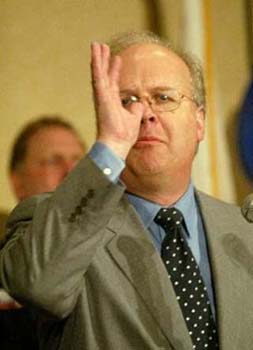
Reeling In Rove


The accumulation of all powers, legislative, executive and judiciary, in the same hands … is the definition of tyranny.

---James Madison

I know something which is known to few but is not a secret. Karl Rove is not a believer, and he doesn’t shout it from the rooftops, but when asked, he answers quite honestly. I think the way he puts it is, “I’m not fortunate enough to be a person of faith.”

---Christopher Hitchens


Rove was asked whose idea it was to start a pre-emptive war in Iraq.
"I think it was Osama bin Laden's", Rove replied.


---The Akron Beacon Journal, 4/19/07
http://www.ohio.com/mld/ohio/living/community/17102685.htm


You won't get an argument from me about the man's brilliance. I do confess wonder at how someone can enjoy the intense level of hatred expressed toward him. I've never had the control on my own anger levels enough to laugh at a person who responds extremely to my taunting. I'm uncomfortable in such a situation, but I understand there are those who love to create that tension. There must be people who adore him, such as those who come to his speeches. Does he have a family or anything like that?

Maybe we'll find out as announcement comes from the White House of the unleashing of an internal investigation by Special Counsel Scott Bloch of Mr. Rove's political shenanigans. My heart leapt with the news...at first. Then I began to wonder.

Aren't Waxman and Conyers on the verge of issuing subpoenas to get this Rove guy under oath? If he's "under investigation" by Bloch, can't he reply he's not allowed to discuss anything until the investigation concludes? Hmmm. How long did Fitzgerald take? Won't Bush Inc. be packed and ready to vacate the Oval Office by then? You know, this sounds vaguely like a Rove strategy in itself!


But now we have news this Bloch character is under investigation himself: something about punishing workers for not being loyal enough, things like that. The LA Times has the story this morning. http://www.latimes.com/technology/la-na-probe25apr25,1,1353271.story?coll=la-headlines-technology Just how chummy are Rove and Bloch I wonder?

If Rove thought this up to avoid Congressional scrutiny, what other evidence do we need of this Administration's contempt for congressional process? Why will they not engage in discussion of policies? And don't give me the wartime powers of commander in chief argument! The Bushies were like this before they invaded the Middle East.

Among the matters Congress wishes to ask Rove about are those secret email accounts. Never mind millions of messages mysteriously have been deleted---in the manner of the Nixon tapes?---what was the purpose and function of those accounts? How were the "private" Republican laptops used? Earlier in the week Bob Fitrakis asserted they were used to manipulate presidential elections. On the hard drives of those machines is the record of interactions of election fraud and the programs that were used to do it. Fitrakis names names. http://www.freepress.org/departments/display/19/2007/2553

If all this is just screwball conspiracy theory (and isn't it fun to ridicule people who think strategies actually might get planned out?) then why will not the White House answer any questions, except ones they hand themselves to friendly reporters? What is the principle that can't budge Rove? Or does he delight in thinking the opposition is just running around in circles?

Saturday, April 21, 2007

If I Hear "Robust" Once More, I'm Gonna Puke


Religion is a way of walking, not a way of talking.

---Dean William R. Inge

I have realized that the past and the future are real illusions, that they exist only in the present, which is what there is and all there is.

---Alan Watts

A Zen master's life is one continuous mistake.

---Dogen

God, how this White House loves that word! Everything they do is ROBUST. The Surge is robust, the economy is robust, our schools are SO robust, anti-abortionists are getting much more robust, and the Gun Lobby never has been so robust! Rove is just busting with robust. He and Bush are in Ohio all the time because we brim with robust!

I suspect it may have been Rove (or his people) who came up with "robust." It has the first 2 letters of his name so that satisfies egomania, and of course "bust" is in it...so he can think of breasts and milk as well as allegiance to his President. What could be better?

The only thing better would be if all Repubs use it...and they do (even when wearing the pink necktie of apology and surrender). Thursday Justice Department spokeswoman Cynthia Magnuson used it against critics who say the Executive's legal people have been using federal attorneys to wipe out the opposition. She said the department has "a completely robust record when it comes to enforcing federal voting rights laws." The Justice Department not only is robust, it's COMPLETELY robust. It's like Heaven on earth there!

I love this photograph by Doug Mills for The New York Times yesterday. There he is, the Attorney General of the United States of America, land of the free, home of the brave. The man used the "can't remember anything" approach to his testimony. At least it's more down-to-earth than the "best-of-my-recollection" song and dance other attorneys general have used. A busy man has to have people on his staff who remember things for him. I understand that. Do you suppose there is someone at Justice who remembers who is supposed to remember the content of meetings? Maybe they can search around.

In the meantime, you might take a look at Greg Gordon's article for the Baltimore Sun Thursday that contains Cynthia's robust remark...and see if you can detect any "legal" strategies in there about crushing free election. And then I guess I have to like best Lara Jakes Jordan's coverage for AP of Gonzales' pathetic appearance Thursday.

http://www.baltimoresun.com/news/nationworld/politics/bal-te.attorneys19apr19,0,23441.story?coll=bal-nationworld-headlines

http://news.yahoo.com/s/ap/20070419/ap_on_go_co/gonzales_prosecutors;_ylt=Aozse9CMyDutN1Gd4tbgjZys0NUE

Monday, April 16, 2007

What Is Self-Sufficient---And Are You?


The drawing illustrates an article in the current issue of In Character, for which Joannah Ralston is credited with design.
Man can learn nothing except by going from the known to the unknown.
---Claude Bernard
The moment one gives close attention to anything, even a blade of grass, it becomes a mysterious, awesome, indescribably magnificent world in itself.
---Henry Miller
I have been reading all day, confined to my room, and feel tired. I raise the screen and face the broad daylight. I move the chair on the veranda and look at the blue mountains. I draw a long breath, fill my lungs with fresh air and feel entirely refreshed. I make tea and drink a cup or two of it. Who would say that I am not living in the light of eternity?
---D.T. Suzuki
When I set about to look for an image to illustrate this entry, I typed the word "solitude" into the search engine. A number of paintings showed up, but surprisingly not many that were created before the Twentieth Century. A few landscapes from the late 1800's seemed to celebrate Wordsworthian romance, but in his poems too we witness the beginnings of modern isolation.
For some time I've been concerned about a gradual loss of community and neighborhood connection that has occured in my lifetime. This may not be the case everywhere or among people who have not lived the kind of life that I have. I've moved around a good deal---especially in the 1960s and 70s---and am not living in the town where I was born. I tend toward liberal ideals and am not a member of a "mega-church." More conservative folks, who can trace lineage in the same geography back several generations, may enjoy a different experience. But how many of those are there, and is their number dwindling? And what good is neighborhood anyway, if you don't want people meddling in your privacy?
Bill McKibben's article in the current issue of the journal referenced above got me wondering whether a reinvigoration of community may be a major ingredient in solving huge problems that face us planetary inhabitants today. Bill McKibben is teaching at Middlebury College currently I guess, but has lived in the Adirondack Mountain region of New York for some time. You may have read his essays in The New Yorker and other publications, usually devoted to spiritual aspects of environmental concern. He's also written a few books.
This article doesn't talk about TV, industrialization, and overpopulation, which are topics that fly to my mind immediately when I think of wanting to get away from it all and just live in the woods with a computer. Here he suggests the very goal of getting off the grid and living the life of the self-sufficient survivalist ultimately may lead nowhere.
Old MacDonald Had A Farmers’ Market – total self-sufficiency is a noble, misguided ideal
By Bill McKibben
Generations of college freshmen, asked to read Walden, have sputtered with indignation when they learned that Henry David went back to Concord for dinner with his family every week or two. He’s cheating; his grand experiment is a fraud. This outrage is a useful tactic; it prevents them from having to grapple with the most important (and perhaps the most difficult) book in the American canon, one that asks impossibly searching questions about the emptiness of a consumer economy, the vacuity of an information-soaked era. But it also points to something else: Thoreau, our apostle of solitary, individual self-reliance, out in his cabin with his hoe and his beans, the most determinedly asocial man of his time — nonetheless was immersed in his community to a degree few people today can comprehend.
Consider the sheer number of people who happened to drop by the cabin of an obscure eccentric. “I had three chairs in my house; one for solitude, two for friendship, three for society,” he writes. Often more visitors came than could sit — sometimes twenty or thirty at a time. “Half-witted men from the almshouse,” busybodies who “pried into my cupboard and bed when I was out,” a French-Canadian woodchopper, a runaway slave “whom I helped to forward toward the north star,” doctors, lawyers, the old and infirm and the timid, the self-styled reformers. It’s not that Thoreau was necessarily a cheerful host — there were visitors “who did not know when their visit had terminated, though I went about my business again, answering them from greater and greater remoteness.” Instead, it was simply a visiting age — as most of human history has been a visiting age, and every human culture a visiting culture.
Until ours. I doubt if many people reading these words have had a spontaneous visit from a neighbor in the past week — less than a fifth of Americans report visiting regularly with friends and neighbors, and the percentage is declining steadily. The number of close friends that an American claims has dropped steadily for the last fifty years too; three-quarters of us don’t know our next-door neighbors. Even the people who share our houses are becoming strangers: The Wall Street Journal reported recently that “major builders and top architects are walling off space. They’re touting one-person ‘internet alcoves,’ locked-door ‘away rooms,’ and his-and-her offices on opposite ends of the house.” The new floor plans, says the director of research for the National Association of Home Builders, are “good for the dysfunctional family.” Or, as another executive put it, these are the perfect homes for “families that don’t want anything to do with one another.” Compared to these guys, Thoreau with his three-chair cabin was practically Martha Stewart.
Every culture has its pathologies, and ours is self-reliance. From some mix of our frontier past, our Little House on the Prairie heritage, our Thoreauvian desire for solitude, and our amazing wealth we’ve derived a level of independence never seen before on this round earth. We’ve built an economy where we need no one else; with a credit card, you can harvest the world’s bounty from the privacy of your room. And we’ve built a culture much the same — the dream houses those architects build, needless to say, come with a plasma screen in every room. As long as we can go on earning good money in our own tiny niche, we don’t need a helping hand from a soul — save, of course, from the invisible hand that cups us all in its benign grip.
There are a couple of problems with this fine scenario, of course. One is: we’re miserable. Reported levels of happiness and life-satisfaction are locked in long-term one-way declines, almost certainly because of this lack of connection. Does this sound subjective and airy? Find one of the tens of millions of Americans who don’t belong to anything and convince them to join a church, a softball league, a bird-watching group. In the next year their mortality — the risk that they will die in the next year — falls by half.
The other trouble is that our self-reliance is actually a reliance on cheap fossil fuel and the economy it’s built. Take that away — either because we start to run out of oil, or because global warming forces us to stop using it in current quantities — and our vaunted independence will start to lurch like a Hummer with four flat tires. Just think for a moment about that world and then decide if you want to live on an acre all your own in the outermost ring of suburbs.
The idea of self-reliance is so deep in our psyches, however, that even when we attempt to escape from the unhappy and unsustainable cul-de-sac of our society, we’re likely to turn toward yet more “independence.” The “back-to-the-land” movement, for instance, often added the words “by myself.” Think about how proudly a certain kind of person talks about his “off-the-grid” life — he makes his own energy and grows his own food, he can deal with whatever the world throws at him. One such person may be left-wing in politics (à la Scott and Helen Nearing); another may be conservative. But they are united in their lack of need for the larger world. Not even to school their kids — they’ll take care of that as well.
Such folks are admirable, of course — they have a wide variety of skills now missing in most Americans; they’re able to amuse themselves; they work hard. But as an ideal, especially an economic ideal, that radical self-reliance strikes me as being almost as empty as the consumer society from which it dissents. Consider, for instance, the idea of growing all your own food. It’s clearly better than relying on food from thousands of miles away — from our current industrialized food economy, which figures “it’s always summer somewhere” and so orders take-out from that distant field every night of the year. Compared with that, an enormous garden and a root cellar full of all you’ll need for the winter is virtue incarnate. But if you believe in many of the (entirely plausible) horror stories about what’s to come — peak oil, climate change — then the world ends with you standing shotgun in hand above your vegetable patch, protecting your carrots from the poaching urban horde.
Contrast that with another vision, one taking shape in at least a few places around the country: a matrix of small farmers growing food for their local areas. Farmers’ markets are the fastest-growing part of our food economy, with sales showing double-digit growth annually. Partly that’s because people want good food (all kinds of people: immigrants and ethnic Americans tend to be the most avid farmers’ market shoppers). And partly it’s because they want more company. One team of sociologists reported recently that shoppers at farmers’ markets engaged in ten times more conversations per visit than customers in supermarkets. I spent the past winter eating only from my valley; a little of the food I grew myself, but the idea of my experiment was to see what remained of the agricultural infrastructure that had once supported this place. And the payoff was not only a delicious six months, but also a deep network of new friends, a much stronger sense of the cultural geography of my place.
Or consider energy. Since the 1970s, a particular breed of noble ex-hippie has been building “off-the-grid” homes, often relying on solar panels. This has been important work — they’ve figured out many of the techniques and technologies that we desperately need to get free of our climate change predicament. But the most exciting new gadget is a home-scale inverter, one that allows you to send the power your rooftop generates down the line instead of down into the basement. Where the isolated system has a stack of batteries, the grid-tied solar panel uses the whole region’s electric system as its battery: my electric meter spins merrily backward all afternoon because while the sun shines I’m a utility; then at night I draw from somewhere else. It’s a two-way flow, in the same way that the internet allows ideas to bounce in many directions.
You can do the same kind of calculation with almost any commodity. Music doesn’t need to come from Nashville or Hollywood on a small disc, for instance. But you don’t have to produce it all yourself either. More fun to join with the neighbors, to make music together or to listen to the local stars. A hundred years ago, Iowa had 1,300 opera houses. Radio doesn’t need to come from the ClearChannel headquarters in some Texas office park; new low-power FM lets valleys make their own. Even currency can become a joint local project — all it takes is the trust that underwrites any system of money. In hundreds of communities, people are trying to build that trust locally, with money that only works within the region.
Thinking this way won’t be easy. We’re used to independence as the prime virtue — so used to it that three quarters of American Christians believe the phrase “God helps those who help themselves” comes from the Bible, instead of Ben Franklin. “Love your neighbor as yourself” is harder advice, but sweeter and more sage. We don’t need to live on communes (though more and more old people are finding themselves enrolling in “retirement communities” that are gray-haired, upscale versions). But we will, I think, need to figure out how to stop relying on both oil and ourselves, and instead learn the lesson that the other primates and the other human cultures never forgot: we’re built to rely on each other.

Saturday, April 07, 2007

There Are No Conspiracies


http://www.theage.com.au/news/world/film-surfaces-to-stoke-jfk-conspiracy-theories/2007/02/20/1171733762800.html

Western laziness consists of cramming our lives with compulsive activity, so that there is no time at all to confront the real issues.

---Sogyal Rinpoche

Tu Fu comes from a saner, older, more secular culture than Homer, and it is not a new discovery with him that the gods, the abstractions, the forces of nature, are frivolous, lewd, vicious, quarrelsome, and cruel, and only men's steadfastness, love, magnanimity, calmness, and compassion redeem the night-bound world.

---Kenneth Rexroth

The search is what anyone would undertake if he were not sunk in the everydayness of his own life. To become aware of the possibility of the search is to be onto something. Not to be onto something is to be in despair.

---Walker Percy

I first became aware of the chief weapon of the new conservative around 1960. The weapon is mockery and it was used effectively against my friends and me at Bates College. The school had a requirement to attend chapel a few times a week for programs of a non-religious character---but it was a chapel of vaguely Christian architecture. You also had to take a couple religion courses and fees were collected from all students to support the Christian Association. The CA had a locked bulletin board, to which I had a key and where I used to post rather leftist material.

The emerging leaders of culture war attacked all of this. Their models and mentors appeared to be Ayn Rand and William F. Buckley Jr. Buckley particularly was on television all the time debating liberals. His method of discourse always was a sneering dismantling of the bleeding heart of concern for the downtrodden. If you are lazy and stupid you should expect to be trod upon in this life. I remember 2 hours of excruciating embarrassment as Buckley mocked out James Baldwin for his passion on civil rights. I recall Buckley concluded one of his "Firing Lines" by warning the audience America is being watched on all sides by greedy eyes in faces "upon which there are no smiles." Mockery was established firmly upon a foundation of fear.

When questions arose surrounding the assassinations of John Kennedy, Robert Kennedy, Martin Luther King, the phrase "conspiracy theorists" showed up. We learn there always will be unanswerable questions about such events carried out by lone nutcases, and if you won't accept that reality you will be mocked. Questions about 9/11 and the Twin Towers? Same deal. We don't have time for this stuff: we must put it behind us and move forward. Weapons of mass destruction. A mushroom cloud could result if we delay our preemptive war. The Christian right delivered Shock And Awe, and there was talk of Judgment Day in the Cradle of Civilization. (At this time of year, one wonders why Jesus didn't move preemptively against Judas.)

Are you concerned about the environment? You are mocked as a "treehugger." Even as evidence mounts and reports are released, the term still is thrown in derision. You can have rugged American individualism but don't rock the boat. Watergate, Enron so quickly forgotten...or rubbed out of our minds. Another conspiracy theory to be ridiculed. MobilExxon spent millions to discount global warming? What's conspiratorial about that? Didn't tobacco companies do the same thing? Federal prosecutors fired for not being "loyal Bushies." They were to "serve at the pleasure of the President"...like the rest of us.

But just maybe this fabric of 40 years of fear is beginning to unravel. I saw a T-shirt recently that announced "The biggest Government Conspiracy is that there are no conspiracies." I've always found the best way to conquer fear is, if possible, just turn on the light. If we have a Congress currently in the mood to shine brightness upon various princes of darkness, let's take some time and do it. Already much has come to light.

Recently not a week has gone by that I haven't become aware of a struggling investigative journalist somewhere who has labored for years to dig around and come up with what's really going on. Hopefully most people are aware of Lucy Komisar, but I wasn't. Here's her bio at a site called gameasoldasempire.com~~~

"Lucy Komisar is a New York–based journalist who travelled in the developing world in the 1980s and 1990s writing about movements to overthrow the despots who were running many of the countries she visited. When she talked to oppositionists in such places as the Philippines, Haiti, and Zaire, they invariably said this about their local dictator: 'He’s looted the country, stolen everything, and it’s all in Swiss banks.' The phrase was, as she discovered, shorthand for a parallel international financial system run by the world’s largest banks using secret accounts and shell companies in offshore havens like the Cayman Islands and Jersey to hide and move the money of dictators, corrupt officials, drug and people traffickers, terrorists, business fraudsters, stock manipulators, and corporate and wealthy tax cheats—and that their political power kept Western governments from acting against the system. Beginning in 1997, she shifted her focus to reportage about offshore banking. Much of what she has published over the last ten years (see www.thekomisarscoop.com) has never been published elsewhere. Based on her investigations, she is writing a book to be called Take the Money and Run Offshore."
http://www.gameasoldasempire.com/Contributors/lucy-komisar.htm

That site thekomisarscoop.com has enough in it to fill your next week! Her articles are all over the Web, chiefly at The Nation, Alternet, and she's got a book or 2. Earlier this week the Inter Press Service News Agency put up her analysis of the Bush family's banking adventures, which---surprise, surprise---involve deals with the bin Ladens, Saddam Hussein and various sheiks of Araby. Liberals have been vaguely connected with this material, but here it's all laid out and names are named~~~
http://ipsnews.net/news.asp?idnews=37213

The very next day, at the same moment Dick Cheney was on Rush Limbaugh's show (again!) to restate Saddam's love affair with Al-Qaeda, we learned of a declassified Defense Department report that declares "captured Iraqi documents and intelligence interrogations of Saddam Hussein and two former aides 'all confirmed' that Hussein's regime was not directly cooperating with al-Qaeda before the U.S. invasion of Iraq." http://www.washingtonpost.com/wp-dyn/content/article/2007/04/05/AR2007040502263.html?hpid=topnews Well, undoubtedly Cheney knew the report was coming out so, since more people listen to Rush than read newspapers, he might try lying to us again. When you have this kind of money and power, who cares what you say?

Surveys show people increasingly are beginning to get the urgency of Global Warming. Al Gore has had a lot to do with it, despite the right's continuing campaign to mock the man out of existence. The United Nations report yesterday describes disaster just around the corner, but the LA Times says the all-night session Thursday was prompted "by governments seeking to deflect calls for action. 'The science got hijacked by the political bureaucrats at the late stage of the game,' said John Walsh, a climate expert at the University of Alaska Fairbanks who helped write a chapter on the polar regions." http://www.latimes.com/news/science/la-sci-warming7apr07,0,6019103.story?coll=la-home-headlines So maybe things are even worse?

Then there's Monica Goodling. Is there some conspiracy of Monicas? Here's this lady who says she won't testify about the Gonzales prosecutor firings...and then yesterday resigned completely. Hopefully before the weekend is up, somebody will give her whatever or however much she wants and we'll have her story. In the meantime all there is is this page of alumni picnic photos from a school called Regent. http://www.regent.edu/alumni/chapters/washington_dc/DCPicnicPhotos.htm Do you suppose the happy campers all are Republicans? Goodness, they certainly do use a lot of charcoal starter! Maybe that's what's wrong with them. I don't know, a loyal Bushie always throws herself onto a live grenade...and she looks like the type.