Saturday, April 15, 2006

Easter In Lascun


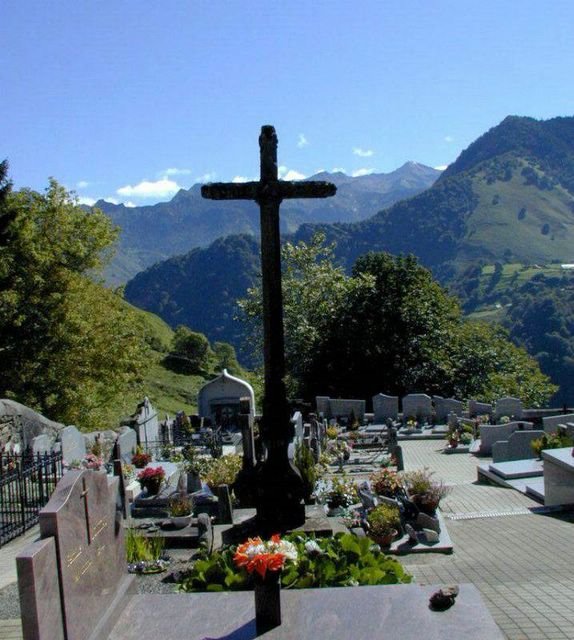
A photo of a churchyard in Lascun Posted by Picasa

How can I construct my humble hut right here in the midst of Oxford Circus? How can I do that in the confusion of cars and buses? How can I listen to the singing of birds and also to the leaping of fish? How can one turn all the showings of the shop window displays into the freshness of green leaves swayed by the morning breeze? How am I to find the naturalness, artlessness, utter self-abandonment of nature in the utmost artificiality of human works? This is the great problem set before us these days.

---D.T. Suzuki, addressing a conference of world religions in London, 1936

Let life happen to you. Believe me: life is in the right, always.

---Rainer Maria Rilke

Winter having come,
the crows perch
on the scarecrow.

---Kikaku

Ilona is in the Pyranees this Easter weekend, where snow may cover the mountaintops all the time...so Kikaku's observation may not be completely inappropriate today. Besides, the cross is something of a scarecrow too...and in the winter of our discontent the crows sit on it and caw away.

No more sermons today in this quiet day of expectation and hope---unless I can't help it. The 6:00 morning here was utter mystery. We have a new pup that Jeroch rescued, as his chain had become entangled in a bridgepost. He must have broken loose with no ID, so we've welcomed him in. We named him Jacques in honor of Ilona's school quarter in France...and that was before the vet told us he's mostly Jack Russell terrier. Down the hill he went after a herd of deer breakfasting in the meadow, waking the late risers among the bird population.

It stormed here all night with lots of rain, but thankfully little thunder and high wind and no tornadoes, at least through our land. I haven't checked the news yet, but of course we were worried given what Iowa got yesterday in the full explosion of this storm system. I think I heard the news say there were so many tornadoes in Iowa no one even could count them. I dread the next time I'll hear my rightwing friends tell me all this weather of the past couple years is a natural cycle. "People have NO effect on the climate," I heard taught in a Middle School science class this week.

The air was wonderfully clear and just a little cool. A miststeam was everywhere. The dispersing clouds revealed a brilliant Jupiter in the southwest, but the gold decoration on the cloud fringes told me the moon was just below. Sure enough, a few minutes later there she was, looking still full but rather frowzy and tired, as if she'd been kept up all night by a stormy lover. The conjunction is a magnificent moonset to look for if you're a Sunrise Service person tomorrow.

We've been missing Ilona especially as Easter approaches. She is active in the Episcopal services we attend, helping the priests...and her absence around the altar hurts. No Easter baskets this year for the first time in our marriage. Empty basket syndrome. But she called us Thursday at dawn here. Her friend Keenan's mother had arrived from Cincinnati, where she is a physician. His stepdad is an avid hiker, so off they were going to a little town of population 200 called Lescun. The place is right on the major trail that traverses the entire mountain range.

Ilona says she definitely will be in a church tomorrow morning, and I imagine the experience is going to be just amazing. We went to a service at a little church on Georgian Bay a couple years ago, and all the references were to a great tradition of fishing in the town. I wonder if the people of Lescun herd sheep or something. This is the heart of Basque country up there, and I know she is curious about that culture. O gee, I am so envious!

I think on Tuesday they're going on into Spain to Pamplona for a couple days. This is where Jeroch's friend Karin just spent the last couple months. Both girls were at DeGaulle the same day, missing each other by one hour. Then some more time at San Sebastian before returning to Pau. Maybe they'll even get to attend some school finally!

This all seems so auspicious in my life. Yeah, I've lived in big cities and loved it, but at heart I'm just a country boy who likes hearing the peepers and frogs leap and dance in the increased wetlands this morning at dawn. May this time of transition revive us all!

Saturday, April 08, 2006

How To Be A Nurse In Appalachian Ohio


Chris Mackler / Senior Photographer / cm285504@ohiou.edu
School nurse Janalee Stock administers a color blindness screening to Jared Ricadonna, a student at Morrison Elementary. Stock has been a nurse for the Athens’ City Public School system for 13 years. Stretching her skills among seven schools, Stock spends much of her work week juggling medical emergencies with everyday scrapes and bruises. Posted by Picasa

No matter how much I contemplate this tea bowl
It is still---a tea bowl!
THUS I arrive in San Francisco.

---Soen Nakagawa

At first you will think of practice as a limited part of your life. In time you will realize that everything you do is part of your practice.

---Baba Ram Dass

Living beings are numberless; I vow to serve until all are liberated.
Ignorance and grasping is boundless; I vow to transform and uproot it all.

---Vows of the Boddhisattvas

Wow, this must be the season of features about esteemed friends! I hope this auspicious Spring is the sign of a stirring and fertile change. First it was a treat to see the article in the Athens News about Elisa Young, and her struggle to farm simply down on the Ohio River in the shadow of more and more power plants crowding the territory. http://athensnews.com/index.php?action=viewarticle§ion=news&story_id=24086 The very next day, yesterday, Ohio University's daily The Post ran a front page story on Janalee Stock, whose nursing serves the Athens School District.

One becomes friends with Janalee in a very practical way. You could be doing almost anything...as long as it is a help somehow to someone else...and you look up, and there she happens to be, doing it too. It could be washing dishes after a community dinner of some kind. It could be setting up for a bake sale or selling the cookies on a street corner. It could be putting away folding chairs from a town meeting. You exchange pleasantries to ease the work, and before you know it and if you discover each other this way enough times, you're friends.

But there's a mystery of some kind to it, a spiritual quality to what Janalee does and how she does it. In the dozen years I've known her, I doubt I've ever talked to her about religious things. She even may shy away from topics like that a bit. (And I mean "shy" in a very good way.) If you say something "spiritual" to her she usually definitely gets it. Mostly she is very down to earth and practical...but in an impressively spiritual way. Let me explain that: as my mother-in-law, Esther Kuhre, and I were talking about Janalee and this article last evening at dinner, I found myself saying, "Janalee never complains." She states facts, she emphasizes goals and objectives, she plans for change...but I think she feels inherently nothing is accomplished by complaining. In fact, that activity can only be negative, spread more exhausting negativity, and ultimately alienate people with its destructiveness. And she just goes around living that way! I look at her do that, and I think, "Janalee is a miracle of some kind!" I hope you take a look at this very impressive piece and feel inspired too~~~

School nurse finds no cure for demands
Kantele Franko / City Senior Writer / kf271804@ohiou.edu

Before Athens students scuttle between buses and classrooms each morning, district school nurse Janalee Stock pulls her office into a parking space, grabs an armful of files and heads to work.

Stock, the only nurse for all seven Athens schools and their nearly 3,000 students, carries a heavy workload on the shoulders of her thin, 5-foot frame — and in her car, which doubles as an office, she said.

Her workload is close to twice that of the nurses serving in nearby districts such as Alexander, where one nurse, a health aid and a part-time AmeriCorps worker serve more than 1,600 students. Because Ohio does not mandate school health service, the 1,100-student Federal Hocking school district is one of more than 50 districts with no nurse, according to the Ohio Association of School Nurses.

A nationwide shortage of nurses is well-known among many people, but few realize how that translates to health care in the school environment, Stock said.

Healthy People 2010, a plan by federal government agencies in the late 1990s to outline national health objectives, recommended a goal ratio of one nurse per 750 students, far from the ratio Stock manages every day.

But she seems to view the challenge through rose-colored glasses – though on this particular day, her focused eyes are framed by bold blue specs.

In her absence, Stock has an AmeriCorps aide, and school staff members handle minor medical problems and call emergency responders for more serious cases. “I trust them implicitly. I have to have that trust in them,” Stock said of her helpers.

Amid her colleagues and students, the graduate of Ohio University and Hocking College has made a name for herself as much more than the band-aid lady.

“She does her job with a smile on her face and never misses a beat,” Athens Superintendent Carl Martin said. Stock even drops by periodically to check Martin’s blood pressure. “She’s just totally interested in the well-being of the students and staff,” he said.

In her thirteenth year with the schools, Stock has chosen to tackle student health risks, including obesity and AIDS, through education and preventative care.

“I’m tired of reading about it. I don’t think school can be the end-all, but I think they can be a part of it,” she said.

And she practices that preaching. The 51-year-old maintains her energy by eating healthy foods (and the occasional chocolate) and running in preparation for a triathlon she’d like to try this summer.

Like many other school nurses in Ohio, she also makes time to research news about nursing and education, including the Healthy People 2010 recommendation of one nurse per 750 students.

The OASN supports those goals but because the state’s education budget is tight, “Unless we find a way to discover some money, it’s not going to happen,” said Gail Pohlman, OASN president and school nurse for the Gallia County school district, about 40 miles south of Athens.

Improving school health care in regions of rural poverty, which keeps more families from seeing medical professionals regularly, is especially important to Pohlman. “We [school nurses] are the health care professionals that students see in Southeast Ohio,” Pohlman said.

http://thepost.baker.ohiou.edu/layout/images/2006/04/07//F2_2.jpg
Chris Mackler / Senior Photographer / cm285504@ohiou.edu
Stock and teacher’s aid Debi Chonkl plan for the care of an insulin-dependent student. Although not in her job description, Chonkl consults with the student’s family daily and monitors the student’s sugar level about 3 or 4 times during a school day. “I trust them implicitly. I have to have that trust in them,” Stock said of her helpers.

http://thepost.baker.ohiou.edu/layout/images/2006/04/07//F2_3.jpg
Chris Mackler / Senior Photographer / cm285504@ohiou.edu
Stock administers a routine vision screening to preschooler Blake Stover, a student at Chauncey Elementary School. Most Chauncey students come from a lower-income background, which increases the need to perform simple medical tasks. “I’m the parents’ first line of defense,” Stock said.

http://thepost.baker.ohiou.edu/layout/images/2006/04/07//F2_4.jpg
Chris Mackler / Senior Photographer / cm285504@ohiou.edu
Stock checks a student’s head for lice at Chauncey Elementary. Lice can be a problem in poorer parts of the school district, causing students to be out of class for weeks at a time.

http://thepost.baker.ohiou.edu/layout/images/2006/04/07//F2_5.jpg
Chris Mackler / Senior Photographer / cm285504@ohiou.edu
Stock leaves the main office of West Elementary, where her makeshift office is located, and travels downstairs with her vision machine to checkup on students’ vision. Her machine, like much of her equipment, was donated to her.

http://thepost.baker.ohiou.edu/articles/2006/04/07/features/12379.html

PS I think Katele Franko has done a wonderful job of writing---and just keeping up with Janalee's daily itinerary. But I don't think she wears blue glasses. She sure does have blue eyes though!

Wednesday, April 05, 2006

Ilona Carlson And Tom DeLay


AFP/PIERRE ANDRIEU
Après leur succès du 4 avril, les syndicats se réunissent mercredi 5 avril pour fixer une ligne commune pour les futures négociations sur le CPE. Posted by Picasa

Man is the matter of the cosmos, contemplating itself.

---Carl Sagan

Who looks outside, dreams; who looks inside, awakes.

---Carl Gustav Jung

I never look at the masses as my responsibility; I look at the individual. I can only love one person at a time---just one, one, one. So you begin. I began---I picked up one person. Maybe if I didn't pick up that one person, I wouldn't have picked up forty-two thousand.... The same thing goes for you, the same thing in your family, the same thing in your church, your community. Just begin---one, one, one.

---Mother Teresa

I feel as if I'm in a unique position this morning. Essentially I'm trying to get all the information I can on 2 stories of concern, strangely related. Of major interest to me is what's going on in France. Our daughter is completing her high school freshman year in Pau, a short distance west of Toulouse. She is a bit young to be doing this, but she is in the care of a family that is there under the auspices of Ohio University. Now in her 3rd week, and 2nd week of classes, she has made adjustments very well and seems (on the telephone) to be having a wonderful time.

I talked with her last evening (her time), and again yesterday she and her friend found most of their classes were not in session, as the teachers were participating in demonstrations downtown. Despite US State Department warnings http://travel.state.gov/travel/cis_pa_tw/pa/pa_2743.html , which I made sure they knew about, they went to the rallies both this week and last. Ilona says the "parades" have been happy, peaceful and impressive. She told me yesterday's march appeared larger than last Tuesday's, when the unions claimed 40,000 people participated in Pau...which number is half the population.

Here's a little background to this kind of situation that I learned. High school particularly is conducted rather like college here in the States. In fact, that's even the name they use for it there. Students have a schedule of classes and they show up for those...but otherwise they don't have homerooms or study halls and all that. If you don't have a class, you can go home or downtown or to a library or whatever you want. Classes are held most days from 8:30 until almost 5:00, with a lunch break of about an hour and a half. Wednesday is a half day. There are no substitute teachers in France, so if the teacher isn't there you leave.

There is a long and honored history of civic participation of French educators. It is to be expected if there is some kind of question being put to the government in public demonstration, the teachers will be there. Last Monday it even was announced at the school that probably there would be no classes the next day. This time there was no announcement, and it was up to the discretion of the teacher whether any class would occur or not. Ilona went to math and the teacher was there, so they had class.

At the demonstrations themselves, the young people are seeing a range of political expression and a quality of participation they've only heard about. Despite the kind of news coverage some media sources think satisifies the market, the reality Ilona sees is that diversity of opinion is understood and welcome. She remarked yesterday all she has to compare this with is unfavorable, namely the heckling she endured from the sidelines at a John Kerry rally. As far as I'm concerned, as an American social studies teacher for some years, I couldn't ask for a more wonderful education in representative government for this young lady.

Please notice that in these weeks of demonstrations---and the negotiations that follow each one---the government slowly and methodically is accommodating to the will of the people. Yes, a referendum eventually may be held on this issue, and indeed on the continued operation of this government entirely. These political figures are held in account by the outcry of the population. This is understood and accepted as how things are done in France. There are "hooligans" who appear AFTER the rallies and overturn cars and things...just as there are in the States. Over here, this is the kind of thing that grabs headlines...if any.

The other story I'm watching...and indeed it's hard to avoid it...is the cheerful resignation of Tom DeLay. He sees it as an important opportunity for career change. The Hammer will be working in the private sector entirely now for the continued success of the Republican Party. After all, to whom can Jack Abramoff's clients turn these days?

Progressives really are dancing with glee this morning, and some brilliant writing is happening. Most stirring to me was William Rivers Pitt's essay, entitled He's Gone, for TruthOut yesterday afternoon http://www.truthout.org/docs_2006/040406A.shtml . Teachers should read it aloud to their classes. Neverthless DeLay is leaving on his own, still calling his shots. No one has forced him, not even outraged public opinion, to do anything at all, except sit for his photograph at the indictment. I remember a Bill Moyers' NOW feature on DeLay in June of 2004, which exposed the man's funding chicanery. Moyers showed us Abramoff's casino deals in November of the same year. http://www.pbs.org/now/archive_politics.html I saw no news items elsewhere following up these stories.

And my unique position this morning is I'm looking at a republican form of government in operation in 2 different countries. In one, a people rise up to question a bill that calls into question the issue of just cause for dismissal from a job. In the other, my own, the people sit, apparently docile and mute, as issue after critical issue is paraded before them. Are Americans just too stunned or bloated to react to anything...except a sale or a new TV show? Here's a report about the Ohio Secretary of State's investment in Diebold voting machine stock. The man, having shaken off demands for legitimate recount of 2004 Presidential election results, is running for Governor. http://www.bradblog.com/archives/00002648.htm#comments Here's a report from students who spent Spring Break still trying to clear Katrina debris in New Orleans. http://www.truthout.org/docs_2006/040406R.shtml Where's the United States I studied about in my social studies classes?

Sunday, April 02, 2006

The Man In The Cave


Posted by Picasa

Only those concerned with the matter of life and death need enter here.

---Inscription on a plaque at the entrance to Eihei-Ji Monastery

The higher part of contemplation is wholly caught up in darkness and in this cloud of unknowing, with an outreaching of love and a blind groping for the naked being of God, himself and him alone.

---The Cloud Of Unknowing

Which do you think is larger, the highest mountain on earth or the pile of bones that represents the lives that you have lived over and over in every realm governed by the patterns of your own karma? Greater, my friends, is the pile of bones than the highest mountain on earth.

---The Buddha

Last weekend we met for coffee and conversation at a quiet pastry shop in Athens, with a friend we made during the 2004 election campaign. I hadn't seen Dick McGinn since the election, partly because he left pretty quick for Indonesia where his work often takes him. He's Associate Professor Emeritus of Linguistics and Southeast Asian Studies, which combination or parts thereof he directed or chaired for at least 15 years. He had emailed to suggest we get together to catch up on things political, share what groups we've gotten involved in, and see if there's any hope anywhere.

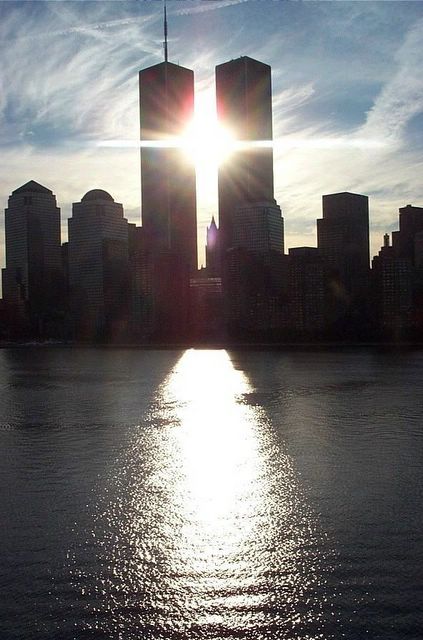
After some chitchat he brought out a folder and produced a letter he just had written to the Dean of Engineering at Brigham Young University. In it he uncovers a sort of interdepartmental feud he claims has been going on there, in which the College of Engineering and Technology publicly disavows research done by a professor of physics and astronomy in the College of Physical and Mathematical Sciences. I'm sure I'd be the last person on earth to know if some facts were wrong in a dispute like that; but our friend pointed out the issue that concerns him here has to do with academic freedom to pursue the research in the field where you have expertise...and not be bound by government grant funding politics. In this case, the BYU professor's field is metal-catalyzed fusion and his presentation is about melting metal at the World Trade Center on 9/11. http://www.physics.byu.edu/research/energy/

I knew nothing about any 9/11 conspiracy theories...and have to confess I didn't want to know. I had had enough trouble with all the assassinations in the '60s, and have ended up like the Joe Pesci character in Oliver Stone's movie about JFK: "It's all a conundrum inside an enigma," or whatever he says. The letter, and a petition to sign about release of government information on 9/11, are part of a campaign by Scholars for 9/11 Truth ( http://www.st911.org/ ), which according to a Popular Mechanics article last year is only one of 628,000 web sites about the "World Trade Center conspiracy." Google it yourself and see. Besides that, there are 3000 books on the subject. http://www.popularmechanics.com/science/defense/1227842.html

The main view seems to be the airplanes were decoys or fuses or something, but the actual collapse of the towers was a controlled demolition set earlier. Apparently there was a 3rd building in the area that came down at the same time and in the same way, which wasn't hit by any airplane at all. Some say there wasn't an airplane involved in the Pentagon blast. Then there's this passport that came fluttering down intact, found among the ashes at WTC, that supposedly was on the disintegrated body of one of the hi-jackers. It's evidence identifying Osama Bin Laden as the mastermind. So the big question is how could some guy, sitting in a cave in Afghanistan, pull all this off?

The paranoia of All The President's Men comes back easily. I hear Jason Robards' voice, as he huddles on the lawn outside his character's own home with Robert Redford and Dustin Hoffman, too cautious to talk indoors because the house is bugged. I thought about writing something on this after our talk and coffee, but decided I'd wait until the thing hit me in the face. Then comes the March 27th issue of New York: The Magazine. For those of you outside New York's direct influence, this is not The New Yorker, which has been around a lot longer. Spunky New York magazine has managed to stay in publication about 40 years though...but not usually by getting into something like 9/11. The main article is called "The Ground Zero Grassy Knoll," by Ted Jacobson, and it takes up 9 pages, with pictures, on the web. http://newyorkmetro.com/news/features/16464/index.html I started reading it, darn it, and couldn't stop.

Then this weekend, all this other news was breaking...including of course the coincidental (?) release by the New York City administration of some of the emergency phone calls from 9/11. http://www.news.com.au/story/0,10117,18675623-401,00.html And the hearings Friday to censure President Bush maybe...and John Dean's testimony. http://www.dailytimes.com.pk/default.asp?page=2006%5C04%5C02%5Cstory_2-4-2006_pg4_7 . Obviously from the links I've chosen, these stories are resounding around the globe. Do they drown out or accent the conspiracy story, I'm wondering. On Friday Doug Thompson at Capitol Hill Blue put up a post asserting the incredibility of the 9/11 conspiracy theories, and immediately drew so many comments the site became paralyzed and he had to shut down the thread. http://www.capitolhillblue.com/content/2006/03/911_conspiracy_theories_dont_p.html And then there's France: will the demonstrations quiet down or not? http://www.time.com/time/europe/magazine/article/0,13005,901060410-1179311,00.html And so here I sit, awaiting a dawn that Daylight Savings Time will make a little "later" this morning, and wondering things about the truth of it all. And I ask myself, Who's the guy in a cave? Osama or me?

Tuesday, March 28, 2006

The Scourge Of Appalachia


Beth Skabar/Athens News Photographer
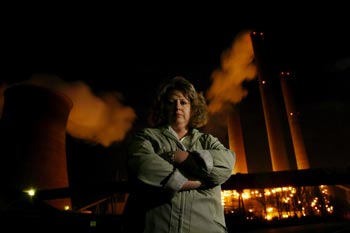
Elisa Young, a resident of Racine, Ohio, stands in front of American Electric Power's Gavin power plant, a coal fired facility in Gallia County. Young, a member of the SierraClub's executive committee, is concerned about the impact of the coal industry along the Ohio River on the health of her neighbors and the area environment. Posted by Picasa

I have deceived the Buddha
For seventy-three years;
at the end there remains only this---
What is it? What is it?

---Suio's Death Poem

Let us endeavor to live so that when we come to die, even the undertaker will be sorry.

---Mark Twain

The snow whisk,
sweeping sweeping,
forgets the snow.

---Basho

As if divinely ordained, on each side of the United States run mountain ranges known as the Appalachians and the Rockies. The symmetry of the arrangement is satisfying to an element of the American character. So far as I know there is no section of the Rocky Mountains known as Rockalalia or Rockyland or some such. But over here there's Appalachia. The exact boundaries of the region are vague and open to dispute. The mountains themselves run from Maine to Georgia, but "outsiders" tend to think of Appalachia as the place where Lil Abner and Snuffy Smith live...and the people must be poor, lazy hillbillies like them. Popular songs of the '40s gave them attributes of a-feudin', a-fussin' and a-fightin', and doin' what comes natur'ly.

It's true the people are independent, strong of opinion (and prejudice---often proud of it: witness the hilarity of redneck humor), and wary of the government and regulation. They're quick to judge whether or not someone is an "outsider" and often put up little tests to check you out---like for instance even how you pronounce the word "Appalachia." You may come from an area of Appalachia yourself, as I do, but still be considered an outsider if your family hasn't been in the region you're in now for a couple hundred years. Where I grew up we didn't think of ourselves as Appalachia because there was no mining there, and for better or worse it's the poverty left by mining that constitutes in the American mind what Appalachia is. At first, coal and timber promised a lasting livelihood, but exhaustion of reserves and technological progress quickly changed the prospects of entire communities. There are towns around where I live now that haven't had real job opportunities in 3 generations...mostly since the mines pulled out and moved on.

Now our locally owned newspaper, The Athens News, has begun a 3 part series entitled "Cradle to grave: Tracking coal's journey through Appalachia." Its author is Katie S. Brandt, an Ohio University graduate student, who comes from Vernon Hills, Illinois, north of Chicago. Even though she's probably been a student here for half a dozen years, she still might be considered an outsider. But the fact is she's been shown around by someone whose credentials are impeccable...and that's Elisa Young. Elisa lives at Racine, by the Ohio River, trying to work a farm organically that's been in the family for generations. She's surrounded by electric companies, powered by coal, that supply an astonishing array of American towns and cities. Her dilemma has become typical of people whose families have owned land in Appalachia---and increasingly everywhere in the US---which is somehow in the path of commercial development. Do you sell out or stay and fight?

To stay means Elisa needs to encourage the power companies to change their ways and clean up their act. One approach she has used in this daunting task is to lead tours of the communities along the River and down into coal country as well. Miss Brandt went on such a tour and her writing is a result. Elisa led a tour weekend before last and here is the itinerary, just to give you an idea of what goes on~~~

March 18/19 TCCT Itinerary:

Saturday March 18th
9:00 -11:30 Travel from Meigs County to Sylvester, WV.
11:30 - 2:00 Sylvester Dustbusters/Mary and Pauline's community - potluck lunch and walking tour.
2:00 - 2:30 Drive from Sylvester to Coal River Mountain Watch office in Whitesville.
2:30 - 5:00 Marshfork Elementary/CRMW - background and information on what's being done to protect the children. (CRMW will give an update on Marshfork and campaign to have new school built and other community issues, then drive down to Marshfork for people to see the school - will need to leave from Marshfork by 4:30) Can speak with CRMW and OVEC organizers in the vans on the way to and from the school.)
5:00 - 6:00 Drop organizers back off at Whitesville and head to Charleston.
6:30 Check in at Red Roof/Knights Inn. Can walk to Bob Evans (will reserve space) or other restaurants close by.
Can watch movies being brought and discuss what we've seen, or have the rest of the evening off.

Sunday, March 19th
8:00 - 9:00 Checkout/Breakfast. Will need to leave by 9:00.
9:00 - 10:00 Travel to Kayford Mountain
10:00 - 12:00 Kayford/Larry Gibson MTR tour
12:00 - 12:45 Lunch (to go ? coming through Charleston)
12:45 - 2:00 Travel to Cheshire
2:00 - 5:30 Meet at community center in Cheshire with Paul Stinson and end with community group/potluck
5:30 - 6:00 People back to their cars to travel home.

She sometimes also schedules flyovers of strip mining and mountaintop removal sites because the view from the air is the best way to comprehend what the people who live down there have to experience. Here is Katie Brandt's first article, which I'm posting online in the hopes of reaching more folks outside the area...yeah, outsiders~~~

Cradle to grave: Tracking coal's journey through Appalachia
By Katie Brandt
Athens NEWS Campus Reporter
Monday, March 27th, 2006

The stories flow from them like water down the polluted rivers where they live. But they only have each other to tell them to. Most other people don't want to know or aren't aware that places and problems like this exist.
For the people along the Ohio River and various other streams in West Virginia and southeast Ohio, though, the problems can't be ignored. For decades the windows of their homes have looked onto coal-processing or coal-burning plants that emit blue and brown plumes of smoke from their highest points. The plumes look peaceful, beautiful almost, as they trace the deep reds and pinks of a sunset sky.

That beauty fades at the realization that the blue in the smoke comes from the sulfuric acid and the brown from nitric oxide produced as byproducts from burning coal. The route the coal took to get to the plant is not so pretty either.

Some call it rape. Others call it devastation. But by whatever name, what coal companies are doing to mountains across Appalachia often wreaks havoc on the land and people. In the Appalachian coalfields, the coal industry owns more than half the rights to the coal underneath the land, and in West Virginia's top coal-producing counties, about 75 percent. Since 1981, they've strip-mined more than 500 square miles of the state, and the most efficient process has been through mountaintop removal.

To mine within the mountain, companies use dynamite to blast hundreds of feet, leveling the mountain's peak into layers from which they extract the coal. In early 2000, the West Virginia Division of Environmental Protection permitted 27,000 acres for mountaintop removal, whereas throughout the `80s, they allotted only 9,800 acres to the process.

Those who oppose such mining object to more than the aesthetic destruction from the process. When the companies block off valleys and fill them with excess rock and debris, they put the people living at the mountains' feet in danger. In the first half of this decade, valley fills had buried more than 700 miles of streams across West Virginia, and nobody is quite sure how this will affect the area's hydrology -- other than that it will be severe.

The process also clears the mountains of their natural flood barriers. Families like Maria Gunnoe's, who lives in Bob White, W.Va., with her husband and daughters, experience flooding now even during years when rain is scarce.

"In 2001 I flooded three times, and that was a year of a drought," she said. "Floods, no rain. Blue skies, sun out, and I got flooded."

Through flooding in the following years, Gunnoe lost five acres of land, including two access bridges and her septic tank, which washed into the river. The five acres swept down the river and helped cause flooding in the next town, which had to be evacuated as a result.

In case of an emergency, Gunnoe keeps two Rubbermaid bins buried in her backyard with items such as tents and garbage bags. She acknowledged that she'll be trapped if any major disaster occurs because she has lost her access bridges. Her only way to safety would be up the mountain behind her home.

"During past floods, 911 (emergency services) came by and hollered, 'Are you okay?' I hollered back, 'What if I'm not?'" Gunnoe recalled, lifting her hands to her mouth in reenactment. "I'm paying taxes for services I can't even use."

The problems don't end at the mines, though. After the coal is extracted, it goes to power plants, like those of American Electric Power along the Ohio River, that burn it for energy. Burning releases toxic byproducts that aren't closely monitored in some cases.

But what can be done? More than 50 percent of American electricity comes from coal, so to decrease its popularity, people will have to look at their own consumption habits as well as alternative energy options.
"We're all implicated in this," said coal researcher Geoff Buckley, an Ohio University associate professor of geography. "Most people don't like to know where their power comes from, but when we look at the impacts of mining, we see our own values and priorities on the land."

The mountain keeper:
From peaks to plateaus

As rays of sunlight barely visible behind thick gray clouds begin to slant lower in the sky, Larry Gibson, a compact man in his mid-50s, leans against his white pickup truck. Colorful anti-coal and pro-mountain bumper stickers coat the truck's back, and Gibson watches his large, black dog, called Dog, sniff around the lot's gravel perimeter.

Gibson is parked in the campground of houses and trailers that he and some of his family's heirs formed on Kayford Mountain, W.Va., about 45 minutes southeast of Charleston. He is waiting for the tour group he has agreed to take up the mountain. They want to see for themselves how a landscape thousands of years old has changed drastically within little more than a decade.

Massey Energy Company, the West Virginia coal empire that has fast become Gibson's arch-enemy, has found a fortune in these mountains. To obtain it, the company has acquired property rights to a handful of the mountains around Gibson's. They have systematically used a concoction of ammonium nitrate and diesel fuel to blow the tops off of each one in a 20-year-old practice of coal extraction called mountaintop removal mining. Unfortunately, scientists estimate that no more than 20 years' worth of coal remains within the mountain walls, rendering the practice that forever changes the face of these mountains useless within two decades.

And that's why Gibson has spent the last few years giving tours and speeches in attempts to draw attention to the relatively voiceless and forgotten region.

His family has lived on these mountains for more than 200 years, and now his 50 acres of land (including his family's cemetery) and the valuable coal rights have been valued at $450 million. He won't give it up without a fight, though, and he said he has seen death threats, shooting attempts and the hanging of one of his dogs -- all because he won't allow Massey access to the 40 seams of coal beneath his property.

On this day, Gibson watches the dark minivan winding up the gravel path toward him. Finally, they've arrived. "Sign this here. I want to keep track," he said, handing over a spiral-bound notebook. Across its pages, people have scribbled their signatures and hometowns. Some have come from as far away as the Middle East and South America.

Today, Gibson will take this small group of Sierra Club members and students from West Virginia and southeast Ohio to the top of Kayford Mountain, 45 minutes outside Charleston. They climb into his truck bed and struggle to keep upright as Gibson begins the steep drive up the mountain. Before reaching the top, though, he stops beside a cemetery, which clings to its survival.

The grass is yellowed here from two months of winter, and the land pockmarked from the instability that constant blasting on surrounding mountains brings. As the echoes of each blast reverberate through the ground, showers of rock and black shale fall on the cemetery. It's a two-sided assault on the land -- from above and below.

Gibson shakes his head as he passes over the uneven ground. Tilting gravestones mark the heads of some graves, and before many the ground sinks into itself as if sighing. Leaning over, Gibson points out a quarter-sized knick in one of the gravestones, attributing it to debris from the blasts. "They send people over here to pick all this up," he said. Sometimes, he said he believes the workers take the damaged gravestones too, which debris tends to knock over.

Perhaps being in the cemetery brings Gibson's mind to the recent mining tragedies in West Virginia that killed more than a dozen miners. "We've been sacrificing our people for years so others can have cheap energy," Gibson said with regard to the thousands of other Appalachians who also have died mining or from mining-related health problems through the years. "This needs to stop." He speaks slowly, his voice rising in anger cultivated from fighting large corporations and government officials who hear only what big money, which Gibson doesn't have, lets them hear.

Back in the truck, the group continues up the mountain. The few in the back bounce with each stone or rut the truck passes over. They laugh as they attempt to keep the eager Dog from crushing their laps as he repeatedly loses his balance.

From where Dog stands with his front legs lifted onto a spare tire, he can look out over the mountain. Through branches, glimpses of mountains once covered in trees now stare back. They've gone bald and flattened; the only thing covering their brownish dust now is mining equipment, such as the "continuous miner" that pulls coal from the mountain's seams and loads it instantly.

While some argue that mining companies will provide jobs for the region, coal researcher Buckley has statistics he said show otherwise.

"There's been a tremendous drop in the amount of employment," he said.

To illustrate, he pulls out charts that show coal production in Ohio on a strong rise from 1950 until its peak in 1970. During that same time, however, employment dropped 83 percent, due in large part to new machinery -- like the continuous miner that can be operated via remote control -- that makes human workers obsolete.

Elisa Young, a volunteer with the Sierra Club from Racine, Ohio, also finds fault with the economic-prosperity argument. "People come to this area to see the mountains," she said, adding that tourism is a prime example of other possible sources of income. Yet with this form of coal removal, the companies behind it are destroying that possibility.

Under the national Surface Mining Control and Reclamation Act (SMCRA), when coal companies take over an area, they are responsible for restoring the land once their work is complete. However, their practices often leave the ground so acidic that it can't support tree growth beyond three feet, and too unstable to sustain any development. Young cites a prison built on the flattened land of a mountaintop-removal site that earned the nickname "Sink-Sink" after its floors and walls sank into the ground.

Each mountain blast leaves a permanent scar on the land, and it's happening across West Virginia, Virginia, Kentucky and Pennsylvania. From the top of Gibson's mountain, the group can see only a piece of the full destruction as they look down upon the other mountains. To fully grasp it, they'd have to see the scene from the sky.

When Gibson speaks again, his words are clipped and to the point, rehearsed almost. He tells them that this mountain used to be the lowest of those around it. All that's left are brown plateaus that leave open vistas to the land that stretches out around them.

"I don't want to be rude," Gibson said, looking directly at each of them, "but if you're going to turn around and walk away from here and do nothing about this, not tell anybody what you've seen here, then I wish you had never come."

http://www.athensnews.com/index.php?action=viewarticle§ion=news&story_id=23878

Tuesday, March 21, 2006

"France---A fond au revoir"


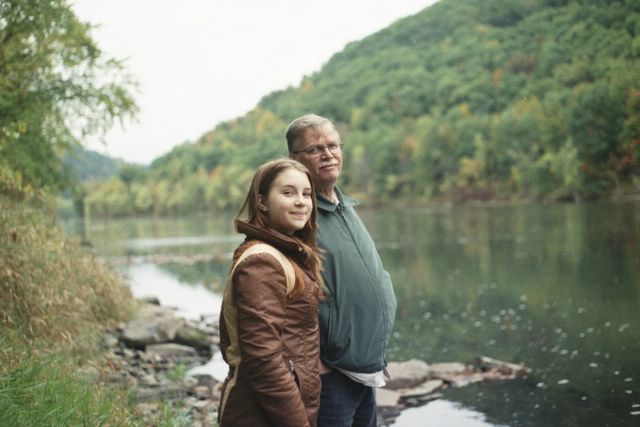
Father and daughter at the mighty Allegheny River last summer. Posted by Picasa

Please subdue the anguish of your soul. Nobody is destined only to happiness or to pain. The wheel of life takes me up and down by turn.

---Kalidasa

Eliminate something superfluous from your life.
Break a habit.
Do something that makes you feel insecure.
Carry out an action with complete attention and intensity, as if it were your last.

---Piero Ferrucci

To the mind that is still the whole universe surrenders.

---Lao Tzu

The century is soft and the year yet new in my daughter. Her 14th year half over, Air France flight 8701 begins descent at this dawning hour over Paris. For the next 80 days part of me will be here in the Ohio River Valley and part will be reaching out 6 hours ahead to Ilona living and studying in France. A few hours ago, after weeks of preparation, her mother and I entrusted her to the care of the family who invited her to go with them. There have been agonizing moments of uncertainty, but finally we committed and several hours ago wished her bon voyage. Just before we left Athens Ilona sent out this email message~~~

"Before I depart, I wanted to share with all of you my love and graciousness for your love, support, prayers and comfort as I leave for France. It has been so wonderful for me to know that I have so many people to love me. Thank you all!

"Thank you all for your support, it's helped me to take a deep breath in order to embark on this life changing and beautiful experience.

"GROS BISOUS! (=
(Big Kiss)"

The English teacher does not reach for his red pencil, impressed as he is with the Big Heart of his young lady. O she will be so changed! Already it has happened...and out of my sight and protection. She took off in an airplane for the first time. And in another hour she will go through customs into a country where her English will be merely a second language. I have Montreal with which to compare it, but her mother and I mostly must imagine everything that will be happening.

We've spent so much time trying to prepare her, but how have we prepared ourselves? We're going to have 2 weeks of adjustment and homesickness too! Fortunately we'll be getting phone calls and Instant Messages, complete with webcam, and all the intimacy technology can provide. Hopefully the pain of parting will be eased.

Things have changed at the airport. It used to be you said good-bye to your loved one as he walked through the door to the plane. Then you ran up a flight of stairs to the flight deck to wave as she climbed aboard or put her hand on the window, if she could get a seat on that side. You waited for the plane to close up and taxi out to the runway. Then you watched thrilled as off it flew.

Not any more. Now you get to Security and it's over. There was the first shock as Ilona realized this is as far as we could go. Tears and kisses. We would wait in the terminal another hour and a half until we were pretty sure that one of the airplanes taking off had to be hers...and then we'd go home. All we could do was try vaguely to squint half a mile across the airfield to where we thought the gate and plane had to be. Back and forth I went to the Departure Schedule to find out when they might be boarding, when the doors were closed, and finally when the flight disappeared from the list. The whole process required more stamina than we were prepared to endure.

The tickets had been checked as the family entered Security and moved towards the screening area. I stood on tiptoe and stretched to watch them as far as I could. At the last moment, Ilona turned to wave one more time. Our eyes met. Tears...but also bravery!

Sunday, March 12, 2006

Search For Tagliabue, Poet


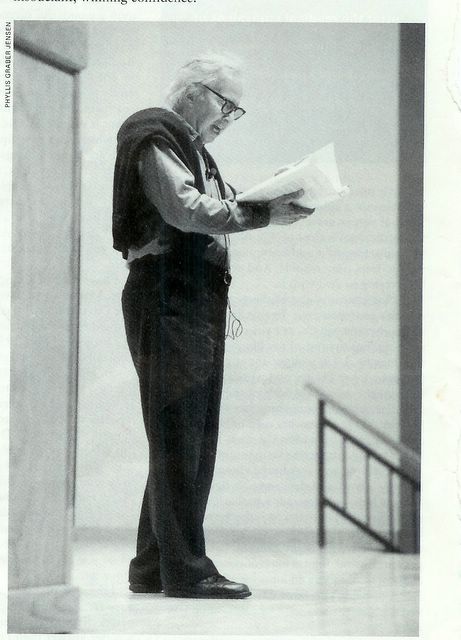
John Tagliabue in full flight of a reading, Bates College Reunion '98.Posted by Picasa

Now, what is poetry? If you say it is simply a matter of words, I will say a good poet gets rid of words. If you say it is simply a matter of meaning, I will say a good poet gets rid of meaning. "But," you ask, "without words and without meaning, where is the poetry?" To this I reply, "Get rid of words and get rid of meaning, and still there is poetry."

---Yang Wan-Li

Poetry, to the poet, is the most rewarding work in the world. A good poem is a contribution to reality. The world is never the same once a good poem has been added to it. A good poem helps to change the shape and significance of the universe, helps to extend everyone's knowledge of himself, and the world around him...

---Dylan Thomas

If there is any absolute, it is never more than this one, you, this instant, in this action.

---Charles Olson

I wonder whether friend and mentor, John Tagliabue, would agree with fellow poet Olson on that notion. I never try to corner a poet about the Absolute. I prefer to follow them about to see what spouts. Our Anglican priest in sermon today shared the Jewish blessing, "May you be covered in the dust of your rabbi!" The point is get close to your teacher, maybe especially around his feet.

At any rate, Tagliabue sent me this poem recently on sort of the same Charles Olson subject~~~

With sometimes Song
and its myriad descendents

Being
cast with the dice & the stars
there is no winning or losing but

Being

I hope you like what Dylan said about poetry up there. It always is sweet, sacred teaching when poets speak about the art and act and thought of It itself. Tagliabue said this~~~

Writing the poem is not a trouble for me, it is not a problem. When my mind-body-spirit and impulse unite, I write and that's it. It's a compulsion, it makes me feel that it makes "reality" complete, and that's all. But when later I force myself to make judgment-selection and I think what does this poem mean---it's not a natural urgent activity for me. Nevertheless it is persistent for me that after the poem is written I'd like to have it received, responded to; I'd like the poems to be read by many. I'm critical while writing---in that I'm making split second decisions, that's dramatic, part of the sense of crisis and climax---but once it's happened it's Happened. Nature has designed the quality of mercy that falls like the gentle rain from heaven; nature has designed the snowflakes; my character and my life's nature-and-needs have designed the poems; they have come they are here. This is not to say that later I think them all equally "good"; (but I do feel that it's good for me that they all happened, that they have been made; of course I do feel there is the urge-cadence-rhythm; the necessity which will and reasoning alone cannot command, and also my mind---such as it is---with its imagination and needs, making the poem). I feel writing the poems is my work, a most vital part of my life.

The Collected Poem

I didn't want it to be
an entertainment commodity
a seminar commodity
an attitude to be approved of
by this fashion or that ideology
I had no plans or programs or theories for it
but it was from my heart
of no importance
of all importance
it was not to be named or foretold
it alone gave me freedom

The strange, for me, title for this article or essay or entry is for the purpose of Google/search engine appeal. Since I began to write on the Internet, I have met the most amazing people who somehow were searching for something---often themselves---and came upon jazzoLOG. (Once and for all, there is no big deal about that name: I was trying to sign into a jazz message board a half dozen years ago, and "jazzology" already was taken: lazy dude that I am, I simply submitted the word without the "y" and it took.) The other day somebody Searched "John Tagliabue" and found me...and hopefully a letter is in the mail from that guy to John. Tagliabue is almost 83, and insists as follows~~~

If you feel like it---sure, send out any of my poems---but please not any of the "medical reports" now---

All sorts of composers, performers, play upon
us musically

We are all little victims of the genetic cosmic forces,
not only
children and adults and young friendly boys who roll on
the ground in
fits of laughter - ( remember those days ? I do.)
Victims ? anyway
forces like antic numerous gods, or fantastic
Influences in
a Javanese Puppet Play. So it goes, so we come
and go as
spectators, actors, in a wonderous unaccountable
Spectacle.
Right now in little Rhode Island there is an Immense
Blizzard
and I am writing a few phrases, this makes me feel
somewhat
like a magician; and I magically like musical
communication
and sometimes I think of you as a pianoforte.

I am writing urgently---for Search Engine identification (Hey US: "terrorism"!)---because I would like there to be a large audience for John Tagliabue's reading and/or appearance at the Concord, Massachusetts library 2 weeks from today: March 26th. http://www.eventkeeper.com/code/events.cfm?curOrg=CONCORD&ref=EK&refNote=TaF#3/26/2006 His readings are legend, and there may not be many more: phone the library before you drive over~~~

Surprises are light as can be

To release the dove
how many years of love have you
to learn from?
turn towards all the birds in the trees you've
seen, all the
green uprisings in poems and people you've known,
all the acts of
kindness friends and saints have shown, burn and
turn with the
Holy Spirit, see how Noah and Christ, whiter than
the foam, more
powerful and magnificent than Rome, have the
powers of
non-possessive love as they see you walking
on the
waters of the sea towards them.


~~~

for Krystyna Wasserman

This is what we continue to hope for

More
art
and
more
peace
and
more
play
and
more
love
to
come

John Tagliabue
November 7, 2005

Thursday, March 09, 2006

A Dual View Of No Mind


Posted by Picasa

Each second is a universe of time.

---Henry Miller

Modern civilization is largely devoted to the pursuit of the cult of delusion. There is no general information about the nature of mind. It is hardly ever written about by writers or intellectuals; modern philosophers do not speak of it directly; the majority of scientists deny it could possibly be there at all. It plays no part in popular culture: no one sings about it, no one talks about it in plays, and it's not on TV. We are actually educated into believing that nothing is real beyond what we can perceive with our ordinary senses.

---Sogyal Rinpoche
http://www.rigpa.org/

A trout leaps;
clouds are moving
in the bed of the stream.

---Onitsura

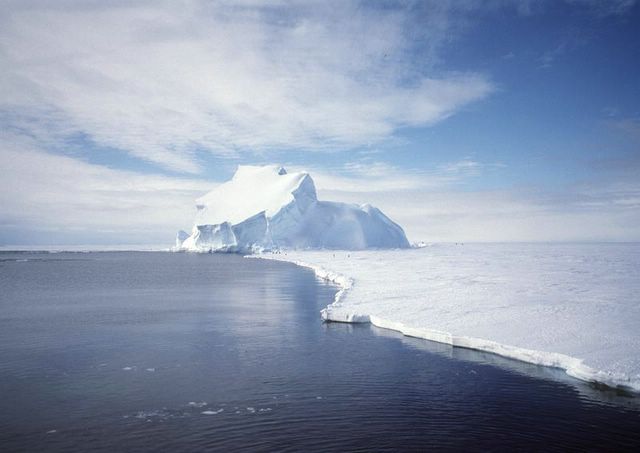
The photograph is of Earth's Shrinking Antarctic Ice Sheet and was featured yesterday as NASA's photo of the day. The explanation asks, "Is the continent at the end of the Earth slowly melting? For millions of years, Antarctica, the frozen continent at the southern end of planet Earth, has been encased in a gigantic sheet of ice. Recently, the orbiting robotic GRACE satellite has been taking sensitive measurements of the gravity for the entire Earth, including Antarctica. Recent analysis of Gravity Recovery and Climate Experiment (GRACE) data indicate that the Antarctic ice sheet might have lost enough mass to cause the worlds' oceans to rise about 1.2 millimeters, on the average, from between 2002 and 2005. Although this may not seem like much, the equivalent amount of water is about 150 trillion liters, equivalent to the amount of water used by US residents in three months. Uncertainties in the measurement make the mass loss uncertain by about 80 trillion liters. Pictured above is an iceberg that is a small part of the Antarctic ice sheet. Future research will likely focus on trying to better understand the data, take more data, predict future trends, and understand possible effects of these trends on the future climate of our entire home planet." http://antwrp.gsfc.nasa.gov/apod/ap060308.html

This article was in yesterday's Washington Post, and is by David Ignatius. His bio is down at the bottom~~~

The Planet Can't Wait
Climate Change Is Real and Must Be Addressed Now
By David Ignatius
Wednesday, March 8, 2006; A19

The warnings are coming from frogs and beetles, from melting ice and changing ocean currents, and from scientists and responsible politicians around the world. And yet what is the U.S. government doing about global warming? Nothing. That should shock the conscience of Americans.

Actually, the Bush administration's policy is worse than doing nothing. It has resisted efforts by other nations to discuss new actions that could reduce emissions of carbon dioxide before the global climate reaches a disastrous tipping point. And it muzzles administration scientists to keep them from warning about the seriousness of the issue. The administration's position is that more research is needed -- and then, as evidence grows that humans are adding to global warming, it calls for still more research.

Congress is no better. Most members apparently are waiting for permission from lobbyists and campaign contributors before getting serious about climate change. The McCain-Lieberman bill to cap emissions languishes in the Senate; Pete Domenici, the powerful chairman of the Senate Energy Committee, has issued a white paper calling for ideas for legislation, but there's no word when a bill might emerge from his committee. Meanwhile, the Senate environment committee is also claiming jurisdiction. So what we have in the Senate is a turf fight. And don't even talk about the House. Maybe members would get interested if they thought Dubai was behind global warming.

Giant corporations such as General Electric and Citigroup have concluded that global warming is real, and they are beginning to mobilize their resources to do something about it. This business activism may offer the best hope of moving government off its duff. I asked Tom Donohue, the head of the U.S. Chamber of Commerce and one of Washington's savviest political operators, when he might commit his organization's considerable clout to taking action on this issue. He's still in the "needs more study" mode, but he added, "When the time is right, we'll be as helpful as we can." Hey, Tom, the time is right.

Every week brings new evidence that global climate change is real and that it's advancing more rapidly than scientists had expected. This past week brought a report in Science that the Antarctic is losing as much as 36 cubic miles of ice a year. Last month researchers reported that glaciers in Greenland are melting twice as fast as previously estimated. One normally cautious scientist, Richard Alley, told The Post's Juliet Eilperin he was concerned about the Antarctic findings, since just five years ago scientists had been expecting more ice. "That's a wake-up call," he said. "We better figure out what's going on."

Animals don't have the luxury of ordering up more studies of global warming. Andrew Revkin of the New York Times reported in January that colorful harlequin frogs found in Latin America are dying at alarming rates because of a fungus that seems to be linked to global warming. Doug Struck explained last week in The Post that climate change is helping the ravenous mountain pine beetle devour forests in British Columbia, killing more trees than wildfires or logging. Similar findings are stacked in a depressing pile in my study that keeps getting taller.

And now we come to the Bush administration -- the folks who once warned that it would be folly to wait so long for evidence that the "smoking gun" might be a mushroom cloud. Their spirit of vigilance was applied to Iraqi weapons of mass destruction, which turned out not to exist -- but not to climate change, which does. In a meeting in Montreal last December, the chief American delegate, Harlan L. Watson, got so peeved about a proposal for new global "mechanisms" to carry out the 1992 Kyoto Protocol that he walked out. The American side relented after the wording was softened to "opportunities," and there's now at least a hope for future talks about talks about global warming.

But woe unto any administration official who becomes so concerned about global warming that he actually tries to sound the alarm. James E. Hansen, the top climate scientist at NASA, found that political minders at NASA headquarters had ordered a review of his lectures, papers, interviews and Internet postings after he called for quick reductions in greenhouse gas emissions to ease global warming. A 24-year-old former Bush campaign worker who allegedly had been involved in efforts to muzzle Hansen later resigned -- after reports surfaced that he had fudged his résumé.

Usually, America's political antics are forgivable, but not on this issue. As evidence grows that human activity is accelerating dangerous changes in the world's climate, the Bush administration's excuses for inaction are running out. History will not forgive political leaders who failed to act on this issue, and neither should voters.

davidignatius@washpost.com
© 2006 The Washington Post Company
http://www.washingtonpost.com/wp-dyn/content/article/2006/03/07/AR2006030701199.html

David Ignatius came to The Washington Post in January 1986 after spending ten years as a reporter for The Wall Street Journal. He started with the Journal in Pittsburgh, where he covered the United Steelworkers Union and the steel industry; David then moved to Washington, where he covered the Justice Department and the CIA and, briefly, the U.S. Senate; then overseas as the Journal's Middle East Correspondent; then back to Washington as chief diplomatic correspondent. While serving in this last job in 1985, David won the Edward Weintal Prize for Diplomatic Reporting.

David came to The Washington Post as editor of the Sunday Outlook section and stayed in that job for four years before becoming Foreign Editor in June 1990, just before Iraq invaded Kuwait. He became the Assistant Managing Editor of Business in January, 1993.

Born in Cambridge, MA in 1950 but raised mostly in Washington. Graduated magna cum laude from Harvard in 1973, then received a Frank Knox Fellowship from Harvard and went to King's College, Cambridge, where he received a diploma in economics in 1975. First job after school was as an editor of The Washington Monthly magazine, and has written extensively for magazines, including The New York Times Magazine, The Atlantic Monthly, Foreign Affairs, and The New Republic.

Has written five novels: Agents of Innocence, published in 1987 by W.W. Norton, SIRO, published in 1991 by Farrar Strauss & Giroux, The Bank of Fear, published in 1994 by William Morrow, A Firing Offense, published in 1997 by Random House, and The Sun King, published in 1999 by Random House. Lives in Washington with wife and three daughters.

Wednesday, March 01, 2006

Time To Impeach


Posted by Picasa

A country is not only what it does---it is also what it puts up with, what it tolerates.

---Kurt Tucholsky

Nothing the happy newspapers say can change the fact that all over India, from the biggest cities to the smallest villages, in public places and private homes, George W. Bush, the President of the United States of America, world nightmare incarnate, is just not welcome.

---Arundhati Roy

We have before us in the White House a thief who steals the country's good name and reputation for his private interest and personal use; a liar who seeks to instill in the American people a state of fear; a televangelist who engages the United States in a never-ending crusade against all the world's evil, a wastrel who squanders a vast sum of the nation's wealth on what turns out to be a recruiting drive certain to multiply the host of our enemies. In a word, a criminal—known to be armed and shown to be dangerous.

---Lewis H. Lapham

Ever since I was stopped by a fully armed, battle dressed SWAT team (which stands for Special Weapons And Tactics) http://www.newciv.org/nl/newslog.php/_v63/__show_article/_a000063-000262.htm or http://www.upsaid.com/jazzolog/archives.php?min=1094297009&max=1098535111 I realized no one catches a glimpse of this President of the United States without an invitation. The man was campaigning in a republic of supposed free election in 2004. What had become of my country? Where was my pride in being an American, the liberators in World War II, the Good Guys?

It wasn't just the War On Terra (as Molly Ivins now is calling it). Here is a leader whose anger at criticism must never be revealed to the people. He must be insulated by handlers, carefully scripted and rehearsed. Some American families have fathers like that. Mom's job is to make sure his blood pressure never flies so high that he blows a gasket. The kids grow up never learning how to negotiate problems or compromise with friends. The United States citizenry has become like that now. All we know how to do is consume. With citizenship practically dead, at least as it used to be taught to us all at home and in school, I've come to despair that anything can be done to stop the insanity of this administration.

Furthermore, the very process of impeachment, which is an effort to correct rather than indict, has become so predictable and cheapened in recent years I've hesitated to join any cries for something to begin. The Clintons were hunted with such tenacity as soon as he took federal office that it's little wonder he finally began the behaviors of a monkey in the zoo. Any mention of Republican problems and we hear about Ted Kennedy again. The Congress refuses to hold hearings about eavesdropping on the American people. So why am I writing about this and what chance is there?

Two articles by a couple of heavy hitters have stirred my hopes. The first is by Arundhati Roy and appears at present only at The Nation's website. Maybe they'll put it in the next issue of the magazine. She won the Booker Prize for The God of Small Things and War Talk, and lives in New Delhi, India, where Bush is showing up tomorrow. Her article is called Bush in India: Just Not Welcome, and is posted today~~~

On his triumphalist tour of India and Pakistan, where he hopes to wave imperiously at people he considers potential subjects, President Bush has an itinerary that's getting curiouser and curiouser.

For Bush's March 2 pit stop in New Delhi, the Indian government tried very hard to have him address our parliament. A not inconsequential number of MPs threatened to heckle him, so Plan One was hastily shelved. Plan Two was to have Bush address the masses from the ramparts of the magnificent Red Fort, where the Indian prime minister traditionally delivers his Independence Day address. But the Red Fort, surrounded as it is by the predominantly Muslim population of Old Delhi, was considered a security nightmare. http://www.alertnet.org/thenews/newsdesk/DEL115154.htm So now we're into Plan Three: President George Bush speaks from Purana Qila, the Old Fort.

Ironic, isn't it, that the only safe public space for a man who has recently been so enthusiastic about India's modernity should be a crumbling medieval fort?

Since the Purana Qila also houses the Delhi zoo, George Bush's audience will be a few hundred caged animals and an approved list of caged human beings, who in India go under the category of "eminent persons." They're mostly rich folk who live in our poor country like captive animals, incarcerated by their own wealth, locked and barred in their gilded cages, protecting themselves from the threat of the vulgar and unruly multitudes whom they have systematically dispossessed over the centuries.

So what's going to happen to George W. Bush? Will the gorillas cheer him on? Will the gibbons curl their lips? Will the brow-antlered deer sneer? Will the chimps make rude noises? Will the owls hoot? Will the lions yawn and the giraffes bat their beautiful eyelashes? Will the crocs recognize a kindred soul? Will the quails give thanks that Bush isn't traveling with Dick Cheney, his hunting partner with the notoriously bad aim? Will the CEOs agree?

Oh, and on March 2, Bush will be taken to visit Gandhi's memorial in Rajghat. http://timesofindia.indiatimes.com/articleshow/1430344.cms He's by no means the only war criminal who has been invited by the Indian government to lay flowers at Rajghat. (Only recently we had the Burmese dictator General Than Shwe, no shrinking violet himself.) But when Bush places flowers on that famous slab of highly polished stone, millions of Indians will wince. It will be as though he has poured a pint of blood on the memory of Gandhi.

We really would prefer that he didn't.

It is not in our power to stop Bush's visit. It is in our power to protest it, and we will. The government, the police and the corporate press will do everything they can to minimize the extent of our outrage. Nothing the happy newspapers say can change the fact that all over India, from the biggest cities to the smallest villages, in public places and private homes, George W. Bush, the President of the United States of America, world nightmare incarnate, is just not welcome.

http://www.thenation.com/doc/20060313/roy
Here's more about her~~~http://www.chitram.org/mallu/ar.htm

The second article has been on the stands and in subscriber mailboxes for a week. It is the centerpiece of the current issue of Harper's, and is by the magazine's editor since 1976 (with a year off in 1982). Born in 1935, Lewis H. Lapham was educated at Hotchkiss, Yale and Cambridge. He's been a newspaper reporter and magazine editor throughout his career. He's written a pile of books and reviewers liken him to Mencken, Mark Twain and even Montaigne. He writes an essay every month in Harper's, but once in a while he spreads out into a major article and the current issue is such a time. A brief excerpt from the whole thing has appeared online~~~

The Case for Impeachment
Why we can no longer afford George W. Bush
Posted on Monday, February 27, 2006.
An excerpt from an essay in the March 2006 Harper's Magazine.
By Lewis H. Lapham.

On December 18 of last year, Congressman John Conyers Jr. (D., Mich.) introduced into the House of Representatives a resolution inviting it to form “a select committee to investigate the Administration's intent to go to war before congressional authorization, manipulation of pre-war intelligence, encouraging and countenancing torture, retaliating against critics, and to make recommendations regarding grounds for possible impeachment.” Although buttressed two days previously by the news of the National Security Agency's illegal surveillance of the American citizenry, the request attracted little or no attention in the press—nothing on television or in the major papers, some scattered applause from the left-wing blogs, heavy sarcasm on the websites flying the flags of the militant right. The nearly complete silence raised the question as to what it was the congressman had in mind, and to whom did he think he was speaking? In time of war few propositions would seem as futile as the attempt to impeach a president whose political party controls the Congress; as the ranking member of the House Judiciary Committee stationed on Capitol Hill for the last forty years, Representative Conyers presumably knew that to expect the Republican caucus in the House to take note of his invitation, much less arm it with the power of subpoena, was to expect a miracle of democratic transformation and rebirth not unlike the one looked for by President Bush under the prayer rugs in Baghdad. Unless the congressman intended some sort of symbolic gesture, self-serving and harmless, what did he hope to prove or to gain? He answered the question in early January, on the phone from Detroit during the congressional winter recess.

“To take away the excuse,” he said, “that we didn't know.” So that two or four or ten years from now, if somebody should ask, “Where were you, Conyers, and where was the United States Congress?” when the Bush Administration declared the Constitution inoperative and revoked the license of parliamentary government, none of the company now present can plead ignorance or temporary insanity, can say that “somehow it escaped our notice” that the President was setting himself up as a supreme leader exempt from the rule of law.

A reason with which it was hard to argue but one that didn't account for the congressman's impatience. Why not wait for a showing of supportive public opinion, delay the motion to impeach until after next November's elections? Assuming that further investigation of the President's addiction to the uses of domestic espionage finds him nullifying the Fourth Amendment rights of a large number of his fellow Americans, the Democrats possibly could come up with enough votes, their own and a quorum of disenchanted Republicans, to send the man home to Texas. Conyers said:

“I don't think enough people know how much damage this administration can do to their civil liberties in a very short time. What would you have me do? Grumble and complain? Make cynical jokes? Throw up my hands and say that under the circumstances nothing can be done? At least I can muster the facts, establish a record, tell the story that ought to be front-page news.”

Which turned out to be the purpose of his House Resolution 635—not a high-minded tilting at windmills but the production of a report, 182 pages, 1,022 footnotes, assembled by Conyers's staff during the six months prior to its presentation to Congress, that describes the Bush Administration's invasion of Iraq as the perpetration of a crime against the American people. It is a fair description. Drawing on evidence furnished over the last four years by a sizable crowd of credible witnesses—government officials both extant and former, journalists, military officers, politicians, diplomats domestic and foreign—the authors of the report find a conspiracy to commit fraud, the administration talking out of all sides of its lying mouth, secretly planning a frivolous and unnecessary war while at the same time pretending in its public statements that nothing was further from the truth.[1] The result has proved tragic, but on reading through the report's corroborating testimony I sometimes could counter its inducements to mute rage with the thought that if the would-be lords of the flies weren't in the business of killing people, they would be seen as a troupe of off-Broadway comedians in a third-rate theater of the absurd. Entitled “The Constitution in Crisis; The Downing Street Minutes and Deception, Manipulation, Torture, Retribution, and Coverups in the Iraq War,” the Conyers report examines the administration's chronic abuse of power from more angles than can be explored within the compass of a single essay. The nature of the administration's criminal DNA and modus operandi, however, shows up in a usefully robust specimen of its characteristic dishonesty.

* * *

That President George W. Bush comes to power with the intention of invading Iraq is a fact not open to dispute. Pleased with the image of himself as a military hero, and having spoken, more than once, about seeking revenge on Saddam Hussein for the tyrant's alleged attempt to “kill my Dad,” he appoints to high office in his administration a cadre of warrior intellectuals, chief among them Secretary of Defense Donald Rumsfeld, known to be eager for the glories of imperial conquest.[2] At the first meeting of the new National Security Council on January 30, 2001, most of the people in the room discuss the possibility of preemptive blitzkrieg against Baghdad.[3] In March the Pentagon circulates a document entitled “Foreign Suitors for Iraqi Oil Field Contracts”; the supporting maps indicate the properties of interest to various European governments and American corporations. Six months later, early in the afternoon of September 11, the smoke still rising from the Pentagon's western facade, Secretary Rumsfeld tells his staff to fetch intelligence briefings (the “best info fast...go massive; sweep it all up; things related and not”) that will justify an attack on Iraq. By chance the next day in the White House basement, Richard A. Clarke, national coordinator for security and counterterrorism, encounters President Bush, who tells him to “see if Saddam did this.” Nine days later, at a private dinner upstairs in the White House, the President informs his guest, the British prime minister, Tony Blair, that “when we have dealt with Afghanistan, we must come back to Iraq.”

By November 13, 2001, the Taliban have been rousted out of Kabul in Afghanistan, but our intelligence agencies have yet to discover proofs of Saddam Hussein's acquaintance with Al Qaeda.[4] President Bush isn't convinced. On November 21, at the end of a National Security Council meeting, he says to Secretary Rumsfeld, “What have you got in terms of plans for Iraq?...I want you to get on it. I want you to keep it secret.”

The Conyers report doesn't return to the President's focus on Iraq until March 2002, when it finds him peering into the office of Condoleezza Rice, the national security advisor, to say, “Fuck Saddam. We're taking him out.” At a Senate Republican Policy lunch that same month on Capitol Hill, Vice President Dick Cheney informs the assembled company that it is no longer a question of if the United States will attack Iraq, it's only a question of when. The vice president doesn't bring up the question of why, the answer to which is a work in progress. By now the administration knows, or at least has reason to know, that Saddam Hussein had nothing to do with the 9/11 attacks on New York and Washington, that Iraq doesn't possess weapons of mass destruction sufficiently ominous to warrant concern, that the regime destined to be changed poses no imminent threat, certainly not to the United States, probably not to any country defended by more than four batteries of light artillery. Such at least is the conclusion of the British intelligence agencies that can find no credible evidence to support the theory of Saddam's connection to Al Qaeda or international terrorism; “even the best survey of WMD programs will not show much advance in recent years on the nuclear, missile and CW/BW weapons fronts...” A series of notes and memoranda passing back and forth between the British Cabinet Office in London and its correspondents in Washington during the spring and summer of 2002 address the problem of inventing a pretext for a war so fondly desired by the Bush Administration that Sir Richard Dearlove, head of Britain's MI-6, finds the interested parties in Washington fixing “the intelligence and the facts...around the policy.” The American enthusiasm for regime change, “undimmed” in the mind of Condoleezza Rice, presents complications.

Although Blair has told Bush, probably in the autumn of 2001, that Britain will join the American military putsch in Iraq, he needs “legal justification” for the maneuver—something noble and inspiring to say to Parliament and the British public. No justification “currently exists.” Neither Britain nor the United States is being attacked by Iraq, which eliminates the excuse of self-defense; nor is the Iraqi government currently sponsoring a program of genocide. Which leaves as the only option the “wrong-footing” of Saddam. If under the auspices of the United Nations he can be presented with an ultimatum requiring him to show that Iraq possesses weapons that don't exist, his refusal to comply can be taken as proof that he does, in fact, possess such weapons.[5]

Over the next few months, while the British government continues to look for ways to “wrong-foot” Saddam and suborn the U.N., various operatives loyal to Vice President Cheney and Secretary Rumsfeld bend to the task of fixing the facts, distributing alms to dubious Iraqi informants in return for map coordinates of Saddam's monstrous weapons, proofs of stored poisons, of mobile chemical laboratories, of unmanned vehicles capable of bringing missiles to Jerusalem.[6]

By early August the Bush Administration has sufficient confidence in its doomsday story to sell it to the American public. Instructed to come up with awesome text and shocking images, the White House Iraq Group hits upon the phrase “mushroom cloud” and prepares a White Paper describing the “grave and gathering danger” posed by Iraq's nuclear arsenal.[7] The objective is three-fold—to magnify the fear of Saddam Hussein, to present President Bush as the Christian savior of the American people, a man of conscience who never in life would lead the country into an unjust war, and to provide a platform of star-spangled patriotism for Republican candidates in the November congressional elections.[8]

* * *

The Conyers report doesn't lack for further instances of the administration's misconduct, all of them noted in the press over the last three years—misuse of government funds, violation of the Geneva Conventions, holding without trial and subjecting to torture individuals arbitrarily designated as “enemy combatants,” etc.—but conspiracy to commit fraud would seem reason enough to warrant the President's impeachment. Before reading the report, I wouldn't have expected to find myself thinking that such a course of action was either likely or possible; after reading the report, I don't know why we would run the risk of not impeaching the man. We have before us in the White House a thief who steals the country's good name and reputation for his private interest and personal use; a liar who seeks to instill in the American people a state of fear; a televangelist who engages the United States in a never-ending crusade against all the world's evil, a wastrel who squanders a vast sum of the nation's wealth on what turns out to be a recruiting drive certain to multiply the host of our enemies. In a word, a criminal—known to be armed and shown to be dangerous. Under the three-strike rule available to the courts in California, judges sentence people to life in jail for having stolen from Wal-Mart a set of golf clubs or a child's tricycle. Who then calls strikes on President Bush, and how many more does he get before being sent down on waivers to one of the Texas Prison Leagues?

* * *

Notes
1. The report borrows from hundreds of open sources that have become a matter of public record—newspaper accounts, television broadcasts (Frontline, Meet the Press, Larry King Live, 60 Minutes, etc.), magazine articles (in The New Yorker, Vanity Fair, The New York Review of Books), sworn testimony in both the Senate and House of Representatives, books written by, among others, Bob Woodward, George Packer, Richard A. Clarke, James Mann, Mark Danner, Seymour Hersh, David Corn, James Bamford, Hans Blix, James Risen, Ron Suskind, Joseph Wilson. As the congressman had said, “Everything in plain sight; it isn't as if we don't know.”

2. In January of 1998 the neoconservative Washington think tank The Project for the New American Century (which counts among its founding members Dick Cheney) sent a letter to Bill Clinton demanding “the removal of Saddam Hussein's regime from power” with a strong-minded “willingness to undertake military action.” Together with Rumsfeld, six of the other seventeen signatories became members of the Bush's first administration—Elliott Abrams (now George W. Bush's deputy national security advisor), Richard Armitage (deputy secretary of state from 2001 to 2005), John Bolton (now U.S. ambassador to the U.N.), Richard Perle (chairman of the Defense Policy Board from 2001 to 2003), Paul Wolfowitz (deputy secretary of defense from 2001 to 2005), Robert Zoellick (now deputy secretary of state). President Clinton responded to the request by signing the Iraq Liberation Act, for which Congress appropriated $97 million for various clandestine operations inside the borders of Iraq. Two years later, in September 2000, The Project for the New American Century issued a document noting that the “unresolved conflict with Iraq provides the immediate justification” for the presence of the substantial American force in the Persian Gulf.

3. In a subsequent interview on 60 Minutes, Paul O'Neill, present in the meeting as the newly appointed secretary of the treasury, remembered being surprised by the degree of certainty: “From the very beginning, there was a conviction that Saddam Hussein was a bad person and that he needed to go.... It was all about finding a way to do it.”

4. As early as September 20, Douglas Feith, undersecretary of defense for policy, drafted a memo suggesting that in retaliation for the September 11 attacks the United States should consider hitting terrorists outside the Middle East in the initial offensive, or perhaps deliberately selecting a non-Al Qaeda target like Iraq.

5. Abstracts of the notes and memoranda, known collectively as “The Downing Street Minutes,” were published in the Sunday Times (London) in May 2005; their authenticity was undisputed by the British government.

6. The work didn't go unnoticed by people in the CIA, the Pentagon, and the State Department accustomed to making distinctions between a well-dressed rumor and a naked lie. In the spring of 2004, talking to a reporter from Vanity Fair, Greg Thielmann, the State Department officer responsible for assessing the threats of nuclear proliferation, said, “The American public was seriously misled. The Administration twisted, distorted and simplified intelligence in a way that led Americans to seriously misunderstand the nature of the Iraq threat. I'm not sure I can think of a worse act against the people in a democracy than a President distorting critical classified information.”

7. The Group counted among its copywriters Karl Rove, senior political strategist, Andrew Card, White House chief of staff, National Security Advisor Condoleezza Rice, and Lewis “Scooter” Libby, Dick Cheney's chief of staff.

8. Card later told the New York Times that “from a marketing point of view...you don't introduce new products in August.”

http://www.harpers.org/TheCaseForImpeachment.html

Tomorrow evening at 8:00, Harper's is sponsoring a Public Forum entitled Is There A Case For Impeachment? It will be at Town Hall in New York City, and there is a charge of $10 for a seat. Participants will be Mr. Lapham, Representative John Conyers, Michael Ratner, Elizabeth Holtzman, and John Dean. I imagine a transcript will be published in next month's Harper's, but I'll try to watch for signs of it before then. Hopefully some New York friend will go and write me a review.

Friday, February 17, 2006

Rule By Executive Order


Posted by Picasa

The wonderful thing about Zen practice is that you get to do it whether you like it or not.

---Zen saying

When we are not sure, we are alive.

---Graham Greene

I lay on the bowsprit, with the water foaming into spume under me, the masts with every sail white in the moonlight towering above me. I became drunk with the beauty and singing rhythm of it, and for a moment lost myself---actually lost my life. I was set free...dissolved in the sea, became white sails and flying spray, became beauty and rhythm and the high dim-starred sky....I belonged within a unity and joy to life itself.

---Eugene O'Neill

I do not want to talk about the hunting weekend. As Joel Achenbach says the incident already has had more coverage than the landing at Normandy. What interests me are the final moments of the Britt Hume interview Wednesday on SweetMother Fox:

Q On another subject, court filings have indicated that Scooter Libby has suggested that his superiors -- unidentified -- authorized the release of some classified information. What do you know about that?

THE VICE PRESIDENT: It's nothing I can talk about, Brit. This is an issue that's been under investigation for a couple of years. I've cooperated fully, including being interviewed, as well, by a special prosecutor. All of it is now going to trial. Scooter is entitled to the presumption of innocence. He's a great guy. I've worked with him for a long time, have enormous regard for him. I may well be called as a witness at some point in the case and it's, therefore, inappropriate for me to comment on any facet of the case.

Q Let me ask you another question. Is it your view that a VicePresident has the authority to declassify information?

THE VICE PRESIDENT: There is an executive order to that effect.

Q There is.

THE VICE PRESIDENT: Yes.

Q Have you done it?

THE VICE PRESIDENT: Well, I've certainly advocated declassification and participated in declassification decisions. The executive order --

Q You ever done it unilaterally?

THE VICE PRESIDENT: I don't want to get into that. There is an executive order that specifies who has classification authority, and obviously focuses first and foremost on the President, but also includes the Vice President.http://blogs.suntimes.com/sweet/2006/02/_cheney_im_the_guy_who_pulled.html

Fortunately Pete Yost, of the Associated Press, picked up on the comment yesterday...but I hardly notice the nation reeling from this announcement. Here's his account...but stick with me: I've got more questions about this~~~ http://news.yahoo.com/s/ap/20060216/ap_on_go_ca_st_pe/cheney_cia_leak;_ylt=AhYQ2.uKi46eNy37deHuedas0NUE;_ylu=X3oDMTA3OXIzMDMzBHNlYwM3MDM-

Cheney Says He Can Declassify Secrets
By PETE YOST, Associated Press Writer
Thu Feb 16, 8:36 AM ET

Vice President Dick Cheney says he has the power to declassify government secrets, raising the possibility that he authorized his former chief of staff to pass along sensitive prewar data on Iraq to reporters.

Cheney coupled his statement in a TV interview Wednesday with an endorsement of I. Lewis "Scooter" Libby, his ex-aide. Libby is under indictment on charges of perjury, obstruction and lying to the FBI about disclosing the identity of undercover CIA officer Valerie Plame.

"Scooter is entitled to the presumption of innocence," Cheney told Fox News Channel. "He is a great guy. I worked with him for a long time. I have tremendous regard for him. I may well be called as a witness at some point in the case, and it is therefore inappropriate for me to comment on any facet of the case."

In a recent court filing, Special Counsel Patrick Fitzgerald revealed Libby's assertions to a grand jury that superiors had authorized him to spread sensitive information from a National Intelligence Estimate. The administration used the NIE assessment on Iraq and weapons of mass destruction as part of its justification for going to war.

At the time of Libby's contacts with reporters in June and July 2003, the administration, including Cheney, who was among the war's most ardent proponents, faced growing criticism.

No weapons of mass destruction had been found in Iraq, and Bush supporters were anxious to show that the White House had relied on prewar intelligence projecting a strong threat from such weapons.

Fitzgerald did not specify which superiors Libby may have been referring to when he testified that higher-ups had authorized him to spread sensitive information.

But in the interview, Cheney said an executive order gives him, and President Bush, power to declassify information.

"I have certainly advocated declassification. I have participated in declassification decisions," Cheney said. Asked for details, he said, "I don't want to get into that. There's an executive order that specifies who has classification authority, and obviously it focuses first and foremost on the president, but also includes the vice president."

Libby is not charged with leaking classified information, and his lawyers said last week that there was no truth to a published report that they had advised the court or prosecutors that Libby will raise a defense based on authorization by superiors.

A legal expert said Cheney's comments could nonetheless foreshadow a Libby defense.

Former Whitewater independent counsel Robert Ray said, "If the focus is off the defendant and on to somebody else, generally for the defense that's a good day. If it turns out that Cheney was actively involved in decisions related to the disclosure of a CIA officer's identity and if the truth of it is that he was orchestrating the disclosure of information to the media, it seems to me that's a fundamentally different case than one centered around the activities of Libby."

The indictment against Libby says Cheney advised his chief of staff on June 12, 2003, that the wife of Bush administration critic and former U.S. Ambassador Joseph Wilson worked at the CIA in the counterproliferation division.

Libby understood that the vice president had learned this information from the CIA, according to the indictment, which says Libby also learned of Wilson's wife's identity from the CIA and the State Department.

On July 14, 2003, the CIA identity of Valerie Plame — the maiden name of Wilson's wife — was published by columnist Robert Novak. Eight days earlier, Wilson had accused the administration of twisting prewar intelligence to exaggerate the Iraqi threat. Wilson concluded it was highly doubtful that a purported sale of uranium yellowcake by Niger to Iraq in the late 1990s had ever taken place.

Libby was indicted last October on five counts of perjury, obstruction and lying to the FBI about how he learned of Plame's identity and what he told reporters about it.

A defense that Libby was authorized to leak sensitive data about Iraq would not appear to provide any defense against the charge of making false statements regarding Plame.

But some lawyers pointed out that setting up defenses before a jury involve more than simply constructing legal arguments.

An authorization defense in the CIA leak case would mean that "much of what Libby was trying to do was aid and protect his boss Cheney," Ray suggested. The downside to employing such an approach is that it "almost comes with a defense that I did it."

Copyright © 2006 The Associated Press.

My first question is What Executive Order is that, and who issued it? Yeah, maybe the Executive should be the one to declassify documents in his jurisdiction, but does it sound like America to you if he also declares himself to have the right to do it? Shouldn't that be something the Congress or Supreme Court would do?

Let's say a law exists on the books. The law was written by Congress and signed by the President. What if it says it's illegal to identify a covert CIA operative? Can the Executive or Vice Executive declassify information that thereby reveals such an identity without breaking that law? Can an Executive issue any Order he wants...and expect it to supercede the law of the land? Is that where we are?

I have to confess I dropped out of the only course in Constitutional Law I ever attempted in graduate school. So where can a guy like me find out about Executive Orders...and this one in particular? After 3 hours of sifting through all the questions about Cheney's shooting itself (What were those guys doing on a remote ranch with a couple of women on Valentine's Weekend without their spouses? How drunk were they? Who else has been hit by birdshot at that supposed range, what was it like, and how many layers of clothing did it go through? How close would you have to be to hit just that area of face and shoulder...and to get the shot floating through the bloodstream and into the heart? Is Whittington actually dead and the guy in the hospital an imposter?), I found that "georgia10" at Daily Kos was on top of it. http://www.dailykos.com/story/2006/2/16/104857/925

"The Executive's authority to classify or declassify information does not come from Congressional statute. Rather, Presidents have long held that it is part of the President's inherent authority. Courts have concurred.

"In 1951, President Truman signed Executive Order 10290 (pdf), the President relied on his Constitutional authority as President of the United States to enact a classification scheme. Such language has been included in classification orders since then.

"In Department of Navy v. Egan, 484 U.S. 518 (1988), the Supreme Court stated in its dicta that the authority to control access to sensitive information is vested in the President of the United States. Accordingly, an argument can be made that the President need not 'ask permission' from the CIA or NSA or anyone when it comes to classifying or declassifying information."

But where does Cheney get off saying he can do it too? What follows at Daily Kos obviously is Bush's whole strategy~~~

"Now, let's examine the current policy in the Bush administration with respect to classified information:

Sec. 1.3. Classification Authority. (a) The authority to classify information originally may be exercised only by:(1) the President and, in the performance of executive duties, the Vice President;

"This section deals with classification authority. Does it include declassification as well? If the President and Vice-President have the discretion to unilaterally classify information, would it not follow that they have the discretion to unilaterally declassify it?

"Part 3 of the order deals with declassification. Plame's identity and occupation were classified and should have remained classified. But, Cheney may have an escape route in this section:

3.1(b) It is presumed that information that continues to meet the classification requirements under this order requires continued protection. In some exceptional cases, however, the need to protect such information may be outweighed by the public interest in disclosure of the information, and in these cases the information should be declassified. When such questions arise, they shall be referred to the agency head or the senior agency official. That official will determine, as an exercise of discretion, whether the public interest in disclosure outweighs the damage to the national security that might reasonably be expected from disclosure.

"How do we know Cheney will cling to this provision for dear life if his authority to declassify is indeed challenged? Because this has been his office's defense since Day 1. Notice that the standard is 'public interest in the disclosure of information.' An extremely broad standard which provides more than enough wiggle room for Cheney to claim he authorized the leaking of Plame's identity and name to 'set the record straight' and minimize the damage Wilson was doing to the case for war. Note that this section of the Executive Order does not speak to motive. I'd also note that particular section is not new but was first enacted under President Clinton in Executive Order 12356, signed in 1995.

"Up until this point, it looks like Cheney is in the clear, at least legally speaking. But let's examine another section pertaining to declassification, Sec. 4.1. General Restrictions on Access:

4.1(c) Classified information shall remain under the control of the originating agency or its successor in function. An agency shall not disclose information originally classified by another agency without its authorization. An official or employee leaving agency service may not remove classified information from the agency's control.

"It reads that 'an agency' shall not disclose information without authorization. Does 'an agency' include the Vice-President of the United States? Yep. In the definitional section of the order:

(i) "Agency" means any "Executive agency," as defined in 5 U.S.C. 105, and any other entity within the executive branch that comes into the possession of classified information.

"So, if we accept that 'entity' includes individual entities like the Vice-President, it looks like Cheney should have asked permission from the 'originating agency' (the CIA) before authorizing Libby to leak. Also, it may be that Cheney's declassification--even if it was consistent with this order--should have gone through the mandatory declassification review in Section 3.5(a).

"Prior to March 25, 2003, the authority to unilaterally classify and perhaps declassify info was vested solely in the President. However, with Executive Order 13292, President Bush greatly expanded Vice-Presidential power. He changed many sections throughout his original order, each time granting Cheney the authority to exercise the same power as the President. Basically, any time the order stated that the President had authority to do something (which, as explained above, that authority is derived from the Constitution), Bush tacked on the phrase 'and in the performance of executive duties, the Vice President'. Bush essentially then delegated that Constitutional authority granted solely to him as Commander-in-Chief to the Vice-President of the United States.

"As 'A Patriot' points out, the timing of the March 25, 2003 order is incredibly suspicious. http://www.dailykos.com/comments/2006/2/15/192055/467/54#54 Why did the President choose March 2003 to enact such a starking aggrandizemnet of Vice-Presidential power? It was in March, as we all know, that the decision to smear Wilson was made:

Wilson connects Cheney to the events involving his wife through a meeting he said occurred in March 2003. He charged that Cheney's staff -- with at least the 'implicit' involvement of the vice president -- met and decided to investigate his background. The investigation, he said, uncovered his wife's role at the CIA.

"'The office of the vice president, either the vice president himself or more likely his chief of staff, chaired a meeting at which a decision was made to do a "work-up" on me,' Wilson wrote in The Politics of Truth.

"So the decision was made to smear the Wilson by leaking the information about his wife. Such a leak could not originate from the President's office--too dangerous, its members too high-profile, and we know that the dirty deeds have been orchestrated by the vice-president's office in the past. Did the President and the Vice-President conspire then to alter the exective order to give the Vice-President the authority to orchestrate the smear?

"Perhaps that is why Bush was able to say with such a straight face the following:

He added that he did not know of 'anybody in my administration who leaked classified information.'

Because of the changes to his order, it's possible Bush thinks that the information wasn't 'leaked,' but rather was 'declassified' by the newly vested authority by the Vice-President. Libby, as his defense claims, didn't leak 'classified' information. They read over the Intelligence Identities Protection Act and concocted the perfect defense. The act reads in part:

Whoever, having or having had authorized access to classified information that identifies a covert agent, intentionally discloses any information identifying such covert agent to any individual not authorized to receive classified information, knowing that the information disclosed so identifies such covert agent and that the United States is taking affirmative measures to conceal such covert agent's intelligence relationship to the United States, shall be fined under title 18 or imprisoned not more than ten years, or both.

"Cheney was the one with authorized access. He disclosed that information to one authorized to receive classified information. But at that moment, the information, according to Cheney, was no longer classified, giving Libby the cover to disseminate the info at will. That explains why the Bush administration has embraced a 'fine, go ahead, investigate us' attitude. They believe that, by virtue of Bush's cover-up amendments, that they have all the legal cover they need.

"The defense all along was to set this up as an authorized disclosure. This tactic is not surprising at all. Break the law, then bend the law to cover up your lawlessness.

"Do you recall that when it became clear Rove had leaked the information to reports, there was a flurry of articles about how 'upset' Bush was, that he felt betrayed by Karl? In the New York Daily News (yes, I know) there was a hint that the anger wasn't at the disclosure, but at the fact the Office of the President was tied to the leak:

A second well-placed source said some recently published reports implying Rove had deceived Bush about his involvement in the Wilson counterattack were incorrect and were leaked by White House aides trying to protect the President.

"Bush did not feel misled so much by Karl and others as believing that they handled it in a ham-handed and bush-league way," the source said.

"That's because, as this whole conspiracy illustrates, the plan was to confine the smear to the Office of the Vice-President. That is why the order was amended to give Cheney the power to smear. That is why Libby was the main leaker. When Rove's deviousness tempted him to play along, he screwed up the plan by tainting the Office of the President with the leak.

"The Vice-President's decision to declassify this information may not be judged in the courts, but rather in the court of public opinion. Courts long have been hesitant to question the President's discretion in dealing with classified materials. Does such deference extend to the Vice-President? Even if the legal cover-up here withstands or avoid judicial review, what will the public make of the fact that Vice-President Cheney committed a crime, but President Bush chauffeured the getaway car?"

This is my first reading of anything by georgia10, and I must say I am impressed indeed. But after all this, here's what I want to know:

Let's say the President and Vice President decide that somebody's report is not creditable because the man's wife had something to do, however remote, with his getting the assignment. Let's say they don't believe in cronyism anymore. What's to stop them from calling a press conference and declaring the situation openly? Why can't they order somebody else to check Wilson's work if it's wrong? Why didn't they?

~~~~~~~~~~~~~~~~~~~~~~~~~~~~~~~~~~~~~~~~~~~~~~~~~~~~~~~~

For those of you interested in the different perspectives of what went on at that 50,000 acre ranch, here's a pile of links~~~

Molly Ivins wondering how liberal Whittington is http://www.alternet.org/story/32240/Arianna Huffington about the Armstrong "get-away" and all the deals that have been made there, including Cheney's 30 years of hanging out there http://www.huffingtonpost.com/arianna-huffington/armstrong-ranch-a-gop-ba_b_15820.htmlBoston Globe compilation of Cheney's history of secrecy http://www.boston.com/news/nation/washington/articles/2006/02/17/activists_assert_secrecy_is_cheneys_hallmark/?page=fullHoward Dean calls on Cheney to resign http://news.yahoo.com/s/ap/20060213/ap_on_go_pr_wh/cia_leak;_ylt=AsG61N1ZoY37xO2l8zOF2QQGw_IE;_ylu=X3oDMTA3OXIzMDMzBHNlYwM3MDM-Veteran hunters talk about birdshot http://www.iht.com/articles/2006/02/16/news/shot.phpWhittington actually is dead (this is humor) http://blogs.washingtonpost.com/achenblog/2006/02/cheneys_entoura.htmlHundreds of questions remain after the Fox interview http://www.washingtonpost.com/wp-dyn/content/blog/2006/02/16/BL2006021601183.htmlBryan Zepp's typically brilliant essay about hunting drunk in Texas http://www.zeppscommentaries.com/VRWC/cheneydrunk.htm
And oh yes, the unbelievable prayer visualization that illustrates this article http://summitlh.com/visualize/presidency/cheney1.html