Friday, June 27, 2008

The Poor In The US Are Sick And Dying: Happy?


The Gini coefficient measures the distribution of income on a scale from zero (where income is perfectly equally distributed among all members of a society) to one (where all the income goes to a single person).

Although the wind
blows terribly here,
the moonlight also
leaks through the holes
in the roof
of this ruined house.

---Shibiku

Getting rid of things and clinging to emptiness is an illness of the same kind. It is just like throwing oneself into a fire to avoid being drowned.

---Yung-Chia

Yet do the lazy Snailes no less
The greatnesse of our Lord confesse.

---John Hall

Yesterday at noon I attended a support meeting that I like to go to when school isn't in session. It lasts an hour, is attended by a few regulars, and consists of sitting in silence---unless someone wants to share how the day is going. When that happens we're not supposed to comment back particularly, or offer judgment. It's just practice in offering up something about oneself honestly and simply. On this day, however, (and this happens sometimes) a young, strong-looking woman no one had seen before jumped in immediately. She had been clinging to the man she identified as her partner, rubbing him and caressing him. He was silent but obviously concerned she was coming apart. Her voice and the rest of her trembled uncontrollably as she told why she was there. She said they were not from here, but had traveled the hour and a half down from Columbus, to move in with her grandmother. They had lost their jobs and home, and had a newborn. Grandmother had taken one look at her, called Social Services, taken custody of the baby, and thrown them both out by court order. The girl had been off crack for 3 days, but---and here she began to cry---she knew no other way to deal with a hopeless situation except to drug, she'd relapsed before, and now she was here in this room, with us.

Any reader who has worked or volunteered in a religious institution or social agency of any kind, I'm sure, has had a situation like this land in your lap. Maybe you've been stung before when you offered food or cash. If you've referred the person somewhere else, you probably never did learn how it turned out. Maybe you're in a group, like the one I go to, where you actually get to see the person again and again, and possibly watch the miracle of a recovery occur---or not. Please forgive me if I insulted any reader with the title, which indicates more and more poor people in the United States are becoming sick, that this is one way of taking care of the "surplus population," and maybe that's OK with you. Maybe you don't know what else to do. Maybe you don't want to hear about it. Or think about it. Then surf on, reader, and be well---because a new article on the subject is out, and we need to go into it.

I was set up to read it, which is in the new issue of Harvard Magazine, by another article my good online friend Astrid sent me from yesterday's UK Guardian. The Guardian is another example of world press providing Americans with news we don't get to read over here anymore. This story was written by a correspondent in Los Angeles, about the increasing number of people who now live in their cars. There are so many of them now that a homeless agency in Santa Barbara has launched a "safe parking" service, so that people aren't hit with fines for trying to sleep in the streets. Many are middle class professionals who have been destroyed by foreclosure, and perhaps job loss too, stuff in storage, and maybe nothing left but a car. LA officials estimate they have 73,000 homeless, and a recent poll of 3000 of them revealed 250 are living in cars. How many of us could be in the same situation within a month, if such tragedy befell? From middle class to poor---who increasingly are sick and dying?
http://www.guardian.co.uk/world/2008/jun/26/usa.creditcrunch

So what about this "increasing" thing? Is it so, and what is it about? That's where the Harvard article comes in, and if you have similar concerns I think you'll find it valuable~~~

http://harvardmagazine.com/2008/07/unequal-america.html

Tuesday, June 24, 2008

George


If the "black box" flight recorder is never damaged during a plane crash, why isn't the whole damn airplane made out of that stuff?
Whose cruel idea was it for the word "Lisp" to have a "S" in it?
How is it possible to have a civil war?
---only 3 of the unanswered questions of George Carlin (1937-2008)
I saw him in person only once, but it's embarrassing to relate. It was in the mid-60s and he just was starting the kind of stand-up that eventually would develop into rants on a philosophical level. I don't know if it was in Boston or New York, but he was the warm-up for some other act---and I don't remember who that was. But I remember George. His microphone was loud and had reverb on it, like disc jockeys were starting to use---and he had been one himself, so he could do this DJ voice thing really good. He already had elements of words you can't say, and I remember him shooting them off at the end. I don't think there were all 7 yet, but it was so reminiscent of Lenny Bruce that I thought he must be imitating and wouldn't amount to much. Well, it turns out what he was doing was perfecting.
Bruce and Carlin (and we shouldn't forget Lord Buckley) still were called comedians, but they created their own stuff rather than employ joke writers whose work they'd memorize and deliver. That was hard enough to do and we still love that kind of comedy. How could Henny Youngman remember all those one-liners? George Carlin could have been one of those guys. He was great at making funny faces for instance. But it wasn't enough for him...and I'm not sure humorist really captures what these people do either. He made us ponder things...and now that the show is over, and there'll be no more "Why do they lock gas station bathrooms? Are they afraid someone will clean them?", maybe we'll have to come up with some answers.
Here's John Nichols' tribute at The Nation~~~
George Carlin: American Radical posted by John Nichols on 06/23/2008 @ 10:29am
I think it's the duty of the comedian to find out where the line is drawn and cross it deliberately. -- George Carlin
http://www.thenation.com/blogs/thebeat/331953 where there are hyperlinks in the article and comments follow

Saturday, June 21, 2008

My Piece Of The Pie


A monumental undulating steel wall by Richard Serra will be the first thing you see when you step inside the new Broad Contemporary Art Museum, Renzo Piano's three-story building for the Los Angeles County Museum of Art.
Dead, our white bones lie silent
when pine trees lean toward spring.
Remembering, I sigh. Looking ahead,
I sigh once more.
This life is a mist. What fame?
What glory?
---Li Po
But, but, but...The Competitive Enterprise Institute, the Cato Institute, the Hudson Institute, the Heritage Foundation, the American Enterprise Institute, the Reason Foundation, the American Freedom Coalition and the Pacific Research Institute for Public Policy (among others) have been spending considerable time and energy explaining that all is well with the world and that things could get even better if we would only come to our senses and get government off the backs of corporations...
Government is harmful and corporations and corporate libertarianism are a boundless good. I mean, ask DuPont, Chevron, Mobil, Monsanto, the Chemical Manufacturers Association, General Electric, General Dynamics, Philip Morris, Chemical Bank, Texaco, Westinghouse, the Western Coal Council and the Reverend Sun Myung Moon.
---comment yesterday evening by Anonymous
So what does this kind of "individualism" mean? Freedom from government? Okay, then does that mean we don’t want any of the services only government can provide? Such as good roads, schools, parks, public safety, clean air and water, oversight, restaurant and food inspections, fire and police services, health care, etc.?
I guess once all these “intrusive” government services (which steal our freedoms) are gone we can finally begin to enjoy the blessings of true freedom. Remember: “tax dollars don’t belong to big government, they belong to you.” Oh yeah? Then who is government if not us, a reflection of who we are? Even if bought up by every corporate interest with a lobbyist we still choose our reps. Select them.
---comment yesterday by Paul Quintanilla
I have a colleague at work who talks all the time about his piece of the pie. He's also semi-retired, a few years my junior, which placed him in Viet Nam as a Marine. Nearly every day he boasts he's a conservative, and often identifies me, in front of faculty and students, as his "favorite liberal." He means it mockingly though, and is not known as someone who listens patiently to someone's argument against what he believes. He comes from coalmining stock around here, learned to work hard as a boy, took tough discipline knocks, and found out what he thinks is important in life his own way. He attends an evangelical church and doesn't like uppity women---and let's 'em know it. He didn't think America was "ready" for a woman president. I've never heard him mention the name Barack Obama.
I'm not sure what he means exactly by his piece of the pie. I don't think it's limited just to stuff he can buy with his hard-earned dollars. But that's a lot of it. He hates taxes that limit his spending because the money seems to go to lazy, no-good people through the hands of corrupt bureaucrats. He follows the boss' orders (unless he can avoid it by laying low) but generally doesn't tolerate being told what to do. He often mentions his distaste for anti-littering campaigns---but chastises students more than anyone else if they toss something onto the ground. He's a pretty average joe I guess, especially in his own eyes.
I used to indulge him in the past more than I do now. I think he's gotten the point, over the last year especially, that I won't good-naturedly laugh off his jagged barbs anymore, but now come back in kind. He's not sure what to do with that, since I'm not sure he learned anywhere that there are good things to come from open discussion. He prefers a chain of command I think, where rank largely has been earned through demonstrable accomplishment. Corporations have been filled with men like this in the United States...but as to whether women approve of this approach---well, that would be a different article. This is about that piece of the pie, whether such a pie really exists, and what you really need to do to be part of it.
I imagine I probably was conceived around the Fourth of July holiday in 1939. My parents had been married for 3 years, and I guess they must have planned to wait that long. It's one of those things people of my generation maybe never thought to ask about while Mom and Dad still were alive. I never heard they had trouble creating children. My sister was chosen from out of Eternity sometime around Thanksgiving of 1945. It seems they waited until the War was over, and possibly more sound economic footing. My family was practical that way, and made do with very little money. My mother had training as a registered nurse, but never used it professionally after we kids were born. So probably my birth in March 1940 was set up because they had enough money, rather than whether we were about to plunge into war. I don't know, but I'm glad I came when I did, that I had a chance to experience that wartime, and that I'm not a Boomer.
The changes I've seen in this life of course have been extraordinary. No need to list all that: there still are enough of us duffers around to go through them with you. But what I have seen and been a part of has been a huge change in education. I taught both social studies (which meant Western history and government then) and English. When I started teaching in 1963, no one diagrammed sentences on the blackboard anymore. Creative writing was starting up. Within 10 years I had repented my flirtation with open classrooms and all that, and gone back to sentence structure and grammar. And spelling! I guess it was too late. I get memos from superintendents and principals now---and English teachers---with errors they shrug off if confronted. Doesn't matter to them---even though I know a badly worded memo on the production line can cost a company millions.
In social studies I liked to teach actual documents of history but maybe I sacrificed dates and timelines. I worked contemporary problems of our society into my courses, and encouraged debate about solutions. I tried not to push an agenda in any classroom, but not hide behind a devil's advocacy either or some kind of anonymity. I always have felt citizenship is what we're in school to learn. We need to be able to read, so we can learn from the free press and take stands on pending legislation. We need to know how our government works and to insist on its legitimacy. We must discuss issues openly with neighbors and the community, and be tolerant. I believe these aspects of life are basic to civilization itself, especially this one we've tried to operate in the United States.
Lately I've been harping increasingly about a loss of focus on these responsibilities of citizenship. I've written on the Internet and said often to those around me that I feel the American citizen has been replaced by the consumer. I hated that word "consumer" from the first time I heard it to describe people---maybe some 40 years ago? I only could think of this huge mouth whining for more and more to go into it. The consumer definitely takes stuff in...with decreasing interest in what he's supposed to put out. We go to work, but are we still filled with the same spirit of dedication we had in the 1940s---or anything like it? What has changed?
I'm seeing more and more people talk about what sort of process led us into consumerism, and whether in fact such a condition of capitalist and even patriotic devotion interferes with citizenship. Some suspect a conspiratorial plot has existed for a long time to dumb-down the populace. As an educator of 45 years, I have some pretty definite opinions about that. So I was greatly heartened to see this article in the Spring edition of World Affairs Journal. The author fears Americans are giving up their sovereignty as a people...and, my friends (as McCain would say), that's as serious as it gets! I plan to get better acquainted with this political thinker, whose name is Benjamin R. Barber~~~

http://www.worldaffairsjournal.org/2008%20-%20Spring/full-Barber.html

Saturday, June 14, 2008

Flag Day


Truckers burn their vehicles in fuel strike in Europe.

You see what power is -- holding someone else's fear in your hand and showing it to them!

---Amy Tan

Over the old wooden bridge
no traveler
crossed.

---Henry David Thoreau

In studying the Way, realizing it is hard;
once you have realized it, preserving it is hard.
When you can preserve it, putting it into practice is hard.

---Zen saying

On June 14, 1891, the Betsy Ross House in Philadelphia held a Flag Day celebration, and in 1916 Woodrow Wilson proclaimed we should do it every year...and so that's the story of that. Today it follows Friday the 13th...and have you read the news today, oh boy! Where to begin?

I think I'd like to mention my concern for my sister-in-law Kirsten, who has lived for many years with her family near Iowa City. I did not hear yesterday whether or not there had been phone contact with them, but if not it wouldn't be the first time they've hefted a sandbag or 2---or perhaps they were among the university folk carrying the library's special book collection to higher ground upstairs. http://www.gazetteonline.com/apps/pbcs.dll/article?AID=/20080614/NEWS/102495439/1006/news While the Cedar River is beginning to recede, the Iowa River won't crest until Tuesday. They're calling this a Five Hundred Year Flood in Iowa City, but I heard an Iowan on the radio yesterday say, "We getting a new Hundred Year Flood every year here now." People are dead in Cedar Rapids, and thousands have fled their homes, many of which have washed away. A railroad bridge across the Cedar River collapsed from the flood, and bridges throughout the state are closed. This is not the first bridge in this country's infrastructure to go down because there's no money for upgrades. Iowa's governor declared 83 of their 99 counties disaster areas. Governor Culver said yesterday the estimate of damage to Iowa's agriculture economy so far this summer is over a billion dollars. Combine this with the flood damage in Illinois and Indiana, and how is your garden coming along?

Is this weather ----and come to think of it, this still officially is Springtime in the US---actually the climate? People still don't talk about the Warming or the Change much here. We were near Toronto a couple years ago when a tornado blew through their downtown. The next day the Canadian version of the Weather Channel began giving hourly seminars on global warming, what it's about, and how it works. Down here at that time the Weather Channel never had mentioned the phrase. I'm still shocked to pick up something like The New York Times this morning and read through the headlines in boredom. But go to the UK and what do you see? Read the Guardian on Thursday, and get hit with this~~~
"Climate chaos is inevitable. We can only avert oblivion
At best we will limit the extent of global warming, but Kyoto barely helps. Does humanity have the foresight to save itself?
Mark Lynas
The Guardian,
Thursday June 12 2008
Sometimes we need to think the unthinkable, particularly when dealing with a problem as dangerous as climate change - there is no room for dogma when considering the future habitability of our planet. It was in this spirit that I and a panel of other specialists in climate, economics and policy-making met under the aegis of the Stockholm Network thinktank to map out future scenarios for how international policy might evolve - and what the eventual impact might be on the earth's climate. We came up with three alternative visions of the future, and asked experts at the Met Office Hadley Centre to run them through its climate models to give each a projected temperature rise. The results were both surprising, and profoundly disturbing."
· Mark Lynas is the author of Six Degrees: Our Future on a Hotter Planet
marklynas.org
http://www.guardian.co.uk/commentisfree/2008/jun/12/climatechange.scienceofclimatechange
Or how about this item in yesterday's Guardian? Can anyone imagine something like this happening in West Virginia coal country?
"Climate change campaigners have hijacked a train carrying coal to Britain's biggest power station, swarming on to the roof of its 20 huge trucks.
The 40 protesters stopped the regular delivery service to Drax in Yorkshire disguised as railway workers in yellow warning jackets and waving red flags, having read up on standard railway safety rules.
The ambush took place at an iron girder bridge over the river Aire between the villages of Gowdall and Hirst Courteney at 8am BST. One group then used the bridge girders and climbing equipment to scale the 12ft high trucks.
They hoisted a huge banner reading 'Leave it in the ground' – referring to the coal destined for the power station's furnaces. The protesters carried food, water and even a portable lavatory with the intention of being able to remain on board for several days."
Move over to the UK's Independent Thursday, and we have Michael Savage's on-the-derrick account of the End of the Age of Oil. Wait a minute, this is not the ugly Yankee shock jock who loves to yuck it up about gays, other races, and Edward Kennedy's cancer. This is a young guy who still was a student in 2006, and joined The Independent's staff last year. Here he goes, out into the North Sea for the story~~~
"Fade to black: Is this the end of oil?
For generations, we've taken it for granted. But as prices soar and reserves dwindle, the time is fast approaching when mankind will have to live without oil. Are we ready to confront some really inconvenient truths? Michael Savage reports from the North Sea
Thursday, 12 June 2008
Aberdeen heliport is heaving. Dozens of rig men are waiting to board helicopters and begin a two-week stint in the middle of the North Sea. It appears that business out on the rigs, known simply as 'the job' in these parts, is booming. Eventually, it's our turn to board a cramped chopper, shoulder to shoulder with the solidly built workers who sit silently, psyching themselves up for a fortnight surrounded by cold, crashing waves.
Two hours later, we land at a rusting rig named Alwyn, 440 kilometres off the coast of Aberdeen. Ollie Bradshaw, the rig's burly production supervisor, meets the new arrivals."
Fortunately not everything in the American media mainstream is business as usual. Paul Krugman yesterday shook up the NY Times with a column that even mentioned the forbidden and dreaded word "socialism!"
"Bad Cow Disease
By PAUL KRUGMAN
Published: June 13, 2008
'Mary had a little lamb / And when she saw it sicken / She shipped it off to Packingtown / And now it’s labeled chicken.'
That little ditty famously summarized the message of 'The Jungle,' Upton Sinclair’s 1906 exposé of conditions in America’s meat-packing industry. Sinclair’s muckraking helped Theodore Roosevelt pass the Pure Food and Drug Act and the Meat Inspection Act — and for most of the next century, Americans trusted government inspectors to keep their food safe.
Lately, however, there always seems to be at least one food-safety crisis in the headlines — tainted spinach, poisonous peanut butter and, currently, the attack of the killer tomatoes. The declining credibility of U.S. food regulation has even led to a foreign-policy crisis: there have been mass demonstrations in South Korea protesting the pro-American prime minister’s decision to allow imports of U.S. beef, banned after mad cow disease was detected in 2003.
How did America find itself back in The Jungle?
It started with ideology. Hard-core American conservatives have long idealized the Gilded Age, regarding everything that followed — not just the New Deal, but even the Progressive Era — as a great diversion from the true path of capitalism."
So how's the Kucinich impeachment legislation moving along? Did the press even cover it? Here's a guy at OpEdNews.com who decided to call up John Conyers and not only ask him why nothing ever seems to come out of that Judiciary Committee---but to accuse him actually of having blood on his hands too! Obviously Representative Conyers was shocked at this, but the rest of the phone call may interest you.
Peace

Thursday, June 05, 2008

What To Do In The Belly Of The Beast


We're not a democracy. It's a terrible misunderstanding and a slander to the idea of democracy to call us that. In reality, we're a plutocracy: a government by the wealthy.

---Ramsey Clark, former U.S. Attorney General

I hope we shall crush in its birth the aristocracy of our moneyed corporations, which dare already to challenge our government to a trial of strength and bid defiance to the laws of our country.

---Thomas Jefferson

I see in the near future a crisis approaching that unnerves me and causes me to tremble for the safety of my country. As a result of the war, corporations have been enthroned and an era of corruption in high places will follow, and the money power of the country will endeavour to prolong its reign by working upon the prejudices of the people until all wealth is aggregated in a few hands and the Republic is destroyed.

---Abraham Lincoln

The photo, taken by Allison Zarcaro Walker last Saturday, is of the marriage of 2 families, the Carlsons and the Thomases.

Today happens to be the birthday of both Adam Smith, born in Kirkcaldy, Fife, Scotland (1723), and John Maynard Keynes, born in Cambridge, England (1883). These 2 pillars of the form of economics called Capitalism are for many in the United States the real Founding Fathers of our country. Smith said that market forces serve the public good, and that government regulation, for the most part, does not. Keynes wrote a book during the Great Depression that argued governments can put people back to work by spending lots of money, even if it means running a deficit. FDR tried it. Since Reagan, certainly continuing with the Bushes, and promised renewal by McCain, our country has received its direction from corporate boardrooms more than the Congress.

Somehow this seems the perfect day to reply to a very important email I received last month. It has been high in my priorities on this machine to do so, but the passion with which it was written needs to be matched by me...and that has taken some time to fuel up. The letter is from a friend and colleague at the school where we both work. I would love to identify him specifically, and maybe I will later if he gives me the high sign to do so. But I want to write this now and so I shall be vague. Besides his academic duties, this man coaches sports. Athletics is extremely important to him, almost as important as his family, living a healthy life and being as self-sufficient as possible. I've known him for 10 years, and I have to say that when it comes to my work with multi-handicapped kids I often turn to him, rather than psychologists and medical people, for an opinion on what challenges the student has to deal with. He can have a kid stand on one foot and tell me what processing is going on. So I trust him and we agree on a lot of stuff---though maybe not on whether theater or sports should get more funding.

Anyway, he replied to something I sent out about the environment and climate change. He said that increasingly his work, the chores at home, the plans for the future, all pale when he looks around at what humans have done, and continue to do, to this planet. He says a change in lifestyle is what's necessary, and few people I know are more serious about it. It's amazing to see someone make that change when they set about to do it. It's a huge commitment, and it might even mean moving somewhere else. People are starting to do that. But he knows he can't do it alone, and he looks to friends and family for support and cooperation. It's not always there. Other people we both see are not doing anything apparently. Many become hostile at the mere mention of the problems we see. They don't want to hear about it. It's not a topic for social discussion in a school.

He's a believer in school spirit, dedicated to and patriotic about the United States. He says, "I, too, feel a sense of 'change is a coming' and I aspire to be ahead of the curve when it comes. It is amazing to me how more people are not standing at the top of the mountain with lungs full of air ready to shout 'its time to act NOW!!!' Where is the leadership in this country? Of course we know where the lack thereof is. I think alot of people are waiting for the change in the WhiteHouse and are looking for someone of National Significance to get the ball rolling, to start making the sacrifices necessary to 'right the Ship'. I keep hope that it is not to late and that the 'American Engine' can lead the way again, but we need to shake this country to its foundation to do so, and the system seems very clogged with 'walk the liners and all will be O.K.'".

The series of storms we've had this week in Southeast Ohio may be something of a wakeup call even for the most hardened among us. People compare the tornadoes to ones we've had before, but no one ever has experienced 5 hours straight of ceaseless lightning and thunder. Skies never have looked more threatening around here...and yesterday in school there was a hush and little nervous laughter when we had the tornado drill. An hour later an announcement came for students not to leave their classrooms because of what was going on outside the building. During this entire year, administrators have had to figure out new guidelines regarding "calamity days," what they are and what to do.

The more conservative Americans feel that through hard work and heroic service you earn your piece of the pie. Once you have that piece you resent any interference from the "outside" that tells you change is necessary. You don't want to be told you can't throw your gum wrapper out the car window anymore, that the way you live may be bad, harmful, wrong. It goes against the grain. And yet, and yet...where did this attitude come from? What happened to the American who wants to help others? To give to a public cause and not just private charity? Was it Viet Nam that split us as a nation, totally and forever?

My friend, to whom this open reply is addressed, hopes this election season will be a rich time of renewal for our country. Whether we lead or control the world or not is not as important as who we really are. We have the chance this summer to review that---and in fact if the weather keeps this wakeup call going, we're not going to be able to avoid it. In the meantime, I enjoyed this poem this morning about what to do if you've been swallowed by a whale. Memories of Disney's Pinocchio came to me as I read it...but for those who wish to continue life-as-usual through it all, here's some good advice~~~

Things to Do in the Belly of the Whaleby Dan Albergotti

Measure the walls. Count the ribs. Notch the long days.Look up for blue sky through the spout. Make small fireswith the broken hulls of fishing boats. Practice smoke signals.Call old friends, and listen for echoes of distant voices.Organize your calendar. Dream of the beach. Look each wayfor the dim glow of light. Work on your reports. Revieweach of your life's ten million choices. Endure momentsof self-loathing. Find the evidence of those before you. Destroy it. Try to be very quiet, and listen for the soundof gears and moving water. Listen for the sound of your heart.Be thankful that you are here, swallowed with all hope,where you can rest and wait. Be nostalgic. Think of allthe things you did and could have done. Remembertreading water in the center of the still night sea, your toespointing again and again down, down into the black depths.

"Things to Do in the Belly of the Whale" by Dan Albergotti from The Boatloads.© BOA Editions, Ltd., 2008.http://www.amazon.com/gp/product/1934414034/102-7592395-7815366?ie=UTF8&tag=writal-20&linkCode=xm2&camp=1789&creativeASIN=1934414034

Tuesday, May 13, 2008

Apocalypse Anonymous


The fresco is titled The End of the World, Apocalypse, created by Luca Signorelli from 1499 through 1502, in Orvieto Cathedral, San Brizio Chapel, Orvieto, Italy.
Winter solitude---
in a world of one color
the sound of wind.
---Basho
Loneliness, my everyday life.
The sweeping winds pass on the night-bell sound.
---Ching An
Science...means unresting endeavor and continually progressing development toward an end which the poetic intuition may apprehend, but which the intellect can never fully grasp.
---Max Planck
Bill McKibben's latest essay, Civilization’s Last Chance: The Planet Is Nearing a Tipping Point on Climate Change, and It Gets Much Worse, Fast, may have appeared first in Sunday's Los Angeles Times, but it's making the rounds fast. Common Dreams put it up yesterday and it has 146 comments so far. http://www.commondreams.org/archive/2008/05/11/8875/ When I read it my first thought was to send it out too, but then I realized I was too depressed to do it. What's the use, I thought. People who will read it already know and either are changing their own personal habits or sending money somewhere. Those who won't read it are the problem.

Psychotherapist and professor of history Carolyn Baker linked it in her newsletter and made this comment: "I have great respect for Bill McKibben, but unlike me, he is still waiting for some miracle of mass consciousness to save civilization. In this article he says we are 'nearing' a tipping point which in my opinion, we have already crossed. I believe that climate change now has a life of its own and that our best human efforts cannot stop it. In contrast to McKibben, I believe that it is only the END of civilization that can save what is left of the earth and its inhabitants, and for me, that cannot happen soon enough."

A friend of mine said a couple years ago, "The sooner we run out of oil the better. Aren't a hundred years of war about the stuff enough?" NASA climatologist James Hansen, quoted in McKibben's article, thinks burning coal to make our electricity is what's done it. President Bush said the U.S. is "addicted" to oil...and then advises us to go shopping. The guy sounds like a pusher. I remember his father being interviewed on television, sitting on the family cabin cruiser in Kennebunkport, in the midst of the gasoline shortage during his administration. At the end of it he was asked if he didn't want to urge Americans to conserve gas. He chuckled audibly...and then said, "Sure, conserve."

Is this the problem? Are we addicts now? I mean real addiction to stuff. Do we think we can't live without gasoline engines and the shopping mall? Or is it I don't want to live if I can't have it? I remember a guy in AA telling me once, "Before I gave it up I used to feel all I wanted to do was drink and smoke until I die." Maybe AA is the answer for consumerism too. Carolyn Baker thinks it is...and so last week she offered her 12 Step Plan to kick the habit. Maybe she's got something here.

12 STEPPING OUR WAY TO ARMAGEDDON, By Carolyn Baker
Friday, 09 May 2008

The end of everything we call life is close at hand and cannot be evaded.
H.G. Wells, 1946
I recently received an email from a reader, frustrated with my insistence on holding a vision of what is possible alongside the dismal, inevitable current realities of civilization's collapse. Admonishing me to bear in mind America's Oprah and NASCAR world view and therefore abdicate any sense of optimism I might have, this reader accused me of suggesting that we should 12 Step our way through Armageddon. Rather than being offended, however, I was overcome with gratitude for this reader's image, frustrated with me as he may be, because in spite of the regular "wordsmithing" that I do as a writer, I always feel a sense of relief and validation when someone else gives words that I may not yet have for what I've been thinking, feeling, or doing.
With the image of the 12 Steps in mind, I decided to look more closely at them in relation to the end of the world as we know it (TEOTWAWKI) and notice how they might in fact be useful not only for recovering from addiction, but for navigating Armageddon. At first I felt shy about applying the Steps to the collapse of civilization, thinking that my readers would think I had seriously gone around the bend, but then someone sent me the "12 Steps Of Peak Oil" from a Vancouver newspaper. At that point, I realized how relevant the Steps might be not only to Peak Oil, but to Peak Civilization itself. Seasoned 12 Steppers argue that despite their 1930s origin, the Steps are applicable to any situation-no matter how monumental, and the collapse of civilization is about as big as it gets. So let's take a closer look.
Step 1: We admitted we were powerless - that our lives had become unmanageable.
Step 1 requires that I admit my powerlessness over the situation with which I'm confronted. Maybe you're thinking, "Well hey, that's no problem-did I ask for this debacle? All those years that I was an upstanding citizen and voted in elections and had faith in the American dream? What was that for? I did all the right things and now we're looking at Armageddon. Of course, I know that I'm powerless."
But that's not exactly what I mean by admitting that one is powerless. Many of us are stockpiling food, learning skills, busily relocating to other parts of the country or world, investing in precious metals, and so much more, but let's not forget that no matter how much we prepare, we're ultimately powerless over the outcome. While we may know that intellectually, letting it sink into the gut is a whole different story.
Powerless means that we don't know the outcome and can't control it, and that's really scary. I mean what it really all comes down to is the "D" word, you know: Death. And even if we end up celebrating a 100th birthday eating soy cupcakes with our friends in some groovy ecovillage, collapse means that we'll be encountering many more endings than we can now imagine, beginning with the end of our current way of life no matter how small our footprint may be.
Control freaks won't do well with TEOTWAWKI; flexibility, on the other hand, is an essential attribute for survival. No matter how "manageable" our lives might be in the current moment, the collapse of empire is certain to challenge that and will compel us to align with others, give and receive support, trust our intuition as well as our intellect, and be willing to adapt to ever-changing circumstances. As a 12 Stepper might say, true empowerment lies in admitting one's powerlessness.
Step 2: Came to believe that a power greater than ourselves could restore us to sanity.
People entering recovery often have a terrible time with this one. First of all, they feel they might have to buy into all that God stuff, but worse, they feel as if in order to recover, they have to admit that they are insane.
Let me hasten to emphasize that I too recoil at the use of the word "God" and wish to define "power greater than ourselves" as broadly as possible. Over the decades, countless atheists have benefited from using the 12 Steps for addiction recovery precisely because they were able to do the same. Atheists, agnostics, and feminists will have a much easier time with the Steps if they widen their concept of Higher Power to something non-theistic and gender-neutral.
"Insanity" as the Steps define it simply means that one does not recognize anything larger or more significant than one's own ego. Simply put, "something greater" could be one's concept of nature or one's confidence in the human spirit or anything else that one considers more benevolently powerful than oneself.
The 12 Steps inherently fly in the face of the ethics of civilization, based as those values are on the supremacy of the human ego-a pre-eminence that consciously or unconsciously deifies itself and whatever material gain it can amass unto itself at the expense of everyone and everything else. Now what could be more insane than that, and isn't everyone reading these words interested in transforming that paradigm into something more compassionate and sustainable? 12 Step programs further define insanity as doing the same thing that doesn't work over and over again, each time expecting different results. I can think of myriad examples of this in the culture of empire, starting with, "Maybe this time, if we just elect the right candidate for president then...."
12 Stepping into Armageddon begins with thoroughly examining how the culture of empire has inculcated us on every level and in every aspect of our lives. It means understanding how empire has programmed us to believe that we are all-powerful and that if we just do all the right things, we will succeed because our ego needs are the raison d'etre for our existence. When we are unable to recognize our powerlessness and resist acknowledging something greater than ourselves, we also rebel against the limits that life on this planet demand of us. We walk around as little "gods" and "goddesses" believing that we can consume whatever we like whenever we like at the expense of all other species as well as our own.
Step 3: Made a decision to turn our will and our lives over to that power.
OK, breathe. Remember-you don't have to use the word "God", and this Higher Power thing is gender-neutral.
This Step is particularly challenging because it requires action. Steps 1 and 2 just require me to admit something, but Step 3 asks me to DO something-something repugnant to the children of empire. It means I have to surrender my will to that "something greater". Eeeeeeew!
Step 3 is where the rubber meets the road-or not. In order to continue with the rest of the Steps, and therefore recovery, if that's what I'm using them for, or navigating collapse, as the case may be, I have to defer to a greater wisdom. What's even more distasteful is that I'm asked to surrender not only my will but my life.
Well, here we are again back to the dreaded "D" word. Anyone who has been researching and preparing for collapse knows the precarious position of the planet and the human race. If 200 species per day are going extinct, then the bottom line is that we are all staring our own mortality in the face as never before in human history. Collapse is, above all, forcing us to confront our personal mortality and that of our loved ones which is the principal reason so few are willing to deal with it. Who would sign up to feel that vulnerable? However, if we can allow that particular emotion, it becomes more possible to surrender our will and our life because what else do we have to lose?
The logical progression of the Steps is simply that since I'm powerless over the outcome, and there is something greater than my human ego and my five physical senses, it behooves me to consider abdicating my attempt to control what my finite humanity cannot. For this reason, I find that Step 3 relinquishes me from having "hope" because hope is ultimately another attempt to control what I cannot.
4. Made a searching and fearless moral inventory of ourselves
So now that I know that my ego can't manage my life, and I'm willing to surrender the outcome of my life and the world as I have known it to a power greater than myself, I have to look more deeply within. If we are using the Steps in relation to TEOTWAWKI, then a moral inventory could be a somewhat different experience than if we're applying the steps in relation to an addiction. Nevertheless, TEOTWAWKI is not unrelated to the addiction issue. In fact, humanity's addiction to material gain and economic growth has resulted in a delusional disregard for the earth's limits. An expression often heard among 12 Steppers is "self-will run riot" which pretty much summarizes humankind's obliviousness and even contempt toward the earth community.
But let's define our terms. Inventory simply means taking stock of what we have and don't have-what we may need more of or less of. The collapse of empire forces all of us, whether we consciously intend to or not, to consider our values and priorities. People losing houses, jobs, having to relocate out of necessity or by choice, finding that their pensions have suddenly evaporated or who have lost health insurance are forced to make tough decision about priorities.
Those of us who have been aware of collapse for some time and have been preparing for it are faced not only with making decisions such as the ones mentioned above, but are also compelled to look more deeply within to notice what qualities we need to develop in the face of collapse and which ones we may need to minimize. For example, I grew up as an only child and have lived an extremely independent life as an adult. I currently find myself working on reaching out to trusted others, making plans to live in community, and although fiercely committed to personal space and daily periods of solitude, consciously forsaking a life that is all about just me and my needs.
In so doing, I am taken to deeper layers of Step 4 as I contemplate my own part in the collapse of civilization. Although I have left a very small footprint on the earth for most of my life, I must own responsibility for the ways, no matter how small, in which I've polluted the ecosystem, my disconnection from the earth community, aspects of personal independence that have manifested in dysfunction, isolation, arrogance, and rationalization about my need for interdependent connection. In other words, although I'm not on the board of Monsanto, I have played a role in violating the human and more than human worlds.
5. Admitted the exact nature of our wrongs.
Taking a searching and fearless moral inventory compels us to admit our errors to ourselves, to something greater, and to someone else. I begin this process by verbalizing these errors to the power greater than me and then to whomever or whatever I have harmed.
With respect to TEOTWAWKI, I must apologize to generations younger than mine for the failure of my generation to preserve and protect the earth. For example, when teaching college students about the collapse of civilization and its repercussions, I'm often confronted with, "Yeah, and it's your fault and the fault of your generation." Without the slightest hesitation, I wholeheartedly agree, and I tell them that I am genuinely sorry. I also point out that collapse has built up over a period of centuries and that inherent within the values of civilization were the seeds of its own demise. Nevertheless, I have made choices in my lifetime that reinforced those values.
6. Were entirely ready to have all these defects of character removed.
Defects of character? What is this?
It's easy to become defensive around this Step unless one takes it to the next level. I define "defects of character" as those aspects of my personality that have resulted from the programming of empire, or my wounds, if you will. These are the qualities that I have taken on while growing up in empire culture which mitigate against the earth community and my connection with it. I'm very ready to have those removed, but I'm also aware that that means I may need to change my lifestyle, perhaps in drastic ways. Speaking only for myself, I need to look at my appetite for meat (which I've almost extinguished); my tendency to think of my own needs first even when I know I shouldn't; my workaholism, which although greatly diminished in recent years is not entirely absent; my tendency to isolate; my quickness to judge others-the list goes on and on. None of these qualities will be useful as collapse accelerates, and I am working to transform their presence in my life which the next Step facilitates.
7. Humbly asked for the shortcomings to be removed
Now I'm back to Step 3 and my relationship with "something greater". Because I've surrendered the outcome to it, I can also surrender my character defects and ask them to be transformed-a word that I personally prefer over "removed" since I have come to believe that no part of me can ever be totally removed. Like energy, parts of myself can be transformed but never made to disappear.
8. Made a list of all we had harmed, and became willing to make amends to them all.
While Steps 4 through 7 are about oneself, Steps 8, 9, and 10 are relational. Step 8 asks me to notice carefully who has been harmed by my empire-inflicted wounds. This definitely does not apply exclusively to people. Without meaning to, I've harmed animals, birds, trees, soil, water, air-myriad members of the earth community, and I need to reflect on that. In fact, even after learning about collapse and how I need to live differently, I have not changed my behavior to the extent that I want and need to. Step 8 is about willingness and paying attention.
9. Made direct amends wherever possible, except when to do so would injure them or others.
So now that I'm willing to make amends, I must do so. Certainly I must make amends to the people in my life that I've harmed, but just as important are those members of the more than human world that I've overlooked, minimized, disregarded, or just simply didn't notice. Just as a 9th Step may require me to sit down with another human whom I've harmed and make amends, it may also require me to spend a day in the forest, or somewhere else in nature, expressing my regrets to trees, insects, streams, birds, or other non-humans for my obliviousness to them and the countless services they perform in the ecosytem from which I benefit.
10. Continued to take personal inventory and when we were wrong promptly admitted it.
So Steps 6-9 are not one-shot deals. I am asked to practice them repeatedly. Inventory-taking is forever because what I have or don't have constantly changes, and it's important that I use both the "glass half empty" and "glass half full" approaches to my evolution. Just as I cannot successfully navigate collapse by myself, neither can I practice the Steps in isolation. I need the entire earth community in order to utilize them effectively.
11. Sought through prayer and meditation to improve our conscious contact with something greater
Some readers may recoil at the words "prayer" and "meditation", but I remind all of us of one of the key slogans of 12 Step programs which is: "Take what you like and leave the rest." If you find yourself reacting to "prayer" and "meditation", don't worry about it. The point of this Step is to improve conscious contact with something greater, and how we choose to do that is far less important than that we do it. Armageddon will not be easy to navigate, but it will be impossible without a conscious, working connection with a power greater than oneself.
12. Having had a spiritual awakening as the result of these steps, we tried to carry this message and to practice these principles in all our affairs.
Virtually every person preparing for collapse has had at least one, if not countless experiences, of attempting to share research, options, and the realities of collapse with others, only to find oneself blown off by the other person. Not unlike the individual addict who must be ready for recovery before fully applying the Steps, the people with whom we share information about TEOTWAWKI will either be ready to learn more or they will resist and maintain their head-in-the-sand posture. So we must be discreet and respectful, remembering that walking our talk (practicing these principles in all our affairs) is the most important message we can carry.
Waking up is an extraordinarily mixed blessing. With it comes tremendous clarity and joy, as well as sometimes excruciating sorrow as one witnesses more clearly civilization's trajectory of self-and-other destruction. Just as addicts in recovery frequently experience the tragic deaths of other addicts in their lives who will not engage in the recovery process, individuals preparing for collapse invariably encounter numerous loved ones about whom they care deeply who prefer to remain asleep. I feel sorrow daily for those I know who will probably never open their eyes. But I have opened mine, and I imagine that most people reading these words have as well. I carry that and these incredibly practical Steps with me, alongside a plethora of emotions and wonderfully awake allies, as each day we journey more deeply into Armageddon.
While I do not feel optimistic about survival in the abyss into which we appear to be descending, I believe that the principles inherent in the Steps can facilitate our planting seeds that may ultimately germinate and flourish as a new paradigm lived out by some of us and our descendents who are committed to creating lifeboats of localized, sustainable living that serve the entire earth community.

Saturday, May 10, 2008

The Snowville Story


The Snowville logo http://www.snowvillecreamery.com/
Great Buddha,
lap filling with these
flowers of snow.
---Kikaku
It would imply the regeneration of mankind, if they were to become elevated enough to truly worship sticks and stones.
---Henry David Thoreau
A vigorous five-mile walk will do more good for an unhappy but otherwise healthy adult than all the medicine and psychology in the world.
---Paul Dudley White, M.D.
It's been a pretty interesting couple of days, as local Krogers patrons registered concern about a single product lots of people seem to like. Snowville Creamery's milk can cost twice as much as other brands, depending on sale situations, but people are devoted. For an old dude like me it's reminiscent of childhood days, not so much of glass bottles the milkman brought to our doorstep---and which we washed out and returned for refill each day. It's because of the cream on top, something I never thought I'd experience again! Mom preferred we shake up the bottles before the first pour, but sometimes I couldn't resist stealing all the cream onto a bowl of Wheaties. Yum! It really was Breakfast of Champions then!
So Thursday and Friday there was a flurry of activity as word got out that for some reason Kroger's had reduced Snowville's shelf area and hiked the price by a buck. As people all over Southeast Ohio called, emailed, and went into the Athens store to contact management, various stories began to emerge. What we learned, if we didn't know already, farm and pharm are hotly competitive...and what the grocer's got and the doctor prescribes are similarly fought over. Lots of people are involved and it's complicated.
For instance, it's not unusual in the aisles of Krogers or in the doctor's waiting room to observe a salesperson pitching away to a department supervisor or the receptionist through the little window. I'll never forget sitting in Dr. Rothstein's one afternoon, and watching this woman push the latest mood-altering capsule. She was inviting the whole crew out to dinner---"someplace special this time"---and then pointed to her clothes which, she said, were specially designed to match the gay colors of the pill. Can you imagine the money involved to deck out the Merck sales force in this wardrobe, plus dinners at the resort? Wonder who pays for all that.
The same goes at the supermarket, as sales people try to convince employees to change around the displays of their products. It's high pressure, and you can watch it out in the open, "free" market all you want to. Receptionists and Krogers folks, to their credit, look embarrassed and nervous while this stuff goes on. They don't want to make a mistake that their supervisors will get angry about, but they have a whole load of work to do---and it's hard to get rid of these corporate reps.
In Krogers this has been especially true since the store has been expanded and redesigned here. Now we need hiking boots for the spaciousness, and lots of patience as we trek around looking for where the products are from day to day. PLUS food prices are soaring at the same time! So maybe all of this motivated so many of us to get busy about Snowville. It appears it was over within a single day or 2...but quite possibly it was accomplished from inside Krogers as well as from our action.
From what I hear, and maybe I'd better keep the source anonymous, there are not only salespeople pressuring for shelf space changes. There also are Kroger regional supervisors in the Athens store a lot to oversee the remodeling. They need to make sure the fussy preferences of agribusiness are taken care of, including setups at the end of aisles and displays that will keep you trudging around the store buying lots more stuff than you came in there for. And of course there's the Kroger line of items...like Krogers milk. So the Krogers dairy guy gets a supervisor from out of town telling him he's never heard of Snowville. What's that! We got Krogers milk on sale, stick Snowville out of reach and raise the price.
So the dairy super has to do it, and then the regional manager leaves the store and goes back to the big city. What happens next, and this is just hearsay mind you, is the local Krogers then put everything back the way it was. Those of us who visited the store during the last couple days came back with different reports of what was going on, depending on what level of the process we happened to observe. When I went in Thursday afternoon, the milk was still hidden away on the top shelf next to Krogers on-sale brand and marked at $3.99 a half gallon. But when I scanned it, it came up $2.99. I mentioned the discrepancy to the clerk and he just smiled.
By yesterday afternoon, Snowville still was on the top shelf next to the sale but priced back to $2.99---and much more product had arrived which was featured prominently at the natural foods section where it used to be. So maybe if the regional guy comes back to check it out, he'll still find Snowville stashed high up and nowhere---and perhaps he won't notice the big display elsewhere in the store. Please remember I'm making this up and I'm not representing Kroger policy, but we are aware our local store manager is very interested in local produce and commerce. He knows Athens people strongly support local initiatives, and never more so than in the face of something like the big box just down the road. Seamans and The Farmacy know this too, and so these stores feature local stuff---because we'll go there to get it instead of to the box. These stores are doing everything they can to stay alive.
We should be grateful to all the people who got involved, even though maybe Krogers was handling the whole thing anyway. We certainly didn't do any harm...and it's helpful to remember this kind of thing is going on all the time with different products. Of course our local entrepreneurs don't have the clout of these big companies, so we should be proud of who cared about this situation. Bob Sheak even provided a model for a letter or email to Kroger headquarters. Susan Gwinn gave support, as did Jennifer Simon of the Chamber of Commerce. Mary Beth Lohse represented Sierra Club and Michelle Ajamian visited the store for AthensGrow. The Warmkes up at Blue Rock Station offered help, as did Kathy Jacobson at Broadwell Hill. And of course there was our anonymous correspondent from inside the store itself. And maybe many people we don't know about. So...it's 6:00 and I think a perfect time for a bowl of cereal---with cream off the top.

Wednesday, April 30, 2008

The Foothill Fanfairs


Knowledge comes but wisdom lingers.

---Alfred, Lord Tennyson

What is beyond, is that which is also here.

---Ancient Indian aphorism

The Emperor's chief carpenter, Ch'ing, once made a music stand so perfect that all who saw it marveled. When Lu asked him to reveal the mystery of his art, Ch'ing demurred, saying: "No mystery, your Highness, though there is something. When I am about to make such a stand, I first reduce my mind to absolute quiet. Three days in this condition and I am oblivious to any reward to be gained. Five days, and I am oblivious to any fame to be acquired. Seven days, and I become unconscious of my four limbs and body. Then, with no thought of the Court in mind, all my skill concentrated and all disturbing elements gone, I go into the forest to search for a suitable tree. It contains the stand in my mind's eye, and then I set to work."

---Chuang-Tzu

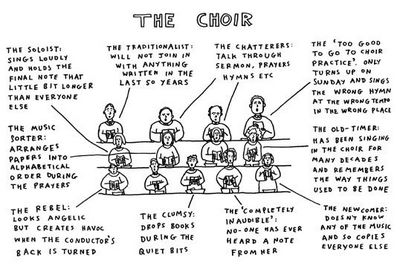
If you've ever been in a choir, particularly the church variety, you may appreciate Dave Walker's cartoon, from the UK's Church Times. http://www.churchtimes.co.uk/blog_home.asp?id=50222

On Saturday, in San Rafael, California, there will be a national competition you may not be aware of. It's the 24th Annual Harmony Sweepstakes A Cappella Festival. Actually this is the final contest, as there already have been 8 elimination contests held in cities all over the country. Now the winning groups there are being flown to Marin Veterans' Auditorium for this big deal over the weekend. It's interesting there are hundreds of these groups involved, and probably not too many are of the barbershop variety anymore. As you can see from these photos and group descriptions, the music is all over the place http://www.harmony-sweepstakes.com/ , but you can be sure of one thing: most of these participants have heard of Phil Mattson and The Foothill Fanfairs.

A couple years ago I stumbled into the best argument I know for writing personal stuff on the Internet. I merely related the coincidental sighting of a name of a musician on a CD set a friend generously gave me, with an LP I had bought years earlier. The name Michele Weir connected me to somebody name Phil Mattson, then I began to find out things about him, and finally I thought somebody somewhere might be interested in this so I wrote about it. http://jazzolog.blogspot.com/2006_11_01_archive.html What followed here, elsewhere I post, and in emails has been a continuous flow of messages from people who studied and performed with this great teacher. Most recently I heard from someone named Roy Turpin, who happens to be a therapist now out in California (isn't everybody?) and he has provided me a rare opportunity.

A month ago Gene Puerling died. His passing went largely unnoticed in the media, but those of us who love acapella singing know he formed The Hi-Lo's in the early 1950s, and then Singers Unlimited a decade later, and we mourned appropriately. Phil Mattson appreciated the Puerling genius, which was a style and technique completely original, and had the brilliance himself to begin teaching it to young people. Well, I suppose some folks must have thought he was crazy to attempt it...because certainly those of us who also loved Puerling thought such singing clearly was impossible---even where there it was on records. It really was impossible, because Gene began to experiment with multi-tracking and eventually had 4 singers sound like 8, then 12, or a whole choir. Phil's challenge may have been tougher, because he used real people...and they were kids.

Roy wrote that when he joined The Fanfairs, which was the name Phil Mattson gave his choir, he couldn't read music. This was over 20 years ago at a community college in California called Foothill. Today it is among the most highly credited schools in the country---and though Phil Mattson isn't teaching there anymore, you still can become a Foothill Fanfair. http://www.foothill.edu/index.php In fact the whole Fine Arts & Communication program at Foothill is awesome! http://www.foothill.edu/fa/ The Fanfairs, as with many college groups like this, began to record what they performed, and there must have been 6 volumes or so. Roy said the group of 12 singers became so popular in the area that the number of performances they did interrupted his studies.

Quickly Phil decided to form a professional group of 6 graduates from the program, and this was the PM Singers which recorded initially for Bob Thiele's Doctor Jazz, and almost immediately was nominated for a Grammy. While Fanfairs material is very rare and costly, you still can purchase the 2 PM Singers releases on CD. Oops, I was going to send you to http://www.a-capella.com/, but I see they're out of stock. Well, how about Michele Weir's site then? She's probably still got some---and her schedule shows she might actually be around during May. http://www.micheleweir.com/catalog/index.php?cPath=24&osCsid=6f3acb0a3484501e40f54605586cdac8 The LP I found originally now is called Night In The City.

One of the albums The Fanfairs created was A Tribute To Gene Puerling. Here, on 8 cuts, Phil Mattson took Puerling arrangements for both The Hi-Lo's and Singers Unlimited, and turned them into performance possibilities for 12 college students, each singing incredibly difficult dissonant lines. The result of course are gorgeous, huge "fat chords," as Roy calls them...and some positively heavenly singing. Roy still has all the LPs, and a couple weeks ago got a new turntable and began to transfer them to MP3. He sent me the Puerling album, which of course I've been wanting for a long time, and over the weekend it arrived. Gene Puerling came to Foothill College to be involved in the project, taught some workshops, became friends with Phil, and wrote the liner notes. Here's what he said~~~

"The Fanfairs are responsible for setting quality performance standards which vocal jazz ensembles across America are following today. Each member of The Fanfairs is a full-time music major at Foothill College... All study applied voice as well as an instrument. In addition, all members gain experience performing para-professionally as soloists, arrangers, and teachers...
"My thanks to the talented Fanfairs for their on-going commitment to high quality performances in person and on this record. It goes without saying, that their dedicated conductor, Phil Mattson, is certainly one of the prime reasons for the success of this great group, and indeed, for the whole exciting field of vocal jazz.
Carry on!
Gene Puerling"

Sunday, April 20, 2008

The Redemption Of Spring


Lose your mind and come to your senses.
---Fritz Perls
It gets late early out there.
---Yogi Berra
A mystical experience is not any more unique than a modern experiment in physics. On the other hand, it is not less sophisticated, either....The complexity and efficiency of the physicist's technical apparatus is matched, if not surpassed, by that of the mystic's consciousness....A page from a journal of modern experimental physics will be as mysterious to the uninitiated as a Tibetan mandala. Both are records of inquiries into the nature of the universe.
---Fritjof Capra
I stepped out my front door this early morning and started down the driveway. Head lowered in thought, time to fetch the Sunday paper in the box down by the road, when I heard the first spring song of a wood thrush in our woods. He must have come back yesterday. I notice the juncos are packing up and moving out to the North woods for the summer. I looked around and the world was transformed. There hadn't been much rain yesterday, but it was slow and steady...and enough to bring on the first real burst of new leaves. The daffodils are mostly done, tulips in full blast, and redbud coming on at its usual leisurely pace. I'm sure there's plenty more wild flower action in the forest and by the creeks. But that thrush's song lifted my spirits to a healing high.
I just had read an email from my sister, describing her early retirement from administration in local public health in our hometown. The job had become more than tedious, with constant and increasing mandates "to do more and more with less and less." It had become dangerous to one's health, life-threatening. Retirement at 59, with 32 years of service...and she listed 3 others in community and environmental health who did the same thing in a matter of months. No double-dipping for these people, they've had it. How many others who chose careers of public service, before Reagan declared government work a waste of money and Gingrich labeled its workers bureaucrats to be gotten rid of, have done the same thing over the last decade? How many thousands, tens of thousands, from the top ranks of the CIA through the military and into the social agencies? Every level of government affected by budget cuts and increased paperwork to prove accountability.
I met one the other night. His name is Rick Sahli, and he's an environmental attorney in Columbus. He was on a panel at OU discussing the Legal Dimensions of Environmental Justice. Beginning in 1983, he worked in the Ohio Attorney General's office on environmental law, and 5 years later became the Deputy Director of the Ohio EPA. On the strong foundation of a promising and socially helpful career, he watched, in 1991, the new Republican governor, George Voinovich, transform the Ohio Environmental Protection Agency into a corporate advocacy group. Voinovich may have repented somewhat by now, but back then he was just following the neocon agenda. Mr. Sahli resigned and since then has devoted his skills and service to grassroots organizers---mostly neighborhood folks being terrorized by industrial waste and toxins. http://home.columbus.rr.com/sahlilaw/
How can it be we've become a country in which people opposed to government and its services are touted as patriots? I was thinking these things before the wood thrush roused me from my doldrums. Besides, I've been suffering a bad cold that came on yesterday. I haven't been sick a day in the past year, but it seems when I catch "what's going around" these days I start getting death thoughts. I know I'm an old man now, but what happened to the kind of sickness that can be diagnosed? Each time I get something now I think this may be the Big One---the virus nobody can treat, the flu resistant to all our antibiotics. At one point yesterday I started coughing---this dry, unproductive hack---and I found myself preparing to give up the ghost. Overnight it loosened up, but then I had that drowning feeling of pneumonia. Oh well, one thing you learn is that when death comes it probably won't be so bad. You just have to let it happen.
Whittier said, "And where the shadows deepest fell, the wood thrush rang his silver bell." Ah yes, Whittier had the same thing happen. Anybody with a middle name of Greenleaf must have wandered the forest paths too. Isn't it wonderful how a bird can reach into your soul and stir your hope once more? This one got me to look around and see new life coming again. This old beautiful planet that has been so forgiving of us, that she still comes back no matter how reckless we've been. It's certainly especially true in this part of Appalachia, where we mine for coal and love our gasoline toys. And where, nevertheless, Spring is more lovely than anywhere on Earth.

Friday, April 18, 2008

Jeff Goodell Shines The Light On Big Coal


The puzzled ones, the Americans, go through their lives
Buying what they are told to buy,
Pursuing their love affairs with the automobile,

Baseball and football, romance and beauty,
Enthusiastic as trained seals, going into debt, struggling —
True believers in liberty, and also security,

And of course sex — cheating on each other
For the most part only a little, mostly avoiding violence
Except at a vast blue distance, as between bombsight and earth,

Or on the violent screen, which they adore.
Those who are not Americans think Americans are happy
Because they are so filthy rich, but not so.

They are mostly puzzled and at a loss
As if someone pulled the floor out from under them,
They'd like to believe in God, or something, and they do try.

You can see it in their white faces at the supermarket and the gas station—
Not the immigrant faces, they know what they want,
Not the blacks, whose faces are hurt and proud —

The white faces, lipsticked, shaven, we do try
To keep smiling, for when we're smiling, the whole world
Smiles with us, but we feel we've lost

That loving feeling. Clouds ride by above us,
Rivers flow, toilets work, traffic lights work, barring floods, fires
And earthquakes, houses and streets appear stable

So what is it, this moon-shaped blankness?
What the hell is it? America is perplexed.
We would fix it if we knew what was broken.

---"Fix" by Alicia Suskin Ostriker, from No Heaven. © University of Pittsburgh Press, 2005.

America is so concerned about Big Oil! The owners at Big Coal like it that way. They do their mining in the light of day now, but still they're most comfortable working in the dark. Underground movements...where no one can see. Why be concerned about coal? Isn't that some old issue from the 19th century...that just kind of went away? Like the locomotive? Like that big old pile in everybody's basement, dumped loudly through a little window from the coal truck, well into the 1940s? Gone away...like the coal companies abandoning the little towns, full of worker families, all across the hills of Appalachia? Take a look at this~~~

http://www.earthpolicy.org/Indicators/CO2/2008_Sectoral%20Emissions.GIF

Yeah so? Electricity? The fossil fuel burned for electricity generation is coal. "Electricity Generation." I like that. We're the Electricity Generation, but how many of us think of coal as our plug-in connector? Jeff Goodell didn't. He grew up in Silicon Valley, he told us in Athens Wednesday night, and never saw a lump of coal until he was 30 years old. Nobody in Silicon Valley thought coal was behind the screens of these computers. He lives in New York now and tells us no one in New York thinks of West Virginia mountains when they flip a switch. The trouble is, as we've learned at Ohio University during its tremendous presentations this Earth Week, coal releases twice as much carbon into the atmosphere when it's burned than anything else. But I thought everything everybody's heard lately is about Clean Coal. What's going on here?

Jeff Goodell writes for Rolling Stone, The New York Times, Washington Post, and just about anywhere else he wants to. He's that good. In answer to a question about the media, in the lecture hall of the Scripps School of Journalism the other night, he told us he got a call from the Today Show when that gold mine in South Africa collapsed. They wanted to send a limo for him to be the talking head about it. "Gold mine? What gold mine? Why call me?" The answer: "You're in the rolodex. You're the mine guy." Are coal mines the same as gold mines? He told them he wouldn't do it. He's the "mine guy" because, as David Roberts at Grist puts it, "In 2001, around the time Dick Cheney's secret-recipe energy plan made its debut, Jeff Goodell was in West Virginia reporting on coal's rising fortunes. He'd been sent to do a story for The New York Times Magazine, but the material spilled over into a new book, Big Coal: The Dirty Secret Behind America's Energy Future. It's a journey from the mines of Wyoming, across the plains by rail car, into the belly of the turbines in the east, and all the way to China, following the tale of the black rock that still, after all these years, afflicts and enables us."

http://www.earthpolicy.org/Indicators/CO2/2008_CO2%20Emissions%201950-2006.GIF

Big Coal remains Goodell's claim to fame, even though he'd written other books earlier that had sold well. But they had been about Silicon Valley, which he knew since childhood. Coal was all new, but this man is a research and investigative journalist, something in this country, alas, that is becoming as rare as a diamond, black or otherwise. I've talked to a lot of people around here who, even though they didn't hear his talk, have heard of him and know his writing. I'm glad to hear that but if you don't, allow me to point you in the direction of a few high points you can find on the Web.

http://www.earthpolicy.org/Indicators/CO2/2008_Top%20Ten%20Emitters.GIF

Here's a good example of his writing from last August, called What It Costs Us, from the Washington Post~~~

"Underground coal miners work in the darkness, invisible to most of us, and when they die -- also in the darkness, from methane explosions or rock falls or any of the hundreds of other hazards they face every day -- their deaths usually merit just a few paragraphs in the local newspaper."The attempted rescue of trapped coal miners, on the other hand, is often headline news. Networks love the real-time drama of the rescue efforts -- it's reality TV from the heartland, complete with anguished family members, heroic workers and dodgy mine owners. Sometimes, these stories have happy endings." http://www.washingtonpost.com/wp-dyn/content/article/2007/08/24/AR2007082401206.html

Did you know the average American uses energy each and every DAY that requires 20 pounds of coal? The readers of Big Coal learned that. Here's an excerpt~~~

"The coal industry is very good at touting new technology and less good at actually doing anything about it. There is new technology that's available now, called IGCC, integrated gasification combined cycle, a kind of gasification of coal. But the industry has resisted building these plants. They prefer to tout these plants that are ten or twenty years down the road and continue building the same old thing."The fact is that carbon dioxide from coal plants has gone up about twenty-seven percent since 1990, and they're continuing to go up. And global warming is an increasing, very urgent problem We need to cut emissions, most scientists agree, by fifty percent or more by the year 2050. And the coal industry is going in the opposite direction ... The fact is that coal can only be considered clean by the narrowest of definitions. It's true that the levels of air pollution of sulfur dioxides and nitrogen oxide that Joe [Lucas, executive director of Americans for Balanced Energy Choices] have fallen. But one of the things he doesn't mention is that the coal industry fought tooth and nail against all of those laws that required those reductions during the '70s and '80s and '90s, spent millions of dollars lobbying against them."http://www.houghtonmifflinbooks.com/catalog/titledetail.cfm?titleNumber=688428

Carbon emissions. That's all we hear about these days regarding global warming or climate change or whatever it is. Legislation starting up everywhere and talk of a carbon tax. What about those people who say this warming stuff is just a natural cycle? OK maybe. But let's take a core sample from some Antarctic ice and compare the amount of carbon dioxide in the air in 1000 AD to what it is now~~~

http://www.earthpolicy.org/Indicators/CO2/2008_CO2%20Concentration.GIF

Here's a link to that Grist article, which actually is a lead-in to a neat interview with Jeff Goodell. I like it because you can sense the very hip attitude and delivery that makes him a favorite for talks and TV and stuff like that~~~

http://gristmill.grist.org/story/2006/7/13/231330/588

Last October he wrote a piece for Rolling Stone about James Lovelock, the direst of predictors about climate change. Here it is~~~

http://www.countercurrents.org/goodell291007.htm

http://www.earthpolicy.org/Indicators/CO2/2008_Top%20Ten%20Emitters.GIF

Finally here's NPR's Fresh Air interview with him from last June, so you can hear what he sounds like~~~

http://www.npr.org/templates/story/story.php?storyId=11254947

Somebody asked him if he ever does any presentations for children. He appeared surprised at the question. He grinned and confided he has 3 kids at home. Obviously, he said, he's an expert in that too. Then he concluded he'd love to, but nobody's asked him. Someone should.

Tuesday, April 08, 2008

HopeDance And Waking Up


No more "evidence" of collapse is needed; it's happening here and now and with dizzying speed. I no longer feel a need to "convince" anyone; I'm simply sitting back and watching the inevitable unfold, and as I report the daily news, I can scarcely keep up with the events that have turned prophets into historians.
---Carolyn Baker, historian and psychoanalyst
http://www.carolynbaker.net/ , her valuable site
We Bring Democracy To The Fish
It is unacceptable that fish prey on each other.
For their comfort and safety, we will liberate them
into fishfarms with secure, durable boundaries
that exclude predators.
Our care will provide for their liberty, health, happiness, and nutrition.
Of course all creatures need to feel useful.
At maturity the fish will discover their purposes.
---Donald Hall, from White Apples and the Taste of Stone. © Houghton Mifflin Company, 2007.
The more clearly we can focus our attention on the wonders and realities of the universe about us, the less taste we shall have for destruction.
---Rachel Carson
The photo is called "Kelley's Tiger Lily," though that isn't what the flower really is, and can be found at http://www.flickr.com/photos/24836803@N06/2344026577/in/pool-350168@N20
The news about climate and economy are so disturbing every day, that even people who never talk to me about current affairs are doing so now. People acknowledge impending disaster and don't know what to do. What is there to do? Are we doomed?
This must be brief this morning, as I have taken so much time to read. But among the first articles to show up was something Carolyn Baker sent along to subscribers during her fundraiser. It's from a free magazine in Southern California apparently, which is called HopeDance. I couldn't find it at the actual site so I don't know when it was written. It is lengthy but it leads one through the "syndrome" of waking up from this lifestyle of convenience most Americans anyway have fallen into over the last 50 years. It's not impossible and in fact it ain't even so hard. Take the time and you'll feel better at the end~~~
Beyond that, the news is more scary than ever. Hopefully Paul Krugman's column yesterday already has been recommended to you. He explained what's happening to the price of grain and why~~~
For those climate change skeptics who advocate the cosmic ray theory, scientists Sunday from Lancaster and Durham Universities offered proof the theory isn't correct, and it's carbon emissions after all~~~
Even worse, James Hansen, head of the Nasa Goddard Institute for Space Studies in New York, said yesterday even our most extreme goals for carbon reduction aren't good enough. He lays out what he projects now~~~
And the World Health Organization put out its predictions yesterday about how climate change will bring new outbreaks of disease and death. In fact, as surely you know, it already is happening~~~
Time to get busy...with that first step you can take in this Dance.

Thursday, March 27, 2008

Green Energy Development


The most alarming sign of the state of our society now is that our leaders have the courage to sacrifice the lives of young people in war but have not the courage to tell us that we must be less greedy and wasteful.

---Wendell Berry

The essence of the problem is about consumption, recognizing that a society that consumes one third of the world's resources is unsustainable. This level of consumption requires constant intervention into other people's lands. That's what's going on.

---Winona LaDuke

What we are calling for is a revolution in public education. When the hearts and minds of our children are captured by a school lunch curriculum, enriched with the experience in the garden, sustainability will become the lens through which they see the world.

---Alice Waters

The quotations can be found in the April/May 2008 issue of Mother Earth News, and at the website www.americanswhotellthetruth.org .

Perhaps your idea of food production in the future resembles the illustrating photo (which I found here http://carolynbaker.net/site/content/view/412/ ) and you may be right. Many people are preparing for a post-petroleum world by forming small self-sustaining communities of like-minded individuals. Fortified by stocks of food in individual cellars and possibly an arsenal of collective weapons, they await the apocalypse. I understand Tom Cruise is building an underground shelter.

With that kind of worry, on Tuesday I entered Ohio University's Walter Hall Rotunda (not the most environmentally sound structure, we discovered) for something called the Green Energy Development Summit. The forum was sponsored by US Senator Sherrod Brown of Ohio, OU's Consortium for Energy, Economics and the Environment (CE3), and the Pew Environment Group (which is one of the Pew Charitable Trusts). That's a pretty formidable team for a small college town in one of the most destitute parts of Appalachia. Was rescue coming at last?

Apparently the idea for the summit was cooked up by Tom Bullock, a representative for Pew in Ohio, and Scott Miller, who directs the energy and environment programs for CE3. They both contacted Senator Brown's office to get at least his name connected and some representatives here, remembering perhaps he visited Athens during his campaign for office to bless the solar array then opening on the roof of Athens Middle School. The senator himself came to Athens yesterday for a review of the conference and to meet with university and business leaders. I sat next to a representative of Governor Strickland. So there we were: a lot of suits and a bunch of blue jeans.

A half dozen of the people in neckties turned out to be presenters, each alloted about 20 minutes to tell us of business initiatives in which they were involved. Now I had 2 problems with this already. First of course is my prejudice that it's free market capitalists that have messed us up to the point where chunks of Antarctica the size of an average country are falling off and dissolving. Second is my ignorance, both about business marketing and the engineering that invents the products. That means I'm not such a great candidate to be telling you about this...but I'll try my best. What I want to accomplish is at least to get something on the Internet about what we learned that day, and hopefully attract some reaction from people who do know what they're talking about.

The first to present were managers of Bellisio Foods whose main plant is in nearby Jackson, Ohio. Bellisio is the third-largest producer of frozen food entrees in the United States, turning out something like 2 million packages a day. http://www.bellisiofoods.com/ That's a lot of food and, as Ryan Wright informed us, eventually tons of organic waste. Bellisio used to pay truckers to come and haul it away someplace. To cook the food the company has 9 huge boilers full of water and heated with natural gas. So somebody got the idea of turning all that good compost into biogas and heating the boilers with that. As a result Bellisio became more environment friendly, saved $650,000 a year hauling costs, and estimates another $900,000 savings this year by waste conversion into biogas.

And you ain't heard nothing yet. The next colorful character to step up was Ben Schafer, an engineer himself and President of American Hydrogen. What Mr. Schafer's company does involves a process developed by research at OU, and then licensed to him. It reduces the amount of electricity needed to split hydrogen from nitrogen in the ammonia molecule, bringing cost of producing hydrogen to less than $2.00 a kilogram. A kilogram of hydrogen is equivalent in its energy content to one gallon of gasoline. No pollution. His assembly line is being set up in neighboring Meigs County, and will create a hundred jobs. http://www.americanhydrogencorporation.com/

But the biggest jaw-dropper of all was the next gentleman, complete with Capetown accent. Neill Lane is President and CEO of Sunpower, with headquarters right here on Mill Street. Sunpower has emerged over the past 30 years as the world's leading developer of free-piston engines, including something called the Stirling engine. http://www.sunpower.com/ For those of us who thought solar just means a little flickering of electricity but hardly anything that could power---say---space exploration or something, these people have news for us! Here's where my lack of afternoons tinkering in gas-powered motors brings this article shuddering to a halt...but I can direct you to Wikipedia's page on the Stirling engine. http://en.wikipedia.org/wiki/Stirling_engine And I invite you to click around Sunpower's site for some really amazing applications. Sunpower had a little humming machine going in a corner of the rotunda, which I guess was an air conditioner that had us all occasionally shivering in that place.

After a break, we spent the next 2 and a half hours in small sessions discussing barriers to and opportunities for more green energy development. I have to tell you that in each of the 3 sessions, public education K-12 was mentioned again and again. The Dean of Energy and Transportation Technologies at Hocking College told us students coming to them from high school are miserably prepared in math and science. Hocking's new Energy Institute was visited by Barack Obama just before the Ohio primary. I suggested preparation for the testing required by No Child Left Behind fills up all teaching time in science and math---and from what I hear is not only impractical but not directed to student needs.

It was an intense day and I'm glad to say my wife, who advocated we go to it, brought our 16-year-old daughter with us. As usual, she was the youngest person there. What was important for us all was the feeling of hope with which we left the building. Profitable innovation is underway that is helpful to our world...but most people don't know enough about it. That's going to change.

An overview of CE3 is here~~~

http://www.ce3.ohio.edu/

and this PDF was our agenda~~~

http://www.ce3.ohio.edu/download/Final%20Agenda.pdf

Scott assured us all the materials we developed will show up shortly online. He also plans to develop a forum on these topics in which anyone can become involved. I'll try to keep you updated.

The Pew Trust Tom represents is here~~~

http://www.pewtrusts.org/our_work.aspx?category=112