Wednesday, April 29, 2009

Chairman Of The Board


Which one of these people do you suppose is Chairman?

A religious person ought, in respect to all the things that he uses, be like a statue which one may drape with clothing, but which feels no grief and makes no resistance when one strips it again. It is in this way that you should feel towards your clothes, your books, your cell and everything else you make use of.
---St. Alphonsus Rodriguez

I must consider myself as a corpse which has neither intelligence nor will: be like a mass of matter which without resistance lets itself be placed wherever it may please anyone;like a stick in the hand of an old man, who uses it according to his needs and places it wherever it suits him.
---St. Ignatius Loyola
Zen is a matter of character, not a matter of intellect.

---D.T. Suzuki
Sometime in the last several years, I came to realize that my sturdy education in representational government wasn't doing me much good in the contemporary United States. My generation had been taught that there may be the occasional corrupt politician, but overall our federal system of checks and balances is the best there is...and the bad apples get discovered and thrown out. They have to be...or the whole barrel rots.

But a quarter of a century or so ago a faded Hollywood actor, who had ended up selling 20 Mule Team Boraxo on TV before General Electric gave him his big commercial break, convinced us that government is the enemy. The marketplace is a better governor and the corporate businessperson always will provide for our families with jobs and trickling wealth. Government legislation and contracts were best devised through the work of specially trained experts, known rather cheaply as lobbyists. Maybe they did make their contacts at first in lobbies, but eventually luxury resorts became the normal scene. There was nothing wrong with a congressperson bought and paid for, as long as he provided treats for his constituency.
I decided those few years ago that reform in Congress was hopeless. Now our only chance would have to be at stockholder meetings. There the average citizen still could get to his feet and speak his mind about what companies should be doing. The boards of directors would have to listen to those average citizens, because it was hard-earned savings that bought those shares of stock. And of course the directors would tell management what had to be done.

I don't own stock myself, so I've never been to one of the meetings I dreamed existed. And I never bothered to research them. So it was with eagerness that I read a newspaper column in our local Athens Messenger the other day about this very thing. Its author is no less than a cultural treasure around here. Guido H. Stempel III is a distinguished professor emeritus in the E. W. Scripps School of journalism at Ohio University, and we are privileged that sometimes he still writes a letter or column. I say "privileged" even though the writing you are about to read completely dashed my hopes for corporate reform through the boardroom. Through Professor Stempel's kind permission, here is his view~~~
It's Spring, and all over America stockholders are being reminded how little control they have over the companies in which they have invested and how little say they over over the compensation of CEOs.
The enlightenment comes from the annual reports issued by companies inpreparation for their annual meetings of stockholders.

If you work your way through the report you eventually will come to the information on the CEO's compensation. You probably have learned that the company's revenue and profits are down, and you know that the stock price is down. It hasn't been a good year, so you are surprised to see the CEO is getting a bonus and some other incidental compensation besides his salary.

Do the stockholders decide what the CEO's compensation will be? Don'tbe silly. What do stockholders know? It's the board of directors who decide.

And what do the members of the board of directors know? Most know they are getting paid more than $100,000 a year to attend a few meetings and give a little advice. Naturally they want the CEO to be well paid.
It is also the board of directors that devises the wonderful goldenparachutes you read about--that payment of millions of dollars in retirement or termination benefits. You probably will be amazed, as I have been, when your read of an apparently unsuccessful CEO getting $20 million in exchange for his or her resignation.

Members of the board supposedly are elected by the stockholders, but you are in for a surprise there. There are no contests. If there are 12 positions on the board, then there are 12 candidates.

Of course, you are free to vote against any or all candidates.However, if you have been paying attention as you have read through thereport you have come to the statement of share owned by the officers and board members. The total is well in the millions, and voting is not oneperson one vote but one share one vote. If you own 100 shares, will yourvote matter?

You have one other matter to vote on. You can vote for or against the auditing firm the CEO and the board recommends. This is no small matter--audits can easily cost a million dollars. Your vote, however, is a small matter.

You may also get to vote on proposals presented by stockholders.Whatever the proposal is, you can count on the board of directors being unanimously and strongly opposed.
There is also a cover letter from the CEO urging you to vote because the company values your vote.

Some companies respect shareholders more than this scenario suggests.Some, for example, inform stockholders of what CEOs are being paid this year and ask stockholders whether or not they think the compensation isappropriate. This is a fairly recently development, and a majority of companies oppose this. Furthermore, those that do it do not promise tochange the compensation if the stockholders don't like it.

When you take all this in, you understand part of the reason for our current recession. It's not all because of bankers and Wall Street. Boardsof directors are part of the problem, and stockholders are virtually powerless to stop them.
The original article can be found here http://www.athensmessenger.com/articles/2009/04/27/opinion/doc49f44fb1c6f24249440292.txt but it is necessary to be a paid subscriber to read it in this format.

Sunday, April 05, 2009

Regulating The Money Changers


Regulate this! Albert J. Dunlap, also known as Chainsaw Al, graduated from West Point before becoming CEO of Lily Tulip Cup and Scott Paper. By firing thousands of employees at once and closing plants and factories, he forced up the share price of his companies and made billions. When shareholders were left holding an empty cup, he sometimes got fined a few million. Overall, toxicity's been profitable.

To be able to spit in their eye and do what you think is right and report the news and have enough readers to make some impact is such a pleasure that you forget, you forget what you are writing about. It becomes, you know, it like, you are like a journalistic Nero fiddling while Rome burns and having a hell of a good time or like a small boy covering a hell of a big fire. It's just wonderful and exciting. You are a cub reporter and God has given you big fire to cover. And you forget, you forget it is really burning.

---I.F. Stone

And when I was brought into the convention center to tell this story (of her arrest) to the networks, one of the reporters for the network said, "How come I didn't get arrested?" And I said, "Oh, were you out covering the protests?" And he said, "No."... You got to get out there. And if the problem with this... It's not just a violation of freedom of the press... It's a violation of the public's right to know. If they're just inside the convention, they get one message. The orchestrated message. And that's important to cover. You got to get into the corporate suites. Who's funding all of this? And you have to get into the streets. Democracy's a messy thing. And all of these voices must be heard.

---Amy Goodman

Watching the news over the over the last two days, while Obama, President Obama, is in London. Watching all of the demonstrators there, some of them violent and militant, but thousands of them not. Marching to a bank, and protesting. I thought of something you wrote recently. You said that for the magnitude of this financial crisis, there should be a lot more popular rage in this country. Why do you think there isn't? Because the taxi driver this morning, coming down here, to me, was angry as hell.

---Bill Moyers, on his PBS Journal, April 3, 2009

Obama's financial policy is coming under closer scrutiny in the media and on the Internet. The suspicion and anger on Main Street, to which supposedly this President listens and responds, is getting louder. Not a day goes by that some American doesn't walk into an office or factory somewhere and just start shooting. Are they all just nutcases, or is there a war starting? Are we going postal? It's time to take a closer look.

Who are these bankers and bosses who have emerged since Reagan? What is the free market like since Poppy Bush declared globalization, and Junior encouraged credit cards without limit and told us all to go shopping. It's your patriotic duty to go shopping. Under Obama, apparently it still is. The same guy seems to be running the show.

The 3 quotations above are from the transcript of Friday's Moyers Journal. I don't know about you, but here in Athens I can't find the show anymore. Our PBS station, with dozens of digital channels and one remaining analog, seems to broadcast it sometime...but between pledge drives and shifting schedules I have no idea where it is. Fortunately I still can go to http://www.pbs.org/moyers/journal/04032009/transcript3.html and find out what happened. Apparently Friday's show was all about journalism and economic regulation. Since Amy Goodman is on a 70 city tour, promoting a new book, and coming here Thursday (broadcasting from a station that doesn't carry Democracy Now!), maybe we need a crash course in cash meltdown.

The first part of the Journal was given over to an interview with William J. Black, author of a book titled The Best Way To Rob A Bank Is To Own One. You get the idea. Mr. Black was a government regulator during the savings and loan scandal of the 1980s. Moyers introduced him thus~~~

"The former Director of the Institute for Fraud Prevention now teaches Economics and Law at the University of Missouri, Kansas City. During the savings and loan crisis, it was Black who accused then-house speaker Jim Wright and five US Senators, including John Glenn and John McCain, of doing favors for the S&L's in exchange for contributions and other perks. The senators got off with a slap on the wrist, but so enraged was one of those bankers, Charles Keating — after whom the senate's so-called 'Keating Five' were named — he sent a memo that read, in part, 'get Black — kill him dead.' Metaphorically, of course. Of course.
"Now Black is focused on an even greater scandal, and he spares no one — not even the President he worked hard to elect, Barack Obama. But his main targets are the Wall Street barons, heirs of an earlier generation whose scandalous rip-offs of wealth back in the 1930s earned them comparison to Al Capone and the mob, and the nickname 'banksters.'"
You need to see or read the whole interview, but here's an excerpt~~~
WILLIAM K. BLACK: AIG all by itself, cost the same as the entire Savings and Loan debacle.
BILL MOYERS: What did AIG contribute? What did they do wrong?
WILLIAM K. BLACK: They made bad loans. Their type of loan was to sell a guarantee, right? And they charged a lot of fees up front. So, they booked a lot of income. Paid enormous bonuses. The bonuses we're thinking about now, they're much smaller than these bonuses that were also the product of accounting fraud. And they got very, very rich. But, of course, then they had guaranteed this toxic waste. These liars' loans. Well, we've just gone through why those toxic waste, those liars' loans, are going to have enormous losses. And so, you have to pay the guarantee on those enormous losses. And you go bankrupt. Except that you don't in the modern world, because you've come to the United States, and the taxpayers play the fool. Under Secretary Geithner and under Secretary Paulson before him... we took $5 billion dollars, for example, in U.S. taxpayer money. And sent it to a huge Swiss Bank called UBS. At the same time that that bank was defrauding the taxpayers of America. And we were bringing a criminal case against them. We eventually get them to pay a $780 million fine, but wait, we gave them $5 billion. So, the taxpayers of America paid the fine of a Swiss Bank. And why are we bailing out somebody who that is defrauding us?
BILL MOYERS: And why...
WILLIAM K. BLACK: How mad is this?
BILL MOYERS: What is your explanation for why the bankers who created this mess are still calling the shots?
WILLIAM K. BLACK: Well, that, especially after what's just happened at G.M., that's... it's scandalous.
BILL MOYERS: Why are they firing the president of G.M. and not firing the head of all these banks that are involved?
WILLIAM K. BLACK: There are two reasons. One, they're much closer to the bankers. These are people from the banking industry. And they have a lot more sympathy. In fact, they're outright hostile to autoworkers, as you can see. They want to bash all of their contracts. But when they get to banking, they say, ‘contracts, sacred.' But the other element of your question is we don't want to change the bankers, because if we do, if we put honest people in, who didn't cause the problem, their first job would be to find the scope of the problem. And that would destroy the cover up.
BILL MOYERS: The cover up?
WILLIAM K. BLACK: Sure. The cover up.
BILL MOYERS: That's a serious charge.
WILLIAM K. BLACK: Of course.
BILL MOYERS: Who's covering up?
WILLIAM K. BLACK: Geithner is charging, is covering up. Just like Paulson did before him. Geithner is publicly saying that it's going to take $2 trillion — a trillion is a thousand billion — $2 trillion taxpayer dollars to deal with this problem. But they're allowing all the banks to report that they're not only solvent, but fully capitalized. Both statements can't be true. It can't be that they need $2 trillion, because they have masses losses, and that they're fine.
These are all people who have failed. Paulson failed, Geithner failed. They were all promoted because they failed, not because...
BILL MOYERS: What do you mean?
WILLIAM K. BLACK: Well, Geithner has, was one of our nation's top regulators, during the entire subprime scandal, that I just described. He took absolutely no effective action. He gave no warning. He did nothing in response to the FBI warning that there was an epidemic of fraud. All this pig in the poke stuff happened under him. So, in his phrase about legacy assets. Well he's a failed legacy regulator.
Frank Rich comes at it from a different angle this morning, but essentially he's covering the same story. Like Moyers, he's wondering why Rick Wagoner got singled out...but the bankers and brokers still are under cover~~~
"Sure, Rick Wagoner deserved his fate. He did too little too late to save an iconic American institution from devolving into a government charity case. He embraced the Hummer. G.M.’s share price fell from above $70 to under $3 on his watch. Yet few disputed the judgment of the Michigan governor, Jennifer Granholm, that Wagoner was a 'sacrificial lamb,' a symbolic concession to public rage ordered by a president who had to look tough after being blindsided by the A.I.G. bonuses. Detroit’s chief executive had to be beheaded so that the masters of the universe at the top of Wall Street’s bailed-out behemoths might survive.
"On this point even the left and the right could agree. The union leader Andy Stern publicly wondered why the administration didn’t also dethrone Ken Lewis of Bank of America. Thaddeus McCotter, a conservative Republican congressman from suburban Detroit, asked, 'When will the Wall Street C.E.O.’s receiving TARP funds summon the honor to resign? Will this White House ever bother to raise the issue?'
"When reporters did raise the issue of a double standard to the White House press secretary, Robert Gibbs, they got double talk: 'I don’t have anything specific on Bank of America.'
"But even as that unanswered question hangs in the air, a more revealing inquiry might be this: Why is there any sympathy whatsoever for a Detroit C.E.O. who helped wreck his company, ruined investors and cost thousands of hard-working underlings their jobs, when there is no mercy for those who did the same on Wall Street? Might we, too, have a double standard? Could we still be in denial of the reality that greed and irresponsibility were not an exclusive Wall Street franchise during our national bender?"
But the most devastating writing I came across on this whole mess is at the Forum section of---sorry, folks---Playboy.com. The writer is named Mark Ames, and I guess he maintains a column there called Backstabber. This article is called "Class War 101," and sets forth they hypothesis that the "economic elite" are not the same kind of human like you and me. Their reptilian brains work differently...and so do the hormones that create their hunger. Sound too cynical for you? Maybe. Born in California in 1965, Ames went to a private Episcopalian school, then the University of California. During the Reagan, both Bushes, and the Clinton years, he became more and more disillusioned with the United States. So why didn't he move to Russia if he didn't like it here. He did. He started a newspaper there called The Exiled, but the government shut him down when he was critical of the Georgian invasion. He's written a book with Rolling Stones' Matt Taibbi, if that gives you an idea of his flavor. See if any of this makes sense to you~~~
"If we’d cared to look around us at any time since the Reagan Revolution, we’d realize that the CEOs, billionaires and finance stars are behaving no differently today than they have been for nearly three decades. When we look back, what will pain us most is the way we admired the billionaires even as they brought about our ruin, turning them into TV celebrities and magazine-cover heroes, worshipping them like rock stars right up to the end.
"A perfect example of the kind of person who benefited from the Reagan Revolution is Al 'Chainsaw' Dunlap, a corporate superstar during the peak Clinton years, when Reaganomics accelerated under the guiding hands of Alan Greenspan, Larry Summers, and Robert Rubin. It was during Clinton’s centrist pro-business presidency that innovations like the like mass-layoff (rebranded as 'downsizing') became a regular feature of economic booms, rather than of economic busts, as they had been in the past. Layoffs expanded right with the economy for the simple reason that each mass firing freed up millions or billions of dollars that had gone to workers, but now could be divided up between executives and major shareholders. The problem was finding people cold-blooded enough to do the job—which is to say, there was no problem whatsoever. As Dunlap himself boasted in a 1998 interview with Fortune magazine, 'Mickey Mouse could do the cost cutting.'...
"This same arc has been repeated all over the American economy—what we once thought were isolated cases turned out to be a pattern, and the pattern repeated so much up down corporate America that it finally became clear: These things are the rule. No wonder the SEC never came down hard on anyone: it would have meant shutting down the entire economy and starting from scratch. "In the past, when downsizings and payouts happened, they were seen as a necessary evil in the overall march to a free-market utopia. Now we understand that what really happened wasn’t as complicated or theoretical as it was made out to be. It was a straight-forward transfer of wealth out of the pockets of, say, 11,200 employees at Scott Paper into the pockets of Wall Street bankers and their CEO henchmen. No matter how many words like 'efficiency' and 'restructuring' you gloss it with, it’s still taking money that formerly went into one group’s pocket, and giving to another, much smaller group.
"What’s so strange, looking back, isn’t just the blatant, shameless plundering of thousands of American families for a few individual’s excessive profit, but the way we all adored them while they were in mid-plunder. They didn’t even try to pretend to be likeable or even human, and we still licked their boots."
Like Taibbi, Mark Ames writes graphically. Visits to the sites of Rolling Stone and Playboy, like purchasing the magazines, can be risky business if you seek to avoid cussing and the sight of flesh. But this is muckraking time...and it's not pretty.
During the Obama campaign there were the same concerns, from Left and Right, about his Chicago connections, and beyond, to wealthy backers and financial interests. Is he just another front man? Except for this area...and maybe Afghanistan...he has stepped forward with answers when questions were raised. Hello Grassroots, do you have any questions?

Thursday, April 02, 2009

Money Meltdown: The Psychologists Speak


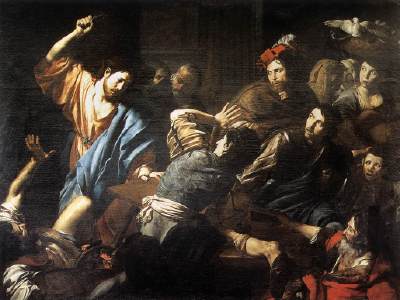
Christ Driving the Money Changers out of the Temple
Valentin de Boulogne
(b. 1591, Coulommier-en-Brie, d. 1632, Roma)


Shake off this sadness, and recover your spirit;
sluggish you will never see the wheel of fate
that brushes your heel as it turns going by,
the man who wants to live is the man in whom life is abundant.


---Miguel de Unamuno


We must learn to see the world anew.


---Albert Einstein


It is said that Mahatma Gandhi (1869-1948) considered the seven deadly sins to be

Wealth without works

Pleasure without conscience

Knowledge without character

Commerce without morality

Science without humanity

Worship without sacrifice

Politics without principle


Maybe I've been reading the wrong guys. Something about the way economists talk and write just clashes with the truths of the poets that first hit me in college. I had planned to go into international law and diplomacy. But then a required English course brought Gerard Manley Hopkins and Dylan Thomas into my life. By the time Gary Snyder hit me a decade later, I was nowhere near a judge's bench...except as an occasional defendant. I love to give the poem the works at the lectern, on the stage. Krugman writes well, but I'm not sure I'd relish performing him...even lately, as he seems to be trying to teach Obama the basics.


I don't like to read psychologists either. They give me the willies...and they possibly worship statistics even more than economists do. I'm sure both are guilty of manipulating the numbers. But this morning, for the first time, I read a psychological view of the current financial crisis...and the urges that overcame unregulated capitalists---again. It made more sense to me than any of the stuff I hear and read everyday. So, for your approaching tax day, Earth Day, Passover, Holy Week, and what-have-you, allow me to share it---and don‘t miss the advice at the end about freezing your credit card~~~


Why money messes with your mind


Dough, wonga, greenbacks, cash. Just words, you might say, but they carry an eerie psychological force. Chew them over for a few moments, and you will become a different person. Simply thinking about words associated with money seems to makes us more self-reliant and less inclined to help others. And it gets weirder: just handling cash can take the sting out of social rejection and even diminish physical pain.
This is all the stranger when you consider what money is supposed to be. For economists, it is nothing more than a tool of exchange that makes economic life more efficient. Just as an axe allows us to chop down trees, money allows us to have markets that, traditional economists tell us, dispassionately set the price of anything from a loaf of bread to a painting by Picasso. Yet money stirs up more passion, stress and envy than any axe or hammer ever could. We just can't seem to deal with it rationally... but why?
Our relationship with money has many facets. Some people seem addicted to accumulating it, while others can't help maxing out their credit cards and find it impossible to save for a rainy day. As we come to understand more about money's effect on us, it is emerging that some people's brains can react to it as they would to a drug, while to others it is like a friend. Some studies even suggest that the desire for money gets cross-wired with our appetite for food. And, of course, because having a pile of money means that you can buy more things, it is virtually synonymous with status - so much so that losing it can lead to depression and even suicide. In these cash-strapped times, perhaps an insight into the psychology of money can improve the way we deal with it.


Relative values


Even as a simple medium of exchange, money can take a bewildering variety of forms, from the strips of bark and feathers of old, through gold coins, pound notes and dollar bills to data in a bank's computer - mostly cold, unemotional stuff. The value of £100 is supposed to lie in how much beer or fuel it can purchase and nothing else. You should care no more about being short-changed £5 at the supermarket checkout than losing the same amount when borrowing money to buy a £300,000 house. Similarly, you should value £10 in loose change the same as £10 in your bank account that you've mentally set aside for your niece's birthday.
In reality we are not that rational. Instead of treating cash simply as a tool to be wielded with objective precision, we allow money to reach inside our heads and tap into the ancient emotional parts of our brain, often with unpredictable results. To understand how this affects our behaviour, some economists are starting to think more like evolutionary anthropologists.
Daniel Ariely of the Massachusetts Institute of Technology is one of them. He suggests that modern society presents us with two distinct sets of behavioural rules. There are the social norms, which are "warm and fuzzy" and designed to foster long-term relationships, trust and cooperation. Then there is a set of market norms, which revolve around money and competition, and encourage individuals to put their own interests first.
Economic exchange has been going on throughout human history, so it is possible that our ancestors evolved an instinctive capacity for recognising the difference between situations suited to social or market norms, and that this could have developed well before the invention of money. Alternatively, we may learn the distinction.
Either way, we appear immediately and subconsciously to recognise the cues associated with the realm of market norms. Experiments published in 2007 reveal that even a passing contact with concepts linked to money puts us into a market-oriented mentality, making us think and behave in characteristic ways.
Kathleen Vohs in the department of marketing at the University of Minnesota, Minneapolis, and colleagues, first got student volunteers to complete a task in which they had to make sensible phrases either from a set of words that had nothing to do with money (such as "cold", "desk" or "outside") or from money-related words (including "salary", "cost" or "paying"). Then they asked individuals from the two groups to arrange a set of discs into a particular pattern.
The researchers found that the volunteers who had been primed with the money-related words worked on the task for longer before asking for help. In a related experiment, people in the money-word group were also significantly less likely to help a fellow student who asked for assistance than were people in the group primed with non-money words (Science, vol 314, p 1154).


Split personalities


Vohs suggests there is a simple dynamic at work here. "Money makes people feel self-sufficient," she says. "They are more likely to put forth effort to attain personal goals, and they also prefer to be separate from others." The touchy-feely social side of us may disapprove of such behaviour but it is useful for survival. This ability to assess which set of norms applies in a particular situation is important in guiding our behaviour, Ariely says. It allows you to avoid expecting too much trust in the midst of a competitive business negotiation, for example, or making the mistake of offering to pay your mother-in-law after she has cooked you a nice meal. "When we keep social norms and market norms on separate paths, life hums along pretty well," says Ariely. "But when they collide, trouble sets in."
The trick is to get the correct balance between these two mindsets. Numerous psychological studies have found a general trade-off between the pursuit of so-called extrinsic aspirations - such as wealth, but also fame and image - and intrinsic aspirations, such as building and maintaining strong personal relationships. People who report a focus on the former score low on indicators of mental health, and those strongly motivated by money are also more likely to find their marriage ending in divorce.
This is not to say that we shouldn't focus at all on extrinsic aspirations. Everyone needs money for those parts of their lives governed by market norms, and it's well known that financial strain can bring depression, perceived loss of control and reduced life expectancy (see "Buy into happiness").
Now that the days of easy credit and rampant consumerism appear to be over, for the time being at least, it would be nice to think that we might acquire a more balanced relationship with money. Unfortunately, it's unlikely to be that simple. One reason why is exposed by Vohs's latest findings, which reveal another peculiar aspect of our mental relationship with money.
In a study to be published soon in the journal Psychological Science, Vohs and psychologists Xinyue Zhou of Sun Yat-Sen University in Guangzhou, China, and Roy Baumeister of Florida State University, Tallahassee, found that people who felt rejected by others, or were subjected to physical pain, were subsequently less likely to give a monetary gift in a game situation. The researchers then went on to show that just handling paper money could reduce the distress associated with social exclusion, and also diminish the physical pain caused by touching very hot water.
"Money seems to have symbolic power as a social resource," says Vohs. "It enables people to manipulate the social system to give them what they want, regardless of whether they are liked." Put bluntly, it looks as if money is acting as a surrogate friend. Could that explain why some people focus on extrinsic aspirations at the expense of real social relationships?
Psychologists Stephen Lea at the University of Exeter, UK, and Paul Webley at the School of Oriental and African Studies, University of London, have suggested another reason for unhealthy and obsessive attitudes to money. They believe that it acts on our minds rather like an addictive drug, giving it the power to drive some of us to compulsive gambling, overwork or obsessive spending (Behavioral and Brain Sciences, vol 29, p 161). "It is an interesting possibility that all these are manifestations of a broader addiction to money," says Lea. Compulsion appears to be a problem for people with several money-related disorders which are increasingly being identified by psychologists (see "Money problems").
Lea and Webley propose that money, like nicotine or cocaine, can activate the brain's pleasure centres, the neurological pathways that make biologically beneficial activities such as sex feel so rewarding. Of course, money does not physically enter the brain but it might work in a similar way to pornographic text, argue Lea and Webley, which can cause arousal not by giving any biochemical or physiological stimuli, but by acting through the mind and emotions.
Some evidence for the notion of "addiction" to money comes from brain imaging studies. In one experiment, for example, a team led by Samuel McClure, a psychologist at Princeton University, asked volunteers to choose between receiving a voucher for Amazon.com right then, or a higher-value one a few weeks later. Those who chose the instant reward showed brain activity in the areas linked with emotion, especially the limbic system, which is known to be involved in much impulsive behaviour and drug addiction. Those choosing the delayed reward showed activity in areas such as the prefrontal cortex known to be involved in rational planning (Science, vol 306, p 503).
The idea that money taps into brain circuits evolved to make biologically important activities rewarding is given a further boost by another strange discovery. In an attempt to provide an evolutionary explanation for our motivation to strive for money in present-day societies, Barbara Briers of the HEC business school in Paris, France, and colleagues decided to test whether our appetite for cash is directly related to our appetite for food.
They made three discoveries: hungry volunteers were less likely to donate to charity than those who were satiated; those primed to have a high desire for money, by having imagined winning a big lottery, went on to eat the most candy in a taste test; and people whose appetites had been piqued by sitting in a room with a delicious smell, gave less money in a game situation than those who played in a normal-smelling room (Psychological Science, vol 17, p 939). Briers reckons this indicates that our brain processes ideas about money using the same pathways evolved to think about food, so that in our minds the two are synonymous. If she is correct, it puts a whole new spin on the term "greedy bankers".
Hungry people are less likely to donate money to charity than those who are satiated
We are still a long from knowing why some people appear to go crazy over money, while others seem to pay it so little attention. Those chasing after it to the exclusion of almost everything else aren't necessarily "addictive". Some may be greedy, and others just needy - thirsty for status or using money to compensate for social shortcomings. What is clear is that money - supposedly a dispassionate tool of exchange - stirs up big emotions and mental strife. It's time economists' models took this into account.


Buy into happiness


People with more money tend to be happier than those with less - but only up to a point. That is the conclusion of psychologists Ed Diener at the University of Illinois at Urbana-Champaign, and Martin Seligman of the University of Pennsylvania, Philadelphia, who have reviewed numerous studies looking at the psychological effects of wealth. They report that money's impact on happiness suffers from diminishing returns: once you have enough for food and shelter, more cash doesn't bring much extra joy (Psychological Science in the Public Interest, vol 5, p 1).
Nevertheless, unless you are already rolling in it, you might want to carry on buying the odd lottery ticket. When Andrew Oswald of the University of Warwick, UK, and Jonathan Gardner of business consultancy Watson Wyatt Worldwide quizzed a random sample of British citizens who had won lottery prizes wins of between £1000 and £120,000, they found indicators of significantly better mental health than in non-winners or those who won very small prizes (Journal of Health Economics, vol 26, p 49). The researchers believe that acquiring extra capital left people less worried about their financial lives, and so less stressed and therefore less prone to stress-related illnesses. The extra cash may not have bought happiness directly, but it certainly gave winners something to smile about.
Even without a windfall, though, you can get more joy for your buck if you are careful how you spend it. Ryan Howell of San Francisco State University and colleagues asked volunteers questions about their recent purchases. The researchers found that people reported "experiential purchases", such as trips to the theatre or travel, as bringing them more happiness than material purchases such as clothes. A concrete purchase may have cost more and lasted longer but a good experience brought more pleasure.


How to master mental accounting


Spending too much on your credit card? Try freezing it - literally. Drop it in a glass of water and put it in the freezer, then when you get the urge to splurge you will have to let the ice thaw, by which time your sanity should have prevailed. According to Richard Thaler, an economist at the University of Chicago, tricks like this are a useful way to counter our brain's irrational financial tendencies. These arise, Thaler believes, because our psychological biases cause us to put money into different "mental accounts" and to think of the contents of each in a different way.
Credit freeze
Adding £50 to a credit card bill already in the thousands seems far less extravagant than paying out £50 cash for a meal. Anyone with a credit card appreciates the truth of this. Indeed, it has been shown that people paying with plastic are less able to remember how much they spent than those paying with cash. As Thaler points out, credit cards act as "decoupling devices", separating the pleasure of the purchase from the pain of payment, which gets pushed into the foggy future. Freezing your card gives you a chance to overcome this emotional pull and act rationally.
In his book Nudge, co-authored with legal scholar Cass Sunstein, also at the University of Chicago, Thaler identifies other irrational biases that lead to distortions in our mental accounting. Almost all of us, for example, are "loss averse" - it hurts more to lose £50 than it feels good to win £50. We also value money in relative rather than absolute terms - we consider £10 irrelevant when buying a house but not when paying for a meal. Similarly, finding £100 will give many people more pleasure than having a heating bill cut from £950 to £835, even though this gains them more in real terms.
We also have a well-known bias in favour of a little money now over more money later, which makes saving so difficult. Thaler has suggested - and many companies are now using - a scheme called "Save more later" that puts this bias to work. Employees can commit themselves to putting more money into their retirement savings in future years, rather than doing it now. It seems to work for the same reason that we are lured by offers of "no payments for the first year", but in a more beneficial way.
Knowing about mental accounting offers some insight into how we might handle money difficulties and the pain that comes with them. Thaler's tip for saving is to take money from the mental category of "loose change". Instead of writing a cheque for £1000 to be deposited in a savings account, he says, it is far less painful and can be just as effective to continually round up our purchases - thinking of an item costing £22.50 as costing £30, say - and then saving the balance.
Another economist has a trick for taking the sting out of costs associated with car troubles or other unforeseen expenses. He sets aside a lump sum at the beginning of each year and mentally earmarks it "donations to charity". If any unexpected bills arise, he pays them from that fund, which in his mind is already gone, and donates whatever is left in December.
Daniel Ariely from the Massachusetts Institute of Technology has come up with a more ambitious plan. He suggests we should all be able to add categories to our credit cards to which we can apply suitable limits: no more than £50 for a meal out, say, or £300 annually on shoes. It may not come as a surprise that he has yet to persuade any bank that this is a good idea.


Mark Buchanan is a writer based in Cambridge, UK, who's written a number of articles for New Scientist lately.
http://www.newscientist.com/article/mg20127001.200-why-money-messes-with-your-mind.html?full=true

Sunday, March 15, 2009

Will Shame Save Us?


Bernie Madoff celebrating New Year’s Eve aboard the yacht of his closest friend and mentor, Norman Levy, who died in 2005, and whose fortune Madoff recently appropriated...courtesy of the lady with the camera. By Carmen Dell’Orefice.
Zen is like looking for the spectacles that are sitting on your nose.
---D.T. Suzuki
You cannot avoid paradise. You can only avoid seeing it.
---Charlotte Joko Beck
Our life is a faint tracing on the surface of mystery.
---Annie Dillard
I've spent the 50 days since the Obama inauguration uncharacteristically silent. A mixture of exhaustion and relief took me into a vacation. Also I wanted to see what happens. I never thought of our new President as a progressive or radical, so I didn't have expectation of that kind of change. Nor was it a surprise to hear him say he wants to look forward rather than launch investigations into the last 8 or 18 or 28 years. I thought that was pretty good political judgment. If there's been indictable wrongdoing, there are other groups to look into that. The Justice Department is available, but we know what's become of the Supreme Court.
I have been alert to the rantings of the fundamentalist right, but it should be clear to everyone the loud ones among the bunch are set on self-destruct. Let them do what they have to do. There are quiet, unassuming fundamentalists who have been friendly all along, but not really welcoming to conversation about basic issues. It seems still too early to test those waters. More moderate Republicans have surprised me with their resistance to cooperate and complaints there still isn't enough bipartisanship. I'm disappointed, but I guess those are the rules of the game.
Ah, but there's the word. Game. This week has stirred me awake again. The players have begun to hit the fan. The vast American public has begun to stir...and a rumbling of rage is faint but strong. Mr. Madoff... Could Dickens have made up a better name for this guy? Mr. Madoff was led away in chains, but not before he expressed shame about bilking his friends and trusting investors. Bankers and players love that word "trust." "Security" is another word they like. Security exchange. The phrase reeks of ethics. Yes, Bernie expressed shame...although we know in his heart of hearts he sees himself a hero, sacrificing himself for family. I await some physician report that announces he has a rare condition and only a week to live.
Then we had Cramer vs. Stewart. I saw that hedge fund clown on CNBC only once, while munching a Big n' Tasty at McDonalds. I'm not into TV much anymore, but he looked like a hundred other frantic personalities on the tube who fill our homes with indignity. So Jon Stewart decided to finger him as a real bad guy, and Thursday night brought him on the Daily Show. It really was wonderful---and yes, Cramer too feels shame. He knew all along...but being a good team player---as all American boys are taught to be---he rolled up his sleeves and gave the game his best shot. Surely you know the video is all over the Internet, but you might check The Daily Show's site, and hope Jon's profanity is left in. http://www.thedailyshow.com/ Bloggers also are trying to build their own transcripts of the thing, for most of the world that can't afford broadband.
Also this week Jim Hightower mustered up some of the sharp rhetoric he used to share with Molly Ivins down in Lone Star country. He takes on that cute NY Times columnist David Brooks, who's been so saddened by the thought the plutocracy might be under scrutiny. Here's a taste of Jim's column this week~~~
"Yet, Brooks and his political brethren are now bemoaning the plight of the plutocrats, assailing the 'redistributionists' who talk of spreading America's wealth. In his column, Brooks cried out for a conservative vision of 'a nation in which we're all in it together — in which burdens are shared broadly, rather than simply inflicted on a small minority.'
"Do we look like we have suckerwrappers around our heads? Where were these tender-hearted champions of sharing throughout the last 30 years, when that same 'small minority' was absolutely giddy with redistributionist fervor — redistributing upward, that is?
"With the full support of their political hirelings from both parties, this minority created tax dodges, trade scams, corporate subsidies, deregulation fantasies, financial hustles, de-unionization schemes, bankruptcy loopholes and other mechanisms that turned government into a redistributionist bulldozer, shoving wealth from the workaday majority into their own pockets.
"Brooks might have missed this 30-year class war, but most folks have been right in the thick of it and are not the least bit squeamish about supporting a national effort to right those wrongs. After all, even a dog knows the difference between being stumbled over — and being kicked."
Thirty years. How well I remember the coronation ceremonies for Reagan's 2nd term. The main ball was on television, with King Ronnie and his queen enthroned upstage...and MC Frank Sinatra, avenging himself and his cronies against Kennedy's snubbing of them, shouting out, "It's FOUR more years of PARTY!" And partytime it has been...with no cleanup the next morning. Until now. Ironically CNBC is owned, I understand, by General Electric, the company that picked up Reagan's dead movie career and turned him into its TV spokesperson. How much power was generated by and to GE through his political career has yet to be seen fully...but it's come full circle now. "Progress is our most important product."
Let's not forget Iraq. Today's Washington Post has a book review of sorts by Philip Bennett of a number of volumes just published about the different views of the occupation. They depend on whether you're here or over there. And if you're over there, whether you're a Yank or an Iraqi. What have the Iraqis gone through and what do they think?
"Today, Iraqis are the anonymous authors of their own history. As the U.S. withdraws, the course of 'Iraqification' will depend partly on how Iraqis reveal and resolve their own versions of the last six years. American journalists should once again take up the mission of reporting their stories as increasing security makes that possible. Public interest in these stories may have disappeared, but their importance hasn't. The lessons of the Iraq war, including making 'the people the prize,' are now migrating under Petraeus's command to Afghanistan, another country of strangers."
The photo of Madoff is from the April issue of Vanity Fair, which features a huge artice about the man, his connections, and the friends he betrayed. To introduce the issue, editor Graydon Carter creates a striking image of America right now~~~
"As far as the global economic crisis goes, part of me thinks the U.S. has gone off a cliff pretty much the way Wile E. Coyote does in the Road Runner cartoons. He doesn’t drop immediately; he’s suspended in midair. He knows he shouldn’t be out there, but he’s not plunging! Filled with hope, he begins to gingerly tiptoe his way back to the ledge. He’s almost made it—he’s not going to fall! And then, with a puff of dust, he’s gone, plummeting far, far down into the canyon. As a nation, we might just be in the tiptoeing stage: we know we’ve screwed up big-time, but we’re praying that we can get back to the ledge before gravity takes over."
Will shame be enough? Do we all feel it, share it? What is the current spiritual state of the country? You probably are aware of the survey published last week that shows the fastest growing religious choice in the country is None. That category of belief now is 15%, up from 8% in 1990. This makes "None" the biggest congregation in this nation, outside of Baptists and Catholics. http://www.usatoday.com/news/religion/2009-03-09-aris-survey-nones_N.htm Who do you trust? Organized religion? Banks, doctors, school administrators? Oh well, I still sing in the church choir---so I gotta go.

Sunday, March 01, 2009

Mr. Obama And The Money Changers


The photo shows Barack Obama on the campaign trail in Virginia last June. MANDEL NGAN/AFP/Getty
There is something obscure which is complete before heaven and earth arose;
tranquil, quiet, standing alone without change, moving without peril.
It could be the mother of everything.
Not knowing its name, I call it Tao.

---Lao-tsu

We have to get quiet. We have to be still, and that's harder and harder in this century.

---Jane Kenyon

When a man tells you that he got rich through hard work, ask him, "Whose?"

---Don Marquis

Yesterday the President gave the Weekly Address. I don't know when that tradition began, but I have to say even though I tend to have the radio on Saturday mornings I can't say I've ever heard one broadcast. Are there any stations that do it? Often the address makes news anyway, partly because nothing else may be going on during the weekends except sports, car crashes and murders.

The headlines are stark, more inciteful and insightful, and designed to "sell papers," as they say---in an industry where another newspaper seems to die off every week. The Los Angeles Times throws "class warfare" onto its front page, and Reuters calls the President "combative." The Chicago Tribune says he's playing "Robin Hood With The Budget." On television, ABC reports Obama is "ready to put 'em up over budget," and others claim he's trying to "talk tough" as Bush did(by way of Andover, Yale and Harvard). Many reactions quote Bush's "Bring it on!", so many in fact the address may get stuck with that label. HuffingtonPost has got it.

What's the point of this? We expect it, I suppose, from the Party of Nope. Republicans, apparently exhausted of a single innovative alternative, now accept Rush Limbaugh and Sarah Palin as their spokespeople. Thirty years of tax-cuts-to-the-rich trickledown wasn't enough? Giving hundreds of billions in unmarked bills to bankers and resisting loans and assistance to rupturing companies can't make sense to anyone who doesn't believe Wall Street players are in touch with some kind of divine guidance. Governor Jindal believes it. This is the nonwhite face the Repubs came up with to "respond" to the President's budget presentation to Congress. His claim to fame is turning down $100,000,000 in federal recovery money for a Louisiana that ranks 46th in high school graduations and 4th with children living below the poverty line.

Having elected Barack Obama on a platform of change, we now await our new appliance to chug into action and deliver the results. How long have the American people been trained to be consumers? When I tell people we used to study citizenship in school and had candidates debate each other in our assemblies, they barely can understand what I'm talking about. They nod gravely, especially social studies teachers, at such reminscences of ancient times. But we can't allow such participation now. Nobody knows how to have a moderated discussion about volatile issues. There would be discipline problems in the streets.

Increasingly I'm getting the impression that Mr. Obama understands these things. I could be wrong, but the man seems positively brilliant in perception beyond his years. He's been around the block. He's organized in the block. And with his address yesterday, he's announced he's back on the block. He reiterated his campaign promises. He showed what he's doing to fulfill them. Why suddenly is this combative?

Presuming the media isn't trying just to stir up trouble---and let's not put that past them: they do speak to the mob---if people are shocked by his shining a light on the lobbyists, it's because now it's real. This isn't empty rhetoric. He's doing it. Lobbyists are guys with jobs. They're like salesmen. Maybe they have experience in the halls of congress. Hopefully they know their products and whether they'll really work. Hopefully they are not out to defraud. Essentially Mr. Obama suggests we now see what they are, what they are made of. Are they part of citizenship or the consumer "culture"?

Please take a moment to go to the White House website to read the text of (or watch if you like) the whole address. It doesn't take long...and it's a classic~~~
--------------------------------------------------------------------------------
Remarks of President Barack Obama
Weekly Address
Saturday, February 28th, 2009

Wednesday, February 18, 2009

The Death Of American Civilization


Cartoon by Sean Delanos on page 12 of today's New York Post and on its website.
The first man to see an illusion by which men have flourished for decades surely stands in a lonely place.
---Gary Zukav
The wind is cold;
through the torn paperscreen
the moon of February.
---Sokan
Empty-hearted in society,
How deeply moved I am
By the snipe calling
In the evening marsh.
---Saigyo
Fortune calls Rupert Murdoch the second most powerful person in the world of business. http://money.cnn.com/galleries/2007/fortune/0711/gallery.power_25.fortune/2.html He owns the New York Post, the London Times, the Wall Street Journal, the Fox TV network, he owns MySpace---oh heck, check Wikipedia for the rest of it. http://en.wikipedia.org/wiki/Rupert_Murdoch He may be the 109th richest person in the world...but who knows these days?
The chimp referenced in the cartoon was a personal pet of someone in Stamford, Connecticut, whose friend came to call, and was torn up by the animal and almost killed. Police were called, came, and shot it to death. The chimp, or anyone involved, had nothing to do with any kind of stimulus package. Maybe it had implanted brain cathodes? Otherwise, whatever stimulus moved it to attack the friend remains a mystery.
So what stimulus package is Murdoch referring to? And who would offer it to Congress, and who signed it into law also yesterday? Who would find the cartoon funny? To what underbelly of this society is Murdoch trying to sell his papers? His political views? And is a thing thing like this still even in the realm of politics? Is the obvious reference so horrible in this 21st century as to constitute some new crime about which we need to invent laws? Or is it a crime as old as time?
When I went to school I learned plenty about America the Beautiful. And I learned about "mistakes" we made. I learned about slavery, and I learned about the great accomplishments and contributions to our nation those people made almost immediately upon emancipation. I learned those things 60 years ago.
Is the measurement of success of our public education to show steady advancement? Or is it a constant catchup with a continuous decline of this culture's mentality? Are there more powerful educational influences out there than the teacher of American history to tell kids what we're all about? At one time those influences were aligned with education. They appear to be no longer.
A couple of years ago, I encountered a student in a school for physically challenged young people who nevertheless seemed to have the potential to achieve a driver's license. I went to the Motor Vehicle Bureau and got him a booklet of the laws of this state and instructions of what to do to learn to drive a car. I told him to take the book home and have his dad go over it with him. He came back the next day and said his father had thrown it away. The man had said, "No government is going to tell me what to do!"
That dad may find Rupert's cartoon funny. I say, if this mentality rules the day, we're finished.

Monday, February 16, 2009

Recovery Or Stimulus?


. . . wars might be avoided by: universal disarmament; limited national sovereignties; provision for all people of the world: of a rising standard of living, better education, more contact with and better understanding of others; and equal access to the technical and raw materials which are needed for improving life. . . .
--- J. Robert Oppenheimer, 1946

What experience and history teach is this -- that people and governments never have learned anything from history, or acted on principles.
--- George Wilhelm Hegel

What lies behind us and what lies before us are tiny matters compared to what lies within us.
--- Ralph Waldo Emerson
The photo, by Anthony Suau for Time, shows Detective Robert Kole making sure all residents of this house in Cleveland are gone. Their mortgage was foreclosed March 28, 2008. The picture won the World Press Photo of the Year last Friday.
Maybe I'm discovered lying on the sidewalk. Concerned passersby summon help for me. A medical emergency team arrives. One member says, "This man looks exhausted. We should take him to a facility where he can receive tender, loving care." Another member says, "What he needs is a jumpstart. Let's give his heart a jolt." What should they do?
I'm not an economist. Nor a sociologist. I tried community organizing a while back, but wasn't very good at it. I might be better now. I read, I write, I'm interested in words. So when I hear one spokesperson call the Package "stimulus" and another refer to it as "recovery," I have to wonder. Am I alone in thinking we may not know what we're doing? All that's certain is it's going to cost another ton of money---which is a bit like you feel when you check into the hospital. Will you survive the procedure...whatever it is?
If I'm sick, does it matter what the diagnosis is? Just give me a pill, I don't care what it is. That blue one looks good. We're told doctors always write a prescription of some kind because people expect it. If you don't go to the pharmacy from the doctor's office, he couldn't have been much good.
Am I just being pedantic...or does it matter? We should have learned from the last Administration that what you call something matters a lot. Liberals rushed out to buy a book telling us about the importance of "framing" your proposition. Everybody said, "Gee, we have to learn how to do that." OK, here we are. What is the frame? Do we need a jumpstart immediately so GM doesn't go bankrupt---or is recovery a slow, deliberate process that will take years. Is it both at once?
What I do know is the Package has passed and the President will sign it tomorrow, the day after this federal holiday. The whole world's watching. The money will be available, money that's being loaned to us I guess. I don't know where it's coming from. But wait---isn't that how we got into this mess? Spending money we didn't have, betting the gamble will pay off? We'll have enough to give the creditors and a profit left over for ourselves? I can't run my household that way.
Be that as it may, here comes the money in search of projects. Is your community ready? Are you organized? Does your neighborhood know what it needs? You can be applying for grants now. Who's doing it? And once the money arrives, do you know what to do with it? Can you account for the expenditures? Can you demonstrate the progress?
We've been through this kind of thing before. I was there. I remember it. Thirty-five, 40 years ago there were community agencies, more than now. There were workers paid with federal funds. The workers spent a lot of time going to meetings at each other's agencies. People walked around the agencies with coffee cups in their hands and sat on each other's desks. Too much of that went on. A Hollywood and TV actor came along and got elected President campaigning about inflation and government spending. A history teacher named Gingrich got us hating the word "bureaucrat," and eventually the whole country decided government is the enemy.
It's clear there still are lots of people around who believe that. Their sketicism is hardened. Republicans are not cooperating with any of this...despite extended hands of friendship. They are hovering everywhere, just waiting for mistakes. Conservatives and fundamentalists are good at organizing. They know if liberals have disagreements, all they do is splinter off and set up another reform group. Liberal towns are full of groups in opposition to this and that...but are they ready now to take command and control of these problems? Are they talking to each other and planning together how to avoid repetition and waste? Do they have a constituency that wants help and will cooperate?
I'm hopeful the President knows about the 1970s, and how a lot of community action went down. He has a history of organizing and America was impressed with his campaign. Clarence Page posted yesterday his account of talking with the President on Friday~~~
Asked whether his experience had changed his expectations of winnable Republican support or how he might win it, he responded sagely. "You know, I am an eternal optimist," he said. "That doesn't mean I'm a sap."
As our laughter subsided, he described his goal? "Assume the best, but prepare for a whole range of different possibilities."
Good advice. We already should be prepared. Time is short.

Wednesday, January 28, 2009

America Does Not Torture


The America I believe in does not torture, says the sign in this photo taken by Jerry Jaspar, of a torture exhibit for Social Justice Awareness Day held at College of the Sequoias, Visalia, California, on March 14, 2008. http://www.momsforpeace.org/
I embrace emerging experience. I participate in discovery. I am a butterfly. I am not a butterfly collector.
---William Stafford
Millions of people, unseeing, joyless, bluster through life in their half sleep, hitting, kicking, and killing what they have barely perceived. They have never learned to see or they have forgotten that man has eyes to see, to experience.
---Frederick Franck
Yet ruined as my house is, you live there!
---Thomas Merton
I've been disturbed the past several days by reports confirmation of Obama's attorney general nominee, Eric Holder, has become hinged on guarantees that Democrats will not seek prosecution of Republicans responsible for illegally detaining suspects around the world and torturing them. At first I thought the idea was absurd, but rumors persisted and eventually some respectable columnists began discussing it, Joe Galloway among the most prominent. Still, no news service or publication was carrying anything of the sort...at least not as a news item. I've grown suspicious of censorship of news in this country however, and so I kept searching.
From a blog at The Washington Post yesterday afternoon however, it appears there have been other matters that concerned Arlen Specter, Pennsylvania Republican ranking member on the Senate Judiciary Committee, who's been central in holding things up. He says now he will vote in favor of confirmation of Eric Holder, and we should have a decision today. http://voices.washingtonpost.com/44/2009/01/27/specter_announces_a_vote_for_h.html?hpid=news-col-blog
In the process of searching this extortion claim against Republicans, I came across a formidable journalist at The Washington Independent. Her name is Daphne Eviatar, a Brooklyn-based attorney, who is absolutely relentless in her concerns about the various prisons around the world used to house and torture the people we lightly shrug off as "detainees." If I'm detained someplace, I have a sense it is momentary while various records are cleared up. I do not think of it as being locked up for years, without explanation or access to help. Guantanamo isn't even the biggest: there are more prisoners at an air base in Afghanistan. http://washingtonindependent.com/24052/bagram-detainees
If you paused to read that link, you're now acquainted with Ms. Eviatar and her commitment to this issue. She writes like that with increasing frequency, sometimes 2 and 3 posts per day at The Washington Independent. What is more revealing in her research are the many individual cases she presents of people still locked up. These are stories we just don't read and I've never heard about before. On Monday she posted maybe the best of them all, as it really calls out President Obama as to just what his position on "extraordinary rendition" is going to be. Here it is~~~
Torture Case Tests Obama Secrecy Policy
Will Obama Administration Break From Bush on Extraordinary Rendition?
By Daphne Eviatar 1/26/09 6:05 AM
President Obama’s sweeping reversals of torture and state secret policies are about to face an early test.
After Obama issued an executive order and two presidential memoranda last week proclaiming a new transparency in the workings of the federal government, advocates for open government were thrilled.
“That was an order we were really looking for,” said Michael Ratner, president of the Center for Constitutional Rights.
The test of those commitments will come soon in key court cases involving CIA “black sites” and torture that the Bush administration had quashed by claiming they would reveal state secrets and endanger national security. Legal experts say that the Bush Department of Justice used what’s known as the “state secrets privilege” – created originally as a narrow evidentiary privilege for sensitive national security information — as a broad shield to protect the government from exposure of its own misconduct.
One such case, dealing with the gruesome realities of the CIA’s so-called “extraordinary rendition” program, is scheduled for oral argument before a federal appeals court in early February. The position the Obama administration takes in this case may be the first major test of its new policies on transparency in government.
Mohamed v. Jeppesen Dataplan, Inc. involves five victims of CIA rendition, or “torture by proxy,” as it’s also known. Abducted abroad, the men were flown by the CIA to cooperating countries whose agents interrogated them under torture. Because federal officials are usually immune from lawsuits, the men later sued the private aviation data company, Jeppesen — a subsidiary of Boeing, one of the largest federal defense contractors — that knowingly provided the flight plans and other assistance necessary for the CIA to carry out its clandestine operations.
The ACLU filed suit on behalf of this group of victims in May 2007, but the Bush administration quickly swooped in, waving the flag of the state secrets privilege. Insisting that the very subject of the lawsuit – the CIA’s rendition program – is itself a state secret, the Justice Department convinced the federal court in California, where Jeppesen is based, to dismiss the case on the grounds that it would harm national security.
By this time though, the CIA’s torture practices had already been widely publicized. As it happens, on the same day that Justice Department lawyers were in a federal court in California insisting that the case against Jeppesen be dismissed to protect CIA secrecy, CIA Director Michael Hayden was testifying before the Senate Select Intelligence Committee under oath that the CIA had waterboarded three prisoners in its custody. Earlier, Hayden had given a speech about “the CIA’s rendition, detention and interrogation programs” at the Council on Foreign Relations. Previous CIA Directors Porter Goss and George Tenet — and even President Bush, in a speech in September 2006 — had also described and defended the program.
In fact, by the time this lawsuit was filed, the CIA’s rendition of suspected terrorists to foreign countries to be tortured had become an international scandal. Foreign countries such as Egypt, Switzerland, the UK and others that had cooperated with the CIA had been forced to investigate; those investigations had corroborated many of the allegations that are the subject of the case pending against Jeppesen.
Still, the U.S. government, now under President Obama, continues to insist in a brief filed with the U.S. Court of Appeals for the Ninth Circuit that “[t]he sensitivity of the information at issue in this litigation, and the serious harms that would result from its disclosure, compel the Government to assert the state secrets privilege.” The Obama administration has not filed any new briefs or amendments in the case.
If the court agrees, none of the victims of rendition in this case — or likely, in any other — will get his day in court.
“These victims not only haven’t been compensated, they haven’t even been heard,” said Ben Wizner, one of the lead ACLU lawyers handling the case. “Torture victims deserve acknowledgment and compensation.”
Take the case of one of Wizner’s clients, Binyam Mohamed. A 28-year-old Ethiopian citizen and legal resident of the UK, Mohamed was arrested at the airport in Karachi, Pakistan on immigration charges in April 2002. For the next three months, he was held in secret detention, interrogated and tortured by Pakistani authorities, he says; he was also questioned by US and British agents.
In July, according to the lawsuit, he was turned over to the exclusive custody of the United States, whose agents stripped, shackled, and blindfolded him, then dressed him in a tracksuit and dragged him on board a Gulfstream V jet aircraft. With assistance from Jeppesen Dataplan, Mohamed was flown to Morocco, where he was turned over to local police and interrogated under torture for the next 18 months. Mohamed says he was routinely beaten to the point of losing consciousness and, as the ACLU describes in its legal brief, “a scalpel was used to make incisions all over his body, including his penis, after which a hot stinging liquid was poured into his open wounds.”
In January 2004, Mohamed was returned to the custody of U.S. officials, flown to Afghanistan and tortured again, he said, this time at a secret CIA prison. After months of beatings and interrogation following sleep and food deprivation, according to the lawsuit, he was transferred to the prison at Guantanamo Bay, where he remains today.
The stories of Abou Brital, Ahmed Agiza, Mohamed Bashmilah and Bisher Al-Rawi are similar, and much in their accounts is corroborated. Ahmed Agiza’s rendition and torture in Egypt, for example, has been investigated and publicly acknowledged by the government of Sweden, where he was seeking asylum when he was captured. (He’s now serving 15 years in an Egyptian prison for membership in a banned Islamic organization.) Jeppesen’s role is also public record, revealed in documents produced in separate inquiries by the Council of Europe and the European Parliament.
Meanwhile, Britain’s High Court of Justice, which corroborated much of Binyam Mohamed’s story in its own investigation, in August ruled that Mohamed was entitled to obtain documents from the British government to establish that he was tortured so he can seek to exclude evidence extracted by torture as unreliable if he is ever prosecuted by U.S. authorities.
Curiously, however, part of the government’s “state secrets” claim rests on the need to protect information about the participation of U.S. allies in the CIA’s rendition program.
“It would be a remarkable irony if this Court were to affirm the dismissal of this suit in order to protect from disclosure the roles played by other nations - when those very nations are engaged in proceedings that continue to expose precisely the relationships and information that the United States here characterizes as ‘state secrets’, ” the men’s lawyers write in a brief filed with the court of appeals.
The Department of Justice declined to comment on this case. In its brief filed before President Obama took office, however, it argues, largely on the basis of a classified declaration of former CIA Director Michael Hayden submitted “in camera” – that is, for exclusive review by the judge — that release of any information pertaining to this case would harm national security. Hayden’s statement “explained more fully than was possible on the public record the scope of information subject to the privilege assertion, and the harms that would flow from its disclosure,” Justice Department lawyers wrote. Although the victims perhaps “cannot appreciate fully the reasons for the district court’s conclusion . . . or comprehend the substantial harm to national security and foreign relations that could reasonably be expected to result from litigating this case,” the court of appeals should rest assured that the government’s reasoning is sound, write the government lawyers.
Contacted last week by TWI, a Justice Department spokesman would not say whether the new Obama administration would change its position in this case. He confirmed only that oral arguments are scheduled for Feb. 9.
If the Obama administration maintains the government’s position in this case, said Wizner, it would further the Bush administration’s strategy of turning the state secrets privilege into a blanket immunity for the most egregious and unlawful government action.
“Every single civil torture case that’s been filed has been dismissed at the pleadings stage on what non-lawyers would call a technicality,” said Wizner, referring to the state secrets and government immunity defenses that have succeeded in other torture cases.
In another lawsuit filed by the ACLU in 2006 on behalf of rendition victim Khaled El-Masri, for example, a federal court in Virginia accepted the government’s same argument that the subject of the entire case was privileged and dismissed the lawsuit. El-Masri was a German citizen and car salesman when he was abducted in 2003 by U.S. authorities, transported to a secret CIA prison in Afghanistan and tortured, until he was released without charge in 2004, dumped on a hill in Albania. The Fourth Circuit Court of Appeals, an ideologically conservative court long dominated by Republican judges, affirmed the lawsuit’s dismissal. (The Ninth Circuit Court in California that will hear the Jeppesen case is considered more liberal.)
“The Bush administration said over and over not just that these programs were necessary, but that they were legal,” insists Wizner. “But they’ve never allowed any court to rule on it.”
None of the victims involved in the case against Jeppesen were available to talk to TWI, but in an op-ed in the Los Angeles Times, Khaled El-Masri wrote after his case was dismissed in 2007:
“Above all, what I want from the lawsuit is a public acknowledgment from the U.S. government that I was innocent, a mistaken victim of its rendition program, and an apology for what I was forced to endure. Without this vindication, it has been impossible for me to return to a normal life.”
Advocates hope the new administration will stop using the state secrets defense to avoid providing that kind of acknowledgment.
“Instead of this notion that the entire subject matter of the lawsuit is a state secret, there should be a parsing of the evidence,” said Sharon Bradford Franklin, senior counsel at the Constitution Project, an independent nonprofit think tank that issued a comprehensive report last year on the need to reform the state secrets privilege. “The new administration might have a valid state secrets claim about some particular pieces of evidence, but it shouldn’t be the entire lawsuit. We all know there’s been this extraordinary rendition program. The government should consent to an independent review by a judge as to what evidence should or should not be disclosed.”
More broadly, advocates have been pressing for a law such as the bipartisan State Secrets Protection Act, introduced by Sens. Edward Kennedy (D-Mass.) and Arlen Specter (R-Penn.) last year, that would codify and narrow the state secrets privilege “to restore the role of the courts as an independent check,” says Franklin. They’ve also asked the Obama transition team to change the government’s policy on its use.
“We’ve asked that the Attorney General put in place a much better system for reviewing when the Justice Department will assert the state secrets privilege,” said Meredith Fuchs, General Counsel for the National Security Archives at George Washington University. “Because once it’s asserted it’s tremendously powerful.”
In a memorandum issued to the heads of all agencies last week, President Obama wrote: “The Government should not keep information confidential merely because public officials might be embarrassed by disclosure, because errors and failures might be revealed, or because of speculative or abstract fears. Nondisclosure should never be based on an effort to protect the personal interests of Government officials at the expense of those they are supposed to serve.”
Advocates will watch closely to see how the Obama administration will handle this and other cases that under the Bush administration were stymied by government secrecy.
“Because the Bush administration was so secretive and it played out in so much litigation,” said Fuchs, “what happens in these cases is a good test of whether the Obama administration really means what it’s saying.”
If you're feeling shocked the United States of America is involved in such goings-on---or worse, don't want to know about it---consider please that our government has boasted a "base" of the fundamentalist religious right for a number of years. Fundamentalists around the world have nothing if not a record of torture. If you think Christians are above such practices, please review your history...and one place to do that might be here~~~

Friday, January 16, 2009

From Duke 'N Satch To Obama: A Personal Triumph


I have been asked many questions in my life about poetry, religion, life, and I have given precisely the same number of answers, but I have never, I repeat, never, satisfied a single interlocuter. Why? Because all questioning is a way of avoiding the real answer, which, as Zen tells us, is really known already. Every man is enlightened, but wishes he wasn't. Every man knows he must love his enemies, and sell all he has and give to the poor, but he doesn't wish to know it---so he asks questions.

---R.H. Blyth

When a man is instantly awakened, he comes back to his original mind.

---The Vimalakirti Sutra

As naturally as the oak bears an acorn and the vine a gourd, man bears a poem, either spoken or done.

---Henry David Thoreau

During the 2008 presidential election campaign, I did not think of Barack Obama as a black man. He mentioned his racial origins himself from time to time, referring to his mother and grandmother when he did so. As president-elect he said, before all the other ferocious issues fell upon him, the most important decision was what kind of dog to get that he had promised his daughters. He'd like to find a mongrel, a mutt, like he is, he said, himself. I really liked that! I like thinking of him as the Melting Pot personified...and I said so one evening at Obama Headquarters here in Athens, Ohio. I realized race is a sensitive issue, even in there, but I was pleased no one seemed shocked or obviously uncomfortable.

With our first lady-elect, it's different. When Michelle Obama started to talk about her origins, the whole Civil Rights Movement came pouring out. I was in a huge audience here one of the times she stood on a stage and did that, my daughter on my left and a black single mom, in graduate school at OU, on my right. All around us were obvious members of every race and mix in the land, and it was thrilling. I was one of the people telling everybody who would listen that I hadn't felt this happy exhilaration in 45 years. That was when there were interracial agencies and programs for educational and neighborhood encouragement. Black and white, we got to know each other intimately sometimes, dance together, party in each other's houses, and---yes---argue. Races in Michelle's audience looked at each other joyfully that way, and I too felt really proud to be an American again---after a long time.

Well, she capitulated to the image makers a bit and I was disappointed if it meant she was being silenced. And like many progressives, I have questions and doubts about how Barack Obama is starting out. I worry about some of those cabinet appointments and so much inclusion of all sides as to risk diluting important decisions. I worry about hesitancy on Gaza and possible support to any and all Israeli policies. I don't want trillions handed over to banks, which have no history as effective social helping agencies. And then there's investigation and possible prosecution of Bush and his people. See Krugman this morning on that! http://www.nytimes.com/2009/01/16/opinion/16krugman.html?_r=1&th&emc=th I understand not wanting it to be partisan, but if President Obama is going to be another one of these politicians who only talks about "moving forward" all the time I'm going to be sick.

But this is a time of inaugural celebration and let's get back to it. I am of a very fortunate generation in this country who has started out in segregation, nationality as well as race, and moved myself and been moved into the wonders of a multicultural world. My mother raised me to "play with our own kind" and she reacted physically to memories of bathing black men off the streets of the Lower East Side during her nursing training at Bellevue Hospital. This was a farm girl from Appalachia...but I didn't excuse her and went my own way. For one thing, we were being taught differently in school. After World War II the curriculum, at least in New York State, changed. We began to get a smattering of black history. We read Booker T. Washington and George Washington Carver in grade school and junior high. Folk music entered our music training, and we got black melody and rhythm...stilted but there. Jackie Robinson was our hero on the Brooklyn Dodgers...though I didn't abandon Stan Musial or the Cards.

One of my father's friends gave me a couple 78 RPM records of Benny Goodman and Duke Ellington. Goodman I responded to immediately, but the Ellington ("Swamp Fire" on one side and "Chloe" on the other) took me years to learn the language. A friend soon gave me a 78 album of 4 Goodman records called "Sextet Session." I was 8 or 9 years old, the album was new, although the sessions were from 1945. The group was integrated, and I soon learned that Benny had been hiring musicians for years because of how well they played, whatever race or nationality they were. I learned jazz was like that. Later I learned there were recording sessions going back to the earliest days of the music that were integrated. Besides that, there were jam sessions after hours in which every conceivable kind of character joined in, as long as he or SHE could cut the changes and create a solo of interest. I loved not only the music but the very idea of it. I became an evangelical about jazz---in the very face of early rock 'n roll---pointing out it was America's original art form and the very essence of democracy.

By the time I went to college in 1958, I already was in the just-emerging Civil Rights Movement. One of the people of whom I was aware was Nat Hentoff. From Boston, he had turned up writing intelligent and informed album notes for jazz records. He also wrote reviews in the couple of magazines that served the music...and he wrote in the Greenwich Village Voice newspaper to which I had been subscribed a couple years---to my mother's mounting horror way out 365 miles west of the Big Apple. Hentoff too was noticing civil rights increasingly, and soon he was writing about it. By the mid 60s he was writing legal columns about court cases and things, work that apparently had no connection to jazz. But those of us who knew him realized it all was connected and one flow in his life and mind, as it was and is in ours. Now Nat has written a piece for the Wall Street Journal on Wednesday, that brings it all together. It's the history of jazz, it's civil rights, it's the new president. It's a classic.

ARTS & ENTERTAINMENT JANUARY 14, 2009, 11:49 P.M. ET
How Jazz Helped Hasten the Civil-Rights Movement
By Nat Hentoff

On Jan. 19, Martin Luther King's Birthday, Jazz at Lincoln Center and the Rockefeller Foundation, also focusing on the next day's presidential inauguration, will present at Kennedy Center "A Celebration of America." Headlining the cast are Sandra Day O'Connor and Wynton Marsalis. As Jazz at Lincoln Center declares, Dr. King called jazz "America's triumphant music," and the presence of Mr. Marsalis is to "illustrate that American democracy and America's music share the same tenets and embody the same potential for change, hope and renewal."

This focus on jazz as well as President-elect Barack Obama (who, I'm told, has John Coltrane on his iPod) should help make Americans, including our historians, aware of the largely untold story of the key role of jazz in helping to shape and quicken the arrival of the civil-rights movement.

For a long time, black and white jazz musicians were not allowed to perform together publicly. It was only at after-hours sessions that they jammed together, as Louis Armstrong and Bix Beiderbecke did in Chicago in the 1920s.

In the early 1940s, before I could vote, I often lied my way into Boston's Savoy Café, where I first came to know jazz musicians. It was the only place in town where blacks and whites were regularly on the stand and in the audience. This led police occasionally to go into the men's room, confiscate the soap, and hand the manager a ticket for unsanitary conditions. There was no law in Boston against mixing the races, but it was frowned on in official circles.

I had heard, however, of a New York jazz club, Café Society, where there was open, unquestioned integration. In "Café Society: The Wrong Place for the Right People," a book by the late Barney Josephson, with Terry Trilling-Josephson, to be published in April by the University of Illinois Press, Mr. Josephson, Café Society's founder, is quoted as having said: "I wanted a club where blacks and whites worked together behind the footlights and sat together out front. There wasn't, so far as I knew, a place like it in New York or in the country." He hadn't ever been to imperiled Savoy Café in Boston.

But Jim Crow was so accepted in the land that when Benny Goodman, during the 1930s, brought Teddy Wilson, and then Lionel Hampton, into his trio and quartets, it was briefly big national news. And Artie Shaw later hired Billie Holiday and Roy Eldridge, both of whom often met Mr. Crow when having to find accommodations separate from the white musicians when on the road.

When booked especially -- but not only -- in the South, members of black jazz bands had to be put up in homes or other places in black neighborhoods. Nor were they seated in restaurants outside of those neighborhoods. In a 1944 New Yorker profile of Duke Ellington, Richard Boyer told of a white St. Louis policeman enthusiastically greeting Duke Ellington after a performance, saying: "If you'd been a white man, Duke, you'd have been a great musician."

With his customary regal manner, Duke, smiling coolly, answered, "I guess things would have been different if I'd been a white man." Later, Duke told me how, when he was touring the deep South from 1934 to 1936, he sidelined Jim Crow.

"Without the benefit of federal judges," he said, "we commanded respect. We had two Pullman cars and a 70-foot baggage car. We parked them in each station, and lived in them. We had our own water, food, electricity and sanitary facilities. The natives would come by and say, 'What's that?' 'Well,' we'd say, 'that's the way the president travels.' We made our point. What else could we have done at that time?"

A stronger point was later made throughout the South and anywhere else blacks were, at best, seated in the balcony. In his touring all-star tournament, Jazz at the Philharmonic, Norman Granz by the 1950s was conducting a war against segregated seating. Capitalizing on the large audiences JATP attracted, Granz insisted on a guarantee from promoters that there would be no "Colored" signs in the auditoriums. "The whole reason for Jazz at the Philharmonic," he said, "was to take it to places where I could break down segregation."

Here's an example of Granz in action: After renting an auditorium in Houston in the 1950s, he hired the ticket seller and laid down the terms. Then Granz personally, before the concert, removed the signs that said WHITE TOILETS and NEGRO TOILETS. When the musicians -- Dizzy Gillespie, Ella Fitzgerald, Buddy Rich, Lester Young -- arrived, Granz watched as some white Texans objected to sitting alongside black Texans. Said the impresario: "You sit where I sit you. You don't want to sit next to a black, here's your money back."

As this music reached deeply into more white Americans, their sensitivity to segregation, affecting not only jazz musicians, increased. A dramatic illustration is the story told by Charles Black, a valuable member of Thurgood Marshall's team of lawyers during the long journey to Brown v. Board of Education. In 1931, growing up white in racist Austin, Texas, Black at age 16 heard Louis Armstrong in a hotel there. "He was the first genius I had ever seen," Black wrote long after in the Yale Law Journal. "It is impossible," he added, "to overstate the significance of a sixteen-year-old southern boy's seeing genius, for the first time, in a black. We literally never saw a black then in any but a servant's capacity. It was just then that I started toward the Brown case where I belonged."

Armstrong himself, in a September 1941 letter to jazz critic Leonard Feather, wrote: "I'd like to recall one of my most inspiring moments. I was playing a concert date in a Miami auditorium. I walked on stage and there I saw something I'd never seen. I saw thousands of people, colored and white, on the main floor. Not segregated in one row of whites and another row of Negroes. Just all together -- naturally. I thought I was in the wrong state. When you see things like that, you know you're going forward."

As Stanley Crouch, a keenly perceptive jazz historian and critic, wrote recently in the New York Daily News: "Once the whites who played it and the listeners who loved it began to balk at the limitations imposed by segregation, jazz became a futuristic social force in which one was finally judged purely on the basis of one's individual ability. Jazz predicted the civil rights movement more than any other art in America."

Also providing momentum were the roots of jazz -- going back to the field hollers of slaves reaching each other across plantations; gospel songs and prayers connecting slavery here with Old Testament stories of deliverance of Jews from slavery; and the blues, the common language of jazz, echoing in Armstrong singing "What did I do to be so black and blue?"

In his recently published "The Triumph of Music" (Harvard University Press), spanning four centuries and diverse nations, Tim Blanning of Cambridge University, tells how black musicians have helped prepare and participated in the civil-rights movement. As when opera singer Marian Anderson, denied permission to sing at Constitution Hall by the Daughters of the American Revolution in 1939, sparked the start of the 1963 March on Washington by rousing the huge crowd with "I've Been 'Buked and I've Been Scorned."

I was there, at the back of the stage, covering this typhoon of protest for Westinghouse radio; and during Martin Luther King's world-resounding speech, Tim Blanning writes, "Mahalia Jackson called out to him: 'Tell them about your dream, Martin!'"

The tribunes of soul music also quickened the tempo of what A. Philip Randolph, the primary organizer of the March on Washington, called "the unfinished revolution" -- among them James Brown, "Say It Loud -- I'm Black and I'm Proud."

During the 1950s and early '60s, when my day and night jobs were all about jazz, I wrote of the civil-rights surge among jazz creators: Sonny Rollins's "Freedom Suite"; "Alabama" recorded by John Coltrane; and an album I produced for Candid Records that was soon banned in South Africa -- Max Roach's "Freedom Now Suite."
It was Max who first taught me the connection between jazz and my other passion, the Bill of Rights. "Like the Constitution, we are individual voices," he said, "listening intently to all the other voices and creating a whole from all these personal voices."

My involvement in his "Freedom Now Suite" -- whose album cover carried a wire-service photo of black students at a whites-only lunch counter in the South -- was to work with the engineer on the sound checks and the timing of the tracks. I wouldn't have dared interfere with the incandescent fusion of anger and triumph in the studio, with Max propelling the black American experience from "Driva Man" to "Freedom Day."

One of the griots was the magisterial Coleman Hawkins, who invented the jazz tenor saxophone, and whose signature sound was so huge he didn't need a microphone in a club. He filled the room that day. And Abbey Lincoln, the former subtly sensual supper-club singer, was transformed before my eyes into a blazing Sojourner Truth.

After Rosa Parks was arrested on Dec. 1, 1955, for refusing to leave her seat in the front of a bus in Montgomery, Ala., Dr. King spoke before some 15,000 black citizens in, and on the sidewalks around, Holy Street Baptist Church. Dr. King, as recalled by his close friend and adviser Clarence B. Jones in his new book, "What Would Martin Say?" (HarperCollins), energized the transportation boycott that followed the arrest: "We are determined here in Montgomery to work and fight until justice runs down like water and righteousness in a mighty stream."

Not long after, when some black civil-rights activists rebuked Ellington for not having been publicly enough involved in the movement, he said to me: "People who think that of me have not been listening to our music. For a long time, social protest and pride in the Negro have been our most significant themes in talking about what it is to be a Negro in this country -- with jazz being like the kind of man you wouldn't want your daughter to be associated with."

Suddenly he brightened: "When Franklin Roosevelt died, practically no American music was played on the air in tribute to him. We, our band, were given a dispensation, however. We did one radio program, during the period of mourning, dedicated to him."

On Jan. 20, joining Franklin Roosevelt in the lineage of American presidents will be Barack Obama. If I'd been asked about the music to be played, I'd have suggested to Wynton Marsalis that he and the orchestra swing into a song I often heard during an Ellington set, "Things Ain't What They Used to Be."

Not that Jim Crow has finally been interred, but jazz has been a force to hasten that day. Clark Terry, long an Ellington sideman, told me: "Duke wants life and music to be always in a state of becoming. He doesn't even like to write definitive endings of a piece. He always likes to make the end of a song sound like it's still going somewhere."

So we will be on Martin Luther King's Birthday and Inauguration Day.

Mr. Hentoff writes about jazz for the Journal.

Printed in The Wall Street Journal, page D7
Copyright 2008 Dow Jones & Company, Inc.

http://online.wsj.com/article/SB123197292128083217.html?mod=article-outset-box