Friday, February 17, 2006

Rule By Executive Order


Posted by Picasa

The wonderful thing about Zen practice is that you get to do it whether you like it or not.

---Zen saying

When we are not sure, we are alive.

---Graham Greene

I lay on the bowsprit, with the water foaming into spume under me, the masts with every sail white in the moonlight towering above me. I became drunk with the beauty and singing rhythm of it, and for a moment lost myself---actually lost my life. I was set free...dissolved in the sea, became white sails and flying spray, became beauty and rhythm and the high dim-starred sky....I belonged within a unity and joy to life itself.

---Eugene O'Neill

I do not want to talk about the hunting weekend. As Joel Achenbach says the incident already has had more coverage than the landing at Normandy. What interests me are the final moments of the Britt Hume interview Wednesday on SweetMother Fox:

Q On another subject, court filings have indicated that Scooter Libby has suggested that his superiors -- unidentified -- authorized the release of some classified information. What do you know about that?

THE VICE PRESIDENT: It's nothing I can talk about, Brit. This is an issue that's been under investigation for a couple of years. I've cooperated fully, including being interviewed, as well, by a special prosecutor. All of it is now going to trial. Scooter is entitled to the presumption of innocence. He's a great guy. I've worked with him for a long time, have enormous regard for him. I may well be called as a witness at some point in the case and it's, therefore, inappropriate for me to comment on any facet of the case.

Q Let me ask you another question. Is it your view that a VicePresident has the authority to declassify information?

THE VICE PRESIDENT: There is an executive order to that effect.

Q There is.

THE VICE PRESIDENT: Yes.

Q Have you done it?

THE VICE PRESIDENT: Well, I've certainly advocated declassification and participated in declassification decisions. The executive order --

Q You ever done it unilaterally?

THE VICE PRESIDENT: I don't want to get into that. There is an executive order that specifies who has classification authority, and obviously focuses first and foremost on the President, but also includes the Vice President.http://blogs.suntimes.com/sweet/2006/02/_cheney_im_the_guy_who_pulled.html

Fortunately Pete Yost, of the Associated Press, picked up on the comment yesterday...but I hardly notice the nation reeling from this announcement. Here's his account...but stick with me: I've got more questions about this~~~ http://news.yahoo.com/s/ap/20060216/ap_on_go_ca_st_pe/cheney_cia_leak;_ylt=AhYQ2.uKi46eNy37deHuedas0NUE;_ylu=X3oDMTA3OXIzMDMzBHNlYwM3MDM-

Cheney Says He Can Declassify Secrets
By PETE YOST, Associated Press Writer
Thu Feb 16, 8:36 AM ET

Vice President Dick Cheney says he has the power to declassify government secrets, raising the possibility that he authorized his former chief of staff to pass along sensitive prewar data on Iraq to reporters.

Cheney coupled his statement in a TV interview Wednesday with an endorsement of I. Lewis "Scooter" Libby, his ex-aide. Libby is under indictment on charges of perjury, obstruction and lying to the FBI about disclosing the identity of undercover CIA officer Valerie Plame.

"Scooter is entitled to the presumption of innocence," Cheney told Fox News Channel. "He is a great guy. I worked with him for a long time. I have tremendous regard for him. I may well be called as a witness at some point in the case, and it is therefore inappropriate for me to comment on any facet of the case."

In a recent court filing, Special Counsel Patrick Fitzgerald revealed Libby's assertions to a grand jury that superiors had authorized him to spread sensitive information from a National Intelligence Estimate. The administration used the NIE assessment on Iraq and weapons of mass destruction as part of its justification for going to war.

At the time of Libby's contacts with reporters in June and July 2003, the administration, including Cheney, who was among the war's most ardent proponents, faced growing criticism.

No weapons of mass destruction had been found in Iraq, and Bush supporters were anxious to show that the White House had relied on prewar intelligence projecting a strong threat from such weapons.

Fitzgerald did not specify which superiors Libby may have been referring to when he testified that higher-ups had authorized him to spread sensitive information.

But in the interview, Cheney said an executive order gives him, and President Bush, power to declassify information.

"I have certainly advocated declassification. I have participated in declassification decisions," Cheney said. Asked for details, he said, "I don't want to get into that. There's an executive order that specifies who has classification authority, and obviously it focuses first and foremost on the president, but also includes the vice president."

Libby is not charged with leaking classified information, and his lawyers said last week that there was no truth to a published report that they had advised the court or prosecutors that Libby will raise a defense based on authorization by superiors.

A legal expert said Cheney's comments could nonetheless foreshadow a Libby defense.

Former Whitewater independent counsel Robert Ray said, "If the focus is off the defendant and on to somebody else, generally for the defense that's a good day. If it turns out that Cheney was actively involved in decisions related to the disclosure of a CIA officer's identity and if the truth of it is that he was orchestrating the disclosure of information to the media, it seems to me that's a fundamentally different case than one centered around the activities of Libby."

The indictment against Libby says Cheney advised his chief of staff on June 12, 2003, that the wife of Bush administration critic and former U.S. Ambassador Joseph Wilson worked at the CIA in the counterproliferation division.

Libby understood that the vice president had learned this information from the CIA, according to the indictment, which says Libby also learned of Wilson's wife's identity from the CIA and the State Department.

On July 14, 2003, the CIA identity of Valerie Plame — the maiden name of Wilson's wife — was published by columnist Robert Novak. Eight days earlier, Wilson had accused the administration of twisting prewar intelligence to exaggerate the Iraqi threat. Wilson concluded it was highly doubtful that a purported sale of uranium yellowcake by Niger to Iraq in the late 1990s had ever taken place.

Libby was indicted last October on five counts of perjury, obstruction and lying to the FBI about how he learned of Plame's identity and what he told reporters about it.

A defense that Libby was authorized to leak sensitive data about Iraq would not appear to provide any defense against the charge of making false statements regarding Plame.

But some lawyers pointed out that setting up defenses before a jury involve more than simply constructing legal arguments.

An authorization defense in the CIA leak case would mean that "much of what Libby was trying to do was aid and protect his boss Cheney," Ray suggested. The downside to employing such an approach is that it "almost comes with a defense that I did it."

Copyright © 2006 The Associated Press.

My first question is What Executive Order is that, and who issued it? Yeah, maybe the Executive should be the one to declassify documents in his jurisdiction, but does it sound like America to you if he also declares himself to have the right to do it? Shouldn't that be something the Congress or Supreme Court would do?

Let's say a law exists on the books. The law was written by Congress and signed by the President. What if it says it's illegal to identify a covert CIA operative? Can the Executive or Vice Executive declassify information that thereby reveals such an identity without breaking that law? Can an Executive issue any Order he wants...and expect it to supercede the law of the land? Is that where we are?

I have to confess I dropped out of the only course in Constitutional Law I ever attempted in graduate school. So where can a guy like me find out about Executive Orders...and this one in particular? After 3 hours of sifting through all the questions about Cheney's shooting itself (What were those guys doing on a remote ranch with a couple of women on Valentine's Weekend without their spouses? How drunk were they? Who else has been hit by birdshot at that supposed range, what was it like, and how many layers of clothing did it go through? How close would you have to be to hit just that area of face and shoulder...and to get the shot floating through the bloodstream and into the heart? Is Whittington actually dead and the guy in the hospital an imposter?), I found that "georgia10" at Daily Kos was on top of it. http://www.dailykos.com/story/2006/2/16/104857/925

"The Executive's authority to classify or declassify information does not come from Congressional statute. Rather, Presidents have long held that it is part of the President's inherent authority. Courts have concurred.

"In 1951, President Truman signed Executive Order 10290 (pdf), the President relied on his Constitutional authority as President of the United States to enact a classification scheme. Such language has been included in classification orders since then.

"In Department of Navy v. Egan, 484 U.S. 518 (1988), the Supreme Court stated in its dicta that the authority to control access to sensitive information is vested in the President of the United States. Accordingly, an argument can be made that the President need not 'ask permission' from the CIA or NSA or anyone when it comes to classifying or declassifying information."

But where does Cheney get off saying he can do it too? What follows at Daily Kos obviously is Bush's whole strategy~~~

"Now, let's examine the current policy in the Bush administration with respect to classified information:

Sec. 1.3. Classification Authority. (a) The authority to classify information originally may be exercised only by:(1) the President and, in the performance of executive duties, the Vice President;

"This section deals with classification authority. Does it include declassification as well? If the President and Vice-President have the discretion to unilaterally classify information, would it not follow that they have the discretion to unilaterally declassify it?

"Part 3 of the order deals with declassification. Plame's identity and occupation were classified and should have remained classified. But, Cheney may have an escape route in this section:

3.1(b) It is presumed that information that continues to meet the classification requirements under this order requires continued protection. In some exceptional cases, however, the need to protect such information may be outweighed by the public interest in disclosure of the information, and in these cases the information should be declassified. When such questions arise, they shall be referred to the agency head or the senior agency official. That official will determine, as an exercise of discretion, whether the public interest in disclosure outweighs the damage to the national security that might reasonably be expected from disclosure.

"How do we know Cheney will cling to this provision for dear life if his authority to declassify is indeed challenged? Because this has been his office's defense since Day 1. Notice that the standard is 'public interest in the disclosure of information.' An extremely broad standard which provides more than enough wiggle room for Cheney to claim he authorized the leaking of Plame's identity and name to 'set the record straight' and minimize the damage Wilson was doing to the case for war. Note that this section of the Executive Order does not speak to motive. I'd also note that particular section is not new but was first enacted under President Clinton in Executive Order 12356, signed in 1995.

"Up until this point, it looks like Cheney is in the clear, at least legally speaking. But let's examine another section pertaining to declassification, Sec. 4.1. General Restrictions on Access:

4.1(c) Classified information shall remain under the control of the originating agency or its successor in function. An agency shall not disclose information originally classified by another agency without its authorization. An official or employee leaving agency service may not remove classified information from the agency's control.

"It reads that 'an agency' shall not disclose information without authorization. Does 'an agency' include the Vice-President of the United States? Yep. In the definitional section of the order:

(i) "Agency" means any "Executive agency," as defined in 5 U.S.C. 105, and any other entity within the executive branch that comes into the possession of classified information.

"So, if we accept that 'entity' includes individual entities like the Vice-President, it looks like Cheney should have asked permission from the 'originating agency' (the CIA) before authorizing Libby to leak. Also, it may be that Cheney's declassification--even if it was consistent with this order--should have gone through the mandatory declassification review in Section 3.5(a).

"Prior to March 25, 2003, the authority to unilaterally classify and perhaps declassify info was vested solely in the President. However, with Executive Order 13292, President Bush greatly expanded Vice-Presidential power. He changed many sections throughout his original order, each time granting Cheney the authority to exercise the same power as the President. Basically, any time the order stated that the President had authority to do something (which, as explained above, that authority is derived from the Constitution), Bush tacked on the phrase 'and in the performance of executive duties, the Vice President'. Bush essentially then delegated that Constitutional authority granted solely to him as Commander-in-Chief to the Vice-President of the United States.

"As 'A Patriot' points out, the timing of the March 25, 2003 order is incredibly suspicious. http://www.dailykos.com/comments/2006/2/15/192055/467/54#54 Why did the President choose March 2003 to enact such a starking aggrandizemnet of Vice-Presidential power? It was in March, as we all know, that the decision to smear Wilson was made:

Wilson connects Cheney to the events involving his wife through a meeting he said occurred in March 2003. He charged that Cheney's staff -- with at least the 'implicit' involvement of the vice president -- met and decided to investigate his background. The investigation, he said, uncovered his wife's role at the CIA.

"'The office of the vice president, either the vice president himself or more likely his chief of staff, chaired a meeting at which a decision was made to do a "work-up" on me,' Wilson wrote in The Politics of Truth.

"So the decision was made to smear the Wilson by leaking the information about his wife. Such a leak could not originate from the President's office--too dangerous, its members too high-profile, and we know that the dirty deeds have been orchestrated by the vice-president's office in the past. Did the President and the Vice-President conspire then to alter the exective order to give the Vice-President the authority to orchestrate the smear?

"Perhaps that is why Bush was able to say with such a straight face the following:

He added that he did not know of 'anybody in my administration who leaked classified information.'

Because of the changes to his order, it's possible Bush thinks that the information wasn't 'leaked,' but rather was 'declassified' by the newly vested authority by the Vice-President. Libby, as his defense claims, didn't leak 'classified' information. They read over the Intelligence Identities Protection Act and concocted the perfect defense. The act reads in part:

Whoever, having or having had authorized access to classified information that identifies a covert agent, intentionally discloses any information identifying such covert agent to any individual not authorized to receive classified information, knowing that the information disclosed so identifies such covert agent and that the United States is taking affirmative measures to conceal such covert agent's intelligence relationship to the United States, shall be fined under title 18 or imprisoned not more than ten years, or both.

"Cheney was the one with authorized access. He disclosed that information to one authorized to receive classified information. But at that moment, the information, according to Cheney, was no longer classified, giving Libby the cover to disseminate the info at will. That explains why the Bush administration has embraced a 'fine, go ahead, investigate us' attitude. They believe that, by virtue of Bush's cover-up amendments, that they have all the legal cover they need.

"The defense all along was to set this up as an authorized disclosure. This tactic is not surprising at all. Break the law, then bend the law to cover up your lawlessness.

"Do you recall that when it became clear Rove had leaked the information to reports, there was a flurry of articles about how 'upset' Bush was, that he felt betrayed by Karl? In the New York Daily News (yes, I know) there was a hint that the anger wasn't at the disclosure, but at the fact the Office of the President was tied to the leak:

A second well-placed source said some recently published reports implying Rove had deceived Bush about his involvement in the Wilson counterattack were incorrect and were leaked by White House aides trying to protect the President.

"Bush did not feel misled so much by Karl and others as believing that they handled it in a ham-handed and bush-league way," the source said.

"That's because, as this whole conspiracy illustrates, the plan was to confine the smear to the Office of the Vice-President. That is why the order was amended to give Cheney the power to smear. That is why Libby was the main leaker. When Rove's deviousness tempted him to play along, he screwed up the plan by tainting the Office of the President with the leak.

"The Vice-President's decision to declassify this information may not be judged in the courts, but rather in the court of public opinion. Courts long have been hesitant to question the President's discretion in dealing with classified materials. Does such deference extend to the Vice-President? Even if the legal cover-up here withstands or avoid judicial review, what will the public make of the fact that Vice-President Cheney committed a crime, but President Bush chauffeured the getaway car?"

This is my first reading of anything by georgia10, and I must say I am impressed indeed. But after all this, here's what I want to know:

Let's say the President and Vice President decide that somebody's report is not creditable because the man's wife had something to do, however remote, with his getting the assignment. Let's say they don't believe in cronyism anymore. What's to stop them from calling a press conference and declaring the situation openly? Why can't they order somebody else to check Wilson's work if it's wrong? Why didn't they?

~~~~~~~~~~~~~~~~~~~~~~~~~~~~~~~~~~~~~~~~~~~~~~~~~~~~~~~~

For those of you interested in the different perspectives of what went on at that 50,000 acre ranch, here's a pile of links~~~

Molly Ivins wondering how liberal Whittington is http://www.alternet.org/story/32240/Arianna Huffington about the Armstrong "get-away" and all the deals that have been made there, including Cheney's 30 years of hanging out there http://www.huffingtonpost.com/arianna-huffington/armstrong-ranch-a-gop-ba_b_15820.htmlBoston Globe compilation of Cheney's history of secrecy http://www.boston.com/news/nation/washington/articles/2006/02/17/activists_assert_secrecy_is_cheneys_hallmark/?page=fullHoward Dean calls on Cheney to resign http://news.yahoo.com/s/ap/20060213/ap_on_go_pr_wh/cia_leak;_ylt=AsG61N1ZoY37xO2l8zOF2QQGw_IE;_ylu=X3oDMTA3OXIzMDMzBHNlYwM3MDM-Veteran hunters talk about birdshot http://www.iht.com/articles/2006/02/16/news/shot.phpWhittington actually is dead (this is humor) http://blogs.washingtonpost.com/achenblog/2006/02/cheneys_entoura.htmlHundreds of questions remain after the Fox interview http://www.washingtonpost.com/wp-dyn/content/blog/2006/02/16/BL2006021601183.htmlBryan Zepp's typically brilliant essay about hunting drunk in Texas http://www.zeppscommentaries.com/VRWC/cheneydrunk.htm
And oh yes, the unbelievable prayer visualization that illustrates this article http://summitlh.com/visualize/presidency/cheney1.html

Tuesday, February 14, 2006

Our Valentine


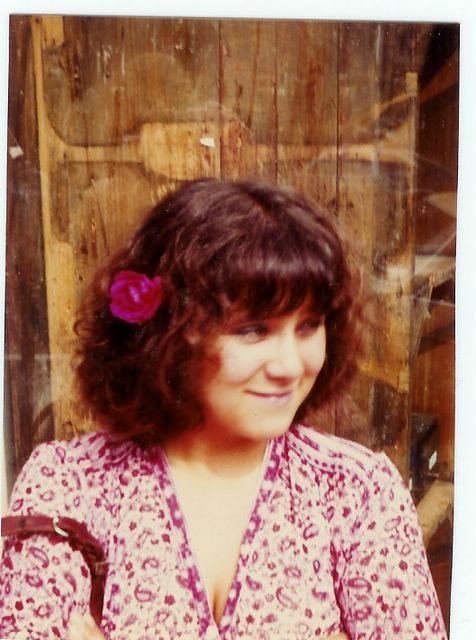
Dana in courtship decor, 1981. Somehow my escape plan never materialized. Posted by Picasa

All the way to Heaven is Heaven.

---St.Catherine of Siena

If only I may grow: firmer, simpler---quieter, warmer.

---Dag Hammarskjold

Since everything is none other than exactly as it is, one may well just break out in laughter.

---Long Chen Pa

The marriage had lasted but 5 years. The exterior usually was ideal. Photos of us look perfect. Wonderful job, nice home, great friends, and most important 2 magnificent children. But there was discontent---unacknowledged, and it had spread fatally. The year was 1968, the sexual revolution just had begun, and there had to be a first victim. We were it.

I didn't take the divorce well. I didn't think it was right. I was ashamed. There never had been divorce on either side of my family---that I know of. That's the point: where I came from, dairyfarming and grapegrowing Western New York, such a thing was a disgrace. She was from Connecticut, where you took "incompatability" in your stride. When she remarried 4 years later she said cheerily, "Now the children will have TWO fathers." I didn't look at it as a grand opportunity. I was bereft not to be raising those kids under my own roof.

My journey of wild wander and mythic monsters had begun in a Bridgeport courtroom. Fifteen years later I was wreckage on a distant shore. There had been tumultuous relationships, all failed. Jobs came and went. In 1974, I found myself in Houston, at John Lomax Jr.'s funeral, sitting in a corner on the floor, weeping. I wanted to go home. I did.

Back in Jamestown after 10 or 15 years, looking for my roots and shelter from the storm, reunion with family wasn't exactly a bed of roses. Emotionally I was coming apart...and a couple of affairs and jobs attempted didn't help. By 1978 I needed a psychiatrist...and somehow got one just right for me then. He was from India and he talked all the time. He didn't think I was crazy, and gave me medication that had me floating like a butterfly. He said I had to succeed at my job, because otherwise I'd have no money to come see him. It was that simple.

A couple years later, I was introduced to Dana through her family. Cousins thought we'd like each other. They lived around my town and we were friends. She was visiting from Ohio. I'd never been there, only passing through a couple times to somewhere else, and I had no interest in visiting the place. I accepted the invitation to meet her down in Sugar Grove, Pennsylvania, one Saturday afternoon. She was younger and I felt like some kind of celebrity. I don't think we were attracted particularly, but we must have chatted pleasantly enough to consider going to a movie that evening. The only shows we wanted to see were playing as a double feature at a drive-in. Once we got there, some kind of magical chemistry took over...and that was it. We finally actually watched those movies at a later date.

The formality of a family introduction appealed to my 1950s sensibilities. I'm one of the only people I know of who's been called both a beatnik and a hippie. But underneath all that is an upbringing of structure and order. This was the first relationship since my marriage that was beginning with this kind of respectability. I had learned that when I "pick up" women---in a bar, a museum, a shop---I lose them the same way I find them. I couldn't take that anymore. Maybe I was ready to settle down.

We courted long distance for only a year. Perhaps we didn't know each other well enough, but we decided we wanted to live together. Dana wasn't that interested in marriage, even if we both wanted children, which we did. I knew my family would go off the deep end if we had a child out of wedlock, so it was I who pushed for getting married. I managed to get to Ohio in my dying Dodge, and asked for her hand in a formal meeting with her mother and father. They didn't know what to make of such a thing. Both well educated with careers, he professing English at OU and she directing a nursing service, they were liberated people...and hardly prepared to accept or refuse a daughter's suitor. "Whatever would make her happy." A date was set for the summer of 1982. One year later our son was born. We welcomed our daughter a few years after that.

Looking back at this Valentine over all those years, we probably are closer to agreement and happiness than we ever have been. We turned out to be the kind of couple that remains 2 distinct individuals. It takes so much hard work, often with irritable rubbing into each other's territory, that our children are surprised when they see us kissing and hugging. What has carried us through is our love of music and laughter, Nature and drama, religion and politics. When we do things together, like shopping and working, we have fun.

Dana is more creative than I am. The ideas she comes up with, supported always with careful research, never stop emerging. I have to be on my toes, and while I may moan and complain I try to balance it with my sincere admiration for her. She found me like some forgotten item at a garage sale. She took me home as a fix-up opportunity. She insisted I get off the butterfly medication immediately. (We informed the doctor a few months later, and he couldn't believe we had managed it.) Over time I see she has allowed me to put myself together, rather than turn me into something I'm not. She has a vast perception, and we keep up with each other. Often one is ahead on something and the other has to catch up...but gradually we are learning to walk together. Love takes time. I guess we both knew that. We are loving more. We are opening our eyes to see Heaven.

Letter To The American Left~~~The WHAT?


Posted by Picasa

There is neither heaven nor earth,
only snow,
falling incessantly.

---Hashin

Life is this simple: We are living in a world that is absolutely transparent and the Divine is shining through it all the time. This is not just a nice story or a fable. It is true.

---Thomas Merton

Don't play as if you've swallowed the metronome!

---Nadia Boulanger

OK, the letter is from Bernard-Henri Lévy...which may be a problem over here. The first a lot of us probably heard of him was due to a review by Garrison Keillor of American Vertigo on the front page in the New York Times last month. http://www.iht.com/articles/2006/01/27/arts/IDBRIEFS28c.php I didn't like the review and thought it revealed Keillor at his uptight-pretending-to-be-cool worst. Levy responded to it a little in an interview, but appears not really to know who Keillor is. http://www.nysun.com/article/26720?page_no=1 So they're even. I doubt Garrison did much more, besides reading the book under review, than Google BHL up...an exhausting proposition.

Bernard-Henri Lévy is one of France's leading philosophers and one of the most esteemed writers in Europe. After starting his career as a war reporter for Combat, the legendary newspaper founded by Albert Camus during the Nazi occupation of France, Lévy became famous as the founder of the New Philosophers group. He's the author of 30 books, including works of philosophy, fiction, and biography and is an activist and filmmaker. His books include Barbarism with a Human Face, Reflections on War, Century of Sartre, Evil and the End of History, Who Killed Daniel Pearl?, and American Vertigo. His films include the documentaries Bosna! and A Day in the Death of Sarajevo. Lévy is co-founder of the antiracist group SOS Racism and has served on diplomatic missions for the French government, most recently heading a fact finding mission to Afghanistan in the wake of the war against the Taliban. For at least a dozen years he's been married to Arielle Dombasle, who regularly is voted in France to be the most beautiful woman in the world. I think he's being truthful when he says he really loves the United States. The letter that follows will be in the February 27th issue of The Nation.

A Letter to the American Left
by BERNARD-HENRI LEVY
Translated from the original French by Charlotte Mandell.

Nothing made a more lasting impression during my journey through America than the semi-comatose state in which I found the American left.

I know, of course, that the term "left" does not have the same meaning and ramifications here that it does in France.

And I cannot count how many times I was told there has never been an authentic "left" in the United States, in the European sense.

But at the end of the day, my progressive friends, you may coin ideas in whichever way you like. The fact is: You do have a right. This right, in large part thanks to its neoconservative battalion, has brought about an ideological transformation that is both substantial and striking.

And the fact is that nothing remotely like it has taken shape on the other side--to the contrary, through the looking glass of the American "left" lies a desert of sorts, a deafening silence, a cosmic ideological void that, for a reader of Whitman or Thoreau, is thoroughly enigmatic. The 60-year-old "young" Democrats who have desperately clung to the old formulas of the Kennedy era; the folks of MoveOn.org who have been so great at enlisting people in the electoral lists, at protesting against the war in Iraq and, finally, at helping to revitalize politics but whom I heard in Berkeley, like Puritans of a new sort, treating the lapses of a libertine President as quasi-equivalent to the neo-McCarthyism of his fiercest political rivals; the anti-Republican strategists confessing they had never set foot in one of those neo-evangelical mega-churches that are the ultimate (and most Machiavellian) laboratories of the "enemy," staring in disbelief when I say I've spent quite some time exploring them; ex-candidate Kerry, whom I met in Washington a few weeks after his defeat, haggard, ghostly, faintly whispering in my ear: "If you hear anything about those 50,000 votes in Ohio, let me know"; the supporters of Senator Hillary Clinton who, when I questioned them on how exactly they planned to wage the battle of ideas, casually replied they had to win the battle of money first, and who, when I persisted in asking what the money was meant for, what projects it would fuel, responded like fundraising automatons gone mad: "to raise more money"; and then, perhaps more than anything else, when it comes to the lifeblood of the left, the writers and artists, the men and women who fashion public opinion, the intellectuals--I found a curious lifelessness, a peculiar streak of timidity or irritability, when confronted with so many seething issues that in principle ought to keep them as firmly mobilized as the Iraq War or the so-called "American Empire" (the denunciation of which is, sadly, all that remains when they have nothing left to say).

For an outside observer it is passing strange, for instance, that a number of progressives needed, by their own admission, to wait for Hurricane Katrina before they got indignant about, or even learned about, the sheer scale of the outrageous poverty blighting American cities.

For a European intellectual used to the battlefield of ideas, it is simply incomprehensible that more voices weren't raised long ago, in the name of no less than the force of "the Enlightenment," to denounce the ridiculous fraud of the anti-Darwinian supporters of "intelligent design."

And what about the death penalty? How can it be that there isn't yet, within the political parties, especially the Democratic Party--which everyone knows will never budge on the question without decisive internal pressure--a trend of opinion calling for the abolition of this civilized barbarity?

And Guantánamo? And Abu Ghraib? And the special prisons in Central Europe, those areas where the rule of law no longer applies? I know, of course, that the press has denounced them. I know you have journalists who, in a matter of days, accomplished what our French press still hasn't finished forty years after our Algerian War. But since when does the press excuse citizens from their political duties? Why haven't we heard from more intellectuals like Susan Sontag--or even Gore Vidal and Tony Kushner (with whom I disagree on most other grounds) on this vexed and vital issue? And what should we make of that handful of individuals who, after September 11, launched the debate about the circumstances in which torture might suddenly be justified?

And I'm not even talking about Bush. I won't even mention Bush's gross lies about the Iraqi weapons of mass destruction, except for the sake of assembling the conclusive evidence. I know, of course, that you denounce him--but mechanically, I am almost tempted to say ritualistically. And yet the United States nearly impeached Nixon because he had spied on his enemies and lied. They impeached Clinton for a venial lie about inappropriate conduct. How is it, then, that it took so long to draw a parallel between those lies and a lie about which the least you can say is that its consequences were anything but venial? How is it that so few "public intellectuals" have been found, within the confines of this formidable, impetuous American democracy, who can bring up the idea of impeaching George Bush for lying?

Some will retort that the "public intellectual" is a European specialty, that we shouldn't blame Americans for their infidelity to a tradition that is not their own. What do such killjoys make of the Norman Mailer of the 1960s? Of the Arthur Miller of The Crucible? Or of that golden age of civil rights awareness, when great writers enunciated what was right and good and true?

Others will object that the massive, resounding mobilization of civil society is not an American custom. All you need to do to convince yourself of the untruth of this is remember the 1960s and the movement for civil rights, then for the rights of minorities in general, which were the honor of the country and did not stem, let it be emphasized, from any of the major political parties.

Still others will wax ironic about the disease of writing up petitions, a French specialty, warded off by American pragmatism. Here the objection is more serious; and I know the fatuity that can exist in the mania for nonstop political engagement in the name of myriad causes--but aren't you afflicted, my American friends, with the radically opposite sickness? Hasn't the ethics of sobriety won once too often, with you, over the ethics of conviction? And how could one not yearn for a petition that would address our common nausea when faced with the spectacle of a diabetic, blind, nearly deaf old man, pushed in his wheelchair to the San Quentin execution chamber in California?

I might be mistaken, but it seems to me that a large part of the country is waiting for this. Everywhere, in the innermost reaches of America, you can meet men and women who hope for great voices capable of echoing their impatience in a momentous way. If I were an American writer, I would try to ponder the lessons of the totalitarian century and those of democracy, Tocqueville-style, all at once, in the same breath, and with the same rigor.

http://www.thenation.com/doc/20060227/levy

Sunday, February 12, 2006

Young Love: Together In France


Graduating from Middle School last year, Ilona and Keenan, with one of his sisters Ameena. Posted by Picasa

The first thing you learn in life is you're a fool. The last thing you learn is you're the same fool. Sometimes I think I understand everything. Then I regain consciousness.

---Ray Bradbury

I embrace emerging experience. I participate in discovery. I am a butterfly. I am not a butterfly collector.

---William Stafford

One day a student asked Taiga, "What is the most difficult part of painting?"
Taiga answered: "The part of the paper where nothing is painted is the most difficult."

---Artist Zen

Yesterday I was sitting around the faculty lounge of one of the Ohio University colleges with a friend. He's a professor and director of graduate programs there. We were drinking some coffee, eating chocolate, and watching the Winter Olympics. Mostly we were talking though. Maybe that combination got us into the topic of early love affairs, but that's what happened. We were comparing our high school experiences. They were rather different, as he was born in Bangladesh.

This morning I'm trying to think back to my very first days of spending time with girls. One time, possibly during the summer vacation between 4th and 5th grade, I went over to see what my little blue-eyed, blonde-haired girlfriend (that my mother approved of a lot) was doing...and as usual her kinda large, faithful, possessive friend Jeannie was there. They were playing house. Being the open-minded, already-liberated guy you know, even in the late '40s, I offered to play. Well...I asked if I could play. Carol and Jeannie whispered together a while, and then said yes. They said I should get up on the porch railing and stand there. I could be Air.

One autumn day in 7th grade social studies class, Miss Weatherly seized a note Carol was passing to Jeannie...and made her stand up in front of the class and read it. She turned the color of a strawberry and with trembling voice did so. It said that her mother didn't want her to be my girlfriend anymore and that she was making her break up with me. Mom feared it would get too serious and we were too young. Then she sat down, put her head in her arms on her desk, and wept ferociously. I was shattered---and part of me still is. Carol married a guy from West Point...and I don't know what happened to Miss Weatherly.

My daughter was in 7th grade 2 years ago, and I was assisting a multihandicapped class in the same school. For the next 2 years I would see Ilona everyday during her lunch period, because I had cafeteria duty...which means you kinda stand around invisible (like Air) and make sure there are no fights. Early in her 8th grade year, I noticed she was starting to sit at a table with all guys. No other girl was doing that, but gradually a few of her friends were curious enough to join her. These particular guys were pretty smart and clever, and so I wasn't concerned. I was rather intrigued. The day it was announced Kerry had lost the election, she found out about it there from Silvie. She stood up, mouth open, turned to suddenly-not-invisible-anymore Dad, came across the whole cafeteria, and wrapped herself around me in tears. We sat down together and collected ourselves. It's one of the proudest moments I have as a parent.

When she went back to that table, I noticed one guy emerged who seemed to comfort her. From that time to this, Keenan has been her friend. Relatively quickly I guess they found affection, and the next February they had declared themselves "going together." In fact Valentine's Day is their "first anniversary," she says. I guess going together is what we called "going steady." Now, in such a situation you don't necessarily "go" anywhere. It's sort of a safe haven for exploration of tender sensitivities, feelings, and loyalties, just outside a turbulent ocean of upheaval. Around Ilona's birthday last year, they had planned a date at last---but what a date! He'd asked her to go see Paul McCartney...and paid for the tickets himself. I won't tell you what they cost.

It was at that point we parents introduced ourselves. The friend I was talking to yesterday is Keenan's dad. They actually had begun planning the date 6 months earlier, and Dana and I met the father last spring at a track meet our kids were running in. He had walked right up to us and Dana said immediately, "You must be Keenan's dad." He was a jubilant bundle of generous energy, and we hit it off at once. From then until now we've discovered our differences in style, interests, and approaches to things, but the whole bunch of us have stuck with it. It's something else I'm proud of because, in my experience, parents of your children's friends don't usually want you this far inside each other's homes. But a reason for our particular intimacy has recently emerged.

Last Thanksgiving, Keenan's dad was dropping him off at our house for an evening and lingered with us in the kitchen. He had a proposal. His work at the University takes him to the college's facilities, which these days reside around the globe. (We won't discuss the politicoeconomics of that situation just now.) He was going to have to be in Pau, France, for 75 days and he was taking the family with him. They wanted to invite Ilona to go along. Dana and I couldn't even get our heads around that, much less give a decision. For the next month we just staggered around dazed, but near Christmas he said we probably ought to come up with an answer because passport and plane ticket need to be addressed.

In the couple months since, I think we've pulled ourselves together and gotten something of a plan together. Obviously the main difficulties are Dana and I never have been to Europe, Ilona's had merely a year and a half of French, and she's only 14. If she were 17 I don't think we'd be quite so worried. Two and a half months is a long time. And does anybody know another family this well? They've rented a house, where Ilona will have her own room, and are arranging with the school in Pau for the young people to attend. We've met with the administration of Athens High to agree on a plan whereby their records can only benefit from the experience. Of course I still can't imagine what it would have been like for me to be immersed in another country and language so far from home. But increasingly we are trusting this incredible opportunity and contributing to its happening. They go next month.

Well...April in Paris. Or at least in the French countryside, with the Pyrenees as a backdrop. A dangerous time in the world? Bird flu, the world of Islam in an uproar, United States people not necessarily the good guys anymore. Yes, we're going to worry everyday, and we'll Instant Message and webcam and telephone all the time. But just maybe this relationship and these young people and a time in beloved France will help us all just a little bit. Perhaps in this very young love is the seed of a tiny part of a new era on this earth for which we all pray.

Thursday, February 09, 2006

Young Love: Alone In Spain


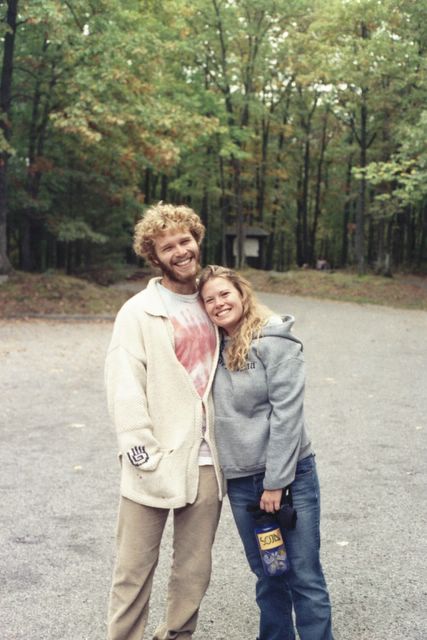
The lovers last summer, together in Kinzua, Pennsylvania. Posted by Picasa

There's no need to discuss the principles of koan study;
just listen carefully
to the wind outside
the pines and cedars.

---Ryonen

Someone else looked at the sky
with the same rapture
when the moon
crossed the dawn.

---Izumi Shikibu

What silence can there be,
What lack of sound compare
to a snowfall from dark air
falling quietly to sea?

---H. D. Eshleman

Yesterday a letter arrived from Espana. It is from a university student who has become very dear to our family these past several months. She is my son's young lady, finishing her advanced degree in Pamplona. He remains here, helping to manage his business. They both are 22.

How well I remember separation at 22. I was at Harvard and she was in Maine, not so far apart as Jeroch and Karen (pronounced KARR-in, as they do in Norway---although few in her life have learned to say it that way). There was a 4-lane highway a few miles outside Cambridge that went right up there. Maybe that made it worse. I only had a bicycle though. Some nights I used to ride it all the way out to that road, and just stand on an overpass, looking North...howling at the moon.

Perhaps Jeroch is a better man than I was. I hope so. A father hopes that for his son. After a month apart, he still appears with a ready smile and his customary hug of encouragement. He asks how we're doing, and he wants to know. He listens intently to any troubles. I have to press him for news of his heart. But he tells us cheerfully of emails and phone calls.

It was just a phone booth for me. One of those old kind you got in and closed the folding door. Encased in a standup coffin with a pocketful of change. The operator would interrupt: she wanted more money. I would plead for just a few more seconds to say goodbye. Fortunately, in New England in the early '60s, they were merciful. Ma Bell we used to nickname the company.

The computer cafe in Pamplona costs money though. I don't know what arrangement they have for long international telephoning. With all the possibilities of Instant Message these days, I'm sure they could work something out...even with a webcam. But not at the cafe I guess. So they make do...and write and phone a lot. And count the days. "I am almost into February," she was writing at the end of January, "and February is the shortest month of the year."

One's heart surely is tested and strengthened in these times apart. It doesn't matter if you're not as young as these two. When Dana and I were courting, we both had jobs and cars but 400 miles of separation. We chose a location on the map halfway and used to meet there. What passion when we'd touch! It's good to remember that, revitalizing like a spring fountain.

Karen is living with a Spanish family, learning the language better and personally, and much about cooking their way. She loves to travel and explore, and so whatever time she can spare from her "pretty tough" courses she's out "into the countryside and the mountains." There's a monastery "built into a mountainside in the 8th century" and El Castillo de Loarre, which she says may be the best preserved Romanic castle in the world. http://www.castillodeloarre.org/amigos/006-Imagenes-0010Scott-Index.htm

And then there is Pamplona itself. "I am in love," she writes. "My window overlooks a huge park, with cathedral towers peeking out behind, and mountains peeking out from behind them. There is a bird sanctuary that is a minute (on foot) away---peacocks and black swans, even roosters---and Giant Sequoyas tower over the rest of the park's canopy. The buildings downtown are beautifully old and worn, with flowers draped off of balconies. The streets are winding and cobblestoned, too narrow for cars (at least the American kind). The coffee is strong, the food is fresh, and the people are warm. I feel safe here, even alone at night." At that point her letter drifts a few sentences into thoughts of Jeroch and missing him...and vivid dreams she has, and how she loves those times of aloneness. Oh, the bittersweet hours. "My blankets are so soft, and the lights from the park cast beautiful shadows that dance around my room at night."

Isn't that lovely, and isn't she sweet to write so gently? When you miss a loved one, any touch from the familiar back around him eases the longing. It intensifies the moments that can be spared in remembering and, perhaps with moist eyes, hugging oneself...or a suddenly very personal pillow. Writing to us touches him too. We stand as a family, looking her way, and awaiting her return. We too are in growing health to be near their young love.

Sunday, January 29, 2006

Optimism: The State Of The Union


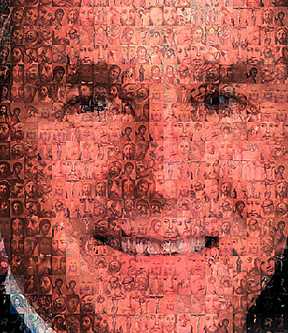
Alabama artist Frank Bear illustrated support for George W. Bush as a follower of Jesus Christ by this work, titled "Our Christian President." The artist pieced together individual portraits of Jesus Christ to make the image of President Bush. Posted by Picasa

To the right, books; to the left, a tea-cup. In front of me, the fireplace; behind me, the post. There is no greater happiness than this.

---Teiga

We are living in a historical period in which we understand that it is necessary for all of us to be conscious and active in our world. None of us can ignore this call to action. And yet, if we do not practice zazen, whether we call it zazen or whatever we call it and however we do it, we cannot act in any accurate way. There has been plenty of action---too much action. What we need is not more action, we need enlightened action. And this means letting go of action.

---Norman Fischer

Swallow the stars until you are one with the universe, with all-pervading universal life.

---Soen Nakagawa

FOXNews has begun the drone repetition of the word "optimism" to prep its millions of viewers for what has become the annual crock in America known as The State Of The Union Address. Obviously I'm not responding well. And thus I place myself in my own concentration camp of negativists and boat-rockers. Such people are not well liked in America, which is why they must be put in detention. They're depressing and they slow us down. People who try to rock the boat are dangerous. Our tradition in these United States is optimism! Naysayers can go someplace else to live---like over to France for instance.

Am I just being facetious? What may have been funny a while ago has gotten serious today. One of my assignments at work is to assist 2 multihandicapped boys in a 7th grade science class of developmentally handicapped students. This placement supposedly is enrichment for our guys---but that's another topic. We're studying El Nino and the ocean currents presently. I've known the teacher for about 10 years. She used to eat lunch in her classroom, listening to Rush Limbaugh's daily broadcast. Sometimes we'd talk politics and religion, and as long as we smiled it went OK. On Friday I brought her a printout of an article in Thursday's Christian Science Monitor, which examines the mineral deposits of tiny creatures that perished during a similar "global warming" 55 million years ago http://www.csmonitor.com/2006/0126/p16s01-stss.html . Not only didn't she want to read it, but she said she didn't have to read it. "How do we know what happened 55 million years ago?" she exclaimed with irritation. She was annoyed. She already had told me global warming is only a theory...and even if it's happening, it's a natural trend that comes and goes from time to time. Anyway, I'm not her boss and who am I to bring her this printout? She would complain to others about me now. She can pull rank on me, claim I disturb her procedure, and have me removed. What I presumed was collegial friendship changed in a flash.

The boy emperor will give the call to his sheep on Tuesday night. That's what Gore Vidal and Chalmers Johnson call him: the boy emperor. A Hun is at the helm and we enter the Dark Age. "For what we are now seeing are the obvious characteristics of the West after the fall of Rome: the triumph of religion over reason; the atrophy of education and critical thinking; the integration of religion, the state, and the apparatus of torture--a troika that was for Voltaire the central horror of the pre-Enlightenment world; and the political and economic marginalization of our culture." http://www.huffingtonpost.com/gore-vidal/president-jonah_b_14439.html What I am feeling more and more every day in America at the very depth of my being is the subjection of reason to faith and authority. Nothing stops him. No election, no legal apparatus, no media attention, no legislative investigation. We don't want to hear it! We want the bright side. Is this what it's like to live in a dictatorship?

Here's Congressman Dennis Kucinich of Ohio~~~

The Truth About The State Of Our Union
Dennis J. Kucinich
Fri Jan 27, 9:28 PM ET

On Tuesday night President Bush will stand before the Congress and the nation to deliver his annual State of the Union address. We are sure to hear a rosy tale of an economy on the rebound, a blossoming democracy in Iraq, a terror network on the run, and a Gulf Coast region rebuilding better and stronger than ever before. As is most often the case with this Administration, the rhetoric does not match reality.

The facts are clear. Our economy is struggling and leaving tens of millions of Americans behind. According to the non-partisan National Journal, since President Bush first stood before Congress and the nation in 2001, the median income in this country has decreased, the jobless rate has jumped from 3.9% to 4.9% and the number of families living in poverty has increased from 8.7% to 10.2%. Our trade deficit has doubled. Inflation has gone up. Personal bankruptcies have gone up. Consumer debt has gone up. College tuition has gone up. And, the price of gas has gone up. All the while, this Administration has turned a $128 billion federal budget surplus into a $319 billion deficit.

Today, almost 6 million more Americans do not have any health insurance than when President Bush took office. In total, over 45.5 million Americans, or over 15% of our total population, have no health care coverage at all.

During his 2003 address, President Bush told the nation that Saddam Hussein "had biological weapons sufficient to produce over 25,000 liters of anthrax", "materials sufficient to produce more than 38,000 liters of botulinum toxin", "as much as 500 tons of sarin, mustard and VX nerve agent" and "upwards of 30,000 munitions capable of delivering chemical agents".

Today, almost three years after the start of the President's war of choice, we know Iraq had no weapons of mass destruction, had no connection to al-Qaeda and posed no threat to our nation. Yet, our armed forces are bogged down in the middle of civil war that our own generals say cannot be won by military force. Our presence in Iraq is counterproductive and has cost the lives of over 2,200 US troops and $250 billion.

President Bush has delivered four State of the Union addresses since the attacks on our nation on 9/11. In four speeches, the President has never once mentioned Osama bin Laden, the mastermind of the terror attacks on this nation. The status of the FBI's most wanted man apparently is not important to the state of our union. Yet, in the same four speeches, President Bush has mentioned Saddam Hussein 24 times, and Iraq 78 times.

President Bush used the opening of his 2003 State of the Union to praise the creation of the Department of Homeland Security. This year our nation, and the world, saw the result of the failure of this massive reorganization of our government. As Katrina rolled ashore, destroying large cities and small towns in four states, it was FEMA, once an independent cabinet level agency--but now rolled into Department of Homeland Security--that failed to react. The searing image of thousands of Americans stranded without food and water dying on American streets will be the lasting legacy of the Department of Homeland Security, not a reorganized government "mobilizing against the threats of a new era" as the President described in his speech.

In his 2004 and 2005 addresses, the President spent a considerable amount of time advocating policies that would roll back much of the social progress made since the New Deal. In 2004, the President touted a Medicare prescription drug bill that will fatten the pockets of the pharmaceutical industry, endangering the future finances of the entire Medicare program, while leaving seniors confused and empty handed as they try to fill their prescriptions under the new plan. In 2005, the President used his address to promote his plan strip seniors of the guaranteed promise of Social Security, and replace it with a risky scheme to gamble their future in the stock market.

What the President has in store for his message this year is not known yet. But, we do know the President Bush will speak in glowing terms about the state of our union. The truth is the state of our union is in great peril. This Administration is conducting a war with no end in Iraq, illegally spying on Americans at home, overseeing an economy that is increasingly leaving more and more Americans behind and abandoning Gulf in their hour of great need.

If recent history is any precedent, then next week we should see more of the same old dance around reality that has been the hallmark of President Bush's annual address.

http://kucinich.house.gov/News/DocumentSingle.aspx?DocumentID=38831

Thursday, January 19, 2006

Bummed Out By Thursday


In the photo the writer and his wife listen to Paul Hackett, candidate for the US Senate from Ohio in the upcoming Democratic primary. http://www.hackettforohio.com/ Posted by Picasa

In Zen meditation we think non-thinking---that is, we think nothing. What this means is that our whole psychological mind ceases to function, and as a result, our whole being becomes united with the essence of mind, which we signify by Mind. You call this essence the God within you, absoluteness, ultimate reason---it doesn't matter. No matter what you call it, to unite with this essence is the very reason we are gathered here to meditate.

---Robert Aitken

To be a philosopher is not merely to have subtle thoughts, nor even to found a school, but so to love wisdom as to live according to its dictates, a life of simplicity, independence, magnanimity, and trust.

---Henry David Thoreau

People with opinions just go around bothering one another.

---The Buddha

I woke up this morning with a vow in my head to ignore the news and controversies of the day. Like many people in the United States and around the world, I've come to think the news endangers my health. I know many people who are adamant about not wanting to learn what's going on. They say even if you do find out, what do you believe? Everybody lies and twists and distorts. It's all maddening so for a balanced and positive outlook on life, it's better not to look, think about it or know about it. This morning I tried not to think or to look. How did I do?

I did rotten. I'm going to blame the shipment of news from Wednesday, and hope to do better tomorrow. One day at a time for a news junkie. I can lick this thing! But not today.

The New York Times
January 18, 2006
2002 Memo Doubted Uranium Sale Claim
By ERIC LICHTBLAU

WASHINGTON, Jan. 17 - A high-level intelligence assessment by the Bush administration concluded in early 2002 that the sale of uranium from Niger to Iraq was "unlikely" because of a host of economic, diplomatic and logistical obstacles, according to a secret memo that was recently declassified by the State Department.

Among other problems that made such a sale improbable, the assessment by the State Department's intelligence analysts concluded, was that it would have required Niger to send "25 hard-to-conceal 10-ton tractor-trailers" filled with uranium across 1,000 miles and at least one international border.

The analysts' doubts were registered nearly a year before President Bush, in what became known as the infamous "16 words" in his 2003 State of the Union address, said that Saddam Hussein had sought significant quantities of uranium from Africa.

The White House later acknowledged that the charge, which played a part in the decision to invade Iraq in the belief that Baghdad was reconstituting its nuclear program, relied on faulty intelligence and should not have been included in the speech. Two months ago, Italian intelligence officials concluded that a set of documents at the center of the supposed Iraq-Niger link had been forged by an occasional Italian spy.

http://www.nytimes.com/2006/01/18/politics/18niger.html?oref=login

White House Silent on Abramoff Meetings
By NEDRA PICKLER, Associated Press Writer
Tue Jan 17, 4:56 PM ET

The White House is refusing to reveal details of tainted lobbyist Jack Abramoff's visits with President Bush's staff.

Abramoff had "a few staff-level meetings" at the Bush White House, presidential spokesman Scott McClellan said Tuesday. But he would not say with whom Abramoff met, which interests he was representing or how he got access to the White House.

Since Abramoff pleaded guilty two weeks ago to conspiracy, mail fraud and tax evasion charges in an influence-peddling scandal, McClellan has told reporters he was checking into Abramoff's meetings. "I'm making sure that I have a thorough report back to you on that," he said in his press briefing Jan. 5. "And I'll get that to you, hopefully very soon."

McClellan said Tuesday that he checked on it at reporters' requests, but wouldn't discuss the private staff-level meetings.

He has said Abramoff attended three Hanukkah receptions at the White House, but corrected himself Tuesday to say there were only two — in 2001 and 2002.

McClellan said Bush does not know Abramoff personally, although it's possible the two met at the holiday receptions.

Abramoff was one of Bush's top fundraisers, having brought in at least $100,000 for the Bush-Cheney '04 re-election campaign and earning the honorary title "pioneer." The campaign took $6,000 of the contributions — which came directly from Abramoff, his wife and one of the Indian tribes he represented — and donated it to the American Heart Association. But the campaign has not returned the rest of the money Abramoff raised.

http://news.yahoo.com/s/ap/20060117/ap_on_go_pr_wh/white_house_abramoff

Democrats outline ethics reform plan in Ohio
Associated Press
Wednesday, January 18, 2006 3:13 PM

National Democrats promoted their ethics reform package today in battleground Ohio, which party Chairman Howard Dean called the center of Republican corruption scandals.

Dean outlined a package of measures to bar members of Congress from accepting gifts from lobbyists, pointing to a federal investigation of GOP Rep. Bob Ney of Ohio, who is accused of taking bribes from former Washington lobbyist Jack Abramoff.

"The cost of corruption is real to Ohioans, and it's real to Americans, and we're going to put an end to that," said Dean, standing just a few feet away from the ceremonial Statehouse office of Gov. Bob Taft.

The Republican governor pleaded no contest in August to failing to report golf outings and other gifts he was treated to, becoming the state's first governor convicted of a crime.

Dean's visit gave a national stage to an argument Ohio Democrats have been making for months: voters should end 12 years of Republican domination of state government because of pervasive GOP corruption.

That includes a scandal involving $300 million in investment losses at the state insurance fund for injured workers.

Democratic candidates for several statewide offices including governor are sounding similar themes as they try to win back seats in the state that has failed to elect a president just twice in more than 100 years.

Republicans dismissed the event as a publicity stunt and said GOP leaders have moved quickly to address problems.

http://www.dispatch.com/news-story.php?story=160712

The Hartford Courant
What Are They Doing With All Our Data?
Laura K. Donohue
January 17 2006

Congress will soon hold hearings on the National Security Agency's domestic spying program, secretly authorized by President Bush in 2002. But that program is just the tip of the iceberg.

Since Sept. 11, 2001, the expansion of efforts to gather and analyze information on U.S. citizens is nothing short of staggering. The government collects vast troves of data, including consumer credit histories and medical and travel records. Databases track Americans' networks of friends, family and associates, not just to identify who is a terrorist but to try to predict who might become one.

Remember Total Information Awareness, retired Adm. John Poindexter's effort to harness all government and commercial databases to preempt national security threats? The idea was that disparate, seemingly mundane behaviors can reveal criminal intent when viewed together. More disturbing, it assumed that deviance from social norms can be an early indicator of terrorism.

Congress killed that program in 2003, but according to the Associated Press, many related projects continued.

http://www.courant.com/news/opinion/op_ed/hc-donohue0117.artjan17,0,992533.story?coll=hc-headlines-oped

The New York Times
January 18, 2006
Editorial
Spying on Ordinary Americans

In times of extreme fear, American leaders have sometimes scrapped civil liberties in the name of civil protection. It's only later that the country can see that the choice was a false one and that citizens' rights were sacrificed to carry out extreme measures that were at best useless and at worst counterproductive. There are enough examples of this in American history - the Alien and Sedition Acts and the World War II internment camps both come to mind - that the lesson should be woven into the nation's fabric. But it's hard to think of a more graphic example than President Bush's secret program of spying on Americans.

The White House has offered steadily weaker arguments to defend the decision to eavesdrop on Americans' telephone calls and e-mail without getting warrants. One argument is that the spying produced unique and highly valuable information. Vice President Dick Cheney, who never shrinks from trying to prey on Americans' deepest fears, said that the spying had saved "thousands of lives" and could have thwarted the 9/11 attacks had it existed then.

Given the lack of good, hard examples, that argument sounded dubious from the start. A chilling article in yesterday's Times confirmed our fears.

According to the article, the eavesdropping swept up vast quantities of Americans' private communications without any reasonable belief that they could be related to terrorism. The National Security Agency flooded the Federal Bureau of Investigation with thousands of names, e-mail addresses, telephone numbers and other tips that virtually all led to dead ends or to innocent Americans.

http://www.nytimes.com/2006/01/18/opinion/18wed1.html?hp

Human Rights Watch World Report 2006
Author: Human Rights Watch
Published on Jan 18, 2006, 07:49

New evidence demonstrated in 2005 that torture and mistreatment have been a deliberate part of the Bush administration's counterterrorism strategy, undermining the global defense of human rights, Human Rights Watch said today in releasing its World Report 2006.

The evidence showed that abusive interrogation cannot be reduced to the misdeeds of a few low-ranking soldiers, but was a conscious policy choice by senior U.S. government officials. The policy has hampered Washington's ability to cajole or pressure other states into respecting international law, said the 532-page volume's introductory essay.

"Fighting terrorism is central to the human rights cause," said Kenneth Roth, executive director of Human Rights Watch. "But using illegal tactics against alleged terrorists is both wrong and counterproductive."

Roth said the illegal tactics were fueling terrorist recruitment, discouraging public assistance of counterterrorism efforts and creating a pool of unprosecutable detainees.

http://www.yubanet.com/artman/publish/article_30502.shtml

Ex-EPA Chiefs Blame Bush in Global Warming
By JOHN HEILPRIN, Associated Press Writer
Wed Jan 18, 5:48 PM ET

WASHINGTON - Six former heads of the Environmental Protection Agency — five Republicans and one Democrat — accused the Bush administration Wednesday of neglecting global warming and other environmental problems.

"I don't think there's a commitment in this administration," said Bill Ruckelshaus, who was EPA's first administrator when the agency opened its doors in 1970 under President Nixon and headed it again under President Reagan in the 1980s.

Russell Train, who succeeded Ruckelshaus in the Nixon and Ford administrations, said slowing the growth of "greenhouse" gases isn't enough.

"We need leadership, and I don't think we're getting it," he said at an EPA-sponsored symposium centered around the agency's 35th anniversary. "To sit back and just push it away and say we'll deal with it sometime down the road is dishonest to the people and self-destructive."

All of the former administrators raised their hands when EPA's current chief, Stephen Johnson, asked whether they believe global warming is a real problem, and again when he asked if humans bear significant blame.

Agency heads during five Republican administrations, including the current one, criticized the Bush White House for what they described as a failure of leadership.

http://news.yahoo.com/s/ap/20060118/ap_on_go_ot/global_warming

The Washington Post
Is It Warm in Here?
We Could Be Ignoring the Biggest Story in Our History
By David Ignatius
Wednesday, January 18, 2006; A17

The best reporting of the non-news of climate change has come from Elizabeth Kolbert in the New Yorker. Her three-part series last spring lucidly explained the harbingers of potential disaster: a shrinking of Arctic sea ice by 250 million acres since 1979; a thawing of the permafrost for what appears to be the first time in 120,000 years; a steady warming of Earth's surface temperature; changes in rainfall patterns that could presage severe droughts of the sort that destroyed ancient civilizations. This month she published a new piece, "Butterfly Lessons," that looked at how these delicate creatures are moving into new habitats as the planet warms. Her real point was that all life, from microorganisms to human beings, will have to adapt, and in ways that could be dangerous and destabilizing.

So many of the things that pass for news don't matter in any ultimate sense. But if people such as (Thomas E.) Lovejoy and Kolbert are right, we are all but ignoring the biggest story in the history of humankind. Kolbert concluded her series last year with this shattering thought: "It may seem impossible to imagine that a technologically advanced society could choose, in essence, to destroy itself, but that is what we are now in the process of doing." She's right. The failure of the United States to get serious about climate change is unforgivable, a human folly beyond imagining.

http://www.washingtonpost.com/wp-dyn/content/article/2006/01/17/AR2006011700895.html

OH BOY!

Friday, December 16, 2005

The Ugly Legacy Of Coal


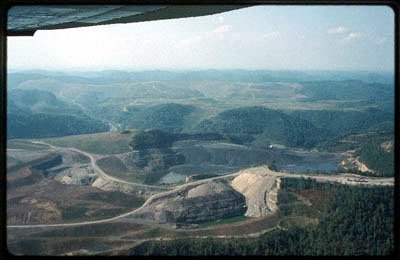
Mary Hufford took this photograph of mountain top removal. This and others are at the Library of Congress site Tending the Commons: Folklife and Landscape in Southern West Virginia. http://memory.loc.gov/ammem/collections/tending/ Posted by Picasa

When a thing is funny, search it carefully for a hidden truth.

---George Bernard Shaw

Searching for words, hunting for phrases, when will it end?
Esteeming knowledge and gathering information only maddens the spirit.
Just entrust yourself to your own nature, empty and illuminating---
Beyond this, I have nothing to teach.

---Bankei

Dying cricket,
His song so full
of life.

---Basho

One of the first questions people ask when they move to a mining area of the Appalachians---or even just drive through mountains of West Virginia, Kentucky, Pennsylvania, Ohio---is "What's happening over there?" They're referring to a startling bare spot on the horizon, out in the middle of nowhere, no towns around, maybe a big crane thing sticking up. What you're seeing is called strip mining or mountain top removal, and the little part of the machine inadvertently visible from the highway might be something like The Big Muskie, which was the largest mobile land machine in the world http://little-mountain.com/bigmuskie/ . It would take a stack of books to describe the history of coal mining and its effect on the lives of the people here---and certainly other regions of the Earth too---but did you know that history continues? Mining goes on here, providing jobs and taking them away, with mountain folks wrestling the same issues they've had to deal with for 200 years.

A great warrior and inspiration to me is Elisa Young, who lives among the coal-powered electric plants around Racine, down on the Ohio River. That's just a couple dozen miles and around a few riverbends from Cheshire, the town American Electric Power BOUGHT rather than clean up their stacks to remove the toxicity that brought poison to the lives of people who used to live there---and toxic rain to the Adirondacks. She's down there going to public meetings and hearings day and night, and reports on her work (all sparetime, as she has a regular job) at a Sierra Club website our local group maintains.

Earlier this week she posted an editorial I'd like you to read. It appeared in the Lexington Herald-Leader on Monday, and was written by Erik Reece, who teaches writing at the University of Kentucky, and wrote a piece called "Death of a Mountain" in the April Harpers Magazine~~~

Coal companies' damage easy to see

By Erik Reece

Bill Caylor (President of the Kentucky Coal Association), in his latest apology for the damage that large coal corporations are inflicting on Eastern Kentucky, claims that while pessimistic editorialists never change, the coal industry has. Certainly no one is getting gunned down in the streets of Matewan anymore. But how much has the industry changed?

Ask Larry Gibson, who, because he refuses to sell his mountaintop homeplace, has seen his cabin set on fire, his two dogs shot and his solar panels sabotaged.

Ask Judy Bonds and Bo Webb of Coal River Mountain Watch, who received death threats last month because they dare to criticize the industry.

Ask Patsy Carter, who, after her daughter was killed by an overloaded coal truck, began speaking out. Since then, she has had 22 flat tires. At night, she can hear nails hit her mailbox as coal trucks speed by.

I have met a whole lot of decent people in the coal industry. But despite corporations' legal right to operate as "persons" under the law, a corporation is not a person. And as the 2000 Martin County disaster showed, corporations often operate without the moral compass that we hope will guide individuals.

How else can one explain why, over the last four years, 65,000 coal trucks have left Massey Energy's treatment plant in Sylvester, W.Va., and, according to an internal document, every single one was illegally, dangerously overloaded.

To look at the eastern coalfields on an aerial map and to see the black scars left by mountaintop removal is like looking at the X-ray of someone suffering from lung cancer. Caylor asserts, correctly, that only "7 percent of all of Appalachia" has been mountaintopped. But what if 7 percent of someone's lung was cancerous, and a doctor said there was no need to treat it?

"But won't it spread?" asks the patient.

"Of course it will," the doctor replies.

"But shouldn't we stop it?"

"Nope. Keep smoking. It's good for the cigarette industry and good for our economy."

I don't evoke this sad analogy lightly. Strip mining is destroying life in the streams of Appalachia and, as an Eastern Kentucky University study of Letcher County found, that polluted water is causing cancer and many other serious health problems throughout the region.

Without serious state or federal intervention, mountaintop mining will continue to spread havoc across Eastern Kentucky.

Caylor asserts that coal mining supports 14,000 jobs in Eastern Kentucky. But according to the Kentucky Coal Association's own Web site, only 5,237 of those jobs are on surface mines. That's about 100 jobs for each Appalachian county in Kentucky. Is destroying entire watersheds -- their trees, their water, their soil, their people -- worth 100 jobs?

"It's the lack of jobs that creates poverty," Caylor writes. It sure is, and it is the increased mechanization of the coal industry over the last few decades that is directly responsible for the lack of jobs in Eastern Kentucky.

It is no coincidence that the counties that have seen the most strip mining remain the poorest.

Caylor is right about one thing, though. We should retire the phrase "act of God" when talking about the damage caused by mountaintop mining. The floods and mudslides that, over the past five years, have killed 14 people who lived under strip mines in southern West Virginia were clearly acts of man. The only act of God was the creation of the Appalachian mountains -- the most biologically diverse ecosystem in North America.

Genesis 2:15 says that the creator put human beings on the Earth "to work it and take care of it." But we have been very poor stewards of the creation, and there may be hell to pay.

But because Caylor says that opponents of strip mining never have a "vision for the future," I want to offer one in the form of the Appalachian Regional Reforestation Initiative.

Paul Rothman and Patrick Angel from the Office of Surface Mining have been encouraging coal companies to reclaim strip jobs with the kinds of trees that the bulldozers unearthed.

There is so much abandoned mine land in Eastern Kentucky right now that a tree reforestation program, funded by the state's severance tax, could reduce the region's unemployment rate to zero. Erosion and flooding would decrease, carbon sequestration would increase and Eastern Kentucky would finally have a wood-products industry that might bring an end to the ugly legacy of coal.

--------------------------------------------------------------------------------
© 2005 Lexington Herald-Leader and wire service sources
http://www.kentucky.com/mld/kentucky/news/editorial/13375607.htm

Erik's Harpers essay, with photos, is preserved here http://www.wesjones.com/death.htm

Elisa added the following in her post~~~

"Thought I would forward this and say the violence is not exaggerated.

"Larry called me one night about a month ago when he dropped a friend of ours off after they'd been out to speak against on MTR (mountain top removal), and her husband was waiting for her - with a pistol. He called to ask me to find out what kind of trouble they were having.

"Halloween they tried to burn Maria's footbridge to her home in the hollow while I was on the phone with her and she had to leave to run and put the fire out. If she loses her bridge it's a one mile walk back into the hollow and a half mile down the hill, and they are carrying in all of their drinking water since MTR started. The estimate to install city water is over $30,000. They don't have that kind of money and the coal company refuses to take responsibility."

People who live in the mountains around here tend to be fiercely independent, trying to sustain their lives without receiving charity from anywhere. You can't depend on government benefits because the next election may wipe them all out. So they garden a little bit, gather herbs and roots, barter, make crafts and moonshine, and grab jobs when one comes around. It's a rough life, but they think living in the mountains is worth it. Mountain top removal? I heard one guy say, "Hey, the top is the best part!"

Thursday, December 15, 2005

Who Are You Supporting In The Iraqi Election Tomorrow?


Posted by Picasa The picture is from a Fox News PhotoEssay entitled Iraq Vote.

Truly, the greatest gift you have to give is that of your own self-transformation.

---Lao Tzu

To live content with small means; to seek elegance rather than luxury, and refinement rather than fashion; to be worthy, not respectable, and wealthy, not rich; to listen to stars and birds, babes and sages, with open heart; to study hard; to think quietly, act frankly, talk gently, await occasions, hurry never; in a word, to let the spiritual, unbidden and unconscious, grow up through the common---this is my symphony.

---William Henry Channing

Our reason has driven all away. Alone at last, we end up by ruling over a desert.

---Albert Camus

I understand President Bush is blaming faulty intelligence for the White House Christmas card this year. It greets his supporters with "Best wishes for a holiday season of hope and happiness." The CIA hadn't told him the War on Christmas has escalated to the incendiary point shots would be fired over his use of "holiday." John Breneman says Rove quickly reworded the inscription to read, "Merry Birth Anniversary of Jesus Christ, our Lord and Savior who died on the cross for our sins so that we may ascend to the Kingdom of Heaven." http://www.seacoastonline.com/news/johnb/12_12fake.htm The President has planned an address to cadets at West Point later today to wish everyone a "Merry Christmas, especially all our friends in the Muslim world," and of course to credit the CIA with doing a heck of a job.

So they're voting in Iraq. Congress is poised to contribute another $50 billion dollars for the war over there, as the Pentagon is requesting $100 billion beyond that right away. http://www.theage.com.au/news/World/Bush-says-Iraq-war-right-facts-wrong/2005/12/15/1134500935484.html With that kind of cash on the ---er--- barrelhead, it occurs to me you probably are watching the Iraqi election pretty closely. After all, the freely elected democracy in Iraq is the real reason we're over there. Or is it the latest reason?

I would never accuse anyone of Bush's stature to be a flip-flopper, but is there a logical consistency to all this? Didn't he say the other day that even if he'd known the intelligence was faulty (and whatever happened to the Downing Street Memo?) we'd have staged Shock and Awe? I think he did. Saddam was a bad man and had to go. And yesterday he said, "Given Saddam's history and the lessons of September the 11th, my decision to remove Saddam Hussein was the right decision." http://www.bloomberg.com/apps/news?pid=10000087&sid=aOxFsmhzls_g&refer=top_world_news Everyone knows Saddam and 9/11 are linked.

Since September 2nd, and Katrina, Bush has been on the campaign trail (paid for by whose tax-cut dollars?) to recover the polls. And it's working like a charm. James Ridgeway has chronicled the whole trip with a timeline that Rove must have planned out on his computer. http://villagevoice.com/news/0551,ridgeway,71059,2.html Step by step Bush has escalated his rhetoric until we're right back where we started. The only thing he hasn't repeated is Saddam was buying yellowcake in Niger. Hello Patrick Fitzgerald, are you still out there?

So what will the election in Iraq accomplish for the Bush team? William Rivers Pitt has organized the factions and issues for us, and set forth the possibilities. Here's the whole essay~~~

Meet the New Boss
By William Rivers Pitt
t r u t h o u t Perspective

Wednesday 14 December 2005

There is an election taking place in Iraq on Friday. According to those who still maintain some kind of hope that the wretched situation over there can be salvaged at the ballot box, this election will be a turning point. "If the result is seen to be fair and the government elected for the next four years is accepted as broadly representative of the interests of most Iraqis," writes Liz Sly in the Chicago Tribune, "there is a real chance that the insurgent violence and the sectarian rivalries that are pushing the country close to civil war will abate."

This vote, the third since the occupation began, is meant to elect a 275-person parliamentary body called the Council of Representatives. All 18 Iraqi provinces will be participating in the election. The Sunnis, who mostly boycotted the elections last January, are expected to participate in far larger numbers this time around. Leading Sunni clerics have issued a fatwa which decrees that Sunni participation in this election is a religious duty.

This election will be no panacea, despite what the hopefuls think. Every electoral model has the Shia and Kurds assuming dominant positions in the Iraqi government. Even if every Sunni in Iraq goes to the polls, they make up only 20% of the overall population. Electoral formulas meant to enhance Sunni power within an Iraqi government will still leave them deeply in the minority.

A collection of leading Sunni parties called the Iraqi Consensus Front has been pushing a straightforward slogan: "Our goal is to get the invaders out and rebuild the country." If their minority status prevents the Sunnis from achieving their first goal according to their wishes, they may well return to violence to achieve their second goal. A leaflet was broadly distributed in the Azamiyah neighborhood of Baghdad last Monday. Sunni Arabs may have a chance to advance their cause politically in the upcoming elections, read the leaflet, but "the fighting will continue with the infidels and their followers."

The campaigning itself, which ended on Tuesday, has been a half-baked farce all too reminiscent of America's watered-down and money-driven electioneering. Thanks to the assassinations and attempted assassinations of several candidates, and thanks to the ever-present threat of violence, almost all campaigning has been done via television. Because television time is prohibitively expensive, only the campaigns with significant financial resources will ever become known to the Iraqi people. Hundreds of viable candidates, a number of them secular, don't stand a chance next to well-funded religious campaigns whose cash comes from unknown and potentially dangerous outside sources.

Juan Cole, professor of Modern Middle East and South Asian History at the University of Michigan, does not see how this election can possibly be seen as credible. "As with the Jan. 30 elections," writes Cole, "the Dec. 15 elections are not being held in accordance with international standards of fairness, and cannot be. Proper elections would require that security be provided to voters and candidates. But there is no security. In many parts of the center-north, voters will have no guarantee of coming home alive. The only way the vote will happen at all is that the US military has forbidden all vehicular traffic, so everyone has to walk for the next few days. This tactic prevents car bombings from disrupting the elections, but it is a desperate measure and not a sign of an election that could be certified as free and fair."

In one sense, however, one can appreciate how difficult it must be to mount an effective political campaign in Iraq. Beyond the real possibility of getting shot, a candidate must face a divided populace that does not, according to a recent ABC News/Time poll taken in Iraq, seem to know what it wants. Make sense of these numbers: 90% believe Iraq needs democracy, but 91% believe Iraq needs a single strong leader; 48% want the mullahs to rule, but only 13% want an Islamic state; 48% think religious leaders should rule, while 49% think military leaders should rule.

The most gifted and adept American politician would struggle to develop a coherent message in this situation. Half the populace wants religious leadership, half the populace wants military leadership, and simultaneously the vast majority believes either of these is amenable to democracy. The only issue the Iraqi people have a clear consensus on is the occupation itself; by large majorities, they want the Americans out.

Imagine, for a moment, that the Iraqi elections on Friday come off without a hitch. No one is killed, maimed or intimidated into voting for a particular candidate by having a gun barrel put to his head. There are no hanging chads, no mayhem or madness. What will the Iraqi and American people get out of the incredible blood and treasure we have poured into this conflict?

We will get an Iraqi government dominated by known and notorious terrorists. We will get an Iraqi government dominated by Iran.

The Shia will walk away from Friday with the lion's share of control over the Iraqi government. The two most powerful Shia political parties, the ones that will come out of this with the big wins, are the Dawa Party and the Supreme Council of the Islamic Revolution in Iraq, which is known by the initials SCIRI. Both were founded and funded by Iran in the 1980s. Both have a history of spectacular violence against the United States and other nations. "These guys are murderers," says former CIA agent Bob Baer, who dealt with Dawa during the 1980s. "They were the core element that blew up our embassy in Beirut in 1983."

Paul Mulshine, writing last week for the New Jersey Star-Ledger, encapsulates this amazing turn of events. "What would you call someone who wants to hand over control of Iraq to a group of terrorists that first made its reputation by blowing up a couple of American embassies?" wrote Mulshine. "I'd call him President Bush. The group is called the Dawa party. In the early 1980s, Dawa terrorists bombed our embassies in Kuwait and in Lebanon. They were universally recognized as vicious America-hating, Iranian-supported terrorists. Now they're part of the coalition that is expected to win control of the new Iraqi parliament in Thursday's elections."

"The other coalition partners aren't much better," continued Mulshine. "The sanest group on the Shi'a side is the Supreme Council of the Islamic Revolution in Iraq. A 1984 Washington Post story portrayed the group, known by its initials SCIRI, as 'a kind of parent organization for four operational terrorist groups.' SCIRI was founded in Iran a couple of years earlier by the Ayatollah Khomeini with the goal of taking control of Iraq. Now, they're about to do so, courtesy of George W. Bush."

A walk through history serves to remind those afflicted with short attention spans of who exactly is about to take control of Iraq.

A story from US News and World Report dated December 26, 1983, titled "The New Face of Mideast Terrorism" describes the bombing of the American embassy in Kuwait: "The terrorist who detonated the truckload of explosives at the US Embassy in Kuwait was identified as a 25-year-old Iraqi belonging to an outlawed Moslem unit, the Iranian Dawa Group."

A story from the Associated Press dated February 11, 1984, titled "Trial of Bomb Blast Defendants Opens" describes the trial of 21 people charged with bombing American and French embassies: "Of the other defendants, 17 are Iraqis; two, Lebanese, three, Kuwaitis and two are stateless. Most of them said they belonged to Al-Dawa (Islamic Call) Party, an Iraqi movement of Shiite Moslem fanatics who are pro-Iranian."

A story from the Associated Press dated December 27, 1986, titled "Five Groups Claim Responsibility, Iraq Accuses Iran" describes the attempted hijacking of an Iraqi jetliner that resulted in the deaths of over 60 people: "The hijackers acted in cooperation with the Dawa party of pro-Iranian Iraqi Shiites."

Etc.

A sharp indictment of SCIRI and its ties to Iran and terrorism can be found, of all places, within the pages of the report put forth by the National Commission on Terrorist Attacks Upon the United States. This commission, put together to investigate the events of and leading up to September 11, heard expert testimony from Mark Gasiorowski, professor of Political Science and Director of International Studies at Louisiana State University.

In his testimony, Gasiorowski stated, "From the early 1980s until about 1996, Iran was directly involved in a wide variety of terrorist activities. It provided extensive support to Islamist terrorist groups such as Hezbollah (in Lebanon), Hamas, Palestinian Islamic Jihad, the Supreme Council for Islamic Revolution in Iraq (SCIRI), the Afghan Northern Alliance and its precursors." Gasiorowski goes on to state that Iran continues to support several terrorist groups, and includes SCIRI among them. "They are most strongly committed to Hezbollah and SCIRI," said Gasiorowski, "with which they have worked closely for over 20 years."

Excellent. It seems the best path to electoral victory in Iraq, besides kissing babies and avoiding assassins, involves a long history of terrorism and extreme violence against the United States. Former CIA agent Bob Baer stated in Mulshine's article, "So now we have a Shia terrorist state. Was this worth $6 billion a month?"

Almost certainly, we will hear apologists for both the Bush administration and the invasion downplay the incredible terrorist histories of the groups about to take over the Iraqi government. "Sure they were terrorists," we will hear, "but they're OK now." In other words, they are terrorists, but they are our terrorists.

Saddam Hussein was our terrorist in Iraq for years, so long as he directed his terrorism primarily at Iran. Osama bin Laden was our terrorist in Afghanistan for years, so long as he directed his terrorism at the Soviet Union. Anyone seeing a pattern developing here?

Just how interested is Iran in Friday's elections? The New York Times reported on Wednesday that, "Less than two days before nationwide elections, the Iraqi border police seized a tanker on Tuesday that had just crossed from Iran filled with thousands of forged ballots, an official at the Interior Ministry said. The Iranian truck driver told the police under interrogation that at least three other trucks filled with ballots had crossed from Iran at different spots along the border." American democracy at its finest, it seems.

It is amazing to consider that Americans, who have almost completely lost faith in the vote as an effective means of political participation at home, are somehow expected to believe that this vote will solve Iraq's incredible problems. One wonders how long it will be before the Vanishing Voter Project opens an office in Baghdad. In Iraq, of course, vanishing voters carry an entirely different meaning.

Don't get your hopes up come Friday. The worst possible outcome will involve horrific bloodshed and unrest. The best possible outcome will place two notoriously deadly terrorist organizations in charge of Iraq. Was this trip really necessary?
--------------------------------------------------------------------------------

William Rivers Pitt is a New York Times and internationally bestselling author of two books: War on Iraq: What Team Bush Doesn't Want You to Know and The Greatest Sedition Is Silence.

© : t r u t h o u t 2005
http://www.truthout.org/docs_2005/121405A.shtml

Sunday, November 27, 2005

Prejudice


William Blake (1757-1827)
The Omnipotent
Oil on canvas, 1794 Posted by Picasa

I would like to beg you to have patience with everything unresolved in your heart and try to love the questions themselves as if they were locked rooms or books in a very foreign language. Don't search for the answers, which could not be given to you now, because you would not be able to live them. And the point is, to live everything. LIVE the questions now.

---Rainer Maria Rilke

Truth is something you stumble into when you think you are going someplace else.

---Jerry Garcia

Watching the moon
at dawn,
solitary, mid-sky,
I knew myself completely:
no part left out.

---Izumi Shikibu

I'm not much of a joiner and never have been. I haven't sought out many groups in my life. Such pursuit never entered the picture much. My parents came from individually quite different backgrounds, weren't joiners either, and didn't bring with them any cultural baggage that got me involved in groups. They both were something like 3rd generation Swedes in America, but they didn't celebrate any traditions from the "old country" except smorgasbord at Christmas...and then it was at a paternal relative's house and not ours. Those people still could speak some Swedish, but I never heard but a few words in my house. Maybe the farming Swedes on my mother's side had been on these shores longer because I never saw a flake in them of any traditions except universally countrified ones. Their generation came out of the Depression and went to World War II, both of which catastrophes encouraged a style of surviving that was tightly knit to the institutions of the United States. My family was middle class America in the 1940s and 1950s, and if any "group" came out of that it probably was The Organization Man.

I suppose my father tried to "fit in" more than my mother did. She had had a career in nursing but stayed at home with my sister and me. She didn't feel compelled to do that, but certainly her girlhood on a working farm influenced what she thought a wife and mother should do. Occasionally my father encouraged her to return to nursing, but only because he thought she might find getting out of the house fulfilling. She didn't want to though. My father learned to play golf, because the guys at work did it. After he left that job he gave it up. Somehow he joined the Kiwanis Club, which is a sort of service organization, and maybe all males. He was becoming a prominent citizen in town and I guess he thought he was supposed to do something like that. Almost immediately people wanted him to run for mayor. His uncle was Mayor Emeritus of our town and he was an ideal candidate. He didn't want that though. He bristled at any feeling of obligation to people for special favors, and in his retirement told me he never really had a job he liked. I don't know what he wanted to be except a good father, and there didn't seem to be a group for that.

I joined the YMCA and the Boy Scouts, but only for the activities and because kids I knew were in them. I wasn't gung ho and never got attracted to the hierarchies or job opportunities with them. We weren't even members of any church, until I heard about a youth group at one that my girl friend went to. My mother was raised fundamentalist United Brethren and she didn't like it---obviously: she married an actor. My father I guess was agnostic, but did like to sing. I dragged them both into the First Baptist Church (not involved in any way with Southern Baptists) and they got my father into the choir. I was baptized (full immersion) in that church, but never felt much allegiance to it or any spiritual development going on.

My father spent World War II working in essential industry at home, building bearings for tanks, and spent no time in armed service. When I came to draft age in the late 50s, the Korean whatever was over...and we had peacetime until the Cuban crisis, which I sweat out at Harvard without deferment. I had been called for a physical in the runup to possible engagement with Russia over missiles in Cuba, and was categorized 1-A. I told the sergeants I was a member of the Fair Play for Cuba Committee, but they'd never heard of it. The Viet Nam lottery came later, but I wasn't called. So there's no tradition of the military in my history either.

OK, so I joined some radical political groups, but I kind of stayed on the outside of those too. I didn't write pamphlets and tracts or burn the midnight oil cranking the mimeograph for leaflets to pass out. I carried signs and went to rallies and demonstrations, which I loved. If I was a member of anything, it was the Alienated Generation. There were good traditions there, but if you lived in smalltown America you really had to look for them. I had discovered jazz and swing by accident before my teen years. I had collected stamps, butterflies, and autographed pictures of movie stars...and records came next. I came out of my room after listening to jazz, and my mother said I looked like I was on drugs. Well, a lot of jazz players were on drugs...and my parents worried. However, jazz musicians are among the most independent and individualistic characters on the planet, and the ideas I got through their horns influenced my life totally. I was in civil rights because of jazz.

In the 1950s, there was Brando and James Dean, "adult" westerns, Beat poets, existentialism, Samuel Beckett, the beginnings of French and Italian cinema, "sick" comics, Jean Shepherd and Jules Feiffer, rhythm 'n blues, girls with rocketship breasts and cars with fins. There also were fraternities and sororities in high school. The normal kids joined. I got invited into one but hated the torture of hazing and quit almost immediately. Why would I want to give up all the wild stuff of the rebel outsider? I became an intellectual and read philosophy. I was a champion debater, and at my most ruthless decided to become a lawyer. But I didn't. Instead I stayed on the outside looking in. I got a job reporting for radio news during high school, and might have been good at journalism...but now that I see what happened to that field in this country, I'm happier I opted for various kinds of teaching jobs instead.

So through it all, I've enjoyed the privilege of knowing people as individuals, and most of my friends have been something like me. Unaffiliated. Recently I joined the Episcopal Church, but I'm hoping I'm too old now to get asked to be any part of a governing board or something. Most of my friends, especially after the 1960s, have been from different religions entirely. I was interested in Buddhism in the 1970s, and spent some time with the Kagyu lineage of the Tibetan variety. One day I asked a meditation teacher if it was possible to be a Buddhist and a Christian at the same time. He laughed softly, looked at me skeptically and said, "I don't think so"...with a definite overtone of Absolutely Not. I nodded and stepped spiritually a step back. I'm used to doing that. I understand that Catholic, Jewish, fundamentalist, pagan, and Buddhist friends do things, go to things where I really don't fit in and don't belong. There's an energy hierarchy in Hindu things, and I prefer not to get too close. I have friends who do though, and probably are "more" in the moment. Islam still is a mystery, but I'm learning.

Groups sometimes open...and then close. In the mid-1960s there was an amazing intermingling of white and black cultures in the US. I mean, it was possible if you tried. I went to work for a rather exclusive private boys school in Connecticut (it's now co-ed and probably totally exclusive) largely because it had a summer program of working with inner city youth, mostly black and Spanish. When I asked the dean of the school why they had the program, he shrugged and said, "Noblesse oblige." I took the job anyway, and got to work with an interracial staff that was the Dream Come True. Once we had a healthy, common working spirit formed---and that happened fast because of individual dedication---we began to open to each other and expose vulnerabilities. We became relentless with each other when that happened. We would pick up on stereotypical trash in one another that we'd say or do, and point out There Is The Problem. Everybody sweat in that spotlight, but what liberation came! And then we'd party. Shugie had us all down to his house in Old Greenwich, the "poor" side of town, where he dug a pit in his front yard and barbecued us ribs for 3 days straight.

But then backlash came, and Black Power was proud. Suspicions returned, disappointments, disillusion...and it was time to step back. OK, I was on into feminism now anyway. There were never any groups that wanted me to join, but I definitely developed an attitude to step back and make room, to advocate for women in places of leadership wherever I was. And there's backlash there too, and now each woman I encounter is an individual...and I need to be sensitive about offending her, either by something I do or don't do. I'm glad I've had this history as a non-joiner to help me be adaptable enough to continue to meet new and challenging people. I love the endless variety of humanity.

However, I'm writing this with a troubled mind. I really despise prejudice, especially in myself. It feels good to get it identified and rid of. The other day my attention was drawn to an active movement to point out anti-Semitism among liberals in the US. One's usual response to a charge like that, and mine is too, is to get defensive and deny stuff right away. It's impossible liberals could be anti-Semitic. Are liberals going around checking off Jewishness in their minds? Are we suspecting Bush's foreign policy is really a Jewish plot? Then one unloads some counter-charges. Jews accuse everybody of anti-Semitism if we disagree about something. They won't let us criticise Israel without accusing us. What about Palestine? Jews wanted us to attack Sadam...but any nation of Arab extraction will do as well. And pretty soon one does sound prejudiced.

What is prejudice anyway? The usual definition is "pre-judging." I decide something about a group or individual without facts, information, experience. Well, that's pretty negative. I'm thinking that prejudice is about some unanswered questions. The questions may be absurd, absolutely farcical, crazy even...but I haven't happened to hear the answers, and I wonder if I'm even allowed to ask. Getting the answers may be risky and painful. Giving such answers about yourself or your group may be humiliating or infuriating. But what I learned in that Upward Bound project in Connecticut is how worth the work the process is. Maybe that was a special time and a special place but it surely was The Dream Come True.

*************************************************************************************************

For information on Facing A Challenge Within: A Progressive Scholars' and Activists' Conference on Anti-Semitism and The Left, try www.facingachallenge.com/

One of the most interesting people involved with these concerns is named Judy Andreas, and you can get acquainted at www.judyandreas.com/ . The "Letter To Judy" there, from November 24th, is worth your time. Her essay "Opening Up Jewish Eyes," from September 30th, is receiving a lot of reprint on the Internet http://www.judyandreas.com/index.php?page=showmonth&m=09&y=2005 .

There are two other sites that are adding to my confusion. One is http://www.jewishtribalreview.com/ and the other is http://www.jewishtribalreview.org/ . Perhaps you'll see what I mean...or can straighten me out.

How serious is current anti-Jewish feeling in America? Try http://www.nationalvanguard.org/ .