Wednesday, May 23, 2007

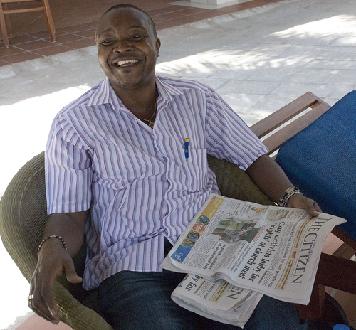
Who Is Davis Mac-Iyalla And Why Is He Here?


Photo of Nigerian Anglican Gay activist Davis Mac-Iyalla in Dar es Salaam, Tanzania, during the Anglican Primates' Meeting February 17, 2007. He was there to confront Peter Akinola, the Anglican Primate of All Nigeria, who has pressed for the world's most sweeping anti-Gay law. (The Rev. Scott Gunn)
Do not attempt to become Buddha.
---Dogen
Resolve to be thyself; and know that he who finds himself loses his misery.
---Matthew Arnold
The more deeply we are our true selves, the less self is in us.
---Meister Eckhart
The simple answer to the question is he has made his first visit to the United States from Togo, where he is in exile, to tell his story. It is the story of a young man born in the south of Nigeria (an important geographic distinction following civil war there some 40 years ago) who happened to get asked to run a church school and accepted. He did so with some fear because at age 14, he realized his sexual desires were for other males. In Nigeria you could go to jail if you acted on such impulses. His work at the school was so successful that it came to the attention of the Anglican bishop of the area at the time, who invited him into his administration. In 2003 Bishop Ugede died suddenly of tuberculosis. The new administration, appointed by Archbishop Peter Akinola, fired Davis and removed any priests who supported him. Within 2 years, Davis had become the center of a growing movement of gays and lesbians in Nigeria demanding rights for their way of life. Archbishop Akinola responded with support for legislation, currently pending, that will make it a crime for any citizen to associate in any way with someone identified as homosexual. The term of imprisonment will be 5 years.
That story is the simple answer. At the same time, the American branch of the Anglican Church, known as the Episcopal, consecrated a bishop in New Hampshire who is openly gay and has a partner. Within hours, Peter Akinola in Nigeria declared the overwhelming majority of archbishops and primates in the area known as the Global South would not recognize Gene Robinson as a bishop. He said the church now was in a "state of impaired communion" and declared he refused ever to be in the same room with a homosexual person. Conservative Episcopal churches in the United States have moved to support Akinola financially and even explore ways to join his diocese in Nigeria. It is possible the entire Anglican church, numbering millions of members worldwide, will divide over this issue. The Archbishop of Canterbury will make his first visit to the States since all this blew open at the end of the summer...around the time Davis will conclude his tour in California. Can this one man have any impact on the situation?
When Davis became convinced he should make himself available in the US for a speaking tour, naturally there were problems getting a visa from this country to allow him in. A call went out for individual churches to extend a formal invitation to him to speak. Among the first---and maybe the first---was from my rector, Bill Carroll, from Good Shepherd Episcopal Church here in Athens, Ohio. So it was that Davis Mac-Iyalla presented the first address of his tour here on Sunday. My personal reflections on the talk, those of my 15-year-old daughter, and press coverage of the event will follow in comments. I wanted to get something up and out right away though because of the urgency surrounding this whole situation.
He was in Columbus Tuesday and continues to Cleveland today. His itinerary still is open for invitation. Accompanying him is a writer named Josh Thomas, from Cincinnati I believe. His account of Davis' story is here [link] among other places on the Internet. A new interview with the Archbishop of Canterbury is reported here [link]

Thursday, May 17, 2007

We've Changed Earth's Climate: Now What?


That which man acquires by contemplation he should spend in love.

---Meister Eckhardt

All know that the drop merges into the ocean, but few know that the ocean merges into the drop.
---Kabir

Everybody talks about the weather, but nobody does anything about it.

---Mark Twain, August 27, 1897

Mark Twain's famous remark remained funny for about a hundred years. Then we began to wonder. With all our technology, why can't we change the weather in some places if we want to? But at the same time, gloomier forecasts were accumulating that in fact humanity, in that same hundred years of industrialization, was changing not only the weather but the very stability of the planet's current climate arrangement. We've had at least 10 years of raging argument about this, and still we have "scientists," mostly in the pay of corporations who can't find a profit motive yet, who tell us it all is too complicated for people to understand and it's better to do nothing. Most people, in the States anyway, seem to believe there's global warming or whatever we end up calling it, but feel it's too big for them to change any behavior about. I mean, what is one guy supposed to do?

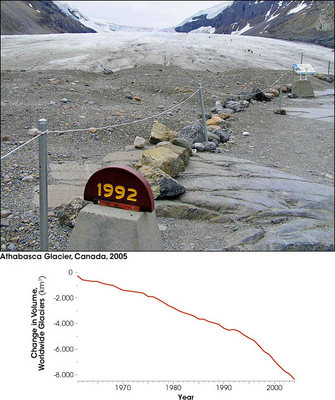
On Tuesday, the government's NASA site called Earth Observatory put up the 2005 photo you see here with this comment:

"Perhaps the most visible sign that Earth’s climate is warming is the gradual shrinking of its glaciers. In North America, the most visited glacier is the Athabasca Glacier, one of six glaciers that spill down the Canadian Rockies from the Columbia Icefield in western Canada. Visitors who return to the glacier a few years after their first visit will notice the change wrought by warming temperatures. In the past 125 years, the Athabasca Glacier has lost half of its volume and receded more than 1.5 kilometers (0.93 miles), leaving hills of rock in its place. Its retreat is visible in this photo, where the glacier’s front edge looms several meters behind the tombstone-like marker that indicates the edge of the ice in 1992. The Athabasca Glacier is not alone in its retreat: Since 1960, glaciers around the world have lost an estimated 8,000 cubic kilometers (1,900 cubic miles) of ice. That is approximately enough ice to cover a two-kilometer-wide (1.2 mile-wide) swath of land between New York and Los Angeles with an ice sheet that is one kilometer (0.62 miles) tall.

"Melting glaciers, dwindling sea ice, rising global temperatures, and rising sea levels. Little by little the evidence is adding up to show that Earth is getting hotter, and scientists are almost certain that people are to blame. A number of activities from burning fossil fuels to farming pump heat-trapping gases—greenhouse gases—into the atmosphere. Once in the atmosphere, these gases stay there for thousands of years, absorbing the heat that comes from the Earth and re-radiating it back to the surface, enhancing Earth’s natural greenhouse effect. Between 1906 and 2006, the average surface temperature of the Earth rose 0.6 to 0.9 degrees Celsius (1.08 to 1.62 degrees Fahrenheit), while greenhouse gas concentrations reached their highest levels in at least the past 650,000 years. Most climate scientists believe that there is a connection and warn that if greenhouse gas emissions continue, temperatures are likely to go up 2 to 6 degrees Celsius (3.6 to 10.8 degrees F) by the end of the 21st century.

"While this might seem like a small change, it will probably lead to big changes in the environment. Warming temperatures will likely lead to more frequent heat waves, bigger storms, including more intense tropical cyclones (hurricanes), and more widespread drought. Since water expands as it heats, and melting glaciers and ice caps have dumped more fresh water into the world’s oceans, sea levels have already started to rise. Higher sea levels lead to more erosion and greater storm damage in coastal areas, many of which are densely populated. As much as 10 percent of the world’s population lives in vulnerable coastal regions that have an elevation less than 10 meters (32 feet) above sea level."
http://earthobservatory.nasa.gov/Newsroom/NewImages/images.php3?img_id=17644

At that point, in a move not at all typical of this site---and I visit it everyday---the reader is referred to another page where begins a lengthy treatise on Global Warming. It is illustrated with many striking photos, maybe most of them taken from satellites circling the Earth. http://earthobservatory.nasa.gov/Library/GlobalWarmingUpdate/ Well, it's a dot gov site, so where's the policy? Must we wait for the dot coms to sell us stuff to solve it? How organized are all the dot orgs? Is the species finished?

Groups are beginning to meet across the land, many of them in churches, and the concern seems to be the first issue since 9/11 that crosses all political boundaries. They've spent the last year looking at the videos and DVDs and hearing the speakers, and now comes the time to figure out what to do. At just this moment, a writer named Garret Keizer from up in Vermont has gotten an essay published on the Notebook page of the June Harper's. Put his name with "climate" into Google this morning, and stand back. I think the magazine arrived in our mailbox the same day Earth Observatory put up that photo, and already the Internet is buzzing about what this guy's got to say. Essentially his message is nothing could be worse than if liberals trot out their usual package of reforms, then go back to their decks and patios overlooking the manicured sward, and end up wondering in 20 years why everything is worse than before. Harper's undoubtedly will get this essay online, but they like to wait a couple weeks so that people actually give them some money at the newsstands. Bits and pieces already are emerging in the blogs and I'll give you a taste of those excerpts in a minute. But first, who is this Keizer dude?

A fairly detailed outline of his life appeared a couple years ago in the Vermont "alternate web weekly" called Seven Days. http://www.sevendaysvt.com/features/2004/gladtohelp0.html Here we learn he grew up in New Jersey, attended the University of Vermont where he got a master's in English, and settled around Burlington, where he taught the subject in high school for 17 years. In the meantime he married a Catholic girl and, not wanting particularly to abandon his Protestant perspective, he got her to attend the Episcopal Church. They asked him to give a sermon and then to take charge of some services, and eventually the church ordained him, even though he never went to divinity school, so he could manage activities in some outlying parishes. He quit teaching partly because of all this, and his own writing became increasingly involved with morality. Christianity Today has 35 articles by him. http://ctlibrary.com/search.html?query="Garret Keizer"&x=10&y=5 In his mid 50s, Garret Keizer may find his quiet life around the Vermont town common suddenly disturbed by the kind of notoriety you get when you seriously rock the boat.

Here are some sections from his essay Climate, Class, and Claptrap~~~

This pretense of not knowing what every idiot knows has increasingly come to define our national discourse. To say, by way of example, that it has characterized the protracted denial of global warming is to understate the point. It also characterizes the burgeoning acknowledgment of global warming, the willingness to grant that a crisis exists even as our key players scramble to guarantee that every systemic cause of that crisis remains intact. It characterizes our farcical debate over the timetable for the withdrawal of US troops from Iraq even as permanent bases are constructed in that country to oversee the flow of its denationalized oil to our national snout. More than anything else, it characterizes our official take on wealth and class, a blind spot as large as any hole in the ozone. ...

...

But I shall be accused of dancing around the most important issue of our time, the issue at the name of which every knee shall bow. Global warming, we are told, will have its most devastating effects on the worlds' disadvantaged. Therefore, we need not care so particularly about the world's disadvantaged; we need only care about global warming -- as mediated, of course, by those who stand to make a bundle off it ...

...

Am I too irreverent? Am I not aware that polar bears are drowning in the Arctic? I am very much aware, and very grieved as well. I am also aware, thanks to book after book by Jonathan Kozol, that children are drowning in our inner-city schools and have been drowning there year after year and decade after decade, but I do not recall anything like the universal lament that has met the drowning scene in An Inconvenient Truth. Then again, the polar bear depicted in that movie has two incontrovertible advantages over Kozol's kids: it's digital and it's white ...

...

The intestinal tipping point came for me when a contingent of students from Middlebury College (annual tuition and fees $44,330) found both the gas money and the gall to drive to the town of Sheffield (annual per-capita income $13,277) in order to lecture the provincials on their responsibility to the earth and its myriad creatures. Not to be outdone, a small private school in our area (annual tuition and fees $76,900) has challenged the wind projects as a source of noise disturbance for its special-needs students. This could actually turn the tide. Like a bookie assessing the hindquarters of horses, I've learned to place my bets with a sharp eye on tuition and fees. Don't tell me where you went to school; just tell me what it cost.

...

Gore speaks of the need for "a different perspective" ... But this is the old perspective: the race to the moon, the triumph of the will, the forward march of progress on a goosestep and a prayer. The unquestioned belief that the answer to every human dilemma and desire is a gizmo -- in short, the very attitude that gave us global warming to begin with. Those measuring the ice shelf in Greenland would do well to spend a few weeks measuring the time that typically elapses between any mention of conservation and the quick segue to something sexier; that is, to something you can buy or sell. The abolition of obscene excess, the equitable distribution of finite resources -- these have the same appeal for our movers and shakers as adopting a crack baby has for the infertile members of their club. We have all these wonder-working technologies, all these clever schemes for producing the golden eggs -- or you could always take home little Bernice. But that's going to be a lot of work.

The bottom line here is, as always, the bottom line, already being parsed out in prospectus form for the eco-savvy investor. ... Gregg Easterbrook, writing in the April issue of The Atlantic, is less of a prig. The question he invites us to ask in regard to climate change -- "What's in it for me?" -- is "neither crass nor tongue-in-cheek," he assures us. Much of what's in it for you (that is, if you happen to be affluent, educated, etc.) will come in the form of carbon trading, a shell game allowing polluters to purchase "offsets," in green-energy production, which may or may not come to include nuclear power ...

...

Presumably this is not the same greed that inspired ExxonMobil to wage a campaign of disinformation about climate change. Presumably we might also consider redirecting the primal human impulse of hate. We could get the Ku Klux Klan to buy "offsets" for lynchings in Mississippi ... It's the Devil's old remedy: If you're being poisoned to death, try taking more poison.

...

... It is not enough to acknowledge that global warming exists; we also need to ask what global warming means. Surely one thing it means is that a culture that has as its highest aim the avoidance of anything remotely resembling physical work must change its life

... But that is only half a meaning, less than half. We're told that "that science is all in on global warming" and that it's just about unanimous. ... But the science has also been in, and in for a while, and is every bit as unanimous in concluding that we are members of a single species, descendents of common ancestors -- family in every conceivable sense of the word. How can we imagine that we will address one overwhelming consensus of scientific opinion without having acted fully on the other? ...

To put that as succinctly as possible, the days of paradise for a few are drawing to a close. The game of finding someone else in some convenient misery to fight our wards, pull our rickshaws, and serve as the offset for our every filthy indulgence is just about up. It is either Earth for all of us or hell for most of us.

...

Those excerpts are taken from a blog that Grist runs, and as of this morning there are 46 comments raging there. http://gristmill.grist.org/story/2007/5/12/02418/8290 Since other bloggers are having a similar experience, maybe a dialogue will start right here. Here's Harper's to watch for the post online http://www.harpers.org/ .

Tuesday, May 08, 2007

Death Of A Bebop Wife


In the photo Grange boards plane to meet Al. (1960)

Death Of A Bebop Wife by Grange (Lady Haig) Rutan
Published by Cadence Jazz Books, Redwood NY 13679 http://www.cadencebuilding.com/cadence/cjb.html

The modern pianist has a very special relationship with his drummer and his bassist. As his instrument has hammers, it resembles the drums; and as it has strings, it's like the bass. His position in the rhythm section is more detached, and more ambiguous than that of his partners, the bass and the drums. If he feels like it, he can stop playing for a few bars and let the bass define the harmony and the drums ensure the rhythm. He can suggest new harmonic directions, fall into step with a soloist, then break away a moment later. On again, off again. He opens or he closes. He's present at the heart of the rhythm, then suddenly he's gone.

---Laurent De Wilde
from chapter 5, p. 21

There's a scene in Grange Rutan's long-awaited book about her first husband Al Haig in which the legendary piano player introduces his young bride to Miles Davis. The men had played together with Charlie Parker in the tumultuous beginning years of bebop, and Al was pianist on one of Miles' Birth of the Cool sessions. By the summer of 1960, Miles Davis was packing in crowds at the Blackhawk in San Francisco, but Al Haig was scuffling for work. After turning down Miles' urgent invitation to sit in with the band, Al sheepishly confesses he and Grange have no place to sleep. Without hesitation, Miles reaches into his pocket and hands Al Haig the key to his dressing room. It was there, on a stained mattress in a shabby back room of a nightclub, the couple consummated their marriage. The bride looked brave, despite 2 black eyes.

Much about jazz, its artists, its working conditions, its devoted followers, and both the generosity and freakouts, is revealed in that passage. There have been many books written about the history of the music, including the death-defying years of bebop, but here's one long overdue from the perspective of a woman who loved a man who created some of it. And Grange Rutan goes beyond her own marriage of 2 1/2 years with Al Haig, into his next marriage which that girl did not survive. Rumors of murder persist to this day, and Grange presents her view as to whether Al could have done it.

Please consider, we are talking about a creator of some of the most gentle and sensitive beauty on jazz piano to come before Bill Evans. Here's a man whose daily warm-up practice involved pieces by Bach, Rachmaninoff, Ravel, Debussy, and especially Chopin. Imagine if you can Chopin playing Night In Tunisia, and you'll get the idea. With a touch as light as Teddy Wilson's, it was Al Haig that Dizzy Gillespie and Charlie Parker had to have in the group if they could get him. And shortly after, Stan Getz would launch a career of gorgeous gold to Al Haig's accompaniment. Could a quiet, dedicated artist like this hurt a woman?

What did it take in a segregated 1945 to be one of the only white men to play this music? What was required to learn the lightning twists and turns of bebop lines? Who can hum for me right now the melodies to Driftin' On A Reed or Quasimodo? I often compare learning bebop to identifying the opening movements of the Haydn symphonies by number. What does it take out of someone to do that...and to do it every night between the hours of 10 and 3 in the morning---maybe 40 minutes on and 40 minutes off---in a smoke-filled room where the audience is getting drunk...and perhaps worse?

Lady Haig, thus dubbed by Dizzy when he met and noticed her regal qualities, does not disguise the wild streak that got her hooked up with Al Haig in the first place. Living in a comfortable Presbyterian home in Montclair, New Jersey, the family nevertheless found itself close enough to the Meadow Brook Ballroom to enjoy the influence of the great dance bands of the late '30s and early '40s. As Grange became a teenager, she was listening to jazz DJs out of New York, instead of that new rock 'n roll stuff. When it came time to be out of school and at her first job, the City's where she headed and meeting jazz players was her goal. It was a risky challenge, considering she vowed to maintain purity for marriage.

While the story is gripping and all jazz fans love to hear new anecdotes about the masters of the music, it's Grange Rutan's wonderful writing style that you'll notice at once. This work of about 550 pages, including index, chronology and discography, 15 years in the writing, is like a scrapbook. There is something of a linear development, but she can't be hemmed in by a structure like that. Maybe it resembles a screenplay, that darts back and forth in time...or a conversation over lunch delightfully going every which way. Actually her style is like a jazz solo. Some of what she plays she's played before, and she relates the material over those same chord changes again and again, but then she's into new territory and trying to describe an experience one more time in a different way.

That's how it is when you remember a love from long ago. Images stick in the back of one's memory and sometimes even the sound of a "tinkling piano in the next apartment." We have both foolish and very serious things in Death of a Bebop Wife, but about one thing there is no doubt: Lady Haig has expressed to us what her heart meant. We begin, "I long to see Al's face. He's still in there and his power over me grows stronger in spite of his death. I never knew what he was going to say next. Some mornings I would wake to see his handsome head leaning on the palm of his hand, staring at me, silently crying. I just didn't know how to handle all this drama. Let me try to pull this together, not just for you but for both of us."

Saturday, May 05, 2007

The 6th Great Die-Off


Without the bitterest cold that penetrates to the very bone, how can plum blossoms send forth their fragrance to the whole world?
---Basho
Each something is a celebration of the nothing that supports it.
---John Cage
The horse's mind
Blends
So swiftly
Into the hay's mind.
---Fazil Husnu Daglarca
All the artwork is by Richard Ross.
Something like 60 years ago I spent some summertime at YMCA Camp Onyahsa on Lake Chautauqua. It was only several miles from Mom and Dad in Jamestown, New York, but I didn't thrive in the situation. The highlight of the whole experience were a couple nature hikes with a young man named Bob Sundell. The boys all called him "Bugs." He had an intensity about what you could see in Nature and how to look that was contagious. Even other boys who weren't into this whole camping thing that much were completely involved with this guy when he showed up. Off we'd go...and immediately there was a snake or a hawk---"It's a Cooper's hawk!" yelled Harold Smith, who later had to wear a ball and chain in the cafeteria because he kept trying to escape...but "Bugs" said, "Hey, that's great!" when he knew that hawk, and Harold was proud. Or there was a flash in the underbrush...so fast I didn't see what it was: a bright blur. "A redstart," "Bugs" whispered...but it was gone and hiding.
Redstarts became my favorite bird and I always wanted to see another one, even though I hadn't really seen the first one. Maybe it was "Bugs'" influence and the way he engaged us little boys. I don't think I ever saw Bob Sundell again although I often thought to look him up when I was back in my hometown. I think he's lived in Western New York all his life, teaching at a community college there and prominent with the Roger Tory Peterson Institute Ornothological Club (Peterson was from Jamestown too) and the local Audubon Society...especially the annual bird count.
The other day, down by the main creek of 3 that run through our woods, I saw another redstart. My second. It's been 60 years! I suppose if I had really gone out and looked in the meantime---made a project of it---I could have seen a bunch by now. But I don't seem to interact with Nature that way. I'm more an alert-and-see-what-pops-up sort of guy. It may be those 2 redstarts are bookends of my life, and I'd be content with that.
I never minded when neocons snarled "treehugger" at the way I feel about Nature. They've called me a lot of things in the past 40 years, but I think hugging trees is a wonderful experience. I much prefer it to knocking down every one I see. A couple weeks ago I threw a father and son off my land because they'd brought in their 4-wheelers. I did it with so much rage I frightened myself. I don't mind hunters---as long as they let me know---but I find those recreation vehicles obscene today. When I look at my neighbors and how they interact with Nature, I feel doomed.
What should I do?
And how much time do we have? Which brings me to the dire task at hand. Before today, there's always been a sense of joy or sharing or work-to-do when I've recommended information to people I know. But now I feel more like it's duty to report this. The June issue of Mother Jones magazine carries a cover story by their environmental reporter Julia Whitty. That cover is here illustrated, and the little card next to that specimen reads "Homo sapiens: -Large brain, opposable thumbs, -Primary cause of Sixth Great Extinction". After the warming and climate change, this is next and more biologists are telling us this everyday. The entire article is online and I believe was picked up by The Independent in the UK, but it's always good to support magazines at the newsstand. I'll warn you Julia begins with a graphic description of death by dehydration...but we need to know how fast it happens and after a certain point no matter how much water they give you, it won't help.

Wednesday, April 25, 2007

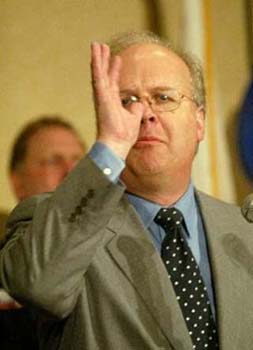
Reeling In Rove


The accumulation of all powers, legislative, executive and judiciary, in the same hands … is the definition of tyranny.

---James Madison

I know something which is known to few but is not a secret. Karl Rove is not a believer, and he doesn’t shout it from the rooftops, but when asked, he answers quite honestly. I think the way he puts it is, “I’m not fortunate enough to be a person of faith.”

---Christopher Hitchens


Rove was asked whose idea it was to start a pre-emptive war in Iraq.
"I think it was Osama bin Laden's", Rove replied.


---The Akron Beacon Journal, 4/19/07
http://www.ohio.com/mld/ohio/living/community/17102685.htm


You won't get an argument from me about the man's brilliance. I do confess wonder at how someone can enjoy the intense level of hatred expressed toward him. I've never had the control on my own anger levels enough to laugh at a person who responds extremely to my taunting. I'm uncomfortable in such a situation, but I understand there are those who love to create that tension. There must be people who adore him, such as those who come to his speeches. Does he have a family or anything like that?

Maybe we'll find out as announcement comes from the White House of the unleashing of an internal investigation by Special Counsel Scott Bloch of Mr. Rove's political shenanigans. My heart leapt with the news...at first. Then I began to wonder.

Aren't Waxman and Conyers on the verge of issuing subpoenas to get this Rove guy under oath? If he's "under investigation" by Bloch, can't he reply he's not allowed to discuss anything until the investigation concludes? Hmmm. How long did Fitzgerald take? Won't Bush Inc. be packed and ready to vacate the Oval Office by then? You know, this sounds vaguely like a Rove strategy in itself!


But now we have news this Bloch character is under investigation himself: something about punishing workers for not being loyal enough, things like that. The LA Times has the story this morning. http://www.latimes.com/technology/la-na-probe25apr25,1,1353271.story?coll=la-headlines-technology Just how chummy are Rove and Bloch I wonder?

If Rove thought this up to avoid Congressional scrutiny, what other evidence do we need of this Administration's contempt for congressional process? Why will they not engage in discussion of policies? And don't give me the wartime powers of commander in chief argument! The Bushies were like this before they invaded the Middle East.

Among the matters Congress wishes to ask Rove about are those secret email accounts. Never mind millions of messages mysteriously have been deleted---in the manner of the Nixon tapes?---what was the purpose and function of those accounts? How were the "private" Republican laptops used? Earlier in the week Bob Fitrakis asserted they were used to manipulate presidential elections. On the hard drives of those machines is the record of interactions of election fraud and the programs that were used to do it. Fitrakis names names. http://www.freepress.org/departments/display/19/2007/2553

If all this is just screwball conspiracy theory (and isn't it fun to ridicule people who think strategies actually might get planned out?) then why will not the White House answer any questions, except ones they hand themselves to friendly reporters? What is the principle that can't budge Rove? Or does he delight in thinking the opposition is just running around in circles?

Saturday, April 21, 2007

If I Hear "Robust" Once More, I'm Gonna Puke


Religion is a way of walking, not a way of talking.

---Dean William R. Inge

I have realized that the past and the future are real illusions, that they exist only in the present, which is what there is and all there is.

---Alan Watts

A Zen master's life is one continuous mistake.

---Dogen

God, how this White House loves that word! Everything they do is ROBUST. The Surge is robust, the economy is robust, our schools are SO robust, anti-abortionists are getting much more robust, and the Gun Lobby never has been so robust! Rove is just busting with robust. He and Bush are in Ohio all the time because we brim with robust!

I suspect it may have been Rove (or his people) who came up with "robust." It has the first 2 letters of his name so that satisfies egomania, and of course "bust" is in it...so he can think of breasts and milk as well as allegiance to his President. What could be better?

The only thing better would be if all Repubs use it...and they do (even when wearing the pink necktie of apology and surrender). Thursday Justice Department spokeswoman Cynthia Magnuson used it against critics who say the Executive's legal people have been using federal attorneys to wipe out the opposition. She said the department has "a completely robust record when it comes to enforcing federal voting rights laws." The Justice Department not only is robust, it's COMPLETELY robust. It's like Heaven on earth there!

I love this photograph by Doug Mills for The New York Times yesterday. There he is, the Attorney General of the United States of America, land of the free, home of the brave. The man used the "can't remember anything" approach to his testimony. At least it's more down-to-earth than the "best-of-my-recollection" song and dance other attorneys general have used. A busy man has to have people on his staff who remember things for him. I understand that. Do you suppose there is someone at Justice who remembers who is supposed to remember the content of meetings? Maybe they can search around.

In the meantime, you might take a look at Greg Gordon's article for the Baltimore Sun Thursday that contains Cynthia's robust remark...and see if you can detect any "legal" strategies in there about crushing free election. And then I guess I have to like best Lara Jakes Jordan's coverage for AP of Gonzales' pathetic appearance Thursday.

http://www.baltimoresun.com/news/nationworld/politics/bal-te.attorneys19apr19,0,23441.story?coll=bal-nationworld-headlines

http://news.yahoo.com/s/ap/20070419/ap_on_go_co/gonzales_prosecutors;_ylt=Aozse9CMyDutN1Gd4tbgjZys0NUE

Monday, April 16, 2007

What Is Self-Sufficient---And Are You?


The drawing illustrates an article in the current issue of In Character, for which Joannah Ralston is credited with design.
Man can learn nothing except by going from the known to the unknown.
---Claude Bernard
The moment one gives close attention to anything, even a blade of grass, it becomes a mysterious, awesome, indescribably magnificent world in itself.
---Henry Miller
I have been reading all day, confined to my room, and feel tired. I raise the screen and face the broad daylight. I move the chair on the veranda and look at the blue mountains. I draw a long breath, fill my lungs with fresh air and feel entirely refreshed. I make tea and drink a cup or two of it. Who would say that I am not living in the light of eternity?
---D.T. Suzuki
When I set about to look for an image to illustrate this entry, I typed the word "solitude" into the search engine. A number of paintings showed up, but surprisingly not many that were created before the Twentieth Century. A few landscapes from the late 1800's seemed to celebrate Wordsworthian romance, but in his poems too we witness the beginnings of modern isolation.
For some time I've been concerned about a gradual loss of community and neighborhood connection that has occured in my lifetime. This may not be the case everywhere or among people who have not lived the kind of life that I have. I've moved around a good deal---especially in the 1960s and 70s---and am not living in the town where I was born. I tend toward liberal ideals and am not a member of a "mega-church." More conservative folks, who can trace lineage in the same geography back several generations, may enjoy a different experience. But how many of those are there, and is their number dwindling? And what good is neighborhood anyway, if you don't want people meddling in your privacy?
Bill McKibben's article in the current issue of the journal referenced above got me wondering whether a reinvigoration of community may be a major ingredient in solving huge problems that face us planetary inhabitants today. Bill McKibben is teaching at Middlebury College currently I guess, but has lived in the Adirondack Mountain region of New York for some time. You may have read his essays in The New Yorker and other publications, usually devoted to spiritual aspects of environmental concern. He's also written a few books.
This article doesn't talk about TV, industrialization, and overpopulation, which are topics that fly to my mind immediately when I think of wanting to get away from it all and just live in the woods with a computer. Here he suggests the very goal of getting off the grid and living the life of the self-sufficient survivalist ultimately may lead nowhere.
Old MacDonald Had A Farmers’ Market – total self-sufficiency is a noble, misguided ideal
By Bill McKibben
Generations of college freshmen, asked to read Walden, have sputtered with indignation when they learned that Henry David went back to Concord for dinner with his family every week or two. He’s cheating; his grand experiment is a fraud. This outrage is a useful tactic; it prevents them from having to grapple with the most important (and perhaps the most difficult) book in the American canon, one that asks impossibly searching questions about the emptiness of a consumer economy, the vacuity of an information-soaked era. But it also points to something else: Thoreau, our apostle of solitary, individual self-reliance, out in his cabin with his hoe and his beans, the most determinedly asocial man of his time — nonetheless was immersed in his community to a degree few people today can comprehend.
Consider the sheer number of people who happened to drop by the cabin of an obscure eccentric. “I had three chairs in my house; one for solitude, two for friendship, three for society,” he writes. Often more visitors came than could sit — sometimes twenty or thirty at a time. “Half-witted men from the almshouse,” busybodies who “pried into my cupboard and bed when I was out,” a French-Canadian woodchopper, a runaway slave “whom I helped to forward toward the north star,” doctors, lawyers, the old and infirm and the timid, the self-styled reformers. It’s not that Thoreau was necessarily a cheerful host — there were visitors “who did not know when their visit had terminated, though I went about my business again, answering them from greater and greater remoteness.” Instead, it was simply a visiting age — as most of human history has been a visiting age, and every human culture a visiting culture.
Until ours. I doubt if many people reading these words have had a spontaneous visit from a neighbor in the past week — less than a fifth of Americans report visiting regularly with friends and neighbors, and the percentage is declining steadily. The number of close friends that an American claims has dropped steadily for the last fifty years too; three-quarters of us don’t know our next-door neighbors. Even the people who share our houses are becoming strangers: The Wall Street Journal reported recently that “major builders and top architects are walling off space. They’re touting one-person ‘internet alcoves,’ locked-door ‘away rooms,’ and his-and-her offices on opposite ends of the house.” The new floor plans, says the director of research for the National Association of Home Builders, are “good for the dysfunctional family.” Or, as another executive put it, these are the perfect homes for “families that don’t want anything to do with one another.” Compared to these guys, Thoreau with his three-chair cabin was practically Martha Stewart.
Every culture has its pathologies, and ours is self-reliance. From some mix of our frontier past, our Little House on the Prairie heritage, our Thoreauvian desire for solitude, and our amazing wealth we’ve derived a level of independence never seen before on this round earth. We’ve built an economy where we need no one else; with a credit card, you can harvest the world’s bounty from the privacy of your room. And we’ve built a culture much the same — the dream houses those architects build, needless to say, come with a plasma screen in every room. As long as we can go on earning good money in our own tiny niche, we don’t need a helping hand from a soul — save, of course, from the invisible hand that cups us all in its benign grip.
There are a couple of problems with this fine scenario, of course. One is: we’re miserable. Reported levels of happiness and life-satisfaction are locked in long-term one-way declines, almost certainly because of this lack of connection. Does this sound subjective and airy? Find one of the tens of millions of Americans who don’t belong to anything and convince them to join a church, a softball league, a bird-watching group. In the next year their mortality — the risk that they will die in the next year — falls by half.
The other trouble is that our self-reliance is actually a reliance on cheap fossil fuel and the economy it’s built. Take that away — either because we start to run out of oil, or because global warming forces us to stop using it in current quantities — and our vaunted independence will start to lurch like a Hummer with four flat tires. Just think for a moment about that world and then decide if you want to live on an acre all your own in the outermost ring of suburbs.
The idea of self-reliance is so deep in our psyches, however, that even when we attempt to escape from the unhappy and unsustainable cul-de-sac of our society, we’re likely to turn toward yet more “independence.” The “back-to-the-land” movement, for instance, often added the words “by myself.” Think about how proudly a certain kind of person talks about his “off-the-grid” life — he makes his own energy and grows his own food, he can deal with whatever the world throws at him. One such person may be left-wing in politics (à la Scott and Helen Nearing); another may be conservative. But they are united in their lack of need for the larger world. Not even to school their kids — they’ll take care of that as well.
Such folks are admirable, of course — they have a wide variety of skills now missing in most Americans; they’re able to amuse themselves; they work hard. But as an ideal, especially an economic ideal, that radical self-reliance strikes me as being almost as empty as the consumer society from which it dissents. Consider, for instance, the idea of growing all your own food. It’s clearly better than relying on food from thousands of miles away — from our current industrialized food economy, which figures “it’s always summer somewhere” and so orders take-out from that distant field every night of the year. Compared with that, an enormous garden and a root cellar full of all you’ll need for the winter is virtue incarnate. But if you believe in many of the (entirely plausible) horror stories about what’s to come — peak oil, climate change — then the world ends with you standing shotgun in hand above your vegetable patch, protecting your carrots from the poaching urban horde.
Contrast that with another vision, one taking shape in at least a few places around the country: a matrix of small farmers growing food for their local areas. Farmers’ markets are the fastest-growing part of our food economy, with sales showing double-digit growth annually. Partly that’s because people want good food (all kinds of people: immigrants and ethnic Americans tend to be the most avid farmers’ market shoppers). And partly it’s because they want more company. One team of sociologists reported recently that shoppers at farmers’ markets engaged in ten times more conversations per visit than customers in supermarkets. I spent the past winter eating only from my valley; a little of the food I grew myself, but the idea of my experiment was to see what remained of the agricultural infrastructure that had once supported this place. And the payoff was not only a delicious six months, but also a deep network of new friends, a much stronger sense of the cultural geography of my place.
Or consider energy. Since the 1970s, a particular breed of noble ex-hippie has been building “off-the-grid” homes, often relying on solar panels. This has been important work — they’ve figured out many of the techniques and technologies that we desperately need to get free of our climate change predicament. But the most exciting new gadget is a home-scale inverter, one that allows you to send the power your rooftop generates down the line instead of down into the basement. Where the isolated system has a stack of batteries, the grid-tied solar panel uses the whole region’s electric system as its battery: my electric meter spins merrily backward all afternoon because while the sun shines I’m a utility; then at night I draw from somewhere else. It’s a two-way flow, in the same way that the internet allows ideas to bounce in many directions.
You can do the same kind of calculation with almost any commodity. Music doesn’t need to come from Nashville or Hollywood on a small disc, for instance. But you don’t have to produce it all yourself either. More fun to join with the neighbors, to make music together or to listen to the local stars. A hundred years ago, Iowa had 1,300 opera houses. Radio doesn’t need to come from the ClearChannel headquarters in some Texas office park; new low-power FM lets valleys make their own. Even currency can become a joint local project — all it takes is the trust that underwrites any system of money. In hundreds of communities, people are trying to build that trust locally, with money that only works within the region.
Thinking this way won’t be easy. We’re used to independence as the prime virtue — so used to it that three quarters of American Christians believe the phrase “God helps those who help themselves” comes from the Bible, instead of Ben Franklin. “Love your neighbor as yourself” is harder advice, but sweeter and more sage. We don’t need to live on communes (though more and more old people are finding themselves enrolling in “retirement communities” that are gray-haired, upscale versions). But we will, I think, need to figure out how to stop relying on both oil and ourselves, and instead learn the lesson that the other primates and the other human cultures never forgot: we’re built to rely on each other.

Saturday, April 07, 2007

There Are No Conspiracies


http://www.theage.com.au/news/world/film-surfaces-to-stoke-jfk-conspiracy-theories/2007/02/20/1171733762800.html

Western laziness consists of cramming our lives with compulsive activity, so that there is no time at all to confront the real issues.

---Sogyal Rinpoche

Tu Fu comes from a saner, older, more secular culture than Homer, and it is not a new discovery with him that the gods, the abstractions, the forces of nature, are frivolous, lewd, vicious, quarrelsome, and cruel, and only men's steadfastness, love, magnanimity, calmness, and compassion redeem the night-bound world.

---Kenneth Rexroth

The search is what anyone would undertake if he were not sunk in the everydayness of his own life. To become aware of the possibility of the search is to be onto something. Not to be onto something is to be in despair.

---Walker Percy

I first became aware of the chief weapon of the new conservative around 1960. The weapon is mockery and it was used effectively against my friends and me at Bates College. The school had a requirement to attend chapel a few times a week for programs of a non-religious character---but it was a chapel of vaguely Christian architecture. You also had to take a couple religion courses and fees were collected from all students to support the Christian Association. The CA had a locked bulletin board, to which I had a key and where I used to post rather leftist material.

The emerging leaders of culture war attacked all of this. Their models and mentors appeared to be Ayn Rand and William F. Buckley Jr. Buckley particularly was on television all the time debating liberals. His method of discourse always was a sneering dismantling of the bleeding heart of concern for the downtrodden. If you are lazy and stupid you should expect to be trod upon in this life. I remember 2 hours of excruciating embarrassment as Buckley mocked out James Baldwin for his passion on civil rights. I recall Buckley concluded one of his "Firing Lines" by warning the audience America is being watched on all sides by greedy eyes in faces "upon which there are no smiles." Mockery was established firmly upon a foundation of fear.

When questions arose surrounding the assassinations of John Kennedy, Robert Kennedy, Martin Luther King, the phrase "conspiracy theorists" showed up. We learn there always will be unanswerable questions about such events carried out by lone nutcases, and if you won't accept that reality you will be mocked. Questions about 9/11 and the Twin Towers? Same deal. We don't have time for this stuff: we must put it behind us and move forward. Weapons of mass destruction. A mushroom cloud could result if we delay our preemptive war. The Christian right delivered Shock And Awe, and there was talk of Judgment Day in the Cradle of Civilization. (At this time of year, one wonders why Jesus didn't move preemptively against Judas.)

Are you concerned about the environment? You are mocked as a "treehugger." Even as evidence mounts and reports are released, the term still is thrown in derision. You can have rugged American individualism but don't rock the boat. Watergate, Enron so quickly forgotten...or rubbed out of our minds. Another conspiracy theory to be ridiculed. MobilExxon spent millions to discount global warming? What's conspiratorial about that? Didn't tobacco companies do the same thing? Federal prosecutors fired for not being "loyal Bushies." They were to "serve at the pleasure of the President"...like the rest of us.

But just maybe this fabric of 40 years of fear is beginning to unravel. I saw a T-shirt recently that announced "The biggest Government Conspiracy is that there are no conspiracies." I've always found the best way to conquer fear is, if possible, just turn on the light. If we have a Congress currently in the mood to shine brightness upon various princes of darkness, let's take some time and do it. Already much has come to light.

Recently not a week has gone by that I haven't become aware of a struggling investigative journalist somewhere who has labored for years to dig around and come up with what's really going on. Hopefully most people are aware of Lucy Komisar, but I wasn't. Here's her bio at a site called gameasoldasempire.com~~~

"Lucy Komisar is a New York–based journalist who travelled in the developing world in the 1980s and 1990s writing about movements to overthrow the despots who were running many of the countries she visited. When she talked to oppositionists in such places as the Philippines, Haiti, and Zaire, they invariably said this about their local dictator: 'He’s looted the country, stolen everything, and it’s all in Swiss banks.' The phrase was, as she discovered, shorthand for a parallel international financial system run by the world’s largest banks using secret accounts and shell companies in offshore havens like the Cayman Islands and Jersey to hide and move the money of dictators, corrupt officials, drug and people traffickers, terrorists, business fraudsters, stock manipulators, and corporate and wealthy tax cheats—and that their political power kept Western governments from acting against the system. Beginning in 1997, she shifted her focus to reportage about offshore banking. Much of what she has published over the last ten years (see www.thekomisarscoop.com) has never been published elsewhere. Based on her investigations, she is writing a book to be called Take the Money and Run Offshore."
http://www.gameasoldasempire.com/Contributors/lucy-komisar.htm

That site thekomisarscoop.com has enough in it to fill your next week! Her articles are all over the Web, chiefly at The Nation, Alternet, and she's got a book or 2. Earlier this week the Inter Press Service News Agency put up her analysis of the Bush family's banking adventures, which---surprise, surprise---involve deals with the bin Ladens, Saddam Hussein and various sheiks of Araby. Liberals have been vaguely connected with this material, but here it's all laid out and names are named~~~
http://ipsnews.net/news.asp?idnews=37213

The very next day, at the same moment Dick Cheney was on Rush Limbaugh's show (again!) to restate Saddam's love affair with Al-Qaeda, we learned of a declassified Defense Department report that declares "captured Iraqi documents and intelligence interrogations of Saddam Hussein and two former aides 'all confirmed' that Hussein's regime was not directly cooperating with al-Qaeda before the U.S. invasion of Iraq." http://www.washingtonpost.com/wp-dyn/content/article/2007/04/05/AR2007040502263.html?hpid=topnews Well, undoubtedly Cheney knew the report was coming out so, since more people listen to Rush than read newspapers, he might try lying to us again. When you have this kind of money and power, who cares what you say?

Surveys show people increasingly are beginning to get the urgency of Global Warming. Al Gore has had a lot to do with it, despite the right's continuing campaign to mock the man out of existence. The United Nations report yesterday describes disaster just around the corner, but the LA Times says the all-night session Thursday was prompted "by governments seeking to deflect calls for action. 'The science got hijacked by the political bureaucrats at the late stage of the game,' said John Walsh, a climate expert at the University of Alaska Fairbanks who helped write a chapter on the polar regions." http://www.latimes.com/news/science/la-sci-warming7apr07,0,6019103.story?coll=la-home-headlines So maybe things are even worse?

Then there's Monica Goodling. Is there some conspiracy of Monicas? Here's this lady who says she won't testify about the Gonzales prosecutor firings...and then yesterday resigned completely. Hopefully before the weekend is up, somebody will give her whatever or however much she wants and we'll have her story. In the meantime all there is is this page of alumni picnic photos from a school called Regent. http://www.regent.edu/alumni/chapters/washington_dc/DCPicnicPhotos.htm Do you suppose the happy campers all are Republicans? Goodness, they certainly do use a lot of charcoal starter! Maybe that's what's wrong with them. I don't know, a loyal Bushie always throws herself onto a live grenade...and she looks like the type.

Sunday, March 25, 2007

The Only Answer To Organized Money Is Organized People


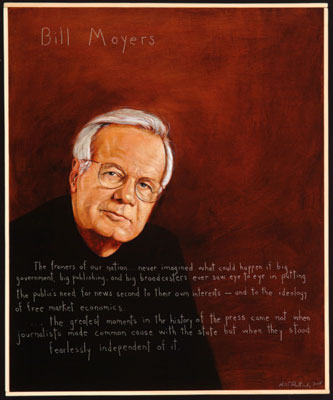
Painting of Bill Moyers by Robert Shetterly
http://www.americanswhotellthetruth.org/index.php

Thomas Jefferson said the only justification for mandatory public education is to teach children their rights, and how to defend those rights. We need lots and lots of us addressing students of all ages, to let them know their rights, and that we’re sorry we’re handing over the mess the country and the world is in.

---christie svane

You can’t lay bricks on top of a crumbling system. It must be torn down first. If the system had been healthy to begin with, we would never have come to where we find ourselves now. I strongly disagree with most American’s premise of what they think America stands for. It never was all it was cracked up to be. It must be made better if it is to rise from the ashes of tyranny. I doubt Americans have the grit for the work that must be done to re-invent America in the image of truth.

---imors

like so many others i have wanted more than anything to make a real and true picture of our beautiful world
and for its own sake but not its own sake alone

i confess right here that ive wanted to correct or possibly infect the mind of whoever crossed paths with my poem
i mean i look around these days - all days really

its easy to see the cars on the freeway and the shopping malls spread under the rise of the moon and feel doomed.
anything else is a sucker punch.

anything else is a refusal to see, ive said, and more than once, and meant it, and do - even right now - do you see?

---maddk

The sayings that introduce this post are comments at CommonDreams.org in reply to a talk given at Occidental College last month by Bill Moyers. At the moment there are 35 such comments since Thursday when CommonDreams put up the speech. Rarely have I seen Internet folk so thoughtful and inspired. Mr. Moyers has given a lot of addresses around the country since he retired from his weekly program on Public Broadcasting, and they all are worth seeking out urgently. Many people are so moved they call upon him to run for President...but he won't. He believes in his work as fearless spokesperson for a Free Press, and it is as journalist that he delivers A Time For Anger, A Call To Action. As in the time of Tom Paine, here are words to be published and posted at every site, to be handed from person to person. It is time again for Americans to shake off our lethargy, our complacency, our hopelessness. Here Bill Moyers helps us with that work.

Published on Thursday, March 22, 2007 by CommonDreams.org
A Time For Anger, A Call To Action by Bill Moyers
The following is a transcript of a speech given on February 7, 2007 at Occidental College in Los Angeles.

I am grateful to you for this opportunity and to President Prager for the hospitality of this evening, to Diana Akiyama, Director of the Office for Religious and Spiritual Life, whose idea it was to invite me and with whom you can have an accounting after I've left. And to the Lilly Endowment for funding the Values and Vocations project to encourage students at Occidental to explore how their beliefs and values shape their choices in life, how to make choices for meaningful work and how to make a contribution to the common good. It's a recognition of a unique venture: to demonstrate that the life of the mind and the longing of the spirit are mirror images of the human organism. I'm grateful to be here under their auspices.

I have come across the continent to talk to you about two subjects close to my heart. I care about them as a journalist, a citizen and a grandfather who looks at the pictures next to my computer of my five young grandchildren who do not have a vote, a lobbyist in Washington, or the means to contribute to a presidential candidate. If I don't act in their behalf, who will?

One of my obsessions is democracy, and there is no campus in the country more attuned than Occidental to what it will take to save democracy. Because of your record of activism for social justice, I know we agree that democracy is more than what we were taught in high school civics - more than the two-party system, the checks-and-balances, the debate over whether the Electoral College is a good idea. Those are important matters that warrant our attention, but democracy involves something more fundamental. I want to talk about what democracy bestows on us?the revolutionary idea that democracy is not just about the means of governance but the means of dignifying people so they become fully free to claim their moral and political agency. "I believe in democracy because it releases the energies of every human being" - those are the words of our 28th president, Woodrow Wilson.

I've been spending time with Woodrow Wilson and others of his era because my colleagues and I are producing a documentary series on the momentous struggles that gripped America a century or so years ago at the birth of modern politics. Woodrow Wilson clearly understood the nature of power. In his now-forgotten political testament called The New Freedom, Wilson described his reformism in plain English no one could fail to understand: "The laws of this country do not prevent the strong from crushing the week." He wrote: "Don't deceive yourselves for a moment as to the power of great interests which now dominate our development... There are men in this country big enough to own the government of the United States. They are going to own it if they can." And he warned: "There is no salvation in the pitiful condescensions of industrial masters... prosperity guaranteed by trustees has no prospect of endurance."

Now Wilson took his stand at the center of power - the presidency itself - and from his stand came progressive income taxation, the federal estate tax, tariff reform, the challenge to great monopolies and trusts, and, most important, a resolute spirit "to deal with the new and subtle tyrannies according to their deserts."

How we need that spirit today! When Woodrow Wilson spoke of democracy releasing the energies of every human being, he was declaring that we cannot leave our destiny to politicians, elites, and experts; either we take democracy into our own hands, or others will take democracy from us.

We do not have much time. Our political system is melting down, right here where you live.
A recent poll by the Public Policy Institute of California found that only 20% of voters last November believe your state will be a better place to live in the year 2025; 51% say it will be worse. Another poll by the New American Foundation - summed up in an article by Steven Hill in the January 28th San Francisco Chronicle - found that for the first time in modern California history, a majority of adults are not registered with either of the two major parties.

Furthermore, writes Hill, "There is a widening breach between most of the 39 million people residing in California and the fewer than 9 million who actually vote." Here we are getting to the heart of the crisis today - the great divide that has opened in American life.

According to that New American Foundation study, frequent voters [in California] tend to be 45 and older, have household incomes of $60,000 or more, are homeowners, and have college degrees. In contrast, the 12 million nonvoters (7 million of whom are eligible to vote but are not registered) tend to be younger than 45, rent instead of own, have not been to College, and have incomes less than $60,000.

In other words, "Considering that California often has one of the lowest voter participation rates in the nation - in some elections only a little more that 1/3 of eligible voters participate - a small group of frequent voters, who are richer, whiter, and older than their nonvoting neighbors, form the majority that decides which candidates win and which ballot measures pass." The author of that report (Mark Baldassare) concludes: "Only about 15% of adult people make the decisions and that 15% doesn't look much life California overall."

We should not be surprised by the consequences: "Two Californias have emerged. One that votes and one that does not. Both sides inhabit the same state and must share the same resources, but only one side is electing the political leaders who divide up the pie."

You've got a big problem here. But don't feel alone. Across the country our 18th political system is failing to deal with basic realities. Despite Thomas Jefferson's counsel that we would need a revolution every 25 years to enable our governance to serve new generations, our structure - practically deified for 225 years - has essentially stayed the same while science and technology have raced ahead. A young writer I know, named Jan Frel, one of the most thoughtful practitioners of the emerging world of Web journalism, wrote me the other day to say: "We've gone way past ourselves. I see the unfathomable numbers in the national debt and deficit, and the way that the Federal government was physically unable to respond to Hurricane Katrina. I look at Iraq; where 50% of the question is how to get out, and the other 50% is how did so few people have the power to start the invasion in the first place. If the Republic were functioning, they would have never had that power."

Yet the inertia of the political process seems virtually unstoppable. Frel reminds me that the chairman of the Senate Budget Committee can shepherd a $2.8 trillion dollar budget through the Senate and then admit: "It's hard to understand what a trillion is. I don't know what it is." Is it fair to expect anyone to understand what a trillion is, my young friend asks, or how to behave with it in any democratic fashion?" He goes on: "But the political system and culture are forcing 535 members of Congress and a President who are often thousands of miles away from their 300 million constituents to do so. It is frightening to watch the American media culture from progressive to hard right being totally sold on the idea of one President for 300 million people, as though the Presidency is still fit to human scale. I'm at a point where the idea of a political savior in the guise of a Presidential candidate or congressional majority sounds downright scary, and at the same time, with very few exceptions, the writers and journalists across the slate are completely sold on it."

Our political system is promiscuous as well as primitive. The first modern fundraiser in American politics - Mark Hanna, who shook down the corporations to make William McKinley President of the United States in 1896 - once said there are two important things in politics. "One is money, and I can't remember the other one." Because our system feeds on campaign contributions, the powerful and the privileged shape it to their will. Only 12% of American households had incomes over $100,000 in 2000, but they made up 95% of the substantial donors to campaigns and have been the big winners in Washington ever since.

I saw early on the consequences of political and social inequality. I got my first job in journalism at the age of 16. I quickly had one of those strokes of luck that can determine a career. Some of the old timers were on vacation or out sick and I was assigned to cover what came to be known as the 'Housewives Rebellion.' Fifteen women in my home town decided not to pay the social security withholding tax for their domestic workers. They argued that social security was unconstitutional, that imposing it was taxation without representation, and that - here's my favorite part - "requiring us to collect (the tax) is no different from requiring us to collect the garbage."

They hired themselves a lawyer - none other than Martin Dies, the former Congressman best known, or worst known, for his work as head of the House Committee on Un-American Activities in the 30s and 40s. He was no more effective at defending rebellious women than he had been protecting against Communist subversives, and eventually the women wound up holding their noses and paying the tax. The stories I wrote for my local paper were picked up and moved on by the Associated Press wire to Newspapers all over the country. One day, the managing editor called me over and pointed to the AP ticker beside his desk. Moving across the wire was a notice citing one "Bill Moyers" and the News Messenger for the reporting we had done on the rebellion.
That hooked me. In one way or another - after a detour through seminary and then into politics and government for a spell - I've been covering politics ever since.

By "politics" I mean when people get together to influence government, change their own lives, and change society. Sometimes those people are powerful corporate lobby groups like the drug companies and the oil industry, and sometimes they are ordinary people fighting to protect their communities from toxic chemicals, workers fighting for a living wage, or college students organizing to put an end to sweatshops.

Those women in Marshall, Texas - who didn't want to pay Social Security taxes for their maids - were not bad people. They were regulars at church, their children were my friends, many of them were active in community affairs, and their husbands were pillars of the business and professional class in town. They were respectable and upstanding citizens all.

So it took me awhile to figure out what had brought on that spasm of reactionary rebellion. It came to me one day, much later. They simply couldn't see beyond their own prerogatives. Fiercely loyal to their families, to their clubs, charities, and congregations - fiercely loyal, in other words, to their own kind - they narrowly defined membership in democracy to include only people like them. The women who washed and ironed their laundry, wiped their children's bottoms, made their husbands' beds, and cooked their families meals - these women, too, would grow old and frail, sick and decrepit, lose their husbands and face the ravages of time alone, with nothing to show from their years of labor but the creases in their brow and the knots on their knuckles.

In one way or another, this is the oldest story in America: the struggle to determine whether "We, the People" is a spiritual idea embedded in a political reality - one nation, indivisible - or merely a charade masquerading as piety and manipulated by the powerful and privileged to sustain their own way of life at the expense of others.

We seem to be holding our breath today, trying to decide what kind of country we want to be. But in this state of suspension, powerful interests are making off with the booty. They remind me of the card shark in Texas who said to his competitor in the poker game: "Now play the cards fairly Reuben. I know what I dealt you."

For years now a small fraction of American households have been garnering a larger and larger concentration of wealth and income, while large corporations and financial institutions have obtained unprecedented power over who wins and who loses. Inequality in America is greater than it's been in 50 years. In 1960 the gap in terms of wealth between the top 20% and the bottom 20% was 30 fold. Today it's more than 75 fold.

Such concentrations of wealth would be far less of an issue if the rest of society were benefiting proportionally. But that is not the case. Throughout our industrial history incomes grew at 30% to 50% or more every quarter, and in the quarter century after WWII, gains reached more than 100% for all income categories. Since the late 1970s, only the top 1% of households increased their income by 100%.

Once upon a time, according to Isabel Sawhill and Sara McLanahan in The Future of Children, the American ideal of classless society was 'one in which all children have roughly equal chance of success regardless of the economic status of the family into which they were born. That's changing fast. The Economist Jeffrey Madrick writes that just a couple of decades ago, only 20% of one's future income was determined by the income of one's father. New research suggests that today 60% of a son's income is determined by the level of his father's income. In other words, children no longer have a roughly equal chance of success regardless of the economic status of the family into which they are born. Their chances of success are greatly improved if they are born on third base and their father has been tipping the umpire.

As all of you know, a college education today is practically a necessity if you are to hold your own, much less climb the next rung. More than 40% of all new jobs now require a college degree. There are real world consequences to this, and Madrick drives them home. Since the 1970s, median wages of men with college degrees have risen about 14%. But median wages for high school graduates have fallen about 15%. Not surprisingly, nearly 24% of American workers with only a high school diploma have no health insurance, compared with less than 10% of those with college degrees.

Such statistics can bring glaze to the eyes, but Oscar Wilde once said that it is the mark of truly educated people to be deeply moved by statistics. All of you are educated, and I know you can envision the stress these economic realities are putting on working people and on family life. As incomes have stagnated, higher education, health care, public transportation, drugs, housing and cars have risen faster in price than typical family incomes, so that life, says Jeffrey Madrick, "has grown neither calm nor secure for most Americans, by any means."

Let me tell you about the Stanleys and the Neumanns, two families who live in Milwaukee. One is black, the other white. The breadwinners in both were laid off in the first wave of downsizing in 1991 as corporations began moving jobs out of the city and then out of the country. In a documentary series my colleagues and I chronicled their efforts over the next decade to cope with the wrenching changes in their lives and to find a place for themselves in the new global economy. They're the kind of Americans my mother would have called "the salt of the earth". They love their kids, care about their communities, go to church every Sunday, and work hard all week.

To make ends meet after the layoffs, both mothers took full-time jobs. Both fathers became seriously ill. When one father had to stay in the hospital two months the family went $30,000 in debt because they didn't have adequate health care. We were there with our cameras when the bank started to foreclose on the modest home of one family that couldn't make mortgage payments. Like millions of Americans, the Stanleys and the Neumanns were playing by the rules and still getting stiffed. By the end of the decade they were running harder but slipping further behind, and the gap between them and prosperous America was widening.

What turns their personal tragedy into a political travesty is that while they are indeed patriotic, they no longer believe they matter to the people who run the country. They simply do not think their concerns will ever be addressed by the political, corporate, and media elites who make up our dominant class. They are not cynical, because they are deeply religious people with no capacity for cynicism, but they know the system is rigged against them.

"Things have reached such a state of affairs," the journalist George Orwell once wrote, "that the first duty of every intelligent person is to pay attention to the obvious." The editors of The Economist have done just that. The pro-business magazine considered by many to be the most influential defender of capitalism on the newsstand, produced a sobering analysis of what is happening to the old notion that any American child can get to the top. A growing body of evidence - some of it I have already cited - led the editors to conclude that with "income inequality growing to levels not seen since the Gilded Age and social mobility falling behind, the United States risks calcifying into a European-style class-based society." The editors point to an "education system increasingly stratified by social class" in which poor children "attend schools with fewer resources than those of their richer contemporaries" and great universities that are "increasingly reinforcing rather than reducing these educational inequalities." They conclude that America's great companies have made it harder than ever "for people to start at the bottom and rise up the company hierarchies by dint of hard work and self-improvement."

It is eerie to read assessments like that and then read the anthropologist Jared Diamond's book, Collapse: How Societies Choose to Succeed or Fail He describes an America society in which elites cocoon themselves "in gated communities, guarded by private security guards, and filled with people who drink bottled water, depend on private pensions, and send their children to private schools." Gradually, they lose the motivation "to support the police force, the municipal water supply, Social Security, and public schools." Any society contains a built-in blueprint for failure, warns Jared Diamond, if elites insulate themselves from the consequences of their own actions.
So it is that in a study of its own, The American Political Science Association found that "increasing inequalities threaten the American ideal of equal citizenship and that progress toward real democracy may have stalled in this country and even reversed."

This is a marked turn of events for a country whose mythology embraces "life, liberty, and the pursuit of happiness" as part of our creed. America was not supposed to be a country of "winner take all." Through our system of checks and balances we were going to maintain a healthy equilibrium in how power works - and for whom. Because equitable access to public resources is the lifeblood of any democracy, we made primary schooling free to all. Because everyone deserves a second chance, debtors, especially the relatively poor, were protected by state laws against their rich creditors. Government encouraged Americans to own their own piece of land, and even supported squatters' rights. In my time, the hope of equal opportunity became reality for millions of us. Although my parents were knocked down and almost out by the Great Depression, and were poor all their lives, my brother and I went to good public schools. The GI Bill made it possible for him to go to college. When I bought my first car with a loan of $450 I drove to a public school on a public highway and stopped to rest in a public park. America as a shared project was becoming the engine of our national experience.

Not now. Beginning a quarter of a century ago a movement of corporate, political, and religious fundamentalists gained ascendancy over politics and made inequality their goal. They launched a crusade to dismantle the political institutions, the legal and statutory canons, and the intellectual and cultural frameworks that have held private power. And they had the money to back up their ambition.

Let me read you something:

When powerful interests shower Washington with millions in campaign contributions, they often get what they want. But it is ordinary citizens and firms that pay the price and most of them never see it coming. This is what happens if you don't contribute to their campaigns or spend generously on lobbying. You pick up a disproportionate share of America's tax bill. You pay higher prices for a broad range of products from peanuts to prescriptions. You pay taxes that others in a similar situation have been excused from paying. You're compelled to abide by laws while others are granted immunity from them. You must pay debts that you incur while others do not. You're barred from writing off on your tax returns some of the money spent on necessities while others deduct the cost of their entertainment. You must run your business by one set of rules, while the government creates another set for your competitors. In contrast, the fortunate few who contribute to the right politicians and hire the right lobbyists enjoy all the benefits of their special status. Make a bad business deal; the government bails them out. If they want to hire workers at below market wages, the government provides the means to do so. If they want more time to pay their debts, the government gives them an extension. If they want immunity from certain laws, the government gives it. If they want to ignore rules their competition must comply with, the government gives its approval. If they want to kill legislation that is intended for the public, it gets killed.

I'm not quoting from Karl Marx's Das Kapital or Mao's Little Red Book. I'm quoting Time Magazine. From the heart of America's media establishment comes the judgment that America now has "government for the few at the expense of the many."

We are talking about nothing less that a class war declared a generation ago, in a powerful polemic by the wealthy right-winger, William Simon, who had been Richard Nixon's Secretary of the Treasury. In it he declared that "funds generated by business... must rush by the multimillions" to conservative causes. The trumpet was sounded for the financial and business class to take back the power and privileges they had lost as a result of the Great Depression and the New Deal. They got the message and were soon waging a well-orchestrated, lavishly-financed movement. Business Week put it bluntly: "Some people will obviously have to do with less... .It will be a bitter pill for many Americans to swallow the idea of doing with less so that big business can have more." The long-range strategy was to cut workforces and their wages, scour the globe in search of cheap labor, trash the social contract and the safety net that was supposed to protect people from hardships beyond their control, deny ordinary citizens the power to sue rich corporations for malfeasance and malpractice, and eliminate the ability of government to restrain what editorialists for the Wall Street Journal admiringly call "the animal spirits of business."

Looking backwards, it all seems so clear that we wonder how we could have ignored the warning signs at the time. What has been happening to working people is not the result of Adam Smith's invisible hand but the direct consequence of corporate activism, intellectual propaganda, the rise of a religious literalism opposed to any civil and human right that threaten its paternalism, and a string of political decisions favoring the interests of wealthy elites who bought the political system right out from under us.

To create the intellectual framework for this revolution in public policy, they funded conservative think tanks that churned out study after study advocating their agenda.
To put muscle behind these ideas, they created a formidable political machine. One of the few journalists to cover the issues of class, Thomas Edsall of the Washington Post, reported that "During the 1970s, business refined its ability to act as a class, submerging competitive instincts in favor of joint, cooperate action in the legislative area." Big business political action committees flooded the political arena with a deluge of dollars. And they built alliances with the religious right - Jerry Falwell's Moral Majority and Pat Robertson's Christian Coalition - who gleefully contrived a cultural holy war that became a smokescreen behind which the economic assault on the middle and working classes would occur.

From land, water, and other resources, to media and the broadcast and digital spectrums, to scientific discovery and medial breakthroughs, a broad range of America's public resources have been undergoing a powerful shift toward elite control, contributing substantially to those economic pressures on ordinary Americans that "deeply affect household stability, family dynamics, social mobility, political participation and civic life."What's to be done?

The only answer to organized money is organized people.

Again:

The only answer to organized money is organized people.

And again:

The only answer to organized money is organized people.

I came to Occidental because your campus has a reputation for believing in a political system where ordinary people have a voice in making the decisions that shape their lives, not just at the ballot box every two or four years in November, but in their workplaces, their neighborhoods and communities, and on their college campuses. In a real democracy, ordinary people at every level hold their elected officials accountable for the big decisions, about whether or not to go to war and put young men and women in harm's way, about the pollution of the environment, global warming, and the health and safety of our workplaces, our communities, our food and our air and our water, the quality of our public schools, and the distribution of economic resources. It's the spirit of fighting back throughout American history that brought an end to sweatshops, won the eight-hour working day and a minimum wage, delivered suffrage to women and blacks from slavery, inspired the Gay Rights movement, the consumer and environmental movements, and more recently stopped Congress from enacting repressive legislation against immigrants.
I believe a new wave of social reform is about to break across America. We see it in the struggle for a 'living wage' for America's working people. Last November, voters in six states approved ballot measures to raise their states' minimum wage above the federal level; 28 states now have such laws. Since 1994, more than 100 cities have passed local living wage laws that require employers who do business with the government - who get taxpayer subsidies, in other words - to pay workers enough to lift their families out of poverty.

Los Angeles has led the way, passing one of the nation's strongest 'living wage' laws in 1997. And just the other day the LA City Council voted to extend that "living wage" law to the thirty-five hundred hotel workers around the Los Angeles Airport - the first living wage law in the country to target a specific industry and a specific geographic area. But it took last fall's march down Century Boulevard - organized people! - to finally bring it about and it took the arrest of hundreds of college students, including several dozen from Occidental.

The great abolitionist Frederick Douglass said that "if there is no struggle, there is no progress." Those who profess freedom, yet fail to act - they are "men who want crops without plowing up the ground. They want rain without thunder and lightning, they want the ocean without the awful roar of its many waters... power concedes nothing without a demand. It never did and it never will. Find out just what people will submit to, and you have found the exact amount of injustice and wrong which will be imposed upon them."

What America needs is a broad bi-partisan movement for democracy. It's happened before: In 1800, with the Jeffersonian Democrats; in 1860, with Radical Republicans; in 1892, with the Populists; in 1912, with Bull Moose Progressives; in 1932, with the New Deal; in l964, with Civil Rights activists - each moment a breaking point after long, hard struggles, each with small beginnings in transcendent faith.

Faith! That's the other subject close to my heart that I have come talk about. Almost every great social movement in America has contained a flame of faith at its core - the belief that all human beings bear traces of the divine spark, however defined. I myself believe that within the religious quest - in the deeper realm of spirituality that may well be the primal origin of all religion - lies what Gregg Easterbrook calls "an essential aspect of the human prospect." It is here we wrestle with questions of life and purpose, with the meaning of loss, yearning and hope, above all of love.
I am grateful to have first been exposed to those qualities in my own Christian tradition. T.S. Eliot believed that "no man [or woman] has ever climbed to the higher stages of the spiritual life who has not been a believer in a particular religion, or at least a particular philosophy." As we dig deeper into our own religion, we are likely to break through to someone else digging deeper toward us from their own tradition, and on some metaphysical level, we converge, like the images inside a kaleidoscope, into new patterns of meaning that illuminate our own journey.
For most of our history this country's religious discourse was dominated by white male Protestants of a culturally conservative European heritage - people like me. Dissenting voices of America, alternative visions of faith, or race, of women, rarely reached the mainstream. The cartoonist Jeff McNally summed it up with two weirdoes talking in a California diner. One weirdo says to the other. "Have you ever delved into the mysteries of Eastern Religion?" And the second weirdo answers: "Yes, I was once a Methodist in Philadelphia." Once upon a time that was about the extent of our exposure to the varieties of Religious experience. No longer. Our nation is being re-created right before our eyes, with mosques and Hindu Temples, Sikh communities and Buddhist retreat centers. And we all have so much to teach each other. Buddhists can teach us about the delight of contemplation and 'the infinite within.' From Muslims we can learn about the nature of surrender; from Jews, the power of the prophetic conscience; from Hindus, the "realms of gold" hidden in the depths of our hearts," from Confucians the empathy necessary to sustain the fragile web of civilization. Nothing I take from these traditions has come at the expense of the Christian story. I respect that story - my story ?even more for having come to see that all the great religious grapple with things that matter, although each may come out at a different place; that each arises from within and experiences a lived human experience; and each and every one of them offers a unique insight into human nature. I reject the notion that faith is acquired in the same way one chooses a meal in a cafeteria, but I confess there is something liberating about no longer being quite so deaf to what others have to report from their experience.

So let me share with you what I treasure most about the faith that has informed my journey. You will find it in the New Testament, in the gospel of Matthew, where the story of Jesus of Nazareth unfolds chapter by chapter: The birth at Bethlehem. The baptism in the River Jordan. The temptation in the wilderness. The Sermon on the Mount. The healing of the sick and the feeding of the hungry. The Parables. The calling of the Disciples. The journey to Jerusalem. And always, embedded like pearls throughout the story, the teachings of compassion, forgiveness, and reconciliation:

Love your enemies, bless those who curse you, do good to those who hate you, and pray for those who spitefully use you and persecute you.
Whoever strikes you on the right cheek, turn the other to him also... and whoever compels you to go one mile, go with him two.
If you bring your gift to the altar, and there remember that your brother has something against you, leave your gift before the altar, and go your way. First be reconciled to your brother, and then come and offer our gift.
Judge not, lest ye be judged.

In these pages we are in the presence of one who clearly understands the power of love, mercy, and kindness - the 'gentle Jesus' so familiar in art, song, and Sunday School.

But then the tale turns. Jesus' demeanor changes; the tone and temper of the narrative shift, and the Prince of Peace becomes a disturber of the peace:Then Jesus went into the temple of God and drove out all those who bought and sold in the temple, and overturned the tables of the moneychangers... and he said to them, "It is written, 'My house shall be called a house of prayer but you have made it a den of thieves.'"

His message grew more threatening, amid growing crowds right on the Temple grounds. In his parable of the wicked tenants, he predicted the imminent destruction of the Jerusalem elites, setting in motion the events that led to his crucifixion a short time later.

No cheek turned there. No second mile traveled. On the contrary, Jesus grows angry. He passes judgment. His message becomes more threatening. And he takes action.

Over the past few years as we witnessed the growing concentration of wealth and privilege in our country, prophetic religion lost its voice, drowned out by the corporate, political, and religious right who hijacked Jesus.

That's right: They hijacked Jesus. The very Jesus who stood in Nazareth and proclaimed, "The Lord has anointed me to preach the good news to the poor" - this Jesus, hijacked by a philosophy of greed. The very Jesus who fed 5000 hungry people - and not just those in the skyboxes; the very Jesus who offered kindness to the prostitute and hospitality to the outcast; who raised the status of women and treated even the hated tax collector as a citizen of the Kingdom. The indignant Jesus who drove the money changers from the temple - this Jesus was hijacked and turned from a friend of the dispossessed into a guardian of privilege, the ally of oil barons, banking tycoons, media moguls and weapons builders.

Yet it was this same Jesus who inspired a Methodist ship-caulker named Edward Rogers to crusade across New England for an eight hour work day; called Frances William to rise up against the sweatshop; sent Dorothy Day to march alongside striking auto workers in Michigan, fishermen and textile workers in Massachusetts, brewery workers in New York, and marble cutters in Vermont; who roused E.B. McKinney and Owen Whitfield to stand against a Mississippi oligarchy that held sharecroppers in servitude, challenged a young priest named John Ryan to champion child labor laws a decade before the New Deal, and summoned Martin Luther King to Memphis to join sanitation workers in their struggle for a decent wage.
This Jesus was there on Century Boulevard last September, speaking Spanish. And it is this resurrected Jesus, in the company of the morally indignant of every faith, who will be there wherever Americans are angry enough to rise up and drive the money changers from the temples of democracy.

To you students at Occidental, let me say: I have been a journalist too long to look at the world through rose-colored glasses. I believe the only way to be in the world is to see it as it really is and then to take it on despite the frightening things you see. The Italian philosopher Gramschi spoke of the "the pessimism of the intellect and the optimism of the will." With this philosophy your generation can bring about the Third American Revolution. The first won independence from the Crown. The second won equal rights for women and for the sons and daughters of slavery. This third - the revolution of the 21st Century - will bring about a democracy that leaves no one out. The simple truth is we cannot build a political society or a nation across the vast divides that mark our country today. We must bridge that divide and make society whole, sharing the fruits of freedom and prosperity with the least among us. I have crossed the continent to tell you the Dream is not done, the work is not over, and your time has come to take it on.

###

http://www.commondreams.org/views07/0322-24.htm
Comments from readers are here~~~
http://www.newscenter.org/2007/03/22/bill-moyers-a-time-for-anger-a-call-to-action/
Add one.

Born in Oklahoma, Bill Moyers grew up in Texas, where he received a journalism B.A. in 1956 from the University of Texas in Austin and then a divinity degree in 1959 from the Southwestern Theological Seminary. For most of the 1960s he alternated between working for the Peace Corps (as a director of public affairs and deputy director) and for fellow Texan Lyndon Johnson (as a personal assistant to the vice-president, then as a special assistant and press secretary to the president.)

Since then, TV has been Moyers’s main focus. In 1971, following a few years as the publisher of Newsday, he began almost 35 years of producing hundreds of hours of television interviews for various series broadcast primarily on PBS. Over the years Moyers earned more than 30 Emmy awards and 10 Peabody awards for his work creating shows like A Walk Through the 20th Century, The Power of Myth (with Joseph Campbell), A World of Ideas, and Healing and the Mind. Some of these series, converted into print, also became best-selling books. He had become, a biographer wrote, “one of the few broadcast journalists who might be said to approach the stature of Edward R. Murrow.” Another called him “a gifted storyteller through words and images,” someone who “reveals to us the spiritual, emotional, and historical sides of our culture.”
In December 2004, Moyers announced his retirement from his final show, the national newsmagazine Now. Before retiring he said, “I believe democracy requires a ‘sacred contract’ between journalists and those who put their trust in us to tell them what we can about how the world really works.” And, “Free and responsible government by popular consent just can’t exist without an informed public.”