Saturday, November 19, 2005

Saturday Catchup


Tara Esler, a physical therapist and therapy director, and Negar Adlib, physical therapist, at work at the Children's Center in Washington DC

Is it then not a mistake to precipitate the time of awakening? Not the greatest master can go even one step for his disciple; in himself he must experience each stage of developing consciousness. Therefore he will know nothing for which he is not ripe.

---De Lubicz

I gave up my house
and set out into homelessness.
I gave up my child, my cattle,
and all that I loved.
I gave up desire and hate.
My ignorance was thrown out.
I pulled out craving
along with its root.
Now I am quenched and still.

---Sangha

Seek simplicity and distrust it.

---Alfred North Whitehead

My early Saturday morning coffee usually is spent scouring through the online newspapers. I try to read more carefully stories I only had time to glance at through the week...and usually Washington sources like to sneak out releases late Friday afternoon they hope will be lost in Friday night and Saturday afternoon football activities. I do all this before going to my favorite blog sites for the more cutting edge stuff. I've found this week's main stories rather earthshaking.

The NY Times arrived in this emailbox a couple hours late this morning...and no wonder. For the second night in a row, the House of Representatives went into loud extra innings fighting over the war in Iraq and budget cuts to education and Medicaid. Last night's debate was on a hastily-drawn resolution to support the President's vow this morning to stay the course "until we have achieved the victory that our brave troops have fought for." http://www.usatoday.com/news/world/2005-11-19-bush_x.htm?POE=NEWISVA

"The battle boiled over when Representative Jean Schmidt, an Ohio Republican who is the most junior member of the House, told of a phone call she had just received from a Marine colonel back home.
"'He asked me to send Congress a message: stay the course,' Ms. Schmidt said. 'He also asked me to send Congressman Murtha a message: that cowards cut and run, Marines never do.'
"Democrats booed in protest and shouted Ms. Schmidt down in her attack on Representative John P. Murtha of Pennsylvania, a Vietnam combat veteran and one of the House's most respected members on military matters. They caused the House to come to an abrupt standstill, and moments later, Representative Harold Ford, Democrat of Tennessee, charged across the chamber's center aisle to the Republican side screaming that Ms. Schmidt's attack had been unwarranted.
"'You guys are pathetic!' yelled Representative Martin Meehan, Democrat of Massachusetts. 'Pathetic.'
"The measure to withdraw the troops failed in a 403-to-3 vote late Friday night." http://www.nytimes.com/2005/11/19/national/19military.html?th=&emc=th&pagewanted=all

If I had C-Span I'd be watching these sessions, and I haven't turned on the radio or TV yet this morning; but Thursday night's fight got a soundbyte on NPR's Friday morning news. I must say I've never heard our Congress sound like this. The 2 sides were shouting at each other like some of the legislative bodies that have struggled in Eastern Europe. It's not like the comparatively sedate shouting in the House of Commons. It sounds like fists are ready to fly. The argument was about this~~~

"The health-education-labor bill was headed for completion Thursday until a band of House Republicans joined Democrats in voting to defeat the measure, which would cut spending by $1.4 billion.
"The cuts would have hit social programs including children's health, Head Start preschool programs for poor children, job training, drug abuse programs, and money for the Centers for Disease Control and Prevention."
http://www.washingtonpost.com/wp-dyn/content/article/2005/11/18/AR2005111802498.html

Yesterday's Washington Post ran a moving account of what the proposed Medicaid cuts will mean to families in all walks of life who are caring for disabled children. Do click on the photo there for a very brief slide show of some of those beautiful people.
http://www.washingtonpost.com/wp-dyn/content/article/2005/11/17/AR2005111701877.html

That previous Post story up above is a good summary of the various appropriation bills under discussion...including of course a $3100 a year pay raise for our Congresspeople. The Associated Press story on that one is seeing the most print. http://abcnews.go.com/Politics/wireStory?id=1328285

The other story that has captured my attention this morning is about the Plame Affair. Yesterday Special Prosecutor Patrick Fitzgerald announced he will appear before a new grand jury to continue his investigation. http://www.nytimes.com/2005/11/19/national/19leak.html?th&emc=th On Thursday "a group of former intelligence officers urged President Bush not to pardon anyone convicted of leaking Valerie Plame's name to reporters and to pull security clearances of any White House officials implicated in the investigation.
"Plame's husband went on the airwaves urging the Washington Post to conduct an inquiry into why top reporter Bob Woodward kept his editor in the dark about an interview 17 months ago with a senior administration official about Plame's identity and her work at the CIA, a conversation a month before another journalist published her name." http://www.nytimes.com/aponline/national/AP-CIA-leak.html

The Post seems to be responding to both the New York Times (and their approach with Judith Miller) and to Joseph Wilson's appeal with an editorial this morning~~~

WE'VE SAID from the start of the investigation into the leak of Valerie Plame's identity that if administration officials deliberately set out to unmask a secret agent, they should be punished. But we've also said that, absent evidence of such behavior, criminalizing communication by officials to journalists would run counter to the public interest. Special prosecutor Patrick J. Fitzgerald's investigation is continuing -- he said yesterday he's going back to a grand jury -- and new facts may come to light. But the principle remains valid: It's not in the public interest for reporters to be forced to reveal their confidential sources in cases such as this. That's why Post reporter Bob Woodward should not be vilified for protecting the identity of his source in this complex affair.
Here we remind readers that the editorial page operates separately from those who gather and publish news in The Post. Mr. Woodward doesn't answer to us, and he has no input on our page. Like other interested observers, we have noted that Executive Editor Leonard Downie, to whom Mr. Woodward does report, has faulted his investigative reporter for failing to tell him sooner what was going on and for expressing personal opinions on television about the Fitzgerald investigation, and Mr. Woodward has apologized. Both rebukes strike us as reasonable -- as does Mr. Downie's characterization of Mr. Woodward as "one of the most careful, accurate and fair journalists I have ever worked with."
But the Woodward flap has significance beyond The Post's newsroom. The longtime Post reporter disclosed this week that, while conducting research for a book, he received information from an administration official about Ms. Plame before her identity was revealed by Robert D. Novak in a July 2003 column. That information was potentially relevant to Fitzgerald's investigation and to a news story that has been extensively covered in this and other papers. Mr. Woodward said he told one Post reporter at the time what he had learned but did not disclose the source. Mr. Woodward recently testified to the prosecutor, with the source's permission and after the source had spoken with Mr. Fitzgerald, but still (again according to his agreement) has not publicly identified the source.
Much of the public finds the media's extensive use of confidential sources objectionable, and understandably so. Their use should be as limited as possible. When they are relied upon, reporters should impart as much information as possible about the sources' motives. Those guidelines are accepted but too often ignored by the press.
But over the years innumerable cases of official corruption and malfeasance have come to light thanks to sources being able to count on confidentiality. It's astonishing to see so many people -- especially in the journalism establishment -- forget that now. Many of those who condemn Mr. Woodward applauded when The Post recently revealed the existence of CIA prisons around the world, a story that relied on unnamed sources.
Is there a distinction to be made based on the motives of the leakers? If so, Mr. Woodward might have had to pass up his first big scoops three decades ago, because his Watergate source, Deep Throat -- recently revealed as FBI official W. Mark Felt -- was disgruntled at having been passed over for the post of FBI director. Newspapers face difficult questions all the time in evaluating the reliability of sources and the appropriateness of publishing their secrets. But if potential sources come to believe that they cannot count on promises of confidentiality, more than the media will suffer.
© 2005 The Washington Post Company
http://www.washingtonpost.com/wp-dyn/content/article/2005/11/18/AR2005111802208.html

This latest development, involving Woodward and Fitzgerald's announcement, has brought comment from John Dean (his bio is here http://writ.news.findlaw.com/dean/ ). You may have seen him last night on David Brancaccio's NOW on PBS, where he affirmed again he thinks the prosecutor may have Cheney "in his sights." http://www.pbs.org/now/politics/dean05.html A couple weeks ago John Dean wrote about the possibility of a Cheney-Libby conspiracy in his column at FindLaw.com. http://writ.news.findlaw.com/dean/20051104.html Yesterday his column presented an Open Letter to Patrick Fitzgerald. If you enjoy legal intricacies...or just are impatient about what's going on, you may want to read this~~~ http://writ.news.findlaw.com/dean/20051118.html

I think that's about it. Time for breakfast and all those Saturday chores! Peace.

Friday, November 18, 2005

"Voting Problems in (Yup, You Guessed It)..."


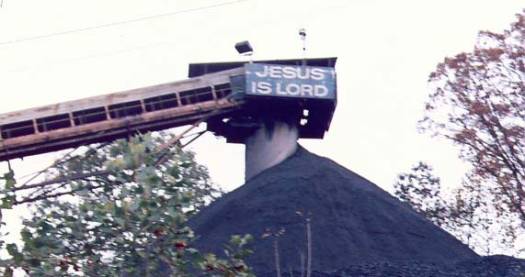
A coal pile at the Egan Mountain mine, operated by Mountainside Coal Co. © Kari Lydersen 2005Posted by Picasa

Mauve takes offense at my having said, "I am an artist"---which I do not take back, because that word included, of course, the meaning: always seeking without absolutely finding. As far as I know, that word means: "I am seeking, I am striving, I am in with all my heart."

---Vincent Van Gogh

As soon as a man does not take his existence for granted, but beholds it as something unfathomably mysterious, thought begins.

---Albert Schweitzer

Freedom is when the people can speak,
democracy is when the government listens.

---Alastair Farrugia

The subject title belongs to Dan Tokaji, assistant professor of law at Ohio State, who maintains often maddeningly sensible commentary on election law at this site http://moritzlaw.osu.edu/blogs/tokaji/index.html . He's referring to the national election last week...and in particular of course to our experience---again---in Ohio. On our state ballot were 4 issues meant to reform the way we run them, motivated largely by what happened in the presidential election last year. All 4 issues were defeated...maybe...probably...well, that's what this is about.

I meant to get into this earlier, but I got involved in the premiere of that Wal-Mart movie and just haven't found the time. Per a request from the West Coast to tell you how it went, I'm happy to report Wednesday night's showing at the Athens Library packed the room we'd reserved to twice what we thought its capacity was. We set up the 60 chairs they have for the room, then emptied out the rest of the library of chairs for the tables and even pillows for the kids section. Besides that, people brought their own chairs from home. And what an audience! Even if there'd been no movie, we'd have had a great time.

Anyway, Professor Tokaji's concerns range mostly in the area of problems with the new and required electronic machines from Diebold. I guess about half of Ohio's counties were using them. Our Secretary of State Blackwell, now running for governor...and many say on the short list for vice presidential candidate in 2008, is giddy with delight on how neat those machines are. Like last year, he is proclaiming the election here "a great day for Ohio voters." His only concern is how overwhelmed with "positive reports" his office is. The ordinarily even-keeled Tokaji comments Blackwell must be talking from an "alternate universe." But these guys are talking technical stuff. They aren't talking fraud.

But Brad Friedman, from BradBlog and HuffingtonPost, and Bob Fitrakis and Harvey Wasserman, at The Free Press, are. Once again the pre-vote polls are way out of line with the reported results. Oh...not on all the issues. They're dead-on here with Issue 1, which provides funding for construction projects. It's just some of the election reform issues, where once again---those poll people must have singled out only liberals to ask, just like last year.

ISSUE 1 ($2 Billion State Bond initiative)
PRE-POLLING: 53% Yes, 27% No, 20% Undecided
FINAL RESULT: 54% Yes, 45% No

ISSUE 2 (Allow easier absentee balloting)
PRE-POLLING: 59% Yes, 33% No, 9% Undecided
FINAL RESULT: 36% Yes, 63% No

ISSUE 3 (Revise campaign contribution limits)
PRE-POLLING: 61% Yes, 25% No, 14% Undecided
FINAL RESULT: 33% Yes, 66% No

ISSUE 4 (Ind. Comm. to draw Congressional Districts)
PRE-POLLING: 31% Yes, 45% No, 25% Undecided
FINAL RESULT: 30% Yes, 69% No

ISSUE 5 (Ind. Board instead of Sec. of State to oversee elections)
PRE-POLLING: 41% Yes, 43% No, 16% Undecided
FINAL RESULT: 29% Yes, 70% No

Brad's article is at 2 sites, and you may wish to visit both for the different comments---although I think the ones at BradBlog are more involving~~~

http://www.bradblog.com/archives/00002015.htm#comments
http://www.huffingtonpost.com/brad-friedman/the-staggeringly-impossib_b_10589.html

Fitrakis and Wasserman are here~~~

http://www.freepress.org/departments/display/19/2005/1559

Wednesday, November 16, 2005

Is Bush A Liar Or Just Stupid?


Paul Gauguin. Eve. Don't Listen to the Liar. 1889.
Watercolor and paste. Marion Koogler McNay Art Museum, San Antonio, TX, USA. Posted by Picasa

Where is the knowledge that is lost in information?
Where is the wisdom that is lost in knowledge?

---T.S. Eliot

Knowledge comes,
but wisdom lingers.

---Alfred, Lord Tennyson

The mountain of release is such that the
ascent's most painful at the start, below;
the more you rise, the milder it will be.
And when the slope feels gentle to the point that
climbing up sheer rock is effortless
as though you were gliding downstream in a boat,
then you will have arrived where this path leads.

---Dante

I think we all should agree by now that even if President Bush is a pretty stupid guy, the people behind him who shield him, writing his lines and US policy, are NOT. Nobody gets rich, plundering the planet as (s)he goes---or stays rich very long, by being stupid. What I know to be the case about the great war of liberation of Iraq is it's a pre-emptive war. The stuff about Sadam and bringing democracy to these fine people were afterthoughts. We launched Shock and Awe on Baghdad when the Administration started talk of mushroom clouds over Manhattan---arriving from Iraq in under an hour.

But look here: it was our first pre-emptive attack upon a nation with whom we were not at war. The first in American history. When a smart Administration...with SMART bombs...initiates such a massive innovation in foreign policy, do not these intelligent people consider all the consequences and ramifications? If they say we know things you don't know and we can't tell you what they are, do they not realize one day history will reveal what those things are...and whether or not they were correct? Wouldn't you think about that even if you only were forming a clique against somebody in grade school? When the Principal catches you torturing that poor classmate, would you say, "OK, we were wrong about the kid, but we can't stop hurting him now"? We all know what kind of greed and hatred rage inside a bully.

And so it is I am delighted with the publication of 2 articles yesterday. One is the belated but strong editorial in the New York Times. The Times isn't calling Bush a liar, but asserts this most recent stance definitely is denial~~~

--------------------------------------------------------------------------------

November 15, 2005
Editorial

Decoding Mr. Bush's Denials

To avoid having to account for his administration's misleading statements before the war with Iraq, President Bush has tried denial, saying he did not skew the intelligence. He's tried to share the blame, claiming that Congress had the same intelligence he had, as well as President Bill Clinton. He's tried to pass the buck and blame the C.I.A. Lately, he's gone on the attack, accusing Democrats in Congress of aiding the terrorists.

Yesterday in Alaska, Mr. Bush trotted out the same tedious deflection on Iraq that he usually attempts when his back is against the wall: he claims that questioning his actions three years ago is a betrayal of the troops in battle today.

It all amounts to one energetic effort at avoidance. But like the W.M.D. reports that started the whole thing, the only problem is that none of it has been true.


Mr. Bush says everyone had the same intelligence he had - Mr. Clinton and his advisers, foreign governments, and members of Congress - and that all of them reached the same conclusions. The only part that is true is that Mr. Bush was working off the same intelligence Mr. Clinton had. But that is scary, not reassuring. The reports about Saddam Hussein's weapons were old, some more than 10 years old. Nothing was fresher than about five years, except reports that later proved to be fanciful.

Foreign intelligence services did not have full access to American intelligence. But some had dissenting opinions that were ignored or not shown to top American officials. Congress had nothing close to the president's access to intelligence. The National Intelligence Estimate presented to Congress a few days before the vote on war was sanitized to remove dissent and make conjecture seem like fact.

It's hard to imagine what Mr. Bush means when he says everyone reached the same conclusion. There was indeed a widespread belief that Iraq had chemical and biological weapons. But Mr. Clinton looked at the data and concluded that inspections and pressure were working - a view we now know was accurate. France, Russia and Germany said war was not justified. Even Britain admitted later that there had been no new evidence about Iraq, just new politics.

The administration had little company in saying that Iraq was actively trying to build a nuclear weapon. The evidence for this claim was a dubious report about an attempt in 1999 to buy uranium from Niger, later shown to be false, and the infamous aluminum tubes story. That was dismissed at the time by analysts with real expertise.

The Bush administration was also alone in making the absurd claim that Iraq was in league with Al Qaeda and somehow connected to the 9/11 terrorist attacks. That was based on two false tales. One was the supposed trip to Prague by Mohamed Atta, a report that was disputed before the war and came from an unreliable drunk. The other was that Iraq trained Qaeda members in the use of chemical and biological weapons. Before the war, the Defense Intelligence Agency concluded that this was a deliberate fabrication by an informer.

Mr. Bush has said in recent days that the first phase of the Senate Intelligence Committee's investigation on Iraq found no evidence of political pressure to change the intelligence. That is true only in the very narrow way the Republicans on the committee insisted on defining pressure: as direct pressure from senior officials to change intelligence. Instead, the Bush administration made what it wanted to hear crystal clear and kept sending reports back to be redone until it got those answers.

Richard Kerr, a former deputy director of central intelligence, said in 2003 that there was "significant pressure on the intelligence community to find evidence that supported a connection" between Iraq and Al Qaeda. The C.I.A. ombudsman told the Senate Intelligence Committee that the administration's "hammering" on Iraq intelligence was harder than he had seen in his 32 years at the agency.

Mr. Bush and other administration officials say they faithfully reported what they had read. But Vice President Dick Cheney presented the Prague meeting as a fact when even the most supportive analysts considered it highly dubious. The administration has still not acknowledged that tales of Iraq coaching Al Qaeda on chemical warfare were considered false, even at the time they were circulated.

Mr. Cheney was not alone. Remember Condoleezza Rice's infamous "mushroom cloud" comment? And Secretary of State Colin Powell in January 2003, when the rich and powerful met in Davos, Switzerland, and he said, "Why is Iraq still trying to procure uranium and the special equipment needed to transform it into material for nuclear weapons?" Mr. Powell ought to have known the report on "special equipment"' - the aluminum tubes - was false. And the uranium story was four years old.


The president and his top advisers may very well have sincerely believed that Iraq had weapons of mass destruction. But they did not allow the American people, or even Congress, to have the information necessary to make reasoned judgments of their own. It's obvious that the Bush administration misled Americans about Mr. Hussein's weapons and his terrorist connections. We need to know how that happened and why.

Mr. Bush said last Friday that he welcomed debate, even in a time of war, but that "it is deeply irresponsible to rewrite the history of how that war began." We agree, but it is Mr. Bush and his team who are rewriting history.

Copyright 2005 The New York Times Company
http://www.nytimes.com/2005/11/15/opinion/15tue1.html?hp

The other is at TruthOut written by Larry Johnson, who worked as a CIA intelligence analyst and State Department counter-terrorism official. He is a member of the Steering Group of Veteran Intelligence Professionals for Sanity (VIPS).

Cooking the Books and Politicizing Intelligence
By Larry C. Johnson
t r u t h o u t Perspective

Tuesday 15 November 2005

Like a passenger who just leaped from the Titanic into the icy waters of the North Atlantic, George Bush is frantically looking for a rescue boat. Understandably, he keeps pointing at the dinghy nearby - i.e., last year's report issued by former Senator Chuck Robb and Judge Laurence Silbermann under the title, "Final Report on Intelligence Capabilities of the United States Regarding Weapons of Mass Destruction." However, that boat don't float too good and Bush's credibility will continue, along with his Presidency, to sink beneath the weight of lies used to bamboozle America into a pre-emptive war.

Hopefully, most Americans will take time to read the report and understand the limitations of the Robb and Silbermann effort. While I agree with the commission's conclusion that analysts made mistakes, the Robb and Silbermann report clearly demonstrates that none of the intelligence analysis from the CIA suggested that Iraq's pursuit of weapons of mass destruction had reached a critical point requiring a pre-emptive strike.

Unfortunately, Robb and Silbermann want Americans to accept the nonsense that politics played no role in the intelligence analysis. They ask America to accept the sorry picture of a President and legislators who, apparently, were willing idiots being spoon-fed wrong information by incompetent analysts. If we accept this fairy tale we will have learned nothing from the fiasco in Iraq.

Consider what is presented in the chapter on the Iraq failure (which Robb and Silbermann concede is the most important issue). According to the report, the analysts said:

The pre-war estimate of Iraq's nuclear program, as reflected in the October 2002 NIE "Iraq's Continuing Programs for Weapons of Mass Destruction," was that, in the view of most agencies, Baghdad was "reconstituting its nuclear weapons program" and "if left unchecked, [would] probably have a nuclear weapon during this decade," although it would be unlikely before 2007 to 2009. The NIE explained that, in the view of most agencies, "compelling evidence" of reconstitution was provided by Iraq's "aggressive pursuit of high-strength aluminum tubes." The NIE also pointed to additional indicators, such as other dual-use procurement activity, supporting reconstitution. The assessment that Iraq was reconstituting its nuclear program and could therefore have a weapon by the end of the decade was made with "moderate confidence."

Pay close attention. The analysts believed, incorrectly, that Iraq was reconstituting its nuclear program. But there were important caveats. First, Iraq would only have a nuke if left "unmolested" to develop such a capability. Did anyone see the words, "therefore Mr. President, you must invade?" Nope. Second, the analysts concluded that, even if left unmolested, Iraq would not have acquired a nuke until at least 2007. And how strong was this judgment? The analysts made it with "moderate confidence."

So, rather than restart or continue with inspections we now know were effective, President Bush opted for war. It was the policymakers, not the analysts, who made the decision to go to war and who oversold the October estimate to a gullible public.

I am not exonerating the CIA for its failures. There were major mistakes of leadership. For example, Robert Walpole, the man who led the drafting of the October 2002 estimate, surrounded himself with true believers who shared the view of Bush administration policymakers at the NSC and Department of Defense that military action in Iraq was required. This National Intelligence Officer did nothing to ensure that dissident voices within the CIA and other parts of the intelligence community were heard. But to pretend that the flaws in the intelligence explain why President Bush took us to war requires that we ignore a host of other uncomfortable facts.

CIA analysts got it right on the lack of operational relationship between Saddam Hussein and al Qaeda. Yet, notwithstanding the correct judgment of the analysts, President Bush and Vice President Cheney have continued to insist that there was such a relationship. In their words, the war in Iraq was an extension of the war on terrorism.

Analysts also got it right in dismissing as nonsense the claim that Iraq was trying to buy yellowcake uranium in West Africa. The analysts who briefed Congress in October 2002 said there was no truth to the allegation. Yet, the White House wanted to run with it. We know that George Tenet had to call Stephen Hadley and Condi Rice to insist that a reference to the Iraq/Niger claim not be included in a speech the President planned to deliver in Cincinnati.

The CIA analysts consistently warned the administration that the information the Brits had also was unreliable and the reports of Iraq's trying to get its hands on a nuke were wrong. The director of WINPAC at the CIA, Alan Foley, repeatedly warned NSC official Robert Joseph that the Niger claim was unreliable. Undeterred, Joseph inserted the bogus 16 words into the President's 2003 State of the Union address.

But the policymakers did not want to hear it. In fact, Don Rumsfeld and his minions were briefing TV and newspaper pundits just two weeks before the President's 2003 State of the Union address that Iraq was trying to acquire uranium in Niger.

Here is the bottom line. There is no such thing as perfect intelligence or perfect analysis. However, we do not serve the security of this country by perpetuating the myth that we went to war in Iraq because a couple of analysts believed Saddam's acquisition of aluminum tubes was part of a secret program to build a nuke. Going to war was and remains a political decision made by a President.

http://www.truthout.org/docs_2005/111505I.shtml

Sunday, November 13, 2005

Wal*Mart: The Movie Comes To Athens


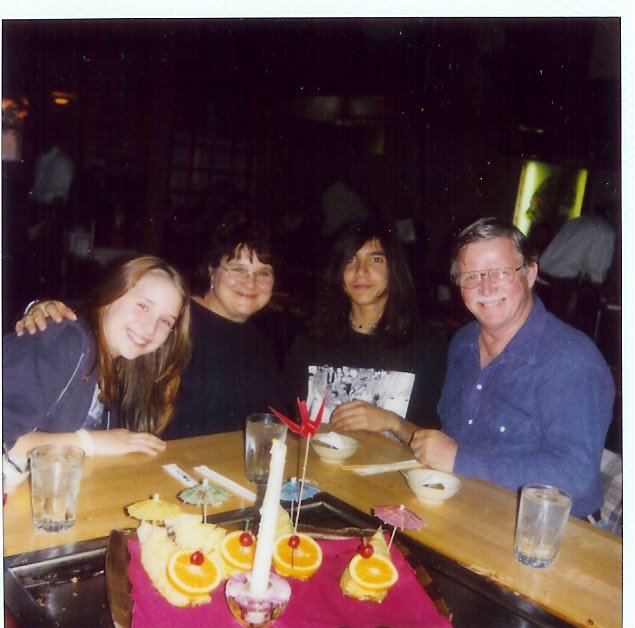
Here we see Dana celebrating her birthday last month at the Japanese Steak House in Columbus, with our daughter and her friend Keenan Huq. Posted by Picasa

The highest point a man can attain is not knowledge, or Virtue, or Goodness, or Victory, but something even greater, more heroic, and more despairing: Sacred Awe!

---Nikos Kazantzakis

Whatever is seen by such a heart and mind is a flower, whatever is dreamed is a moon. Only a barbarian mind could fail to see the flower; only an animal mind could fail to dream the moon.

---Basho

Thank God for the things that I do not own.

---St. Teresa Of Avila

Actually the title is WAL*MART: the high cost of low price, a new film by Robert Greenwald, whose previous documentaries include OUTFOXED: Rupert Murdoch's War on Journalism and UNCOVERED: The War On Iraq, both from last year. This week WAL*MART will premiere at 7000 (and counting) different locations across America...and apparently in several other countries as well. What is novel about Greenwald's approach to premieres is they occur in living rooms, public meeting chambers, and union halls...and only in a few movie theaters. Teaming up with MoveOn and the Internet, he began advertising a couple months ago for screening kits you could order. I think he asked 10 dollars or something for it, you typed in your mailing info online, paid with PayPal or the like, and soon a box arrived with the DVD, a couple big posters, and some other brochures. Your name and screening location goes online and people can reserve a seat, depending on your capacity. MoveOn has changed the political landscape of this country using an approach to organize that's both fun and dynamic.

Dana, Ilona and I went to our first MoveOn houseparty, I think, when Fahrenheit 9/11 came out. The same technique was used, and after the movie there was an online chat set up with Michael Moore, as he answered questions from living rooms across the land. Through Jim and Howard Dean's Democracy For America group Dana got involved in MMOB, which stood for Mainstreet Moms Opposed to Bush (but now is called Mainstreet Moms Operation Blue). That group locally, I think (you know how liberals keep changing stuff around), evolved into WORD, which I guess means Women Openly Reclaiming Democracy. WORD decided last month to sponsor a screening of WAL*MART at the Athens Public Library, and that's planned for Wednesday evening at 7:00. Most of the premieres in this country will be Tuesday.

Well, we sent out some notices by email...and took brochures around town. Seemingly within a matter of hours, the signup for Athens at http://www.walmartmovie.com/host.php was at capacity already. The room WORD reserved may hold somewhere around 50 people, so now they're wondering whether to try 2 screenings (the film is almost an hour and a half), reserve another night too, or change the location to someplace bigger. Perhaps another copy we ordered will arrive tomorrow, and if there's a second room in the library available we could show them both at the same time. The DVD has a condensed 20 minute version, and I suppose they could show that in 3 or 4 shifts. The library itself has just gotten an addition, which is quite spacious and hasn't been filled with anything yet. In fact, one wit wrote the newspaper last week to suggest the place could house the Bush Memorial Library...but then thought better of it, since the learned and unclassified documents easily could fit into a janitor's closet. There might not be enough chairs to set up in that area, but maybe folks wouldn't mind standing or sitting on the floor around the big TV set. So WORD has to figure this stuff out today and tomorrow.

As for the movie itself, you can read reviews by the LA Times, NY Times, and Salon through the links at the top of that walmartmovie site just above. It has quite a different tone than Greenwald's previous work, but certainly is just as skilled. For one thing, he wants to address a more representative audience. The people who work and shop at Wal*Mart are not the people ready to mock out the Fox News Network. They're probably people who watch it religiously. He does not want to offend that audience this time. There is a quiet, compassionate tone in these stories of business families driven out by the arrival of the big store, of employees who work full time (or as "full" as the company allows) but must apply for WIC, food stamps and Medicaid, and of managers who thought Wal*Mart really wanted to help regular folks. Once we start visiting their unmonitored parking lots and the sweat shops abroad however, the more familiar Greenwald tension begins to build.

You know, I happen to feel that a partnership between a company and government social programs isn't necessarily a bad thing. Big benefit packages haven't been around forever, and given how corporations are having a tough time with them, maybe the concept was a wrong turn. I realize that what they do is raise prices for consumers in order to maintain the profits they want, but particularly with medical and now fuel costs I understand companies are squeezed. Wal*Mart's response to union organizing and benefit talk is swift and tough. The stories from the sweat shops where they get their cheap goods are horrifying, but I guess we have a foreign policy that turns a blind eye to such practices. We don't seem to invade countries over that kind of tyranny. At the same time the US apparently has a tax code that does not weigh heavily on businesses like Wal*Mart. Increasingly I feel like I'm paying, along with the other little guys, for the few social programs that remain. I guess I resent having to pay for my own benefits and for those of Wal*Mart employees too. But all Wal*Mart is doing is taking advantage of the openings and loopholes...and that's the good ol' American way. Is this movie going to change that? Sit back and enjoy the show.

Thursday, November 10, 2005

Iraq Is A Local War


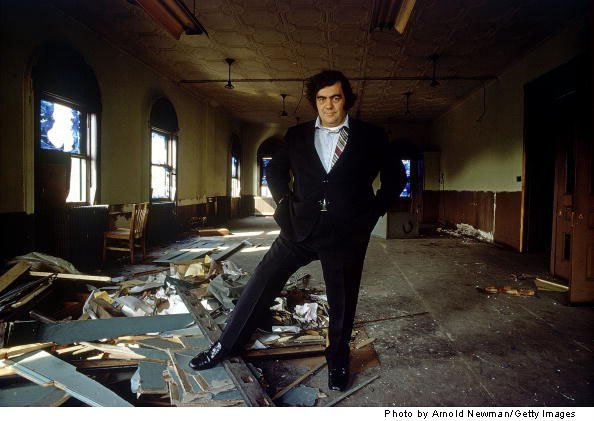
Jimmy Breslin, Pulitzer Prize winning journalist and author, poses for a portrait May 19, 1971 in Brooklyn, New York. Posted by Picasa

In order to arrive at that which thou knowest not,
Thou must go by a way that thou knowest not.
In order to arrive at that which thou possesseth not,
Thou must go by a way that thou possesseth not.

---St. John of the Cross

The more faithfully you listen to the voice within you, the better you will hear what is sounding outside. And only he who listens can speak.

---Dag Hammarskjold

Earth's crammed with heaven,
And every common bush afire with God.

---Elizabeth Barrett Browning

My good friend Quinty (Paul Quintanilla http://www.lqart.org/ ) sent out yesterday's column by Jimmy Breslin with this comment~~~

"What is poetry? The truth burning through lies? The sharp taste of reality? Here's Jimmy Breslin burning a whole forest of lies down."

For the sake of younger readers and folks from outta town, Wikipedia at least has this stub of a description of him~~~

Jimmy Breslin (born October 17, 1930) is an American columnist who has appeared regularly in various newspapers in New York City, where he lives. On November 2, 2004 he retired as a regular columnist from Newsday but stated his intention to continue writing. In his final Newsday column, Breslin incorrectly predicted a Kerry victory in the 2004 election.

In 1969, he ran unsuccessfully as an independent for New York City Council President allied with writer Norman Mailer running for Mayor, with the agenda of New York City secession as the 51st state.

He won the 1986 Pulitzer Prize for Commentary.

Among his notable columns, perhaps the best known was published the day after John F. Kennedy's funeral, focusing on the man who had dug the President's grave. The column was indicative of Breslin's style, which often highlights how major events or the actions of those considered "newsworthy" affect the "common man."

Breslin is the author of a biography of Damon Runyon (Damon Runyon - ISBN 044050502X) and several novels, the best-known of which is The Gang That Couldn't Shoot Straight (ISBN 0316111740).

COMMENTARY

War must be a local issue
Jimmy Breslin
November 9, 2005

The church was empty at dusk. You stood in the stillness and looked at the place, right there on the side of the altar, where Michael Bloomberg spoke over the casket of a fallen aristocrat of the city, Riayan A. Tejeda, Marine, dead in Iraq at age 26.

Bloomberg pronounced, "He died to keep the weapons of mass destruction out of the hands of ..."

You heard no more. He was up there in the presence of a gallant New Yorker and he spread a lie and for me it was the start of his campaign and it ended with me not voting for him last night.

He says of Iraq, "It is not a local issue."

This was almost two years ago at St. Elizabeth's Catholic Church on Wadsworth Avenue in Washington Heights, which is more than somewhat local.

By myself, I have been at the deep grief of another soldier's funeral in the Bronx, one in Ridgewood, another in Brooklyn.

If the kid who gets killed is local, then - the war is local.

This war continues without an official protest that would call out the will of the people of the City of New York and might count in a nation that by now realizes it has been the victim of a president who is a fake and a fraud and a shill and a sham and now is going around with the blind staggers.

Only the other night, in a television appearance with the opponent, Ferrer, Bloomberg was asked about withdrawing troops from Iraq and - heavens! - you can't do that. Why, that would mean that New York's fallen military would have died in vain. And why you could never say that about the three or four who would be killed on the day after that, and tomorrow and tomorrow.

They die in the splendor of bravery, the prayer of valor. And fall in vain because the government causes them to die in vain.

Around this great city yesterday, the day went into the heart of the night without excitement. There was an election for mayor and the streets should have been loud with the shrieks of people crying for your vote. Bloomberg last night finished spending at least $70 million to get re-elected and the money suffocated the election. That is not democracy. Every one of those dollars should form the seeds of a revolt.

He is the mayor in a time of National Alzheimer's, and New York, too, is stricken. We have Bloomberg silent on a war. And once in this state we had as senators at the same time, Robert F. Kennedy and Jacob Javits. Look at the citizenry here accepting as United States senators, Clinton and Schumer, who both supported the war. The coin has cheapened and no outcry is heard.

How can Mike Bloomberg be the mayor of this city and not try to put his voice and weight into saving lives?

Bloomberg follows the smirking, deadly lies of a president who had people getting killed for what? For oil, for Dear Old Dad, for a racist disdain for a guy in an alley with a rag on his head. Bush saw the rag but never noticed the gun the guy carried.

Last night, Julio Cesar Tejada, the dead Marine's father, stood in the swarms of people going past his building at 602 W. 180th St. He is 53 and stocky, with short black hair and a pleasant face. On the sidewalk next to him was the small, permanent grotto to his son. A photo. Flowers. Candles. Prayers in Spanish and English.

"How has it been?" he said. He patted his chest. "My heart fell apart. I cannot work. I spend all the days going to the doctor."

"The wife?"

He shook his head. "It is very bad for her."

He said he had to get the Con Edison bill paid. "They turn off the lights if you don't."

At the corner, a young woman, a college student, asked him about Bloomberg clinging to the war. Now I mentioned the speech at his son's funeral.

Julio shook his head. "I was too mixed up at the funeral."

He said then he was going to vote.

"For whom?"

He shook his head. "I don't know 'til I get there."

Copyright 2005 Newsday Inc.http://www.newsday.com/news/columnists/ny-nybres094505071nov09,0,5025678.column?coll=ny-news-columnists

I found most enlightening this page of Breslin quotes...if you're in the mood for more~~~

http://www.brainyquote.com/quotes/authors/j/jimmy_breslin.html

Wednesday, November 02, 2005

Tears For Baghdad


An Iraqi man cries over the bodies of his children in Hillah, some 110km south of Baghdad, after US troops bombed a residential quarter of the town. (Photograph:Reuters, April 1, 2003) Posted by Picasa

In proportion as our inward life fails, we go more constantly and desperately to the post office. You may depend on it, that poor fellow who walks away with the greatest number of letters, proud of his extensive correspondence, has not heard from himself this long while.

---Henry David Thoreau

Pride flees from the man who penetrates into the self as the light of a campfire before the rays of the sun.

---Zen saying

You should know that no one can hold the mind by himself, if it not be held by the Spirit. For it cannot be held, not because of its mobile nature but because, through neglect, it has acquired the habit of turning and wandering hither and thither....A mind thus inclined and withdrawn from God is led captive everywhere.

---St. Gregory Of Sinai

How many civilians, the elderly, women, children, male noncombatants, have died in the War on Iraq? It used to be that a casualty count was important in warfare. It's how you knew you were winning. Of course that's when soldiers would gather on a field of battle, face each other, march up with some fancy footwork and football plays, and shoot it out. Civilians got killed in the seige of a castle or city...or mass execution later...but it's been fewer than a hundred years of glorious history since we've improved ourselves enough to provide access to air attack.

To begin the generals played by the old rules, lobbing bombs onto troop locations, splattering civilians only by accident. But then, maybe troops started hiding behind the lady's skirts, so the only thing to do was aim at buildings and homes. This activity required a new kind of behavior and discipline from the average pilot...and I imagine it still does the first time a pilot is ordered to shoot a rocket where there might be babies. But it looks as though humans can get used to anything...and of course duty calls.

At first, the firebombing campaign against Dresden by the team of the USAAF Eighth Air Force and RAF Bomber Command in 1944 and 1945 wasn't talked about much. So many tens of thousands of people were killed and almost the entire city flattened by tens of thousands of tons of high-explosive bombs and incendiaries that folks had trouble even thinking about it. http://en.wikipedia.org/wiki/Bombing_of_Dresden_in_World_War_II Possibly Kurt Vonnegut, who experienced the February 1945 attack as a prisoner of war and survived, is more responsible than our history teachers for making us remember that it happened at all.

Besides, when we almost immediately went on to drop atomic bombs on Hiroshima and Nagasaki, the business at Dresden seemed like small potatoes. At least 120,000 people were killed immediately, almost 95% of them civilian. Nearly twice that number have died since from their injuries and radiation. http://en.wikipedia.org/wiki/Atomic_bombings_of_Hiroshima_and_Nagasaki Obviously the Japanese army wasn't hiding in schools and hospitals in those cities. This was a preventive attack, an object lesson, a morality tale. The Allies were the Good Guys, and here was the proof. No, I'm not arguing anything in favor of the Nazi Axis, but I do call into question the sense of superiority that particularly the United States assumed 60 years ago and has labored on ever since.

We've never been really proud of Hiroshima and Nagasaki, but I don't think we apologized either, did we? In the Orient official apologies from one nation to another are highly honored. Generally I think Americans feel it was horrible to do it, but it had to be done. This is how war goes. We've never thought of ourselves as war criminals in any sense. We expect our own court martials to take care of perpetrators of massacres a la Viet Nam. We know that people freak out in war, and now with television and instant computer communication we know such things occur more than we used to.

Which brings us to Shock And Awe. Here we were going after one man who might be in Baghdad. The whole strategy was planned out with pinpoint accuracy. http://www.shockandawe.com/ How many civilians died during the display...and after? General Tommy Franks, of the US Central Command, replied, "We don't do body counts." http://www.iraqbodycount.net/ Why not? What happened to the tally that tells us whether or not we're winning? Are we ashamed? Don't we want anyone to know? Is this the way our leaders hide behind the lady's skirts these days? We just don't talk about it? We aren't allowed to think about it?

How many women and children and elderly have died in Iraq? This past weekend the generally excellent PRI show "This American Life" featured a Johns Hopkins survey done in Iraq and published an entire year ago that attempted to answer that question. You can hear the show here http://www.thislife.org/ and you can read the survey after you register (quick and free) at the distinguished British journal The Lancet http://www.thelancet.com/journals/lancet/article/PIIS0140673604174412/fulltext . The estimate then---over a year ago---was 100,000 people. The method of the survey generally has been applauded by major scholars everywhere who keep up with those kinds of investigations and statistics. The guys from Johns Hopkins who conducted it were lucky to get in and get out alive.

What Ira Glass was wondering during his broadcast is how come no one heard about this study? The authors thought their results would be all over the media...and they even confess to having expected moral outrage. But almost nobody carried the release and results at all. I wonder why. Do you think there's a conspiracy of publishers to keep news from us? Are we all too confused and numb to deal with our own consequences? Has the United States come to a point where its population just can't handle it? How dangerous would be such a state of mind? What does it take to drive an Iraqi son, husband, and father insane with grief? What would it take to make you that way?

Friday, October 28, 2005

To My Friends On The Right


Special Counsel Patrick Fitzgerald (L), who says he doesn't photograph well, arrives at his Washington office October 27, 2005. (REUTERS/Micah Walter) Posted by Picasa

We must be able to let things happen in the psyche. For us, this actually is an art of which few people know anything. Consciousness is forever interfering, helping, correcting, and negating, and never leaving the simple growth of the psychic processes in peace. It would be simple enough, if only simplicity were not the most difficult of things.

---Carl Gustav Jung

To know that you do not know is the best.
To pretend to know when you do not know is a disease.

---Lao Tzu

Give me, kind Heaven, a private station,
A mind serene for contemplation.

---John Gay

I like to maintain dialogue with people of conservative philosophies, and several get these dispatches I send to cyberspace from time to time. Apparently a few even read them and sometimes lash back when they get mad. This is OK because usually there are other things at the heart of our friendship...and we just go back to those topics. I'm not being demeaning because there are elements of the conservative view, including the basic tenets of Hobbes, that are very convincing to me. I like best to talk with conservatives because I may be wrong about things and they help me be the first to know when I am.

There are two things I know about conservatives that come to mind this morning. One is they allow more secrecy in planning and government than I like or agree with. They respect the sanctity of the huddle. I must admit the intrusion of television technology onto the playing field can spoil the fun. I do not want to learn what the next pitch is going to be, or what the manager just whispered into the coach's ear. But politics is not a game to me, and if Cheney's energy cronies have carved up the world for their financial gain, using the public office of the Vice Presidency to do it, I want to know!

But the second conservative conviction that I think of today I do agree with and respect tremendously. Conservatives believe in playing by the rules. Fascists don't. They believe in making up rules by "necessity" as they go along. And so conservatives I've been talking to are anticipating the announcements by Fitzgerald today as much as I am. When Miers withdrew yesterday one such associate said to me, "Now we'll get a nominee to replace her so far to the right there won't be a confirmation before Christmas!" His remark helped temper my excitement.

The left is going wild on the Internet at this hour. I understand it. I woke up at 3 and had to get down to the computer to read the news. Some of you write or tell me you like it when I chart where I've been because it saves you time. Google News is featuring well over 2000 entries at this hour on who in the White House is about to be indicted, and an extension of the grand jury investigation for more about Karl Rove. Yahoo is carrying the basic AP story http://news.yahoo.com/s/ap/20051028/ap_on_go_ca_st_pe/cia_leak_investigation , but Reuters' Adam Entous kept updating his coverage until after midnight sometime. You can type in www.reuters.com and find yourself with the latest news, but I like Entous' earlier story which appeared on The Boston Globe site last night http://www.boston.com/news/nation/washington/articles/2005/10/27/leak_case_announcement_seen_friday/ . It also sums up The New York Times story, appearing in this morning's edition, that says Karl Rove will not be charged today because Fitzgerald is looking for more.

Another excellent summary I think is at BradBlog http://www.bradblog.com/archives/00001956.htm#comments . There are lots of hyperlinks there to lead your curiosity to the original sources. The most significant I think is the reference to a dispatch from Murray Waas at the National Journal http://nationaljournal.com/about/njweekly/stories/2005/1027nj1.htm . Here we learn, "Vice President Cheney and his chief of staff, I. Lewis 'Scooter' Libby, overruling advice from some White House political staffers and lawyers, decided to withhold crucial documents from the Senate Intelligence Committee in 2004 when the panel was investigating the use of pre-war intelligence that erroneously concluded Saddam Hussein had weapons of mass destruction, according to Bush administration and congressional sources.
"Among the White House materials withheld from the committee were Libby-authored passages in drafts of a speech that then-Secretary of State Colin L. Powell delivered to the United Nations in February 2003 to argue the Bush administration's case for war with Iraq, according to congressional and administration sources. The withheld documents also included intelligence data that Cheney's office -- and Libby in particular -- pushed to be included in Powell's speech, the sources said. " While still at BradBlog, especially those of us in Ohio, be sure to check out his writeup of Tom Noe's 3 count indictment of money laundering for Bush and Blackwell http://www.bradblog.com/archives/00001954.htm#comments . Dana sent this out to her list already last night.

If you want to get farther out, brace yourself for Arianna Huffington's blog, which actually is a legion of liberal bloggers http://www.huffingtonpost.com/ . The latest headlines and links to those sites are also there, and lots of photos. Her own entry today is about Macbeth and Bush and how they both lost their mojo. Well...you catch the drift.

The piece that captured most of my attention was an analysis of the whole Bush collapse by Tom Englehardt, who attended both Yale and Harvard and is involved, I guess, in a couple liberal thinktanks and publishing projects. He maintains something called TomDispatch http://tomdispatch.com/index.mhtml and yesterday put out this essay that TruthOut and a number of others have picked up http://tomdispatch.com/index.mhtml?pid=31576 . Clearly Englehardt is a bit on edge himself , as he chronicles how hard he's been working over the past year for this moment. Yeah well, haven't we all? But further into the piece he gets going~~~

"In all their guises -- in relation to the media, the federal bureaucracy, and other countries -- they actually were dominating isolationists. They took a once honorable Republican heartland tradition -- isolationism -- turned it on its head and thrust it into the world. They acted in Iraq and elsewhere as armed imperial isolationists. Where the elder Bush and Bill Clinton were multinationalists and globalizers; they were ultra-nationalists and militarists, focused only on the military solution to any problem -- and damn the torpedoes, full speed ahead!
"But when you are a cabal, using such close-to-the-breast, not to say mom-and-pop, methods of ruling, and you falter, whether in Iraq or at home, unilateralism becomes weakness. And when it turns out that what you rule is the 'last superpower' and you've sidelined, pacified, or punished large numbers of people in the vast, interlocking worlds of the governmental bureaucracy and the media, your enemies still retain the power to strike back.
"When something closer to the full story of our moment is known, I suspect we'll see more clearly just how the bureaucracy began to do so (along with, as in this week's New Yorker magazine in the person of Brent Scowcroft, the old multinational ruling elite). In the meantime, it's clear that what the potential implosion moment awaited was the perfect storm of events now upon us. If this moment were to be traced back to its origins, I would, for the time being, pick the spring of this year as my starting point and give the mainstream media -- anxious, resentful, bitter, cowed, losing audience, and cutting staff -- their due. The Bush slide has been a long, slow one, as the opinion polls indicate; but like that famed moss-less rolling stone, it picked up speed last spring as the President's approval ratings slipped below 50%, and then in the ensuing months plunged near or below 40%, putting him at the edge of free-fall.
"If there's one thing that this administration and Washington journalists have in common, it's that both groups parse opinion polls obsessively; so both saw the signs of administration polling softness and of a President, just into a second term, who should have been triumphant but was failing in his attempt to spend what he called his 'political capital' on social security 'reform.'
"Vulnerability, it gets the blood roaring, especially when it seeps from an administration so long feared and admired as the 'most disciplined' and 'most secretive' in memory, an administration whose highest officials (as the Plame case showed) regularly whacked their opponents with anything at hand and then called on their media allies, always in full-battle-mode, for support. Probably the key moment of weakness came in August, when Cindy Sheehan ended up in that famed ditch at the side of a road in Crawford, Texas, and the President and his men -- undoubtedly feeling their new-found vulnerability, anxious over an Iraq War gone wrong and the protesting mother of a dead soldier so near at hand -- blinked."

I hope this has helped you with your Friday morning and the announcement to come later today. Enjoy it, especially if it's payday besides! And get your chores done tomorrow.

Tuesday, October 25, 2005

In Memoriam Rosa Parks


Posted by Picasa

Pride means the end of wisdom.

---Japanese proverb

It is just like learning archery; eventually you reach a point where ideas are ended and feelings forgotten, and then you suddenly hit the target.

---Ying-An

We find great things are made of little things,
And little things go lessening till at last
Comes God behind them.

---Robert Browning


Rosa Parks, 1913 - 2005


"I am leaving this legacy to all of you ... to bring peace, justice, equality, love and a fulfillment of what our lives should be. Without vision, the people will perish, and without courage and inspiration, dreams will die — the dream of freedom and peace."

http://www.voanews.com/english/2005-10-25-voa3.cfm

US Civil Rights Icon Dies at Age 92
By Matthew Schneider
Washington
25 October 2005

Rosa Parks, a seamstress from Montgomery, Alabama, who would not give up her bus seat to a white man in 1955, died Monday at the age of 92. Historians mark the date of her quiet-but-revolutionary act as the start of the modern civil rights movement in the United States.

If you had seen Rosa Parks walking down the street, in recent years, you would never guess that the slender, silver-haired lady with large spectacles had anything to do with an event that ignited black civil rights as one of the main national issues of the middle 20th Century.

On December First, 1955, Mrs. Parks had finished her work as a seamstress in a Montgomery, Alabama, store and boarded a city bus to go home. She took a seat in the 11th row, behind the seats reserved exclusively for white passengers, as required by the city's segregation law at that time. Blacks were entitled to seats from the 11th row to the rear of a bus. However, the city law said if the first 10 rows were filled, a white passenger could request a seat in the back of a bus. Rosa Parks remembered the bus was crowded with people standing in the aisle when several whites boarded. A white man told the driver he wanted a seat. The driver, who had the authority under city law, went to the rear of the bus and ordered Mrs. Parks and three other black passengers to get up. The others reluctantly stood. Rosa Parks, tired after a day of work, refused.

"When they stood up and I stayed where I was, he asked me if I was going to stand and I told him that 'no, I wasn't,' and he told me if I did not stand up he was going to have me arrested. And, I told him to go on and have me arrested," Mrs. Parks said.

The bus driver called the police and when they arrived he told them he needed the seats for his white passengers.

"He pointed at me and said, 'that one won't stand up.' The two policemen came near me and only one spoke to me. He asked me if the driver had asked me to stand up? I said, 'yes.' He asked me why I didn't stand up," Mrs. Parks said. "I told him I didn't think I should have to stand up. So I asked him: 'Why do you push us around?' And he told me, 'I don't know, but the law is the law and you are under arrest.'"

Mrs. Parks said her decision to remain seated was based on her desire to be treated with decency and dignity:
"This was not the way I wanted to be treated after I had paid the same fare this man had paid -- he hadn't paid any more than I did but I had worked all day and I can recall feeling quite annoyed and inconvenienced. And I was very determined to, in this way, show that I felt that I wanted to be treated decently on this bus or where ever I wasMrs. Parks said.

Rosa Parks, who worked for the local chapter of the National Association for the Advancement of Colored People, the NAACP, continued to assert that she had not intended to provoke her arrest.

"I had only intended to go home and take care of whatever matters I had because I had an NAACP youth conference that weekend and I also was getting out the notices for the senior branch of the NAACP (convention). I didn't move because I didn't feel like it was helping us or making things lighter [easier] for us -- me as an individual and us as a people to continue to be pushed around because of our race and colorMrs. Parks said.

Her arrest for violating the city segregation law was the catalyst for a mass boycott by blacks of the city's buses, whose ridership had been 70 percent black.

That boycott brought the young minister Martin Luther King, Junior, to national prominence as the head of the Montgomery Improvement Association, the group that organized and led the protest. The Montgomery Improvement Association also filed a federal suit challenging the constitutionality of the segregation law on February first, 1956. The boycott continued 382 days, until December 20, 1956, when the United States Supreme Court ordered city officials to desegregate their buses.

Rosa Parks was born Rosa Louise McCauley on February Fourth, 1913, in Tuskegee, Alabama. Her father was a carpenter and her mother, a teacher. They enrolled Rosa in the Montgomery Industrial School for Girls, a private school that encouraged each girl to "take advantage of the opportunities, no matter how few they were." In those days, "few" was the key word for blacks, especially in the southern states of America. Rosa told a newspaper that blacks didn't have any civil rights. She said, "It was just a matter of survival...of existing from one day to the next. I remember going to sleep as a girl and hearing the Ku Klux Klan ride at night and hearing a lynching and being afraid the house would burn down."

When she was 19, she married Raymond Parks, a barber who was active in black civil rights and voting registration. She attended a small black university in Montgomery for a few years and then worked for the Montgomery Voters League, the NAACP Youth Council and other civic and religious organizations. Having gained a reputation for getting things done, she was elected secretary of the Montgomery chapter of the NAACP in 1943. At that time the civil rights organization had to spend much of its energy working on cases of white violence against blacks. Aside from beatings and murder, blacks had to contend with peonage, a system where blacks who owed money or were in jail would be forced to perform labor without receiving pay. She said, "We didn't seem to have too many successes. It was more a matter of trying to challenge the powers that be, and to let it be known that we did not wish to be continued as second class citizens."

During the next 20 years Mrs. Parks helped support her family by taking sewing at home. She also worked as a house cleaner and for a brief period as an insurance agent.

The Parks family moved to Detroit, Michigan, soon after the conclusion of the bus boycott because of continuing threats of violence by the racist organization the Ku Klux Klan as well as by angry individuals who held Mrs. Parks responsible for the desegregation of the city buses.

Raymond Parks resumed working as a barber. Rosa, after recovering from stomach ulcer problems, was hired by Michigan Congressman John Conyers, Junior, as a secretary and administrative assistant.

In the following years the shy lady conquered her fear of public speaking and became a spokeswoman for civil rights issues.

In later years, Rosa Parks received honorary university degrees and various awards from civil rights organizations. The city of Detroit, Michigan, named a street for her. In 1989, one of the most unusual tributes came from the Neville Brothers singing group who honored her by writing a song entitled "Sister Rosa." Its reggae chorus is: "Thank you Miss Rosa / You are the spark / You started our freedom movement."

Rosa Parks said she wanted to be remembered "as a person who wanted to be free and wanted others to be free." In a 1984 radio interview she said that sometimes she couldn't escape the fame and responsibility that was thrust upon her:

"I've managed -- someway -- but there are times when I didn't want to take as much responsibility as they put upon me, but I accept whatever comes if it's going to be of any help to other peopleMrs. Parks said.
Rosa Parks, who ignited the modern civil rights movement in the United States when she refused to surrender her seat on a bus to a white man on December First, 1955. Rosa Parks -- dead at the age of 92.

Saturday, October 22, 2005

Dear Europe, Get Out Your Woolens!


The Gulf Stream can be seen (red) in this thermal satellite image.
© NOAA Posted by Picasa

As for sitting in mediation, that is something which MUST include fits of ecstatic blissful laughter---brayings that will make you slump to the ground clutching your belly, and even after that passes and you struggle to your feet, will make you fall anew in further contortions of side-splitting mirth.

---Hakuin

When the striving ceases, there is life waiting as a gift.

---Saul Bellow

Please do not get caught in that place where you think you know.

---Zen saying

Last month NCN.org member and chemist Silvia Martinez, who lives in Spain, answered my request for links to articles she has been reading about a decrease in the flow of the Gulf Stream. I had heard dire predictions about this occuring some 30 years ago, but then it was all theoretical and frankly rather confusing. The idea is salt water can't freeze unless it's so cold the salt gets expelled in the process. For the last hundreds of years this has happened in the Greenland Sea most noticeably. The salt sinking causes warmer water from the southwest to flow in, washing the lower salt water southerly and forming a cycle we call the Gulf Stream (since it ends up and turns around in the Gulf of Mexico). More fresh water from the melting of ice age glaciers is diluting the salt water around Greenland to the extent that sinking salt isn't bringing in the same rush of warmer water. Here is the note Silvia sent me and the links.

Dear Richard,
I've been following this topic since a few years, and have read many reports. As you probably know, there is too much especulation & prediction, but few scientific data.
In this report, they comment that the melting ice in the Arctic Ocean is causing that more fresh water goes into the ocean, thus slowing down the Gulf Stream because of a decrease in the salinity of the water: http://www.emagazine.com/view/?2518
And this is the Times of London article that the above website refers to, reporting that the Gulf Stream slowdown is already occurring:
http://www.timesonline.co.uk/article/0,,2087-1602579,00.html
Others don't give so much importance to this stream in the context of the climate change: http://www.earthinstitute.columbia.edu/news/2002/story09-27-02.html
This is a review pretty interesting and gives a lot of information about these ocean streams as it was observed in the past until the nineties, it's long but IMHO its reading is worthy. Besides, the main page has a lot of interesting reports.
http://www.aip.org/history/climate/oceans.htm
Light and love,
Silvia

A few hours ago UK's Independent put online its lead story of the day, which warns of a catastrophic winter ahead for countries warmed for centuries by the Gulf Stream~~~

Are we heading for a new winter of discontent?
By Jonathan Brown, Jeremy Laurance and Barrie Clement
Published: 22 October 2005

Britain could be left paralysed by energy shortages, a health crisis and gridlock on the roads if the predicted Arctic winter strikes with severity.

Prolonged sub-zero temperatures after nearly a decade of mild winters could result in the death of tens of thousands of people, with fears that the National Health Service faces the prospect of a full-blown winter bed shortage for the first time since Labour came to power in 1997.

The Confederation of British Industry warned that power shortfalls caused by the rising domestic demand to keep warm and Britain's dwindling strategic stockpiles could lead to factory shutdowns and a return to the three-day week. At present, only 11 days' supply of gas is being held in reserve, compared with 55 days' worth elsewhere in Europe. Consumer groups fear that hardest hit will be members of the two million poor households already struggling to cope with the 40 per cent rise in energy prices since 2003.

Transport specialists also warn that the authorities have not acted fast enough to keep motorways and other routes open in the event of heavy snowfalls. The situation would be worse in Scotland.

Concern has been mounting since the Meteorological Office took the unprecedented step of issuing a long-range forecast predicting the likelihood of a much harsher-than-average winter. The "amber alert" was based on lower-than-average sea temperatures recorded near Iceland and off the Azores this spring. The findings are a typical precursor for a phenomenon known as the North Atlantic Oscillation (NAO) which has resulted in some of the harshest winters on record. The effects of the NAO were felt most spectacularly in 1963, when temperatures dropped as low as minus 22C, the Thames iced over and large swaths of southern England were blanketed more than a foot of snow for weeks on end.

Forecasters say they are 67 per cent confident that this winter will be among the coldest on record, and are urgently working on models predicting exactly how cold it will be and for how long Britain will freeze. A spokesman said the Office of the Deputy Prime Minister, John Prescott,had been informed immediately, as had the NHS, the Highways Agency and other relevant departments. "We told them to go back and look at their plans. We have had nearly 10 years of warm winters and society has changed in that time," the Met Office spokesman said.

The Arctic temperatures could not come at a worse time for Britain's energy consumers. All six power companies have relentlessly increased prices in the past two years in the midst of worsening volatility in the global energy markets. Average customers can now expect to pay £750 a year on fuel costs. Already two million households are spending 10 per cent of their income on gas and electricity bills. Three-quarters of these are classified as vulnerable - among them the elderly, sick or very poor. "When it is really cold at a time when prices have already gone up dramatically, will people make the decision to keep warm? We pray to God that they do," said Adam Scorer, head of campaigns at Energywatch.

An extra 8,000 deaths are anticipated for every one degree centigrade that the temperature falls below the winter average. When home temperatures drop below 16C, resistance to respiratory diseases falls. Cold air temperatures lead to a rapid rise in the number of strokes and heart attacks.

A DoH spokeswoman said plans were being made to clear beds and cancel operations should the worst-case scenario unfold. A spokesman for the department said: "We are aware of the Met Office's severe weather forecast for this winter but we always prepare for the worst anyway." Concerns are growing that the Government has seriously underestimated the impact of an exceptionally cold winter on business. Sir Digby Jones, the director general of the CBI, said this week that "businesses will shut down" and that the biggest energy users will be forced to "throw the switch".

Demand peaked in the relatively mild January of 2003, when 449 million cubic metres (mcm) of gas were used. This year, total availability will be lower than in previous years at 476mcm - allowing a margin of error of just 6 per cent. Lord Woolmer of Leeds, chairman of the House of Lords European Union Committee, warned that the situation had deteriorated since he submitted a report on the supply situation last year.

North Sea supplies have been run down faster than envisaged over the summer to exploit high prices on the Continent. Meanwhile the European energy market, from which Britain must now import much of its supplies, remains unreformed, and serious doubts have been expressed that it can meet the extra demand.

The severe hurricane season in the Gulf of Mexico means that production of liquefied natural gas (LNG) has been badly disrupted. Consignments destined for Britain have been diverted to the United States. Big industrial energy users, such as steel and chemical companies, may have tohalt production on very cold days to allow domestic suppliers to take precedence. "The Government said that voluntary agreements will be sufficient. But the real danger is that they may not be enough," Sir Digby said.

The Energy minister, Malcolm Wicks, dismissed the talk of a three-day week as "scaremongering". A Department of Trade and Industry spokesman said: "The market is likely to correct itself in the event of any shortfall of supplies. A mechanism is in place to restrict supplies to some parts of industry should the situation require it."

http://news.independent.co.uk/uk/this_britain/article321425.ece

Sunday, October 16, 2005

A Pause And Applause For Pinter


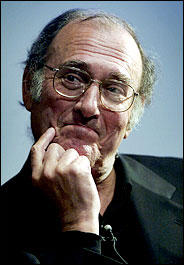
Playwright Harold Pinter in a rare appearance at the Orange Word Screenwriters Programme, at the British Library, in 2004.
Bruno Vincent/Getty Images

The individual becomes perfect when he loves his individuality in the all to which he belongs.

---D.T. Suzuki

Value judgments are destructive to our proper business, which is curiosity and awareness.

---John Cage

When one tugs at a single thing in nature, he finds it attached to the rest of the world.

---John Muir

I don't remember how I stumbled across Harold Pinter. It must have been in the mid-60s sometime, but I don't know if it was a live performance of a couple one acts or that terrifying Dirk Bogarde movie The Servant. It might have been Anne Bancroft and Peter Finch duking it out in The Pumpkin Eater. All I know is his plays grabbed me by the throat instantly. I already was a fan of Samuel Beckett, and had staged Waiting For Godot as a student in 1960. Pinter was trickier. For a production of The Homecoming in 1974, my colleagues and I felt we had to build a 2 story house in the theater. Getting the pauses right required actors literally to count off seconds to themselves. One of the eeriest moments of my life occurred in the late 60s as I walked along Fifth Avenue, and Pinter and his wife at the time, Vivien Merchant, came towards me, each on either edge of the sidewalk, obviously in the midst of an argument and issuing forth icy silence. In the instant they passed on each side I was living a Pinter play. O why hide it, my whole life has been a Pinter play. Isn't everybody's?

Giving Us Pause
Nobel laureate Harold Pinter: The silences demarcate the warring lines on the battlefield of words.

by Michael Feingold
October 14th, 2005 5:39 PM

Every playwright of stature has a single most famous line, and Harold Pinter's is undoubtedly (Pause.). The key moments of Pinter's drama, notated as carefully as key changes in chamber music, are those precious seconds of silence in which something important is intentionally left unsaid. The surrounding text may vary from the reddest fury to the tenderest expressions of love or the wooziest flights of surreal fancy, but sooner or later, the Pinter silence, marked off from the dialogue by that tiny italicized word, is sure to fall. As if confirming the inherent truth of his art, Pinter himself was afflicted with a momentary silence last week, on learning that he had been chosen as the recipient of this year's Nobel Prize for Literature. There's something gloriously human—and authentically Pinteresque—in the idea that a master of language could tell the chairman of the Nobel committee, "I don't know what to say."

Words are the dialectical battleground of Pinter's works, sometimes treasured and hoarded like irreplaceable gems, sometimes scattered heedlessly like junk in a looted dime store. His people live by them, betray them, bicker over them, flay one another with them. A Pinter woman says "casserole" when she means "wife." A Pinter man, asked if he went "the whole hog," replies that you can sometimes be satisfied "without going any hog." At times, the words are the action; at others, they exist in a schizophrenic counterpoint to it, placid where the physical life is violent or fast and furious while the bodies onstage remain in utter stasis. The silences demarcate the map of this double battlefield, temporary truces in both the war over words and the war between words and actions.

These perennial clashes are the essence of Pinter's artistic identity, coming from a personal identity which is itself a sort of permanent conflict: English and Jewish, he is an actor who became a poet who became a playwright and screenwriter who became a stage director who became a prominent political figure; with the arguable exception of poetry, he has done outstanding work in all these fields. To examine his work in any of them is to discover more instances of his dualism. While his plays are celebrated for their terse, brutal contemporaneity, his best-known screenplays are steeped in a haunted, pre-modern past (The Servant, The Go-Between, The French Lieutenant's Woman). As a director he has delved in the works of both predecessors and disciples: Who else could have produced notable stagings of such antithetical works as Noel Coward's Hay Fever and David Mamet's Oleanna?

When the news of the Nobel award broke, many reporters mentioned Pinter's outspoken opposition to the war in Iraq, but this was no surprise to those who have followed Pinter's public outcries, both in his works and in active political statement, against torture, against the suppression of artists and journalists, against ethnic hatred and violence. The gratifying paradox is that his stance on these matters has carried weight globally precisely because of the powerful role that violence, torture, and degradation play in his works, from the time of his very earliest plays, like The Room and The Birthday Party. Pinter, the world can agree, is an artist who fully understands the human heart's potential for cruelty, and one of the rare ones who has been able to express it without exploitation. From the interrogation of Stanley in The Birthday Party and the tormenting of Davies in The Caretaker to the evocation of torture in One for the Road and gulags in Mountain Language, Pinter eschews all possibility of letting his audience revel in violence. It is there because it is in us; disconcertingly, he puts a human face on it so that we can see it in ourselves. At such moments the silences in Pinter test the extremes of human behavior: They are the silence of resistance, of terrified or complacent acquiescence, of outrage.

In this respect, Pinter's actor training and actor's instinct are the core of his philosophic vision. The ability to imagine oneself as someone else, which is the essence of all acting, becomes in his hands the terrifying possibility that all human beings possess, of becoming something that is within them but that they never perceive as part of themselves. The past 75 years, which have witnessed inconceiveable cruelties while at the same time making previously unimaginable progress in human healing and comfort, are perfectly expressed in Pinter's contradictory, obstinately convincing works, the products of an artist who, himself a paradoxical figure, has become a guide and a primary influence in his art without ever giving lip service to any shibboleths, dogmas, or ideals of the kind that have so often been proven false by the bitter experiences of his—of our—time.

http://www.villagevoice.com/theater/0542,webfeingold,68923,11.html

Monday, October 03, 2005

Mush & Carolyn: A Burn


The painting by Marshall Arisman was done for an issue of Time magazine on violent crime, and can be seen online here http://hypnotic.club.fr/folie_14.html Posted by Picasa

Everything you learned in school as "obvious" becomes less and less obvious as you begin to study the universe. For example, there are no solids in the universe; not even the suggestion of a solid. There are no absolute continuums. There are no surfaces. There are no straight lines.

---R. Buckminster Fuller

People born into this floating world
Quickly become like roadside dust:
At dawn, little children,
By sunset, white-haired and old,
With no inner understanding
They struggle without cease.
I ask the children of the universe,
Why do you bother to pass this way?

---Ryokan

We are all many persons. Some of these people we know and others we don't---only someone else knows them. Some of these people we like and some of them we don't like....All of this is music; it is the music of our lives if we could only stop and listen. Music doesn't have any meaning; you can't explain it. Eating a meal doesn't have any meaning, either, but if there's no eating there's no life, and if we don't hear music we can't dance. This is our practice---to eat our meals and clean up; to dance to the music of our lives, each one in our own way, and then die when it's time.

---Norman Fischer

What follows are some accompanying notes to a CD I've been assembling and creating essentially as a gift for an old friend whose birthday is fast approaching. Now I think I'll make a few more copies to send out to friends who might be interested. (Let me know if you'd like one.) The reason I decided to publish the notes like this is Mr. Arisman, whom you'll meet, is being honored with a retrospective of recent paintings later this month and continuing through December at the Brooklyn Lyceum (details at his website the link to which is in the text below). I didn't know that when I wrote this, but it does seem like a good opportunity to advertise the exhibition as repayment of the many gifts of his friendship. It looks as if the opening will be October 22nd, and I certainly wish I could be there. If you'll be in the New York area the next few months, you may want to get down to Brooklyn. And if you see Marshall, tell him "Philly Joe says Hello."

***************************************************************

This collection is mostly about Blue Note CD reissues, which almost always generously and irresistibly include some alternate takes or cuts never released before. Since all this stuff is from the Golden Era of New York jazz for us older guys...AND recorded by Rudy Van Gelder, every sound is revitalizing.

However, the third cut on this Burn is different and quite personal. When I was a sophomore in high school, one of the seniors who was nice to me and seemed to recognize and encourage a commonality was a guy named Mush Arisman. I first had run into him when I was in junior high because he had a little band, in which he played alto in all styles...but I would say mostly it was a mellow rhythm 'n blues kind of group. It was well behaved enough to get booked for some of our sock hops...and we had plenty of them in the '50s. There also were fraternities and sororities for kids back in the day, and they had dances too. Mush did OK for work...although I later learned he liked art courses even more, and made paintings.

Once a night during the dances, Mush would let loose on that alto, the group would kick in, and we'd have a honking blues that prompted some of us to jitterbug to oblivion. Somehow things turned into dance battles, which Mush would oblige by continuing to play until the last kid turned into a puddle of sweat. When the inevitable BUMP...-badah-BUMP started up, I always excused myself from whomever had been my date and headed for Carolyn Valone. Carolyn and I had been pals since about 1st grade, both liked music and, though we kissed and hugged a couple times, never really ventured into the heat of teen romance with each other---but we went crazy when we danced a fast one. And so, with Mush blasting away, Carolyn and I took on everybody...and always made it to last couple standing. It is quite possible that 50 years later, each of us has a very fond memory of those times.

Carolyn now is professor emerita of art history at Trinity University in San Antonio, but has lived in Rome for many years. I believe her specialty has been to unearth the influence of women upon art, both as creators and patrons, during the Renaissance. A couple years ago I decided to try to find her and so emailed Trinity. The folks in her department were happy to help out and without hesitation gave me her telephone number in Rome. They said she never emailed...and to be prepared for a little wait if I phoned, because it was in a deli downstairs from her apartment and they'd have to yell for her. Undaunted I called the place, and lucked out. Of course she was floored, and surprised me back by mailing a lengthy treatise she'd written. She may be getting more involved with the Internet now, since I see she offers an online course at a site specializing in Rome. The thing is called "Soul Sisters"---huh?---but is about Renaissance matrons who built architecturally amazing churches and monasteries with their inheritances. http://www.urban-iconography.org/sisters.htm

As for Mush...I doubt anyone calls him that anymore. I knew he had gone to New York, and I used to see illustrations he'd made in The Village Voice and various leftwing (usually) magazines. For years I had his drawing of a black guy playing an alto sax that was chained around his neck, which I hung lovingly in my record room wherever I lived (you'll meet that guy I think on the CD). I guess fairly recently, one of his terrifying depictions of war and violence turned up on the cover of Nation or something...and I decided to resort to Google. There he was, Chairman of the MFA degree program at the School of Visual Arts in NYC...and even better here~~~ http://www.marshallarisman.com/ . I wrote, and soon back came a package that contained a book of his work and a CD called Cobalt Blue. That's what you'll hear. Now look, I've tried for at least a year to get more copies of that CD so I can send them out...and I wrote Marshall asking for help and to his agent as well. No dice, so I figure he won't mind terribly if I burn a couple for really close friends. If the thing ever becomes easily available again, I'll buy up a bunch.

I imagine neither Carolyn nor Mush knows whatever happened to each other...and I think it will be my sheer delight to lay this info on 'em. I mean, what good is aging if you don't stumble across this kind of stuff? The thought of the 3 of us sharing some laughs around a little table together is almost more delicious than I can stand! By the way, I don't really buy that story Marshall tells about giving up the alto as soon as he heard Charlie Parker. There's no way he didn't hear Bird by 1956. I mean Tony Haworth would have MADE him listen---but that's another story. BUMP...-badah-BUMP...

THE MUSIC

Art Blakey, drums: It's A Long Way Down (Wayne Shorter, tenor)
Lee Morgan, trumpet; Curtis Fuller, trombone; Cedar Walton, piano; Reggie Workman, bass (April 15, 1964)

Joe Henderson, tenor: In 'N Out (Henderson) alt take
Kenny Dorham, trumpet; McCoy Tyner, piano; Richard Davis, bass; Elvin Jones, drums (April 10, 1964)

Marshall Arisman, narrator: Cobalt Blue, True Stories About The Art World
Music composed and performed by Chuck Hammer, although Mush sings and plays a little soprano sax (2003)

Hank Mobley, tenor: A Baptist Beat (Mobley) alt take
Freddie Hubbard, trumpet; Wynton Kelly, piano; Paul Chambers, bass; Blakey, drums (November 13, 1960)

Tina Brooks, tenor: Good Old Soul (Brooks) alt take
Hubbard, trumpet; Duke Jordan, piano; Sam Jones, bass; Art Taylor, drums (June 25, 1960)

Hubbard, trumpet: Arietis (Hubbard) alt take
Bernard McKinney, euphonium; Shorter, tenor; Tyner, piano; Art Davis, bass; Jones, drums (November 30, 1962)

Horace Silver, piano: How Did It Happen (Don Newey)
Blue Mitchell, trumpet; Junior Cook, tenor; Gene Taylor, bass; Louis Hayes, drums (August 30, 1959)