Saturday, November 04, 2006

Phil Mattson Brings Us Jazz Choirs


In this photo from a rare LP are (l-r) Jason Smith, Michele Weir, Mary Schmid, Sara Jennison, Joe Finetti and John Paddock: The P.M. Singers (1984, corrections welcome) Posted by Picasa

Time is simply God's way of keeping everything from happening all at once.

---Anonymous

No, no, you're not thinking, you're just being logical.

---Niels Bohr

The most important thing in music is what is not the notes.

---Pablo Casals

About 20 years ago I learned something was happening in a kind of music I like, but it wasn't until yesterday I found out what it was. You'd think in this day of instant communication I could have done better than that, and probably were I a musician I might have known more or sooner. Some of my most important lessons have dawned slowly I guess, and that's OK. It makes aging tolerable.

People who know me pretty well realize I've always liked singing groups...especially ones with close and intriguing harmonies. I've never been a singer though---except for a couple of unique occasions when I got talked into something. But a year ago my wife and a conductor ganged up on me and I've joined a choir. Look, I'm at the age when a guy should do everybody a favor and stop singing, but of course I seem to live a lot of life backwards and so suddenly I'm learning more about group vocalizing.

So on with the story: back 20 years I understood the vocal groups I liked (The Four Freshmen, The Hi-Lo's and even some Beach Boys) were pretty much past their prime and it was the end of an era. There was a group around called The Manhattan Transfer whose repertoire tried to cover everybody from The Pied Pipers (who had the breathtaking Jo Stafford singing lead---and Frank Sinatra sometimes adding a high baritone) to Lambert, Hendricks and Ross with some doo-wop in between, but clearly there wasn't much of an audience even for them...except when they made a disco hit out of the theme from Twilight Zone. But I ran across an LP in a cut-out bin by some people called Phil Mattson and the P.M. Singers that suddenly perked up my musical life

.The record was on a label called Doctor Jazz that just had tanked in 1986, despite the fascinating and skillful production of afficionado Bob Thiele. We jazz fans unfortunately are used to recording companies that start up and go down faster than it takes to get the records into a shop downtown. This item's title was Setting Standards, the 6 young people on the cover looked irresistibly fresh and healthy, and the selections included Body And Soul, a song written by Joni Mitchell, Richie Cole's New York Afternoon, and Thad Jones' lovely instrumental, A Child Is Born. For a couple bucks I had to find out what was going on.

The set turned out to be one of my favorites, especially the words someone had set to and the performance of A Child Is Born...which still is so moving tears come to my eyes. The piece is pretty much a capella, except for an occasional piano chord and tinkle...but the P.M. Singers' intonation is so perfect, it made my hair stand on end. The cover had almost no information about who these people were, but I assumed Phil Mattson must be one of them and I picked out a guy who seemed to be standing commandingly in the picture. There were no liner notes and all the credits said was Mattson had arranged the whole thing---except A Child Is Born, which had been done by somebody named Michele Weir. Their version of Body And Soul was the same Manhattan Transfer had on their Extensions album from 1979, and I assumed this one was just an OK cover.

Slow forward now to an email last month from my college buddy, Don Frese, over in Maryland. He writes he's just sprung a bundle for a 5 CD set that he knows I'd love so much he's ordered another one for me. Watch for a package from some place in California, he says, and let him know if it gets there. This guy's a collector too, so I'm lickin' my chops for a couple days. When it arrives, inside is a highly coveted collection of highlights from a 4 day festival in 1991 to honor the career of Stan Kenton. Practically everybody who'd ever been in a Kenton band and still could hold a horn---and some who couldn't---were there playing old and new or reminiscing with incredible stories of being on the road.

So of course, it's wonderful and I'll be forever grateful---but when Don wrote back he wanted to know what I thought of the vocal version of Intermission Riff. I hadn't gotten that far through it, so I went into Volume 4. Well, it was a choir of 13 singers who somehow managed, with the inevitable help of a trombone or 2, to capture the sound and spirit of how the Kenton band did it every night. I spotted the leader's name---and thank goodness my memory for some things still is hanging on. It was Michele Weir. I knew I had seen that name somewhere...and went right to that old LP.

Google to the rescue! In the meantime, it turns out Michele has blossomed into one of the most respected vocal arrangers anywhere. She has a solo album celebrating that impeccable intonation by carrying only acoustic guitar accompaniment. But most of her website seems to advertise and praise the gifts of this Mattson guy. Finding anything about him turns out to be a bit trickier. There's one site that carries about a dozen of his CDs, most on the label of The School For Music Vocations (do I sense a pun?) which must be connected to the Southwestern Community College, because that name's on there too, over in Creston, Iowa...in whichever corn field that might be! I ordered a shopping cart full, including a reissue of the Doctor Jazz because my LP is pretty worn out.

I Google on after Phil Mattson, and yesterday found a Phd thesis by Sheryl Lynn Monkelien for the University of Nebraska in 2001. It's a very formal 182 pages and costs $30 to read...so I settle for a preview. The Influence Of Phil Mattson On Vocal Jazz Education In America: A Case Study. She says she ran across this guy when she got her first teaching job in a high school out on the prairie somewhere. Her assignment included the choral program, so she was going through the library assembled by her predecessor. The arrangements looked very strange to her and quite difficult. She was unfamiliar with any of this material, although apparently well prepared for her post. She went to the principal and made the comment that these charts didn't seem typical for a high school swing choir. The principal said, "That's because we don't have a swing choir. We have a jazz choir."

A JAZZ choir! What's that? She went back to the arrangements, noticed Mattson's name on some, and decided to look him up. Lo, he's giving seminars and intensives and stuff in Iowa, so she signs on for one. Another disciple is born.

Now look, I'm not a big fan of the word "guru," especially when it's used to describe anybody with a special knowledge for sale. But I have to admit guru seems to apply to Phil Mattson. First of all, he was not the good looking guy on the P.M. Singers LP. (Oh, Mattson's still good looking...but in a rather more weathered way.) In fact, apparently he wasn't among the singers at all. He's the keyboard player. He arranged Body And Soul for Manhatten Transfer, and it sounds like him playing there too. He also prepared the gorgeous I Remember Clifford on the Transfer's classic Vocalese album. Michele Weir was one of the P.M. Singers, which were nominated for 2 Grammies by the way during their brief existence, and is one of the beautiful people looking out of that cover art.

Phil Mattson has stayed afloat somehow during this trying era of arts privatization. (Don't worry, that's as political as I'm going to get in this.) Amazingly from out there in Iowa somewhere, somehow he's revolutionized choral singing...and mostly he's done it one kid at a time. He had a group that recorded before P.M. Singers that he called The Fanfairs. Of their 4 releases in the 70s on the Foothill label, one copy of A Tribute To Gene Puerling still exists at a rare record site. I'm fighting the temptation to spend the $25 for it. After the P.M. Singers, there doesn't seem to be another of his groups surfacing until 1995, when comes along VoicesIowa. They have a few releases available...and each one clearly has at least one moment of staggering ensemble brilliance. In 1999, he formed Vocalogy and recorded an album of The Sacred Choral Music Of Duke Ellington. Whether or not you knew there was any, I highly recommend it to anyone with an interest in choirs, jazz or otherwise. Mr. Mattson likes to work with 6 singers I guess, and that's what he's got here. He plays a lot of piano on this disc...and Duke would have loved it! If you're interested in learning more or finding any of this stuff, get in touch.

Sunday, October 29, 2006

Tortured Over The Election?


If you do not get it from yourself, where will you go for it?

---Alan Watts

My advice to you is not to inquire why or whither, but just enjoy your ice cream while it's on your plate---that's my philosophy.

---Thornton Wilder

No more words. Hear only the voice within.

---Jalal Ad-Din Rumi

What to say as we enter the final week of preparation for America's 2006 election? Can anyone remember or reference a midterm election so momentous? I think it's safe to say they're usually so uninteresting many people forget to vote at all. But not this one. There's a sense of desperation in the attack ads of one politician against another. FactCheck.org, run by the Annenberg Public Policy Center of the University of Pennsylvania, said Friday the quality of mud being slung is industrial scale...and gives incredible examples from around the country. http://www.factcheck.org/article460.html

I have a category for a certain kind of voter that I call the Quiet Conservative. These people tend to rise above all controversy and dispute. They often are or have been administrators or managers of some kind. They've trained themselves simply to observe the currents of power and opinion in their surroundings and make their decisions accordingly. Usually I can't tell which political party they tend to favor...and probably they don't favor any at all, making contributions as the flow of the polls and markets indicate. They follow the money, be it funding or profit. But this year the QC's in my acquaintance have gotten tense and irritable in recent days. One guy came up to me last week, shook my hand as usual, and said, also as usual, "Here's my good friend whose stuff I love to read, but don't always agree with"...and then uncharacteristically punched me in the arm. It hurt a bit. Maybe there's an edgy mood now. Beware the Quiet Conservative.

What is it about and what is at stake? Well, there are lots of issues...like education and healthcare and the environment. And the Terror War of course. But Republicans tell us profits are high, the economy is robust. (If I hear the word "robust" one more time I may blow a gasket!) Bloomberg is reporting this morning we're in the most vigorous stocks rally in a year. Third quarter earnings of Exxon, Chevron, Amazon.com, and of course Halliburton are through the roof, breaking profit records on all sides. http://www.bloomberg.com/apps/news?pid=20601103&sid=axTprEZ.pMuE&refer=us Given all the favorable treatment from the feds, doesn't this mean they'll immediately begin trickling down the benefits to the rest of us...and especially the working stiff who's voted Republican every time since Reagan?

Ah, but what is going on inside Halliburton? Is this company sleeping in White House sheets? Does Cheney's secret "energy" plan still involve him with his old firm or not? Heather Wokusch, in a must-read article, says, "In a stunning conflict of interest, Cheney still holds more than 400,000 stock options in the company." Is there anything wrong with that? Here we have Halliburton posting a 22% increase in profits this quarter due, they say, to fewer disruptions from hurricanes this year. When was the last time you saw your earnings climb 22%? "Halliburton's Iraq-related work contributed nearly $1.2 billion in revenue in the third quarter of 2006 and $45 million of operating income, a performance that pleased analysts. 'Iraq was better than expected,' said Jeff Tillery, analyst with Pickering Energy Partners Inc. 'Overall, there is nothing really to question or be skeptical about. I think the results are very good.' http://www.chron.com/disp/story.mpl/ap/fn/4279402.html It's that remark by Mr. Tillery that sets the stage for Ms. Wokusch's article about the money the entire Bush family is raking in from the invasion of Iraq. http://www.dissidentvoice.org/Oct06/Wokusch27.htm

But back to my question about Halliburton? Is there anything wrong with this? I guess most of the work being done to "reconstruct" Iraq specifically is in the hands of a subsidiary called KBR. (Since I worked for TRW a couple years, I confess to suspicions of companies with only initials for names.) Like Halliburton, KBR is in the business of oil and gas exploration. Perhaps as a civic duty, these companies are volunteering to restore schools, hospitals, electricity, water...stuff like that. But their expertise, and also one of their contracted chores, is to restore Iraq's "oil infrastructure." The New York Times reports yesterday KBR is refusing transparency in their auditing practices to Congressional oversight. Now why would they do that? They say their competitors could learn too many of their trade secrets. http://www.nytimes.com/2006/10/28/world/middleeast/28reconstruct.html?_r=1&oref=slogin

At the same time, Halliburton/KBR reportedly are subcontracting their work out to companies in Kuwait, Lebanon, and other countries not unsympathetic to the US. Those outfits bring in workers from a global labor market representing the Philippines, India, Pakistan, and other south Asian countries. Some work for $10 a day and there are reports of stinking living conditions and regular beatings. http://ipsnews.net/news.asp?idnews=35239 Furthermore, conveniently Halliburton is about to "spin off" KBR momentarily, which sale probably means no one can expect Halliburton to know anything about anything that KBR's been up to. For a complete transcript of the Halliburton conference call last week to its investors and friends, in which profits and plans for KBR were announced, it's here for free~~~http://energy.seekingalpha.com/article/19026

Joe Galloway writes for Military.com. He's the senior military correspondent for Knight Ridder and has been writing about war for 40 years. Desert Storm's Schwarzkopf called him "the finest combat correspondent of our generation -- a soldier's reporter and a soldier's friend." Thursday he published a scathing indictment of the Bush administration called "Ruining America." http://www.military.com/opinion/0,15202,117849,00.html The lead article in the November 16th issue of The New York Review of Books is by Garry Wills, and it takes a look at the authenticity of Bush's faith-based approach to everything. http://www.nybooks.com/articles/19590 The problems facing the Republican Party this week are chronicled well by Jonathan Schell in the lead article called "The Torture Election" for the new issue of The Nation. http://www.thenation.com/doc/20061113/schell Speaking of torture, Garrison Keillor continued his relentless attack on the Torture Bill this week both with his column in the Chicago Trib and on his broadcast last night, in which he portrayed Cheney as a mechanical Halloween ghoul that chortles at simulated drowning. http://www.chicagotribune.com/news/opinion/chi-0610250093oct25,1,6491333.column Prosecutor Fitzgerald apparently took apart one of Libby's star witnesses last week, a psychologist expert in matters of memory---you know, since so many of these guys just can't seem to recall certain conversations and stuff. Don't miss this Washington Post account~~~http://www.washingtonpost.com/wp-dyn/content/article/2006/10/26/AR2006102601612.html

So with the crumbling away, piece by piece, of this horrendous Bush administration, what is the big issue remaining that we worry about? It's whether there will be a fair election in this United States. The situation was summed up very well in Friday's Guardian: the electronic voting machines are a mess. "Ballot Box Chaos" The Guardian calls it. http://www.guardian.co.uk/midterms2006/story/0,,1932655,00.html Worse, the American Statistical Association is predicting dozens of major elections to be coming down to a wire too close to call by any technology available. http://www.amstat.org/news/StatisticalIssuesInElections.pdf (Go to amstat.org if you can't handle the pdf.) Yet another computer programmer, this one specializing in secure currency exchange for banks, published this week a huge article condemning electronic voting entirely. http://www.opednews.com/articles/opedne_bruce_o__061025_pull_the_plug_on_e_v.htm and http://www.opednews.com/articles/opedne_bruce_o__061026_pull_the_plug_on_e_v.htm .

Yes, we all must vote one more time. We must do it, one way or another. And we must report and protest any problems we encounter. And what will it mean if we lose? What will America be like after two more years of this? Will it be the end of the road? Are there Americans who would be relieved to bother no longer with freedom?

Saturday, October 14, 2006

A Little Reflection


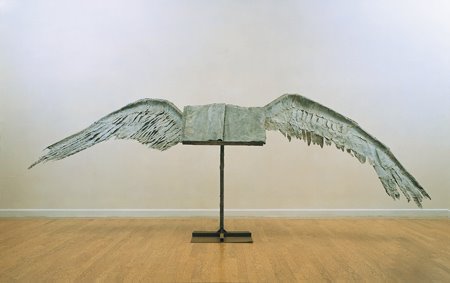
The sculpture, made of lead, is called Book With Wings (1992-1994) by Anselm Kiefer. Posted by Picasa

Year after year, year after year.
And yet I like to fly above the clouds
I am only skin and bones, like an old crane.

---Yasutani

As far as Buddha Nature is concerned, there is no difference between a sinner and a sage....One enlightened thought and one is a Buddha, one foolish thought and one is again an ordinary person.

---Hui-Neng

The violets in the mountains have broken the rocks.

---Tennessee Williams

I've been relatively quiet everywhere the past few weeks. All my formal education was accomplished in New York and New England prior to the mid-1960s. I believe it was a good time and place to learn. It was quiet and there was peace. We looked at films from Italy, France, Sweden, and were amazed. We read books and tracts from all sorts of writers who found themselves categorized Existentialists---which apparently was some sort of philosophy...but Philosophy Departments refused to acknowledge them. There were demonstrations about Civil Rights and nuclear bomb testing---and sometimes things got very rough, but essentially they were peaceful, singing movements. Indochina, now called Viet Nam, only was beginning, but the Cold War had a showdown about Cuban missiles. Mostly I was comfortable remaining in 1-A draft status the whole time. During the part of my military physical in Maine when I got asked about possible unAmerican activities, I confessed to joining the Fair Play for Cuba Committee. The sergeant examined his list of groups (that now would be categorized as "terrorist"), found only Black Shirts, Brown Shirts, Silver Shirts and said he'd never heard of my group. I never was called for Service, so got a job and started a family.

What I learned in school about a government seemed solid and I still believe it today. We were taught a ship of state sails most smoothly if there is a system of checks and balances. We may proceed slowly with all that stuff, but our progress will be sound and sure. Any branch of that government can become corrupt and falter. We can elect some palooka as our Executive. Congress can be infiltrated by robber barons and party bosses. The Supreme Court could bring the whole nation to a skidding stop with an interpretation of some obscure clause. But it would be next to impossible for all 3 branches to fail at the same time, leaving us at the mercy of the desperate mob. If that were to happen, the education I received provides no remedy. These past weeks, anticipating our election here in 3 more weeks, I've been thinking about that.

On Saturday mornings, while the rest of the house sleeps late, I like to catch up on email, articles, and the newspapers I missed during the workweek. This morning there turns out to be enough monumental disturbance to interrupt my reverie, pile all the stuff into a list, and ask if you see what I see.

Let's start with a Frank Rich column from a month ago, just after that 2-night ABC "docu-drama." Mr. Rich, who has a new book out, is an ideal commentator for our political times because essentially he's a theatre critic. This guy knows scripts, play- and screenwriting. One thing all Americans agree on is generally there's a hype (a term Webster says came to prominence in 1955) to everything. When he's really on, Frank Rich untangles it all like nobody's business. But now it's harder to find him---and there may be an intriguing story in just that. Several months ago, the administration of The New York Times, where he works, decided to charge money to read online the columns of Frank Rich, Maureen Dowd, Paul Krugman, and various other writers you and I probably have come to depend on. Well, another thing Americans generally agree on is nobody ever is sure just what or who the administration of The New York Times really is up to. Fortunately the Internet Underground and various friends, who are shelling over the money and thereby become the Select, do their best to distribute the best columns to the rest of us. For this piece of Rich brilliance, we can thank TruthOut~~~

http://www.truthout.org/docs_2006/091706Y.shtml

Much of my silence was inspired by the legislation passed by Congress just before adjournment. The passage of the Torture Bill created one of the darkest days in the history of the republic. There was an audible moan that came out of the Internet, and my own was among them. My friend, Bryan Zepp, out on the West Coast, wrote one of the best reactions...and I urge it upon you~~~

http://www.mytown.ca/ev.php?URL_ID=116794&URL_DO=DO_TOPIC&URL_SECTION=201&reload=1160817417

Zepp begins his essay with mention of William Rivers Pitt, a former teacher who gave up his career a couple years ago, to devote himself fulltime to saving his country from downfall. His essay yesterday considers our history of these past 5 years~~~

http://www.truthout.org/docs_2006/101306R.shtml

Thursday Robert Parry assembled an argument to support a diagnosis of our President as perhaps hopelessly deluded. Robert Parry broke many of the Iran-Contra stories in the 1980s for the Associated Press and Newsweek. His latest book, Secrecy & Privilege: Rise of the Bush Dynasty from Watergate to Iraq, can be ordered at secrecyandprivilege.com~~~

http://www.consortiumnews.com/2006/101106.html

OK, what about it? Are these people just paranoid? Do any of us who may have some doubts about "staying the course" really have to be afraid we'll be disappeared? Here's The New York Times yesterday~~~

Documents Reveal Scope of U.S. Database on Antiwar Protests By ERIC LICHTBLAUWASHINGTON, Oct. 12 — Internal military documents released Thursday provided new details about the Defense Department’s collection of information on demonstrations nationwide last year by students, Quakers and others opposed to the Iraq war.The documents, obtained by the American Civil Liberties Union under a Freedom of Information Act lawsuit, show, for instance, that military officials labeled as “potential terrorist activity” events like a “Stop the War Now” rally in Akron, Ohio, in March 2005.The Defense Department acknowledged last year that its analysts had maintained records on war protests in an internal database past the 90 days its guidelines allowed, and even after it was determined there was no threat.http://www.nytimes.com/2006/10/13/washington/13protest.html?_r=1&adxnnl=1&oref=slogin&adxnnlx=1160820313-PQ8MuBiXLAhvwl9oVm2Dlw

And then, also yesterday, we read another report of how far Abramoff was able to burrow his influence into the Capitol~~~

Report Says Nonprofits Sold Influence to AbramoffBy James V. Grimaldi and Susan SchmidtWashington Post Staff WritersFriday, October 13, 2006; 1:32 AMFive conservative nonprofit organizations, including one run by prominent Republican Grover Norquist, "appear to have perpetrated a fraud" on taxpayers by selling their clout to lobbyist Jack Abramoff, Senate investigators said in a report issued yesterday.The report includes previously unreleased e-mails between the now-disgraced lobbyist and officers of the nonprofit groups, showing that Abramoff funneled money from his clients to the groups. In exchange, the groups, among other things, produced ostensibly independent newspaper op-ed columns or news releases that favored the clients' positions.Officers of the groups "were generally available to carry out Mr. Abramoff's requests for help with his clients in exchange for cash payments," said the report, issued by the Senate Finance Committee. The report was written by the Democratic staff after a yearlong investigation and authorized by the Republican chairman, Sen. Charles E. Grassley (R-Iowa).http://www.washingtonpost.com/wp-dyn/content/article/2006/10/12/AR2006101200889.html

And of course you know that our Ohio guy, Bob Ney, pleaded guilty yesterday, after months of denial of any wrongdoing. Tightly organized letterwriting campaigns saturated all the newspapers in the state with what a wonderful representative he is...and ain't it a shame if that bad Abramoff took advantage of his radiant character! Gee, just like "Denny" Hastert---whom Bush hugs in Chicago as another family man.

http://www.washingtonpost.com/wp-dyn/content/article/2006/10/13/AR2006101301031.html

Then we have this new book coming out Monday by a man Bush hired to keep the Religious Right on the way to Republican Rapture. I guess David Kuo began to lose his faith in Faith-Based Initiatives after he kept hearing Rove refer to Evangelicals as "nuts." The UK Guardian has a good story on it~~~

http://www.guardian.co.uk/usa/story/0,,1922408,00.html

as does MSNBC, where Keith Olbermann continues to risk his life, breaking such stories~~~

http://msnbc.msn.com/id/15228489/

Finally, we have a cheery report in yesterday's Guardian about how much it's going to cost the global economy to repair all the damage the Warming is going to cost.

http://www.guardian.co.uk/usa/story/0,,1922408,00.html

Well, undoubtedly this is the kind of thing our fearless free enterprisers have been waiting for. A cost to the global economy is retranslated as profits in their pockets. I guess I ought not complain. If Holy Jobs can be created by the environmental movement, maybe the species will start to move in a sane direction. You want to get really optimistic? Take a look at DuPont!

http://www.nytimes.com/2006/10/14/business/14online.html?th&emc=th

I'm trying to stay hopeful, folks. Let's see how the election goes and whether we've still got a chance. In the meantime, thank God, there are the Major League Playoffs!

Friday, September 22, 2006

Is Savagery Good For America?


Photo of Bush demanding torture (or "alternative" interrogation) by Khue Bui for Newsweek September 25th issue

If we are too busy, if we are carried away every day by our projects, our uncertainty, our craving, how can we have the time to stop and look deeply into the situation---our own situation, the situation of our beloved one, the situation of our family and of our community, and the situation of our nation and of the other nations?

---Thich Nhat Hanh

Negotiations then turned to the amount of time that a detainee's suffering must last before the tactic amounted to a war crime. Administration officials wanted "prolonged" mental or physical symptoms, while the senators wanted something milder. They settled on "serious and nontransitory mental harm, which need not be prolonged."

---from The Seattle Times edition of the LA Times story by Julian E. Barnes and Richard Simon

[link]

[link]

The Bush administration had to empty its secret prisons and transfer terror suspects to the military-run detention centre at Guantánamo this month in part because CIA interrogators had refused to carry out further interrogations and run the secret facilities, according to former CIA officials and people close to the programme.

---from Financial Times (London) September 20, 2006 [link]

I can't recall a morning when the headlines were more confusing and even contradictory. The LA Times says "Bush Bows to Senators on Detainees." [link] The Washington Post says, in editorial, "The Abuse Can Continue; Senators won't authorize torture, but they won't prevent it, either." [link] Bloomberg has it that "President to Define Prisoner Abuse in Agreement With Senators By James Rowley Sept. 22 (Bloomberg) -- President George W. Bush would be able to write secret rules on how to treat suspected terrorists during interrogations under an agreement the administration worked out with dissenting Republican senators." The New York Times editorial says, "Here is a way to measure how seriously President Bush was willing to compromise on the military tribunals bill: Less than an hour after an agreement was announced yesterday with three leading Republican senators, the White House was already laying a path to wiggle out of its one real concession. About the only thing that Senators John Warner, John McCain and Lindsey Graham had to show for their defiance was Mr. Bush’s agreement to drop his insistence on allowing prosecutors of suspected terrorists to introduce classified evidence kept secret from the defendant. The White House agreed to abide by the rules of courts-martial, which bar secret evidence." [link]

The bottom line of course is to get some kind of legislation before the election in November to protect the Bush-Cheney gang from prosecution under our own War Crimes Act. Should the Democrats win control of either House or both and regain subpoena power in committee, the business-as-usual of spreading the neo-Con brand freedom might be slowed down a mite. Incidentally, Robert Kennedy Jr. unblinkingly expands his campaign about the "e-government revolution" (that's a Diebold Electronic Elections Systems slogan by the way) in the October 5th issue of Rolling Stone, now online. [link]

But let me ask you this: what does it take to reduce a relatively civilized population to a condition of animal savagery? And if it happens, is that necessarily a bad thing? Animals are creatures of nature with instincts of survival. Savages are people with traditions of tribal gathering, hunting, celebration and warfare that perhaps are closer to nature than citified people. The Wild West was tamed sometimes in savage ways to show who was boss. Is this not how the world always has been? Is this how things really are?

There were reports the last few days about bodies found strewn around Iraq. They show signs of "alternate interrogation" techniques, some of which perhaps caused death. Acid was poured on the people. Electric drills were employed to illicit information. Hot wires burned them. If they die from this...and everyone finds out they did...what lesson does the population learn? Now the United States revives its tradition of getting tough. I'm sure my military friends, particularly from VietNam, will tell me we've always done this stuff, only it's been secret. Yeah, we've got to credit Bush for going public about it...although the photos from our "detention" centers may have had something to do with it. But is all this good for democracy and freedom?

I'd like a clean election this time to find out how Americans really feel about all this. I know there may be too much power and money involved to allow a clean election, but I'd really like to find out. Are we now the tough guys, the fearless rangers, the hanging judges the rest of the world must respect...or else? Are public executions good for the village morale? Is it invigorating and disciplinary at once for the tribe to see the enemy intestines dragged out of his body and into the campfire? Are we ready to enjoy the enemy torn apart by hungry animals in the stadium? Is it all really only a pep rally, with bonfire, before the homecoming game?

What happens to a civilization that goes this way? What does history tell us? Does it matter...when we are on a courageous path of creating our own reality? I have a friend who retired this year. He's a soldier who saw action and suffered from it. He's given his civilian career in a very helpful way to others, but he's maintained a hard edge about life. He knows how to survive and fishes and hunts and always has a weapon on hand. He doesn't take a walk in the woods without a handgun. He's fed up with government and will not be surprised if his pension and other funding vanish. He has a plan: he will live in a cave...and if necessary, eat other humans. He's kidding of course...or is he?

For a lighter view, here's Molly Ivins on Wednesday~~~ [link]

For statistics about torture and how well it works, here are 2 links to current Newsweek articles~~~ [link] [link]

Friday, September 15, 2006

Why Have Liberals Been Afraid?


The picture's of Daytona, in 1957. Posted by Picasa

The soul that is attached to anything, however much good there may be in it, will not arrive at the liberty of the divine.

---St. John of the Cross

The hermit doesn't sleep at night:
in love with the blue of the vacant moon.
The cool of the breeze
that rustles the trees
rustles him too.

---Ching An

The trouble is that you think you have time.

---Zen master

Yes, we accuse Rove/Bush of keeping the masses in cowering fear, but who's scared? My redneck neighbors have decals on their pickups pissing on fear. Their kids tool through the woods on their 4-wheelers with nary a care everyday. Those folks Support Our Troops with flags waving, trusting the security of the heartland to the War on Terror. The biggest horror of kids at school is if pizza gets taken off the cafeteria menu.

Yesterday I emailed a link Bob Sheak had sent along to an article at TomPaine by Robert L. Borosage. http://www.tompaine.com/articles/2006/09/11/repealing_the_bush_doctrine.php My friend Paul Quintanilla left a couple of comments about it at jazzoLOG, but concluded with these questions~~~

14 Sep 2006 @ 22:43 by Quinty @68.226.88.25 : And yet another thing -
Why haven't the Democrats abopted Borosage's strategy?
After all, the idea of a "Manhattan project" for clean and self-sustaining energy resources has been around for a long time. The biggest argument, I guess, against it being cost. But we have no problem throwing billions away monthly on a wasteful war. For that we have unending funding.
(For the simple minded - dare I say? - violence is always an easy solution. By exerting a superior force of arms you can be sure to win. No questions asked. That is the current course we are on now.)
And the other approaches Borosage raised are fairly obvious too. But do many Democrats still feel they are too hot politically to handle? Does Bush's ship have to sink further before they may become palatable? What are the Democrats afraid of? Of the unknown? The future? Of getting it wrong? Of not being loved?
Then they don't deserve to lead. But then who do we got?
~~~~~~~~~~~~~~~~~~~~~~~~~~~~~~~~~~~~~~~~~~~

Others have been asking similar questions lately...including some members of Congress and even Colin Powell (finally!) who've seen through Bush's legislative attempt to be sure he and his people never can be tried for war crimes. http://www.thestar.com/NASApp/cs/ContentServer?pagename=thestar/Layout/Article_Type1&c=Article&cid=1158270614332&call_pageid=968332188492 When TruthOut sent us to Bill Fisher's blog yesterday to reminisce about the radio commentators of the McCarthy era http://billfisher.blogspot.com/2006/09/murrow-moment.html , I realized as someone who was a teenager at the time how much like those days this country has become again.

One commentator Fisher didn't mention was Fulton Lewis Jr. I imagine Paul Harvey considers him something of a mentor. He broadcast everyday on the Mutual Network, one of whose stations I happened to work for after school. My sophomore high school year, WJOC was "honored" with the arrival of his son, Fulton Lewis III, for a few weeks. He apparently was training to take over his father's work and he broadcast over the network to the entire country every evening from our little station. During the day Fulton tooled around town in his sports car and visited the school libraries. Imagine what he found! Dirty communist books. I think Catcher In The Rye (1951) was one. Lewis III began a series of stories about the corrupt, unAmerican schools in Jamestown---a public school system that previously had been considered among the best in New York. The Superintendent of Schools was named Carlyle C. Ring. His son Gordy was a classmate of mine and a friend since kindergarten. Following Fulton's scathing series on how the Reds are in all the libraries...and the desired public panic, Dr. Ring was forced to resign. Shortly afterwards he died of a heart attack.

Today Fulton Lewis III, and probably his father, are forgotten. Carlyle Ring eventually got a school named after him that I see is listed at GreatSchools.net. http://www.greatschools.net/modperl/browse_school/ny/1283 But at the time Dr. Ring's career and life depended on them, liberals were hiding under desks. And today we face a similar, and maybe worse, challenge. The current London Review of Books carries a column by NYU historian Tony Judt. Professor Judt's opinions are hotly contested around the world, but here he writes an answer of sorts to Paul's question about liberals...and challenges us to revive our fighting traditions. http://www.lrb.co.uk/v28/n18/judt01_.html Have a good day!

Sunday, September 03, 2006

Pictures And Prose For 9/11


Patricia McDonough, a professional photographer with a fisheye lens, made this picture from her apartment’s living room within minutes of the first airliner’s impact.Posted by Picasa

You are the light,
You are the refuge,
There is no place to take shelter but yourself.

---Inscription over the Buddha's ashes

Let us be poised, and wise, and our own, today.

---Ralph Waldo Emerson

The morning after the storm
the melons alone
know nothing of it.

---Sodo

You have to grit your teeth just to get through Garrison Keillor's gripping review this morning of a new book called Watching The World Change: The Stories Behind The Images Of 9/11. I'm trying to imagine what reading the book would be like. Here is Garrison, taking you through it~~~

----------------------------------------------------------------------------

The New York Times
September 3, 2006
Bearing Witness
By GARRISON KEILLOR

It was a perfect late-summer day in New York, the sort of day when a person feels terribly lucky to be in the city. A man named Pavel Hlava was showing his brother Josef around town and raised his video camera toward the World Trade Center just in time to catch a bright object flashing in the sky and then a puff of smoke from the north face of the north tower. A French filmmaker, Jules Naudet, who was making a documentary about firefighters, was with a fire truck responding to a gas leak at Lispenard and Church Streets downtown when he heard the roar of a jet engine and raised his camera to catch the plane too. And so did two Webcams from an apartment window in Brooklyn. It was 8:46 a.m. on the 11th of September, 2001. At 8:49 a.m., CNN went live with a shot of the towers from a camera on the West Side. The second plane hit the south tower at 9:03, and by that time dozens of cameras were on the scene, aiming upward.

In his apartment at Broadway and Franklin Street, Lyle Owerko heard the first explosion, grabbed a Canon EOS 3 with a 400-millimeter zoom lens, dashed downstairs and around the corner to Chambers Street. “Life was still oddly normal,” he tells David Friend. “People stood buying bagels and coffee [from] corner street vendors.” Tom Flynn, a CBS News producer, was reading the morning paper on his deck in the West Village when “a plane went over the trees in my garden. It was low, it was loud, and it was determined. It was not right. It seemed to be revving up. Then there was a pop, like the sound of a softball hitting a glove.” He said to his wife, “We’re under attack,” and jumped on his bike and headed downtown. At the trade center, he found a Merrill Lynch employee, Eddie Remy, shooting video, and signed him up for CBS. By the time the south tower collapsed, shortly before 10 a.m., there were hundreds of photographers on the scene, some on assignment, some freelancers, most of them amateurs. Grant Peterson, shooting for Brides magazine in his studio near Broome Street and Broadway, turned his 4-by-5 view camera toward the burning towers. A woman named Kelly Price bought disposable cameras at a bodega and was taking pictures of the fires when the south tower pancaked to the ground. She raced down Broadway, running for her life, stopped at Pine Street and took a picture of the advancing Niagara of dust and debris and a man running ahead of it. He is holding a camera in his right hand and glancing over his left shoulder.

Friend, who was director of photography at the old Life magazine, writes: “As the morning crept on, New Yorkers poured into the streets, many to help, many in flight, all of them aghast. Out, too, came their cameras. Men and women by the hundreds, then thousands — bystanders with point-and-shoots, TV news teams, photojournalists by the score — felt compelled to snap history, fiery and cruel against the blue. People photographed from windows and parapets and landings. They photographed as they fled: in cars, across bridges, up avenues blanketed in drifts of ash and dust. They even photographed the images on their television sets as they watched the world changing, right there on the screen.” And soon thereafter, rescue workers in dusty yellow slickers started showing up at the Time & Life Building in Midtown trying to sell pictures they had taken.

A brief review can’t do justice to “Watching the World Change,” a lucid, thoughtful and wide-ranging book. In truth, Friend’s excellent writing conveys more of the truth of the day than photographs can. The picture of the three firemen raising an American flag over the ruins, which became an icon of 9/11, is not nearly so gripping as the story he tells of the exploitation of the picture, the feelings of the photographer, Thomas Franklin, and the stoical refusal of the three firemen to be lionized (though they did approve plans for a bronze statue of themselves, 18 feet tall on a 12-foot marble pedestal).

Photography is meant to convey reality, but some realities were judged unbearable. Jules Naudet arrived at the north tower with the men of Engine 7, Ladder 1, his camera running. He saw a screaming woman who was burning in an inferno of aviation fuel that had poured down an elevator shaft and decided, “I didn’t think anyone should have to see this.” An Associated Press photograph of a dark-skinned man falling through the air, upside down, his arms at his sides, one leg lifted, was printed in some newspapers; most considered it too graphic. The Daily News, after debate among the editors, published a picture of a severed hand lying in the street — “You can’t do the story without doing the story,” said the editor, Edward Kosner. French television, but not American, showed “scenes of plummeting people . . . one after another. Some tumbled. Some held hands, jumping in pairs, or three and four at a time.” Owerko, shooting the burning north tower, heard the crowd around him let out a long gasp: “I looked up to see an object descending from the tower. I recognized it to be a person and stood frozen as the body flipped and turned in a slow, tragic ballet, down to the courtyard. People screamed and cried. I watched in shock as another human shape began falling to earth. . . . I clicked away. . . . I wasn’t photographing death, it seemed to me. I felt, instead, that I was preserving the last moment of these individuals’ conscious existence.”

We saw photographs that week of buildings burning, stunned onlookers, dust-covered firemen. Very few pictures conveyed the fact that people just like us, our fellow passengers on the subway, suddenly found themselves in a mortal predicament and many died horribly. We who weren’t downtown that morning tried to comprehend the horror. The most electrifying picture I remember from that week was a snapshot by a Port Authority employee, John Labriola, descending with other office workers in a stairwell of the north tower. A handsome young fireman is ascending the stairs, his eyes open wide, perspiring, hauling gear. All week one had seen distant images of fire and smoke, but here was a shot from inside a building about to collapse, and you looked at the fireman and thought, “My God, that man is about to be crushed to death.” (In fact, he escaped with a minute to spare, Friend reports.)

But mainly a cool decorum prevailed. We were shown pictures of this and not of that, allowed to see this and not look over there. The mainstream media seized upon inspirational and patriotic images, such as the picture of the three firemen; thus began a sort of mythification of the day into which George W. Bush and Rudolph Giuliani entered, bearing spears and shields. Photography assisted in that. Photography couldn’t convey the failure of national defense and intelligence, or the failure of the city of New York, even after the 1993 bombing of the trade center, to coordinate police and fire communications, a failure that cost many lives that morning, or certain tragic choices in the design of the towers. You need prose reporting for that. And in the end the images become common and one turns to words to find the reality. “The one conclusion I came to on 9/11 is that people in the stairwell . . . really were in ‘a state of grace.’ They helped each other. They didn’t panic,” Labriola says. “Most people are basically good. I knew this, with certainty, because I had gone through the crucible. What a great example people left: be selfless, help the person around you and get through it.”
Garrison Keillor is the host and writer of “A Prairie Home Companion” and the author of 16 books. He is the editor, most recently, of an anthology titled “Good Poems for Hard Times.”

Copyright 2006 The New York Times Company http://www.nytimes.com/2006/09/03/books/review/Keillor.t.html?8bu&emc=bu

Monday, August 28, 2006

The Old Telephone


It's amazing, a wonder, that one wakes up in the morning.
---Nagarjuna

Better a handful of quietness Than both hands full of toil And much chasing the wind.
---Ecclesiastes

I have to let go of the need to know so much. What we can know is so small---the holiness around is so large. Now I trust in simplicity, simplicity and love.
---Hindu sage

This morning I received an atypical communique from a friend who is Professor Emeritus of Anthropology and Sociology at Ohio University. Ordinarily he checks stuff I send out with a meticulous eye and lets me know when I get carried away. This time his eye seems a little moist and I readily admit he got me that way too...with this wonderful story~~~

When I was quite young, my father had one of the first telephones in our neighbourhood. I remember well the polished old case fastened to the wall. The shiny receiver hung on the side of the box. I was too little to reach the telephone, but used to listen with fascination when my mother used to talk to it.

Then I discovered that somewhere inside the wonderful device lived an amazing person - her name was "Information Please" and there was nothing she did not know. "Information Please" could supply anybody's number and the correct time.

My first personal experience with this genie-in-the-bottle came one day while my mother was visiting a neighbour. Amusing myself at the tool bench in the basement, I whacked my finger with a hammer. The pain was terrible, but there didn't seem to be any reason in crying because there was no one home to give sympathy. I walked around the house sucking my throbbing finger, finally arriving at the stairway.

The telephone! Quickly, I ran for the footstool in the parlour and dragged it to the landing. Climbing up, I unhooked the receiver in the parlour and held it to my ear. "Information Please," I said into the mouthpiece just above my head. A click or two and a small clear voice spoke into my ear. "Information."

"I hurt my finger. . ." I wailed into the phone. The tears came readily enough now that I had an audience. "Isn't your mother home?" came the question.

"Nobody's home but me." I blubbered.

"Are you bleeding?"

"No," I replied. "I hit my finger with the hammer and it hurts."

"Can you open your icebox?" she asked. I said I could. "Then chip off a little piece of ice and hold it to your finger," said the voice.

After that, I called "Information Please" for everything. I asked her for help with my geography and she told me where Philadelphia was. She helped me with my math. She told me my pet chipmunk that I had caught in the park just the day before would eat fruits and nuts. Then, there was the time Petey, our pet canary died. I called "Information Please" and told her the sad story. She listened, then said the usual things grown-ups say to soothe a child. But I was un-consoled. I asked her, "Why is it that birds should sing so beautifully and bring joy to all families, only to end up as a heap of feathers on the bottom of a cage?"

She must have sensed my deep concern, for she said quietly, "Paul, always remember that there are other worlds to sing in." Somehow I felt better. Another day I was on the telephone. "Information Please."

"Information," said the now familiar voice.

"How do you spell 'fix'?" I asked.

All this took place in a small town in the Pacific Northwest. When I was 9 years old, we moved across the country to Boston. I missed my friend very much. "Information Please" belonged in that old wooden box back home, and somehow never thought of trying the tall, shiny new phone that sat on the table in the hall. As I grew into my teens, the memories of those childhood conversations never really left me. Often, in moments of doubt and perplexity I would recall the serene sense of security I had then. I appreciated now how patient, understanding, and kind she was to have spent her time on a little boy.

A few years later, on my way west to college, my plane put down in Seattle. I had about half an hour or so between planes. I spent 15 minutes or so on the phone with my sister, who lived there now. Then, without thinking what I was doing, I dialed my hometown operator and said, "Information, Please." Miraculously, I heard the small, clear voice I knew so well, "Information." I hadn't planned this but I heard myself saying, "Could you please tell me how to spell 'fix'?"

There was a long pause. Then came the soft spoken answer, "I guess your finger must have healed by now."

I laughed. "So it's really still you," I said. "I wonder if you have any idea how much you meant to me during that time." "I wonder," she said, "if you know how much your calls meant to me. I never had any children, and I used to look forward to your calls." I told her how often I had thought of her over the years and I asked if I could call her again when I came back to visit my sister.

"Please do, she said. "Just ask for Sally."

Three months later I was back in Seattle. A different voice answered "Information." I asked for Sally. "Are you a friend?" she asked. "Yes, a very old friend," I answered.

"I'm sorry to have to tell you this", she said. "Sally had been working part-time the last few years because she was sick. She died five weeks ago."

Before I could hang up she said, "Wait a minute. Is your name Paul?"

"Yes."

"Well, Sally left a message for you. She wrote it down in case you called. Let me read it to you. The note says, 'Tell him I still say there are other worlds to sing in. He'll know what I mean.'"

I thanked her and hung up. I knew what Sally meant. Never underestimate the impression you may make on others. On that note I would like to ask you to remember how much difference one person can make in someone's life.

And now, when you've recovered, the item I sent back to my friend~~~

ORIGINS: Some of us tend to think the Internet age spawned the current spate of sentimental tales, because for many our first contact with these gems was their appearance in our inboxes. Yet glurge [link] has been circulating in its current form for decades, as evidenced by this current story about the friendship between a little boy and a telephone operator. "Information, Please" was first published in 1966 in Reader's Digest, a magazine known for offering at least one of these "slice of life" heartwarming yarns in each issue.

There are differences between the version circulated on the Internet (which is the text used as the example above) and the original as it appeared in Reader's Digest. For the most part, these differences amount to the dropping of a line here and there, the changing of one word into another (the "tall, skinny new phone" becomes the "tall, shiny new phone"), and the rendering of words from the original story with British rather than American spellings ("neighbor" instead of "neighbour"; "parlor" instead of "parlour"). Perhaps whoever transcribed this story from the original was working with a hard-to-read photocopy.

There are also two key departures: one of omission; the other of addition. Omitted is a lengthy anecdote that should have immediately followed the "How do you spell 'fix'?" line, about the author's having been given a fright by his sister that resulted in his pulling the telephone receiver from the wall-mounted unit and the quick appearance of a repairman to fix the phone and to inform "Information Please" that the children were all right. (The phone conversation had been unexpectedly interrupted after a loud scream was heard in the background, so the operator had dispatched someone to check what happened.)

Added are the two lines that now close the piece: "Never underestimate the impression you may make on others. On that note I would like to ask you to remember how much difference one person can make in someone's life." In the original, the story concluded with "I thanked her and hung up. I did know what Sally meant." Unlike whoever took it upon himself to edit the piece, Paul Villiard trusted his readers to understand the moral of his tale.

Is this particular entry a true story? It (like many others) was presented as a "first person tale," but glurge-like stories are often full of embellishments and exaggerations — and are sometimes complete fabrications — despite their "true story" labels, and tracking down the originator of a single 36-year-old piece is no easy task. As usual, the better approach to this type of narrative might be to ignore the issue of its literal truthfulness and consider the message: Does this wistful tale truly represent life as it was — a now-gone world in which even anonymous telephone operators took time out to comfort lonely children by helping them treat their injuries, assisting them with their homework, and offering them bits of philosophical advice — or does it represent a way of life we'd like to believe in, one that never really existed outside our imaginations?

Sources:

Canfield, Jack. A 3rd Serving of Chicken Soup for the Soul. Deerfield Beach, FL: Health Communications, 1996. ISBN 1-55874-379-0 (pp. 14-18). Villiard, Paul. "Information, Please." Reader's Digest. June 1966 (pp. 63-65).

The URL for this page is http://www.snopes.com/glurge/infoplea.htm Urban Legends Reference Pages © 1995-2004 by Barbara and David P. Mikkelson

Saturday, August 26, 2006

Maynard The Fox


When a dog is chasing after you, whistle for him.

---Ralph Waldo Emerson

Today's begging is finished: at the crossroads
I wander by the side of the Buddhist shrine
Talking with some children.
Last year a foolish monk.
This year, no change!

---Ryokan

The temple bell stops
but the sound keeps coming
out of the flowers.

---Basho

How do you tell the difference between a member of the Boomer generation and someone from the generation just before? Here's one way: ask if there's a preference toward a trumpet or an electric guitar. If you're a boy 16 or 17 in many cultures, you like things loud and fast. Boomers love a couple guys on stage with amplified guitars let out full. Whatever the generation that came before them is called prefers a trumpet section in a band, no microphone needed. Both sounds make your hair stand on end and are wonderful, but most Boomers seem to have let the wind instruments lapse into near extinction.

Anyone who knows the name Maynard Ferguson probably can tell you what it was like the first time you heard him...and maybe what the song was. For me it was a feature for him, arranged by Shorty Rogers, of the Bob Haggart-Johnny Mercer ballad "What's New." Joe Rico played it on the radio nearly every day out of that little AM station in Niagara Falls. I remember going downtown to the Music Box record shop (I must have been 12 or 13) and plunking down my 50 cents for a 45 rpm recording of it. (The other side was terrible: "The Hot Canary".) It featured a range of the trumpet previously considered impossible on just one instrument. Maynard played low down into a trombone sound...and then all the way up within seconds to an octave and a half above high C, where generally flutes take over. The arrangement started slow, then changed tempo to way up, finishing off with Maynard pasting noteshigher and higher until he nailed that last one that made people gasp throughout his 60 year career of doing it.

At the time Maynard (we always called him by his first name) was the high note man with the Stan Kenton Orchestra...but he was just about to leave along with over half the band for adventures on the West Coast. Us guys didn't find that out for a while, and so in the meantime we started collecting all the Kenton records we could find. We thought every high trumpet on them must be Maynard. Capitol put out records then without any dates on them, so little did we know we were listening to Kenton from 10 years earlier when Chico Alvarez, also from Montreal by the way, may have been the guy. Didn't matter though: we were getting turned on to some of the most radical orchestral music (and loudest) of the 20th Century.

Soon Joe was playing another Maynard feature he had recorded at a concert at Cornell by Kenton's Innovation Orchestra, which consisted of nearly a hundred players including full string section. This unit toured the whole United States TWICE...before caving in to financial reality of the early 1950s. The feature was called simply "Maynard Ferguson" and was composed by Shorty Rogers. The thing lasted 5 minutes and clearly was death-defying for any trumpet man. Maynard made it sound simple, scrambling, swinging, screeching over that instrument. It was available around 1951 or '52 on a 10 inch LP, which eventually I got, but since Joe Rico played this live recording of it we came to understand these incredible players did this music every night somewhere! Since Kenton's death, at least a half dozen such recorded concerts have been found and released...and you can hear Maynard do it literally night after night. I saw the man a few times and I think I've heard nearly everything that got recorded of the Kenton band when Maynard was in it: I never heard him fluff a note. I know he must have, but I never heard it. How did he do it?

That's what we teenage boys wanted to find out, particularly Tony Cusimano and Gerry Gullo who played trumpet themselves. By the time we were 16 and 17, Maynard had gotten lured out of the sound studios of Hollywood and back onto the road, this time with his own band. He was only 30, but believed in the philosophy of attracting younger players and arrangers with new ideas. There are recordings of his first band in its formative stages but I consider the first record to be "A Message From Newport," on Roulette which I think was released in late 1958. We already had seen this band twice in my hometown. The album and the band were absolutely staggering. For one thing, when he came to Jamestown, he played at a joint called the Fairmount Grill. The place had a bit of a dance floor and a bandstand...but everything had been designed with a little country & western outfit in mind I think. Maynard carried 13 men, and they were crammed up there so close they had to be careful not to finger the other guy's horn! The sound of 4 trumpets, Maynard out front, 2 trombones (Don Sebesky and Slide Hampton, by the way), the "angry" alto of Jimmy Ford, 2 tenors and a baritone, and a full rhythm section of John Bunch, Jimmy Rowser and Jake Hanna was enough to blow us up against the wall opposite side of the room---which of course was the bar. (The owner would serve us at 17, but I assure you one beer on the table lasted the night.) Almost all of the compositions and charts were by guys in the band.

Maynard stood out in front of that band like a cheerleader/drillsergeant somehow combined. He was constantly on the move to the rhythm. He must have been in a marching band around his home of Montreal when he was a kid, because he liked to tuck his horn under his arm and just march up there while the ensemble played away. A huge smile on his face and eyes closed, marching, marching, a bit hunched over...until time for that closing climax, when he'd face us and let loose with such a screaming, molten sound, our jaws would drop and stay that way. He loved to talk to us during breaks and gave us all the time we wanted. Tony finally asked him the question: how the hell does he do it? Critics had been saying for years that Maynard had some kind of freak lip and wouldn't last. Maynard gave the grin that earned him the nickname The Fox and said, "Well Tony, what I do is plant both feet solid on the floor. That high note comes from there. I feel it out of the floor, through my feet, and with tons of breath, I blow that thing out of the horn." Later Tony said to me, "You hear that? He doesn't reach for it. It comes up out of him."

Maynard Ferguson was the most dependable workhorse I think I ever saw in music, particularly jazz. He was there on time and no matter how old he got...and how disappointing eventually his music had to be for me, he kept going. When nobody else in the world had a traveling jazz band (or whatever it was called after "Rocky" and "Star Trek" and other hits he managed to achieve) Maynard still went. Sometimes there were just a few guys with him, but the arrangements were the same...and he'd bring in synthesized keyboards to make more sound. The other day Maynard died at age 78. The New York Times obit tells us his last words were an urgent plea to let him get back on the road. Another tour, in which he would ride the bus like always with the sidemen, was scheduled in a couple weeks. Still the sound of Maynard The Fox rings in my ears.

http://www.maynardferguson.com/index.htm

Tuesday, August 22, 2006

Once Upon A Time


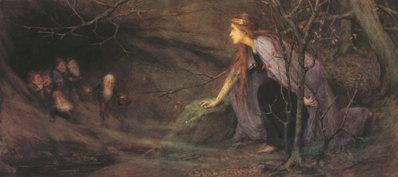
Once Upon a Time by Henry Maynell Rheam
British Pre-Raphaelite Painter, 1859-1920

Waves recede.
Not even the wind ties up a small abandoned boat.
The moon is a clear mark of midnight.

---Dogen

You have a saying, "to kill two birds with one stone." But our way is to kill just one bird with one stone.

---Suzuki Roshi

After the ecstasy, the laundry.

---Zen saying

Having worked with children and young people most of my career, I noticed almost immediately a major gap in attempts to communicate with these generations. My childhood took place before television and before suitability ratings became recommended at the movies. Nearly every day I marveled at the wonders created in my mind by books. These were children's books and they were directed to a special world kids were allowed to live in then. When I would mention children's tales from which I had learned important things, I've usually found students in class have no idea what I'm talking about. My childhood was a controlled and protected world and I realize there were disadvantages to being in it. Nevertheless as I become an old man, I treasure the memories, the stories, and the traditions of that abandoned world.

I've preserved, not always carefully, many of those books to share---especially the fascinating illustrations---with my own children. But the timing and the choices available to contemporary youth are very different from the 1940s. My daughter, almost 15, can get back as far as the 1950s with her interests...but she pretty much comes skidding to a stop there. Letting loose of a televised perception is something like coming to the edge of an earth that's flat. Falling off would be madness and a nightmare of monsters. Besides, there are so many "adult" problems kids have to solve, like families falling apart, teachers too "stressed" to take interest, murder and mayhem in the news, being marked by capitalism as major consumers, whether our species will survive on the planet. And so I was interested this morning to learn Norton Anthology series---those huge thick books with tissue-thin pages you may have had to read in school somewhere---has added a children's literature volume. What follows is a keen review of the thing. Despite its reservations, I'm going to see if I can find one today, become lost in that world again, and look for the magic key to get out.

Let Sleeping Beauties Lie
By Dorothea Israel Wolfson
Posted August 2, 2006
This essay appeared in the Summer 2006 issue of the Claremont Review of Books.

A review of The Norton Anthology of Children's Literature: The Traditions in English edited by Jack Zipes, Lissa Paul, Lynne Vallone, Peter Hunt, and Gillian Avery

Parents have always fretted about what to read to their children, and experts have always been ready with advice. In their educational writings, John Locke and Jean Jacques Rousseau together mentioned only three books worthy of a child's mind. Locke recommended Aesop's Fables and Reynard the Fox, while in Emile the tutor Jean Jacques offered his charge only Robinson Crusoe. How times have changed. The new 2,471-page, lap-crushing Norton Anthology of Children's Literature includes several hundred entries, both old and new. But far from representing an efflorescence in childhood literature, this volume marks the genre's sad end.

The editors of the anthology acknowledge in passing their debt to Locke and Rousseau—who in a sense created our modern understanding of childhood, permanently influencing all subsequent children's literature. The editors, however, wish to promote a revolution of their own: a new, more candid, and frankly, more nihilistic corpus. Despite heralding children's literature as "life-enhancing" and "life-changing," the Norton editors aim in fact to dampen children's enchantment with the world, forcing them to acquiesce to the grim realities and multicultural obsessions of contemporary adults.

Of course, this could be because the book was never meant to be read by or to children. The editors, all scholars of some sort, with backgrounds in literature, education, and history, describe their handiwork as a "more scholarly" anthology, one that incorporates "profound changes" from earlier collections, and is intended mainly for the college student. Whereas editors of previous anthologies "favored classic authors" and "canonical texts," with a minimum of reader notes and introductions, the Norton edition aims to be more inclusive of "emergent" literature. As the editors state, "Our critical perspectives, like those of scholars in other literary fields, have been greatly influenced by the research and criticism rooted in the feminist and multicultural movements." Their real hope is "to revolutionize the undergraduate curriculum."

The anthology is divided into 19 chapters covering various divisions within children's literature ("Chapbooks," "Primers and Readers," "Fairy Tales," "Classical Myths," "Legends," "Fantasy," "Verse," "Picture Books," "Books of Instruction," etc.). Each chapter begins with a long introduction in which the editors supply an overview of the genre's historical trajectory, and discuss its defining works, including many hitherto unknown. The chapters contain at least one "core" text in full, along with shorter or excerpted "satellite" texts. Each text is preceded by laborious reader notes, many of which are longer than the text itself. There is also a 32-page section of illustrations from some of the great picture books, including Beatrix Potter's Tales from Peter Rabbit, Jean de Brunhoff's The Story of Babar the Little Elephant, Marjorie Flack's Angus the Duck, Ezra Jack Keats's Snowy Day, and Maurice Sendak's Where the Wild Things Are.

The editors included some genuine classics, to be sure, some excerpted and some in full, like The New England Primer, A Child's Garden of Verses, Peter Pan, Ramona and her Father, chapbook versions of Bunyan's Pilgrim's Progress and Defoe's Adventures of Robinson Crusoe, and the poetry of Charles Causley and Robert Graves, to name just a few. One could certainly quibble with the editors about omitted texts. Why no poetry from Emily Dickinson, for instance, or any meaningful mention of Shakespeare, whose plays were re-written into children's story form by Charles and Mary Lamb? But such quibbling is to miss the larger problem with this volume. It is not so much an anthology as a postmodernist manifesto.

* * *
As the editors declare in the preface, "In our choice of texts and in our introductions, we have paid close attention to…perceptions of race, class, and gender, among other topics, in shaping children's literature and childhood itself." Practically every text and every author (save for the "emergent") is subjected to a wicked scolding from the editors for its racism, sexism, and elitism. Forget about ogres, witches, monsters, and evil stepmoms; today's villains are gender stereotypes, white males, the middle class, and the traditional family. Retrograde literature must therefore be replaced by a new one, one that is, as it were, beyond good and evil: "In our postmodern age, in which absolute judgments of 'good' and 'evil' are no longer easily made, the distinction between heroes and villains is often blurred."

The editors herald this as a great advance, one they wish to promote by burying the stories under a ton of commentary. To read a children's story out of context, say the editors, is so passé (so childish?): "Discourses such as reader-response theory, poststructuralism, semiotics, feminist theory, and postcolonial theory have proven to be valuable in analyzing children's books." Thus the editors introduce Fun with Dick and Jane by noting that the "world of Dick and Jane was the idealized image of white, middle-class America." The introduction to the chapter on "Legends," which includes The Merry Adventures of Robin Hood and King Arthur and the Knights of the Round Table, warns that "history has generally been written by the victors and the elites, who tend to view those like themselves—white males, for the most part—as heroes."

In the chapter on "Classical Myths," the editors ponder whether myths are being "kept alive" "by unreflective adults." After all, myths are prone to "strong gender stereotyping—females are passive, males are active.... The protagonists are devoted to a ruthless elimination of the 'other' and to a savagery that is scarcely tolerated" in other children's literature. The genre of domestic fiction—which includes works like Little Women, Anne of Green Gables, and The Bobbsey Twins—"showcased white middle- or upper-class families." But the editors are happy to report that "the genre has come to reflect ethnic, racial and class diversity." Nor are they above offering advice to would-be authors: "still more change would be welcome here."

All this Sturm und Drang over children's stories is hardly new. Ever since Socrates took on Homer by banning poets from the Just City, philosophers have well understood that, as Shelley put it, "poets are the unacknowledged legislators of the world." But to understand how we got here, we need not go back so far. There have been three revolutions in modern children's literature.

The first was instigated by John Locke. In founding a new political and intellectual order—a liberal, tolerant regime—he believed that reforming children's education was of the utmost importance. Notably, he advised against reading Scripture to children, because, as he wrote in Some Thoughts Concerning Education, the Bible was ill-suited to a "Child's capacity" and "very inconvenient for Children." Locke's aim was to take education from the hands of the clerisy, and to overcome its domineering and persecutory spirit.

Contrast Locke's sensibility with that of a contemporaneous textbook. The God-fearing New England Primer (c. 1690), included by the Norton editors, drilled children in their ABCs thus:

A: In Adam's Fall
We sinned all

B: Heaven to find
The Bible Mind

C: Christ crucify'd
For sinners dy'd

This was an education not simply in reading and writing, but in living and dying, one that did not condescend to the limited understandings of children. Locke rejected all this, mischievously suggesting that children learn their letters by playing dice. In the wake of Locke's reformation, a more humanistic educational literature gradually blossomed. Unlike the somber New England Primer, the stories were secular, rational, and geared towards children. Though entertaining, these stories were meant to impart a moral message, to help children grow into responsible adults. In this sense at least, Locke still had something in common with the authors of the old New England Primer.

In the late 19th century, another revolution took place, this time marked by a wholesale shift away from moralizing. A new genre of children's fantasy emerged, seeking only to entertain. One of its most prominent voices was Lewis Carroll. As the editors explain, his "mockery of instructional verse, rote learning, and moralizing school curricula helped move the genre from eighteenth-century concerns with the instruction and correction of children toward modern celebrations of play." This era is known as the "golden age" of children's literature—golden precisely because it celebrated the innocence and playfulness of childhood, and sought to free children from the grief and worry of adults. Carroll's Crocodile, a parody, "seemed to license childhood playfulness, fantasy, laughter, and even idleness." "The change was welcome," add the editors.

Alas, golden ages never last, and children's literature was no exception. The third and last great change occurred in the 1970s, when writers started to "push the boundaries" of material considered acceptable for children. According to the Norton editors, "In the wake of this revolution, writers for the young can deal with sex, violence, disease, and death—in particular because many believe that the innocence of childhood has been destroyed by the media and the commodification of childhood."

* * *
Indeed, it's hard nowadays to tell children's literature from adult literature. As the editors correctly observe, this is partly because the lines between childhood and adulthood have themselves become blurred. Locke thought that the "tender" minds of children should be protected from the corruptions of the adult world—and yet these are now the genre's warp and woof. "Children's literature has also begun to resemble adult literature in subject matter," write the editors, "using frank and provocative language to depict and discuss social problems such as homelessness, drug addiction, abuse, and terrorism and expanding the notion of family to include nontraditional families led by single parents, stepparents, and gay and lesbian parents."

Thus the postmodern adult world, in all its vulgar glory, is visited upon our children. The editors enthusiastically endorse Jonathan Miller's 1984 picture book The Facts of Life, which includes a "pop-up penis." Apparently, alternative families provide especially good material for young readers today. After touting the groundbreaking work Heather Has Two Mommies, and chiding Focus on the Family and the Heritage Foundation for seeing it as a threat to "what they call traditional American values," the editors assure us that "there are today no real taboos in domestic fiction for young adults, and few in books for the youngest readers. Family stories now tackle every painful issue imaginable."

Indeed, they do. Fairy tales, which have always dealt with dysfunctional families, especially wicked stepmothers, now take on a hard modern edge by tackling perhaps the last taboo, incest. The Norton Anthology contains ten versions of Little Red Riding Hood, beginning with Charles Perrault's classic and ending with Francesca Lia Block's Wolf (1998). Block, unlike Perrault, isn't satisfied with the sexual undertones and imagery of the original; her heroine is the victim of rape at the hands of her mother's boyfriend ("he held me under the crush of his putrid skanky body") whom she kills with a shotgun at her grandma's house. The editors tell us that this "story shows how a young girl can take charge of her life, while at the same time exposing the sado-masochistic ties that exist in many dysfunctional families."

Well, perhaps, but is this really a story for children? "Once upon a time" used to be a gateway to a land that was inviting precisely because it was timeless, like the stories it introduced and their ageless lessons about the human condition. But this invitation must now apparently read, "Once upon a time when women were powerless and exploited and white male hegemony ruled the world, and when the sky was dark…."

In a strange way, completely unappreciated by the anthology's editors, we have returned to the pre-Lockean age of children's literature. Locke wished to scrub stories clean of horrific images and premonitions of death—not because he was a naïf or a utopian, but because he believed it possible to build a more rational, humane world. The Norton editors break with him on this central issue. They do not believe in the possibility of a more rational world, or even, it would seem, in childhood itself. And so they have more in common with the New England Primer than they dare to admit. They, too, are obsessed with death and the apocalypse, only they don't believe in redemption.

http://www.claremont.org/writings/crb/summer2006/wolfson.html

Thursday, August 03, 2006

Fundamental Madness


Still Life with Fruit and Shellfish (and insects), 1653
Jan van Kessel

In my hut this summer,
there is nothing---
there is everything!

---Sodo

Know that joy is rarer, more difficult and more beautiful than sadness. Once you make this all-important discovery, you must embrace joy as a moral obligation.

---Andre Gide

Don't play what's there, play what's not there.

---Miles Davis

My mother was a country girl, born and raised on a working farm in the dairy country around Frewsburg, New York. That is, she was until her father died suddenly just as she entered her teenage years. Then her mother had to sell the place and move her and her 2 sisters into a house in town. It was a difficult time, but through it all that family and the relatives were strengthened and maintained by a religion of strict fundamentalism. No dancing, no music that wasn't church, no theater, no card games (except one called rook, for some reason), lots of Bible and hours and hours at services. These were the United Brethren, a sect related to Amish and Mennonite, which communities also flourished in that part of New York. They still do, although I understand the United Brethren have disbanded. The radio humorist and writer Garrison Keillor was raised United Brethren and he talks about it sometimes---but not often.

My mother became a registered nurse and met my father at a hospital in the nearby city, where he was working as an orderly. He was not a churchgoer particularly, and some family history showed unrepented troubles. The more successful of the Carlsons were politicians and lawyers. His uncle Samuel was mayor of the town, eventually earning the honor of Mayor Emeritus of Jamestown, New York. All of this did not impress my mother's family one bit. The Johnsons opposed the relationship in spades---er, rooks. Dad had great interest and experience in drama, eventually getting a job with the fledgling radio station there. He also took leading parts in plays at the active community theater. When they married, the Johnsons saw it as my mom's seduction into sin by my father. Mom no longer went to church. When I was born a few years later I suppose I was viewed as some kind of bastard at best.

It was very strange growing up and being viewed by my mother's side this way. We didn't see much of them, but of course some family events were unavoidable. My father was well known in the area and he did his best to be cheerful and at least entertaining, but mostly it all was extremely uncomfortable. I had a cousin on that side who was a boy and about my age. We got along pretty well, but playing together was a bit strange since there was so much he couldn't do---and I had been coached not to mention those kinds of things. By the time he was a teenager he was one of the wildest boys in town, with fast cars and fast girls. His family moved quickly to repair that situation by sending him to a rigid bible college. He came back into the fold and remains there still. His 2 brothers-in-law are fundamentalist ministers.

It's really hard to measure and comprehend the effects on one's life of exclusion like this. I don't recall, except once maybe, anybody from the Johnson side trying to convert me or get me to acknowledge my sins. I think I would have been tolerated if I had approached them as a sinner in need of their salvation, but mostly I just felt rejected and alien all my life. I used to see those people once in a while but now that fundamentalists are claiming rule of the United States and the Middle East too, we don't anymore.

I'm very sensitive to fundamentalist presence around me, and that's particularly true in the schools where I work. When my son went through middle school, he received education in sexual matters including birth control. A few years later my daughter took the same courses and heard only about abstinence. Currently Federal funding prohibits teaching other birth control techniques and devices in this country. I saw a documentary on television recently about a girl in Texas who worked for 4 years to get sex education (other than abstinence) into her high school...and failed. A member of a fundamentalist church there herself, she had been confronted by her pastor with a remark that was quick shocking to me. He said many people think Christians are supposed to be tolerant, but actually "Christianity is a very intolerant religion."

A couple weeks ago Bryan Zepp wrote an essay about things fundamentalists won't tolerate. Apparently somewhere in the Bible it says shellfish really are insects and therefore not to be eaten. He presents a waitress confronting a restaurant owner that it's against her religion to serve lobster to a patron...from there to the sacredness of sperm and stem cells, and on to even a glimpse of the End Times. The essay, written I think the day before Bush vetoed stem cell legislation, has stayed with me and I'd like to share it. I'll warn you it's strongly worded.

~~~~~~~~~~~~~~~~~~~~~~~~~~~~~~~~~~~

Kosher Medicine
Keeping the jeezus wheezers out of your groin area
© Bryan Zepp Jamieson
07/16/06
http://www.zeppscommentaries.com/S&E/kosher.htm

Imagine that you are running a restaurant. It’s a fairly classy joint, nothing snobby, but you can go in and get a nice steak and the edges of your customers’ credit cards won’t be smoking when they leave.

Business is good, but a number of customers have asked about a “surf and turf” plate. You look into it, decide the menu can take a small expansion, and you add a steak and lobster plate.

It’s a hit, and you’re making a decent margin on it. But then one evening, one of your customers comes to you, irate, and tells you that one waitress has told him that she won’t serve the steak and lobster plate for religious reasons.

You confront the waitress, who explains that the bible says that lobsters are an insect, and are an abomination to eat (the bible actually does say that of all shellfish) and that she thus cannot serve it to others because it is wrong. She points out that when she entered your employ, the restaurant did not serve lobster.

You could mention the shrimp salad, but that’s only served on Fridays, and she had requested Friday from an hour before sundown until Saturday an hour after sundown off, and so you just simply never scheduled her for those two days.

So what do you do? The restaurant has the right to serve lobster. You try to respect the religious needs of your employees, scheduling those off who are observant of their sabbaths and allowing the Moslems to take their breaks to coincide with call to prayer. You can’t exactly set up different sections in your restaurant: “No lobster”; “No meat”; “Lactose-intolerant” and “No peanuts”. You already have warnings about milk and peanuts on your menu. You would go broke if you Balkanized the place like that.

Most of the restaurant owners would make a simple choice: tell the waitress to either serve anything available that is on the menu, or seek employment elsewhere.

Keep in mind that the bible strictures about eating lobster are very straightforward. God hates it. You will fry in hell for eating lobster.

Oddly enough, the bible doesn’t say anything about abortion or birth control. This, despite the fact that there were plenty of midwives around in biblical times who had elixirs and potions to induce abortions and decrease the possibility of pregnancy. Indeed, the only thing the bible says about ending or preventing a pregnancy is that if two men are fighting, and hit a woman, causing her to miscarry, they can be subject to a fine. (In America, those two could expect a fine and jail time).

So naturally, we have fundamentalist Christians who are cheerfully serving lobster on Friday nights across the country, while fundamentalists medical providers of all sorts take it upon themselves to deny patients treatment, care, or services that relate in any way to birth control or abortion.

So: abortion. No big deal. If you do it without the woman’s permission, you can get fined. Eating shellfish, very big deal. Fry in hell forever. Hiss, crackle, crackle. Bad juju. So the fundies go after abortion and birth control.

Now, I don’t have any desire to try and explain this thinking. I regard fundamentalism as a mental disorder, one that if allowed to take over a society can be extraordinarily destructive to life and liberty. Kept out of power, it’s a foible, one that can be tolerated. In power, it is madness incarnate.

America spends much of its time teetering on the verge of being taken over by one form of fundamentalism or another. If it isn’t the religious variety, it’s the free marketeers who believe against all logic that an empowered aristocracy will safeguard the rights and safety of working people.

At this time especially, it’s terrifying to realize that there are people in government, including possibly the president himself, who believe that the rapture can be brought about if America sides with Israel in a general regional war in the middle east. More rubbish based on the stoned writings of Saint John of Patmos.

Eventually someone in Israel will read Revelations and figure out that the storyline calls for Israel to get seriously fucked by the True Believers, and they’ll put the brakes on Armageddon. Hopefully. Israel is afflicted with their own brand of idiot fundies.

In the meantime, we have fundies here who are slobbering that God has placed them in positions where they can interfere with patients’ rights to legal and safe treatment because that’s what God wants, even though he’s sorta forgotten to mention it until the past century or so.

Now, if it was just a few fundies employed by stores and hospitals doing this, the stores and hospitals could tell them to seek employment in fields that didn’t conflict with their religious beliefs. I understand Dr. Dino is hiring. But unfortunately, organized religion has decided to get their way over the American people by simply buying out as many hospitals, clinics and pharmacies as possible. The Catholic Church alone controls a majority of the hospitals in America now, and they forbid abortions and contraception, even emergency post rape treatment to prevent pregnancy.

Unfortunately, the law (and the constitution) make it pretty much impossible to tell a business owner that he MUST violate his religious beliefs. You can’t force a fundamentalist restaurant owner to sell lobster, and you can’t tell the Catholic church that it must make abortions available.

Which means that the only real solution is socialized medicine. Allow the churches to own hospitals and pharmacies and the like, but if the American people want to retain their rights to all medical treatment, and not just that which doesn’t violate some fundie’s squeamishness, then they are going to have to act through their agent, the government, to make sure that they have access to medical treatment that doesn’t require permission from the Pope.

Of course, getting the government to go along isn’t easy, since the fundies have been trying to take that over, too. The Senate is expected to vote on stem-cell research tomorrow, allowing use of stem cells that derive from fertility treatments, but Putsch is expected to veto it. It’s part of that idiotic “every sperm is sacred” nonsense the fundies believe. Undifferentiated cells differ from fully developed human beings only in that fundies are willing to save the life of the cell.

You want to keep your freedoms? Then start thinking about giving the fundies a sharp rap on the snout and putting them in their place. That place is not on the back of your neck!